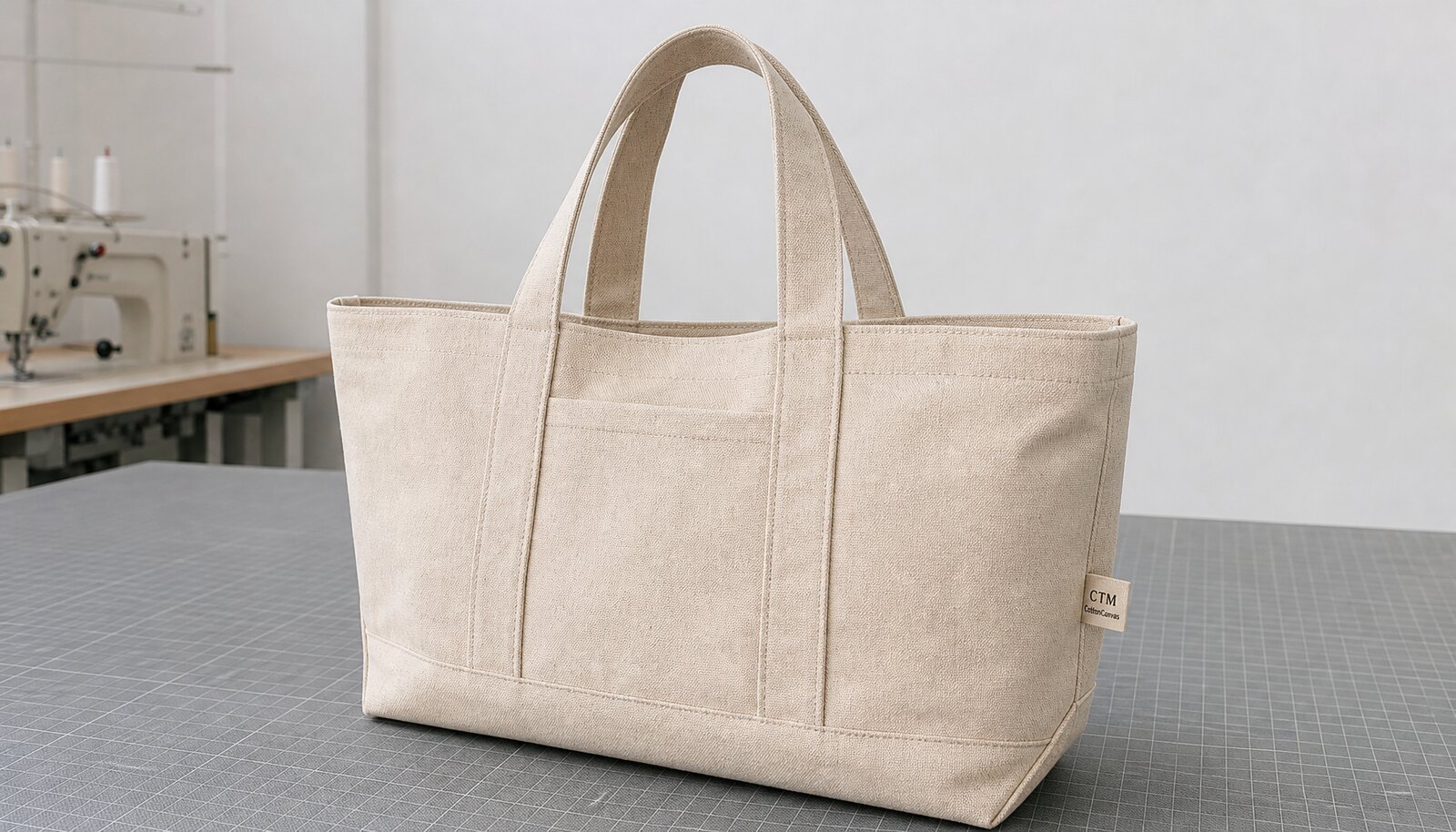
Start With the Retail Use Case
A canvas library tote bag for a retail chain is not just a fabric bag with a logo. It needs to survive store handling, shelf display, customer carry use, and carton movement through a distribution center. If the buyer does not define the use case first, every supplier will fill the gap differently. One will quote a light promo tote, another will build a heavier book bag, and a third will interpret the order as a premium shopping bag with extra finishing. Those are not interchangeable products, even when the artwork looks the same.
The cleanest buying brief starts with the expected load, the store position, and the price tier. A tote meant for books or daily retail carry usually needs a more structured canvas, a reinforced handle attachment, and a print method that holds up after repeated folding. If the bag is a seasonal add-on near checkout, the spec can be lighter and the packing simpler. If the chain plans a core private label item, the buyer should treat the tote like a repeatable SKU, not a one-off promo item.
- Decide whether the bag is for books, general retail carry, or event promo before asking for a quote.
- Define the maximum expected load in practical terms, not just as a marketing phrase.
- State where the bag will be sold and how it will be displayed, because that affects finish and packing.
Lock the Core Spec Before RFQ
The spec sheet should settle the basics that drive price and performance: finished size, gusset depth, handle length, fabric weight, print area, and construction details. For most retail chains, 10 oz canvas around 340 GSM is the light end, 12 oz around 407 GSM is the most common middle point, and 16 oz around 542 GSM is the heavier premium option. Those numbers matter because a supplier can use the same artwork on a very different base cloth, and the bag will feel and behave differently in store.
The buyer should also define small but material details that often appear too late in the process. A flat tote and a gusseted tote are not the same for packing, stacking, or carrying books. A short handle may look neat on a hanger but become awkward at retail. A one-color print is not just a cheaper artwork choice; it can be the difference between a stable, durable process and a decoration method that requires tighter registration control.
- Write the finished dimensions in a way the factory can measure after sewing, not only the cut size.
- State whether the bag should have self-fabric handles, cotton webbing handles, or a blended tape.
- Call out the print location in centimeters or inches from the top edge and side seam.
Choose the Supplier Route That Matches the Program
Retail buyers usually have three sourcing routes: direct factory, trading company, or local decorator/converter. Direct factory sourcing gives the strongest control over sewing, fabric use, and print execution, which matters when the chain wants repeat orders and stable quality. A trading company can be useful when the buyer wants more flexibility on MOQ, backup capacity, or mixed product lines, but that only works if the intermediary can prove which factory will actually produce the order. A local decorator is the simplest path for a rush launch or test program, but it is rarely the lowest landed cost for a full retail rollout.
The right route depends on volume, schedule, and how much production risk the buyer can absorb. A chain planning replenishment should care less about a low first quote and more about whether the supplier can repeat the same bag in the next season without shade drift, print variation, or packing changes. If the supply base cannot support repeatability, the buyer ends up re-qualifying the product every time the program restarts.
- Use direct factory sourcing when the bag will repeat and the construction needs tight control.
- Use a trading company only if the production site, not just the sales contact, is transparent.
- Use local decoration when speed matters more than unit cost or long-run consistency.
Read the Quote Like a Production Buyer
A useful quote does not hide cost inside one line. It separates the bag body, print setup, print run cost, sample charge, packing format, carton cost, and any testing or documentation fee. When those items are blended together, the buyer cannot compare two suppliers with different factory structures. One supplier may look cheaper until the packing format changes or the print is expanded from one side to two sides. Another may appear expensive but actually include the carton build and barcode label that the first quote forgot to price.
The quote should also show what version of the bag is being priced. A 12 oz canvas bag with one-color screen print, flat bulk pack, and no individual polybag is not the same as the same bag with a gusset, inside print label, and retail-ready barcode sticker. Procurement teams should compare like for like. If the supplier cannot state the fabric weight, print method, and packing format clearly, the quote is not ready for award.
- Ask for a separate line item for sample development so the production quote stays clean.
- Require the supplier to state whether the quoted fabric weight is finished weight or greige reference weight.
- Confirm whether freight, duties, and destination handling are excluded or included.
Use MOQ Logic to Protect Price and Flexibility
MOQ is not only a supplier restriction; it is a cost structure. On canvas bags, the MOQ is usually driven by fabric cutting efficiency, screen setup, print color count, and packing labor. A supplier may accept a low bag count but still require a higher print MOQ because the screens, registration setup, and curing time do not scale down well. That is why a buyer should not accept a single MOQ number without knowing whether it applies to the bag, the artwork, or the final packed SKU.
For retail chains, the best MOQ is the one that balances launch risk with replenishment risk. If the chain expects frequent replenishment, a slightly higher first order can reduce unit cost and stabilize the fabric lot. If the program is still unproven, a smaller test run is reasonable, but the buyer should accept that the price per unit will usually rise and that some decoration methods become uneconomic. The real mistake is not a small MOQ. The real mistake is approving a small MOQ without knowing what version of the product can be repeated later.
- Separate bag MOQ, print MOQ, and packed SKU MOQ in the RFQ.
- Ask whether the supplier can hold fabric for repeat orders from the same dye lot or weave run.
- Treat low MOQ quotes with caution if the quote does not explain the setup charge structure.
Pick the Print Method That Fits the Sell-Through Window
For canvas library tote bags, one-color screen print is usually the most dependable choice when the design is simple and the order size is meaningful. It gives solid opacity on natural canvas and tends to wear better under folding and abrasion than many short-run transfer methods. The tradeoff is setup time and color-by-color complexity. If the artwork uses multiple colors or fine gradients, the buyer should decide whether the visual gain is worth the extra process risk. In many chain programs, the best result is a clean, bold logo that reproduces reliably, not a busy design that is difficult to keep consistent across production lots.
Short-run programs sometimes push buyers toward heat transfer or digital transfer. Those methods can work if the artwork needs detail or the opening order is small, but the buyer needs to inspect edge lift, cracking, and rub resistance before mass approval. On a retail tote that will be folded, handled, and carried daily, decoration failure is often visible before fabric failure. That is why the print method should be chosen based on how the bag will actually live in the store and in the customer home, not only on what looks sharp in a mockup.
- Keep the artwork simple if the bag is intended for repeat replenishment.
- Specify print position tolerance so the logo does not drift between samples and bulk goods.
- Ask for a production test on the exact canvas color that will ship.
Approve Samples for the Way the Chain Will Use Them
Sample approval should test the bag as a retail SKU, not as a design object. The sample needs to confirm the canvas handfeel, stitching, handle balance, gusset shape, print registration, and overall build quality. A good sample process usually includes at least three stages: the initial reference sample, the pre-production sample, and the sealed gold sample that the buyer keeps as the production reference. If any one of those is missing, the line between approved design and actual shipment becomes too loose.
The biggest mistake is approving a sample that does not match the final supply chain. A supplier may send a hand-made sample from a different fabric lot, different print process, or different sewing line. That can make the sample look better than mass production. A serious buyer should ask how closely the sample reflects the actual production method and whether the same fabric lot, print screens, and sewing attachments will be used in bulk.
- Measure the sample, do not just view it.
- Check handle symmetry, print alignment, loose threads, and seam finish.
- Keep one sealed sample signed off by sourcing, QA, and the business owner.
Pack for Distribution, Not Just for Shipping
Packing changes cost, damage risk, and warehouse behavior. A flat bulk pack is usually the cheapest and most efficient route for a retail chain that receives cartons into a distribution center and then repacks by store or channel. Individual polybag packing makes sense when the bag must reach the shelf in retail-ready condition or when barcode handling matters more than cost. The buyer should decide early, because packing format affects labor, carton dimensions, gross weight, and even how well the bags recover from folding marks after transit.
The carton spec should be part of the quote review, not an afterthought. Buyers should ask for carton count, inner pack count if used, master carton size, and gross weight. That information helps the DC plan receiving and storage, and it exposes hidden cost moves. A supplier may quote a low unit price but build inefficient cartons that inflate freight. The pack plan should also account for any retailer ticketing rules, barcode labels, country-of-origin marking, or retail hangtag needs.
- State whether the bag will ship flat, folded once, or packed with tissue.
- Confirm whether individual polybags are required and whether they must be recyclable or otherwise compliant with buyer policy.
- Verify that carton labels match the SKU structure used by the buying team.
Set QC Thresholds Before Production Starts
A tote bag program fails most often at the edges: small size drift, weak handle attachment, sloppy print placement, dirty packing, or carton count errors. The QC plan should define the acceptable range before the first bulk cut is made. For a canvas library tote, that usually means a tight check on finished dimensions, seam quality, handle reinforcement, print position, and overall cleanliness. If the bag is intended to carry books or heavier retail items, handle attachment deserves special attention because that is where consumer failure becomes obvious first.
The buyer should not rely only on final inspection. The best practice is to align the pre-production sample, the first bulk output, and the final shipment against the same reference. If the fabric tone, print density, or stitch profile starts to move during production, the supplier should stop and correct it before the run continues. That saves time, but more importantly it protects the store program from mixed quality across replenishment lots.
- Define measurement tolerances for size, handle length, and print placement.
- Set a visible standard for thread trimming, stain rejection, and odor.
- Use carton count verification as part of the shipping release.
Compare Landed Cost, Not Just Factory Price
The lowest factory quote is not always the best buying decision. A buyer should compare landed cost by adding print setup, packing, cartonization, inland handling, sea or air freight, duty, and any destination charges that the chain cannot avoid. A bag that looks cheap at the factory can become expensive if the carton pack is inefficient or if the supplier needs extra labor to meet retail packaging rules. Likewise, a slightly higher unit price can be justified if the product ships in fewer cartons, arrives with fewer defects, and reduces receiving labor at the DC.
Retail chains also need to think about repeatability. If the supplier can keep the same fabric weight, the same print method, and the same pack format on replenishment, the real landed cost becomes more predictable. That predictability is worth money because it reduces the chance of emergency rework, store delays, and price renegotiation after the first season. The best award decision is usually the one that gives the buyer stable performance, understandable quotes, and enough flexibility to reorder without reopening the whole spec.
- Compare quotes on the same fabric weight, artwork count, and packing format.
- Include freight and pack-out labor in the decision if the bag is going into a retail chain.
- Favor the supplier who can repeat the same result on the next order, not only the first one.
Specification comparison for buyers
| Spec decision | Recommended option | When it fits | Buyer risk to check |
|---|---|---|---|
| Sourcing route | Direct factory with cutting, sewing, and print in-house | Best when the chain needs stable repeat orders, tighter spec control, and fewer handoffs | Confirm actual production line capacity, not just a sales office promise |
| Sourcing route | Trading company with a fixed factory pool | Useful when you need mixed SKUs, lower MOQs, or backup sourcing in more than one region | Ask who owns quality issues if the factory changes between quotes and samples |
| Sourcing route | Local decorator or domestic converter | Works for urgent launches, test programs, or small replenishment runs | Watch for higher unit cost, fewer fabric options, and limited custom construction |
| Fabric weight | 10 oz canvas, about 340 GSM | Fits entry retail, promo programs, and lighter library use where cost matters most | Risk of thin handfeel, lower opacity, and faster edge wear if the bag is heavily loaded |
| Fabric weight | 12 oz canvas, about 407 GSM | Usually the safest middle ground for retail chains that want a durable but still commercial price point | Check whether the supplier is quoting true finished fabric weight, not only greige cloth |
| Fabric weight | 16 oz canvas, about 542 GSM | Best for premium retail, higher load use, or a more structured bag silhouette | Cost, folding stiffness, and freight weight rise quickly |
| Print method | One-color screen print | Best for bold logos, large replenishment runs, and long wear on a cotton surface | Verify color density, registration tolerance, and cure quality |
| Print method | Heat transfer or digital transfer | Useful for short runs, detailed artwork, or seasonal artwork changes | Check cracking, edge lift, and wash or rub resistance before approval |
| Packing route | Flat bulk pack with carton marks | Good for DC receiving, pallet optimization, and lowest packing cost | Count accuracy and crease control become critical during handling |
Buyer checklist before sampling
- Set the finished bag size, handle length, gusset depth, and target fabric weight before requesting quotes.
- State the intended retail use: book tote, general carry tote, or promotional retail giveaway, because load expectations change the construction.
- Define artwork early, including logo size, number of print colors, and whether the art must sit on one side or both sides.
- Ask for a sample in the same fabric weight and construction you want in production, not a substitute fabric.
- Require quotes to separate bag price, print charge, sample fee, packing cost, carton cost, and any testing or document fee.
- Confirm the MOQ per color, per artwork, and per packaging format, because suppliers often quote a low bag MOQ but a higher print MOQ.
- Request carton pack quantity, master carton dimensions, and gross weight so the DC can plan receiving and storage.
- Agree on lead time from sample approval date, not from inquiry date, and ask what happens if artwork or packaging changes after approval.
- Specify acceptance criteria for stitch quality, print position, shade variation, and handle strength before production starts.
- Keep one approved gold sample, one pre-production sample, and one sealed production reference at your receiving team.
Factory quote questions to send
- What is the exact finished size, fabric weight in oz and GSM, and seam construction included in the quote?
- Is the printed area quoted as one color, two colors, or full coverage, and does the price include setup or screen charge?
- What is the MOQ for the bag body, the print, and the final packed order, and where do those thresholds differ?
- Which fabric source will be used, and can you show the fabric spec or weave density that matches the quoted sample?
- What is the estimated lead time after sample approval, and what production step usually creates delays?
- How are the bags packed for shipment, how many per inner pack or carton, and what are the carton dimensions and gross weight?
- What quality checks are included before shipment, and can you share a pre-shipment inspection format or report template?
- If we change logo placement, handle length, or packing format, which line items change in price and lead time?
Quality-control points to confirm
- Measure finished size against the approved spec, including width, height, and gusset, and set a clear tolerance before mass production.
- Inspect canvas weight and handfeel against the approved sample so the production run does not drift to a lighter or rougher cloth.
- Check stitch density, seam alignment, and bar-tacks at handle ends, especially where the tote carries books or heavier retail items.
- Review print position, print saturation, edge sharpness, and color match on the actual canvas tone, not on a white paper proof.
- Confirm handle length consistency and symmetry so the bag hangs straight and does not twist when loaded.
- Test a small production lot for load handling using the buyer's realistic use case, not a generic promotional carry test.
- Inspect odor, lint, loose threads, stains, and needle marks before bags are packed into inner bags or cartons.
- Verify carton count, carton labels, and SKU marks against the purchase order to avoid DC receiving disputes.