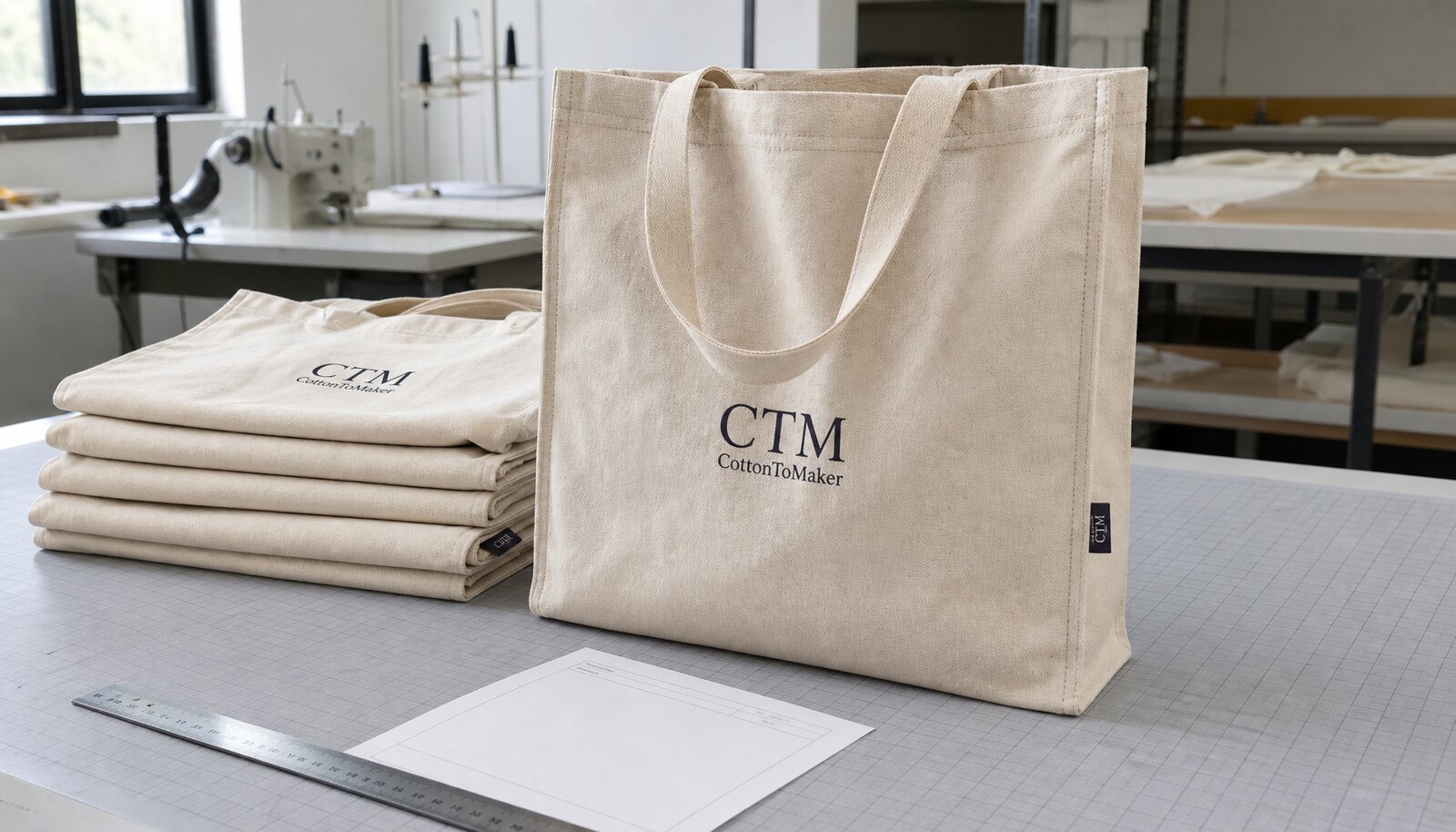
What a retail chain is really buying
A retail chain is not buying a tote bag in isolation. It is buying a repeatable item that has to move through merchandising, warehouse receiving, store shelving, and customer use without creating avoidable exceptions. For a library-style canvas tote, that means the bag has to look clean on a shelf, hold a predictable load, and arrive in packaging that the distribution center can process without hand-sorting.
That is why a useful spec starts with use case. A tote for book carry needs a different body depth, handle length, and seam strength than a tote used for a seasonal gift program or a simple checkout add-on. If procurement does not define the end use, suppliers fill in the gaps with their default construction, and the result is often a quote that looks competitive but does not match the chain's operating needs.
- Write the buying purpose in one sentence before asking for price.
- Separate retail presentation requirements from load-bearing requirements.
- Treat the packing and carton plan as part of the product, not an afterthought.
A usable base spec for canvas library tote bags
For most retail-chain programs, a practical starting point is a finished bag around 14 in W x 15 in H x 4 in gusset, or 15 in W x 16 in H x 4 in gusset if the tote needs to hold books, catalogs, or folded apparel with less distortion. That size is large enough for everyday carry but still compact enough to merchandise well in a checkout area or on a hook display. Smaller bodies can work for giveaway programs, but they start to look underbuilt once the bag is sold as a real retail item.
A common structural baseline is 10 oz to 12 oz natural canvas, a 1 in to 1.5 in cotton webbing handle, and a finished handle drop of about 10 in to 11 in. For sewing, ask the supplier to quote a 12 mm main seam allowance and a 25 mm double-fold top hem, then confirm stitch density on the approved sample. The point is not to force one universal construction. The point is to define enough of the build that two suppliers cannot quote wildly different bags under the same SKU.
- Finished size should be stated in both inches and millimeters if the chain buys globally.
- Use one baseline construction for price comparison, then quote alternates only after the base line is locked.
- Ask for a cut spec and a finished spec so the factory cannot hide shrink or over-trim risk.
Fabric, shrinkage, and sewing detail buyers should lock early
Canvas is often described only by ounce weight, but that is not enough for procurement. The buyer should also ask for weave density, yarn count if available, finish type, and whether the fabric is pre-shrunk or enzyme-washed. Two bags both described as 12 oz can look and behave differently if one has a looser weave, a softer finish, or a heavier shrink response after the first wash. That difference matters because retail chains need consistent shelf shape and repeat-order stability.
For shrinkage, a practical allowance is to ask the factory to keep finished dimensions within a 3 percent shrink window after any intended wash or finishing step, or to state a tighter internal control if the bag is washed during production. If the tote is unwashed natural canvas, the buyer should confirm whether the approved dimension is measured before or after any conditioning process. On stitching, ask for 6 to 8 stitches per inch on load-bearing seams and 8 to 10 stitches per inch on hems, plus reinforcement at every handle end. The most common handle failure is not the webbing itself but the stitch pattern at the attachment point.
- State whether the canvas is natural, bleached, washed, or enzyme-treated.
- Ask the supplier to identify the seam allowance, hem depth, and the exact reinforcement pattern at the handle.
- Require the pre-production sample to be measured after finishing, not from cut parts.
Print, labels, and artwork controls that survive bulk production
For chain retail programs, screen print is usually the safest option when the artwork is one or two colors, the logo has clear edges, and repeatability matters more than graphic complexity. It is easier to price, easier to inspect, and less likely to drift between samples and bulk. If the design uses fine text or small linework, the buyer should define minimum stroke width and clear space around the logo before the supplier prepares screens. That prevents the common problem where art looks acceptable on a monitor but fills in on the bag.
If the chain needs woven labels, side labels, or barcode labels, those should be quoted separately from the bag body. Label cost is small compared with the bag itself, but label lead time often drives the schedule. Ask for the exact label size, placement, stitch method, and whether the label is sewn in, heat applied, or packed loose. If a sleeve or insert card is used for retail presentation, require an art proof and a physical folded sample because label and fold interaction can change the way the bag sits in a carton or on shelf.
- Set the number of print colors before asking for pricing.
- Define minimum line thickness and minimum text size for the logo.
- Ask whether label changes require a new setup charge or only a print file update.
- Require the print location to be measured from the top edge and side seam on the approval sample.
Packaging specification: fold, polybag, carton, and shipping marks
Packaging is where many tote programs lose time and money. A clean bag can still arrive with wrinkled panels, mixed SKUs, or shipping labels that slow the distribution center if the packing spec is loose. For retail chains, the simplest stable format is often one bag per polybag, flat folded to a fixed size, then packed in a master carton with one SKU per carton. That format is easy to count, easy to receive, and easy to rework if the chain wants to move inventory between stores.
Ask the factory to quote the packaging components separately: polybag, suffocation warning if required, insert card, barcode label, carton mark, and any inner pack. A common example carton for folded canvas totes might be around 52 cm x 40 cm x 30 cm, with 25 or 50 pieces per carton depending on fabric weight and fold size. The exact count matters because carton weight affects freight and handling. The buyer should also lock the fold direction so the front print faces the same way in every unit and the bags do not pop open inside the carton.
- Specify finished folded size, not just that the bag should be flat-packed.
- Define units per inner pack and units per master carton.
- Ask for gross weight, net weight, and carton cube before approval.
- State whether polybags need suffocation warnings, recycled content, or no-polybag packing.
Carton labeling, pallet pattern, and DC receiving format
Retail distribution centers do not want mystery cartons. They want a label that tells them exactly what is inside, how many units are inside, and which purchase order it belongs to. A practical shipping-mark schema includes style number, color, size if applicable, PO number, carton number out of total cartons, unit count, gross weight, carton dimensions, country of origin, and a barcode that the buyer's system can read. Many chains use Code 128 or GS1-128 for cartons, but the exact symbology should match the retailer's inbound standard.
Palletization should also be written into the spec. A common export pattern is a 1200 mm x 1000 mm pallet, 4 layers high, with cartons aligned to avoid overhang, corner boards if needed, and stretch wrap from pallet base to top. If the chain receives by DC, ask whether the facility allows mixed SKU pallets or prefers single-SKU pallets only. A pallet that looks efficient at the factory can still create receiving delays if the retailer's dock team has to break it down by hand.
- Use a carton label format that includes PO, SKU, carton number, unit count, and barcode.
- Confirm pallet height limits before the factory sets the stack pattern.
- If the chain uses cross-dock receiving, avoid mixed cartons unless the buyer explicitly approves them.
Sourcing route, MOQ, and what moves price in the real quote
For a recurring retail tote, a direct factory quote is usually the cleanest path because it exposes the actual cost of fabric, sewing, print, packing, and cartonization. Traders and sourcing agents can help with communication or consolidation, but they sometimes hide where the work is actually done, which makes it harder to hold the right party accountable when the sample and bulk shipment do not match. If the program is important enough to repeat, the buyer should know the factory name, the production location, and who owns the inspection records.
MOQ is better treated as a set of thresholds rather than one number. Typical factory ranges for a custom canvas tote are often 500 to 1,000 pieces per color or artwork version for standard programs, with better unit pricing at 3,000 pieces and above. Samples are usually chargeable once the design is custom, and a pre-production sample may cost a modest fee plus courier. The main price drivers are fabric weight, handle width, print colors, label changes, zipper use, carton printing, and packing complexity. Ask the supplier to quote FOB first so freight does not get buried in a single all-in number, then compare landed cost separately.
- Separate MOQ by body color, print version, label type, and packing variant.
- Ask if screen charges are one-time or repeated on every order.
- Request FOB, EXW, and DDP only if you can compare them on the same landing assumptions.
- Make packaging a separate line item so you can see the real cost of inserts, labels, and printed cartons.
Comparison table: the tradeoffs buyers need to see
The right choice is not always the cheapest bag. In chain buying, the better decision is usually the one that keeps the order stable, receives cleanly, and reorders without surprises. The table below compares the most common procurement choices by the factors that actually matter at scale: unit cost, lead time, defect risk, and receiving complexity.
Use this as a planning tool, not a substitute for the actual RFQ. The goal is to avoid approving a quote that looks efficient on paper but adds hidden work at the DC or at store level.
- Cost and quality are not separate decisions when the chain plans repeat orders.
- The cheapest quote often becomes expensive when packing or receiving is not controlled.
- Choose the construction that matches the chain's reorder plan, not only the launch order.
Sample approval and QC that can be enforced at the factory
A sample is only useful if it mirrors the actual bulk plan. Photo approval is not enough for a retail chain because it misses seam tension, print hand, fold behavior, and carton fit. The pre-production sample should use the final fabric, final ink, final handle, final label, and final packing method. If any of those change after approval, the buyer should treat the order as a revised spec, not a routine release.
QC should be written as measurable checks. Finished dimensions should sit within plus or minus 1/4 in, or 6 mm, unless the chain wants a tighter band. Handle drop should be checked on several units from each lot. Print position should be measured from a consistent reference point, and the carton count should be reconciled against the packing list before the shipment leaves the factory. For testing references, buyers commonly ask suppliers to align with seam strength and fabric performance methods such as ASTM D1683 for seam strength, ASTM D5034 for grab tensile strength, ISO 105-X12 or AATCC 8 for rub resistance, and AATCC 61 or an equivalent wash fastness method when wash performance matters.
- Approve one physical sample before mass production starts.
- Record the approved sample's dimensions, print position, and packing method.
- Ask the supplier to attach an in-line inspection sheet and final QC report to the shipment file.
- If the retailer requires it, include drop or carton compression checks in the factory acceptance plan.
What should be frozen before the RFQ goes out
Procurement gets the best quotes when the RFQ is complete enough that suppliers can cost the same bag. Before release, freeze the finished dimensions, fabric weight, print method, handle spec, closure type, packing count, carton size target, pallet requirement, and shipping term. If any of those are left open, the factory will quote with assumptions, and those assumptions rarely match between suppliers. The result is a comparison that looks competitive but is not actually like-for-like.
The best RFQ packs are short, visual, and specific. Include a line drawing or clear reference photo, the artwork file, a finished spec sheet, packing instructions, carton mark format, and the expected commercial terms. If you need a price break, ask for two options in the same quote: the base spec and a controlled alternate with one change only, such as a lighter canvas or a different handle width. That makes tradeoff review much easier for procurement and merchandising.
- Freeze only one base spec for the first quote round.
- Use alternates sparingly so suppliers do not quote a moving target.
- Keep the product spec, artwork file, and carton spec in the same document set.
- Ask the supplier to highlight every assumption they made where the RFQ was not explicit.
Specification comparison for buyers
| Spec decision | Practical buyer choice | Cost, lead-time, and defect tradeoff | Receiving or QC risk to check |
|---|---|---|---|
| Fabric weight | 10 oz to 12 oz natural canvas | 10 oz is usually the best cost balance; 12 oz raises fabric and sewing cost but improves structure and shelf presence | Too-light fabric looks thin after print and can distort at the handles; too-heavy fabric increases freight and carton weight |
| Finished size | 14 in W x 15 in H x 4 in gusset, or 15 in W x 16 in H x 4 in gusset for book carry | A larger body adds a little material and carton cube but reduces complaints about tight fit | If the bag is undersized, retail staff may overstuff it, which drives seam stress and returns |
| Handle construction | 1 in to 1.5 in cotton webbing, 24 in total length, 10 in to 11 in drop | Longer handles add webbing cost and a little sewing time; short handles reduce shoulder carry comfort | Weak handle attachment is the first failure point under book or catalog loads |
| Print method | 1-color or 2-color screen print for standard programs | Screen print is usually the lowest-cost option at volume and the easiest to repeat on reorders | Fine type, halftones, and gradients can fill in or shift if the artwork is not simplified |
| Closure style | Open top for value retail; top zip for premium or secure carry | Open top keeps cost and lead time lower; zips add hardware cost, trimming, and defect points | Slider failure, sewn zipper waviness, and crooked top edges are common complaints |
| Packing unit | Flat-folded, 1 piece per polybag, 25 or 50 pieces per master carton | Simple packing is cheaper and faster; inserts, tissue, and header cards add cost and manual labor | Poor fold control increases wrinkling, carton bulge, and receiving rework |
| Supplier route | Direct factory quote with physical pre-production sample | Direct factory sourcing usually gives better control of print, packing, and repeat-order pricing | If documentation is weak, the buyer may not know who actually owns the sewing and packing process |
| Incoterms | FOB for comparison, then landed-cost review by the buyer | FOB makes freight visible and easier to compare; DDP can hide shipping and handling assumptions | If the term is unclear, buyers can misread the true landed cost and receiving responsibility |
Buyer checklist before sampling
- Define the exact use case before RFQ: bookstore carry, library promotion, paid retail tote, or bundle bag for paper goods.
- Lock a finished size in inches or millimeters, not a general description like medium or large.
- State the fabric weight, weave feel, and whether the canvas is natural, bleached, or washed.
- Specify seam allowance, stitch density, handle width, handle drop, and the reinforcement method at the handle end.
- Decide whether the bag is open top or zippered, and whether the closure is structural or decorative.
- Provide print art as vector artwork and define the exact number of colors, print placement, and minimum line thickness.
- Request a pre-production sample that uses final fabric, final print method, final label, and final packing format.
- Ask for carton dimensions, units per carton, gross weight, and barcode or shipping-mark layout before approval.
- Confirm pallet pattern, pallet height, stretch-wrap requirement, and whether the DC accepts mixed-SKU pallets.
- Tell the supplier which test standards matter to your chain, such as seam strength, colorfastness, rub, and carton-drop expectations.
Factory quote questions to send
- What is the exact canvas weight in GSM or oz, and what yarn or weave construction is being quoted?
- What are the finished dimensions, seam allowance, top hem depth, and handle attachment method?
- What stitch density are you using on load-bearing seams and hems, and is the handle end reinforced with box-X or bar-tack stitching?
- What is the MOQ by color, by artwork version, and by packing variation?
- What is the setup charge for each print color, each screen, each label type, and any custom carton printing?
- What sample charge do you apply for the first pre-production sample, and is it credited back on bulk order?
- What are the carton dimensions, unit count per carton, gross weight, and pallet count per 40 ft or 20 ft container?
- Which Incoterms can you quote, and what freight or destination charges are included or excluded?
- Can you share test records or in-house inspection data for seam strength, print adhesion, rubbing, and packaging drop performance?
- What are the longest lead-time items in this order: fabric, webbing, labels, zipper, print screens, or carton printing?
Quality-control points to confirm
- Finished dimensions should stay within plus or minus 1/4 in, or plus or minus 6 mm, of the approved sample unless the buyer sets a tighter range.
- Handle drop should stay within plus or minus 1/2 in, or plus or minus 12 mm, so the bag hangs consistently on shelf and on shoulder.
- Load-bearing seams should show even stitching at about 6 to 8 stitches per inch, with no skipped stitches or broken thread paths.
- Top hems should be clean, straight, and fully caught through the fold, typically with a double-turn hem of about 1 in, or 25 mm.
- Handle ends should be anchored with box-X stitching or an equivalent reinforcement pattern, with no loose ends or open corners.
- Print placement should remain within about 1/8 in to 3/16 in, or 3 to 5 mm, of the approved centerline and height mark.
- Color variation should be judged against the approved bulk standard, not against a blanket expectation that all natural canvas looks identical.
- If a zipper is included, sample several units for smooth slider movement, end-stop security, and seam waviness at the top edge.
- Carton counts should match the packing list exactly, and carton labels should match SKU, PO, carton number, and quantity.
- Reject visible oil marks, stains, damaged corners, puckering, broken webbing, and any print bleed that changes the retail-facing appearance.