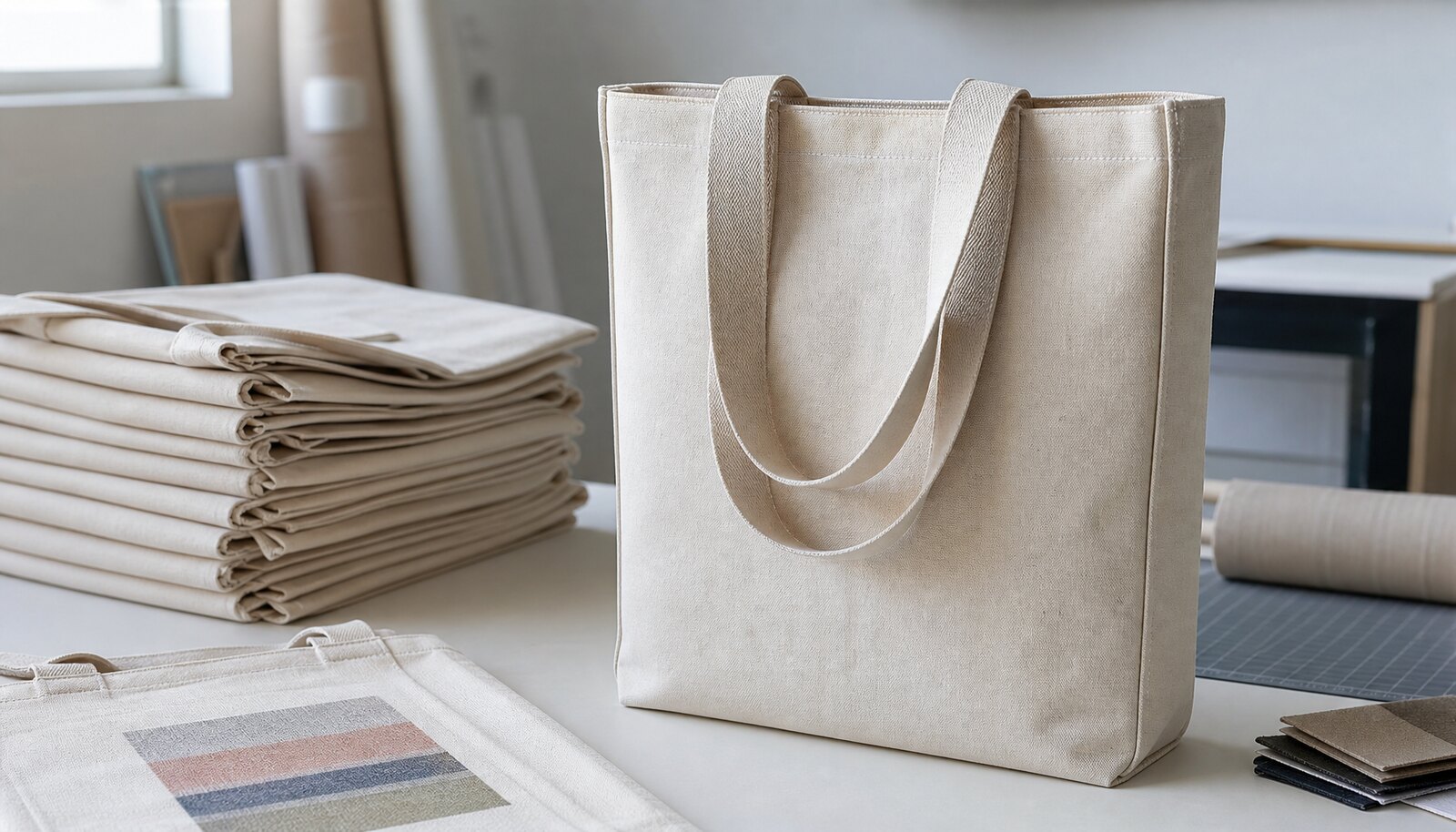
Why a reorder needs more control than a fresh quote
A reorder for hotel tote bags looks straightforward because the product already exists. That is exactly why it becomes risky. Buyers often assume the last production sample, the last PO, and the new quote all refer to the same thing. In practice, those three documents can drift apart. One supplier may remember the cloth by feel, another may remember the price target, and procurement may only remember the artwork. The result is a bag that is technically similar but not actually the same product.
For a hotel program, that drift matters. The tote may sit in a gift shop, carry library books, hold room-drop materials, or be used as a reusable amenity carrier. If the bag changes in stiffness, handle length, print placement, or fold behavior, it affects both presentation and usability. A poor reorder usually does not fail dramatically; it fails quietly by feeling cheaper, looking off, or creating more labor at the property.
The right approach is to treat the reorder as a controlled spec review. The question is not, "Can you make this bag again?" The question is, "Can you repeat this exact bag, at this exact finish, with this exact packing method, on this schedule?" That framing is what keeps the quote comparable and the bulk shipment predictable.
- Common drift: the supplier keeps the same bag name but changes cloth weight or weave.
- Common hotel issue: print placement shifts enough to look off-center on a counter display.
- Common internal issue: the PO repeats the product name, but the approved sample is never attached to the new order.
Start from the last approved sample, not the last invoice
The most useful reference for a repeat order is the last approved physical sample, plus the measurements and artwork file that went with it. A past invoice is not enough. It may confirm quantity and price, but it usually does not capture seam allowance, stitch count, handle drop, or where the logo sat relative to the top edge. If the factory has changed staff or if the project moved through a middleman, those gaps quickly become expensive.
A practical reorder file should include the approved sample date, product version, artwork version, and notes on anything that was intentionally accepted outside the normal standard. For example, if the sample had a slightly softer hand because the buyer preferred it that way, that preference should be written down. Otherwise the next factory team may "correct" it by using a stiffer cloth or a different finishing process.
Do not approve from photos alone if the order is material to the hotel program. Photos are useful for visibility, but they do not show weight, drape, or how the handles sit under load. The best practice is to keep one retained sample or a sealed reference set in the buying file and compare the next sample against it before release.
- Keep one retained sample or a high-resolution reference set with dimensions.
- Mark the approved artwork version, not just the artwork file name.
- Record any intentional deviations so they are repeated on purpose rather than by accident.
Choose the size and carry profile before you talk price
Size is not a cosmetic detail. It determines how the bag feels in the hand, how it fits on a shelf, and what the user can actually carry. For hotel use, a flat tote can work when the contents are light and the goal is a neat presentation. A modest gusset is better when the bag needs to hold books, boxed amenities, or a mix of printed collateral and retail items. The bag should be specified as a finished product, not as a vague category.
A good hotel tote spec usually names the finished width, height, and gusset depth, plus the handle drop. Handle drop deserves more attention than it usually gets. A bag that is fine for hand carry may be awkward when a guest wants to sling it over the shoulder. A bag with a long drop can feel right in use but look sloppy if the visual profile is meant to be compact and tidy on a property shelf.
The buyer should also decide whether the bag must stand upright. That single requirement affects the gusset, base reinforcement, and top opening. If the bag is meant to present well in a guest shop or library nook, a bit more structure may be worth the cost. If it is purely a back-of-house carrier, a simpler build may be enough.
- Specify finished dimensions, not only cut dimensions.
- Define handle drop separately from handle length.
- State whether the bag must stand upright when empty or only when filled.
Fabric weight and construction choices drive durability more than the bag name does
Canvas is often described loosely, but a procurement buyer needs more precision than that. A 10 oz bag and a 12 oz bag can look similar in a quote and feel very different in use. Lighter cloth reduces cost, but it is more likely to stretch at the handle points and lose shape over time. Heavier cloth gives a better sense of quality and tends to hold its line better on a hotel display, but it increases material, sewing, and freight cost.
The same logic applies to finish and construction. An unlined bag is usually the most economical and simplest to repeat. It is also the easiest to QC because there are fewer hidden layers and fewer opportunities for internal slippage. If the hotel wants a more premium feel, the buyer may consider a self-lined edge, an interior binding, or a boxed bottom. Those choices are not bad, but they should be deliberate because they add labor and increase the chance of variation from one run to the next.
Handle reinforcement is one of the most important construction details on a tote. Ask how the handles are attached, where the stress point sits, and whether the reinforcement is a bar-tack, X-stitch, or another method. A lot of tote failures start where the handle meets the body, not in the middle of the bag. If the bag is likely to carry books, bottles, or multi-item kits, this detail matters more than a small price difference on the fabric.
- 10 oz canvas is usually the lower-cost choice for lighter hotel use.
- 12 oz canvas is safer when the bag needs structure or repeated reuse.
- Reinforced handle attachment is worth specifying even on moderate-volume orders.
Printing and branding should be chosen for repeatability, not just first-sample appearance
For most hotel tote programs, screen print remains the most practical option when the logo is simple and the color count is low. It is easier to repeat, easier to price, and usually more stable across reorders than more decorative methods. That does not mean it is always the right answer. If the artwork includes gradients, fine details, or multiple small colors, transfer or digital methods may be necessary. The buyer should still ask how those methods behave after handling, packing, and storage.
The real question is not which method looks best in a sample room. It is which method can be reproduced at the same standard six months later. In hotel procurement, the risk is not one bad print sample. The risk is a supplier quoting a method that works for a first run and then changing the process when the job is repeated. That can show up as a softer edge, a slightly different color cast, or a finish that feels more plastic than expected.
Buyers should define the logo size, placement, and acceptable color variance. If the logo sits too high, too low, or too close to the seam, the bag can look off even when the print itself is technically clean. If the brand uses a specific Pantone target, say so, but also ask for a physical strike-off on the actual canvas, because ink and cloth interact differently than they do on coated paper.
- Use screen print for simple, repeatable hotel logos whenever possible.
- Reserve transfer or digital methods for art that truly requires them.
- Approve the print on actual canvas, not only on a digital proof.
A useful RFQ separates setup cost from recurring cost
Many tote quotes look comparable at first glance because the unit price is similar, but the quote structure hides the real differences. A hotel buyer should force the quote into visible buckets: bag body, print setup, label cost, special packing, and any one-time tooling. If a supplier bundles all of that into one number, it becomes hard to compare them fairly or to understand why a reorder later changes price.
MOQ should be broken out the same way. The minimum order might be one number for the bag shell and another number for the print version or the label version. That matters a lot for hotel groups with multiple properties, where one design may be repeated in several places and another may be a one-off seasonal run. A low total MOQ can still be expensive if each artwork version carries its own setup charge.
The best RFQ forces the supplier to answer the same questions every time: what exactly is included, what is optional, what changes the unit cost, and what changes the schedule. That makes negotiation cleaner because the buyer can see whether a lower quote is actually efficient or merely less complete.
- Request separate lines for fabric, sewing, printing, labels, and packing.
- Ask for MOQ by artwork version, not only by total quantity.
- Make setup charges visible so repeat orders are easier to benchmark.
How to read supplier quotes line by line
The comparison table below is more useful if you read it as a pricing control tool rather than a style guide. Each decision has a downstream effect on cost, lead time, and failure risk. The most common procurement mistake is to compare only the headline unit price and ignore the hidden assumptions underneath it. A quote that looks cheaper may simply be using lighter cloth, fewer reinforcement stitches, or a more permissive QC standard.
For canvas tote programs, the main line items that tend to move price are fabric weight, handle construction, print method, and packing format. The next tier is less visible but still important: whether the factory has to source a special label, whether the product is being cut from stock cloth or a reserved batch, and whether the carton spec is optimized for export or for hotel distribution. If those things are not written down, they tend to be negotiated later when time is already short.
Use the comparison table as a checklist during quote review. If two suppliers differ on one row, ask them to explain the consequence in plain language. That is often where the real decision sits.
- A lower quote can mean lower cloth weight, not better efficiency.
- A higher quote can reflect better handle reinforcement or cleaner packing.
- Ask suppliers to explain the exact cause of every price difference.
Sampling should prove the bag can be repeated, not just admired
Sampling for a repeat tote order should answer one question: can the factory reproduce the approved bag without interpretation? That means the sample process has to be more disciplined than a simple photo approval. At minimum, the sample should be checked against measured dimensions, print placement, handle symmetry, fabric feel, and the way the top edge closes. If any of those items differ from the retained reference, the buyer should pause and ask whether the change is acceptable or whether the spec needs to be corrected.
Factory-level QC is most useful when it is concrete. Ask for a measurement sheet showing finished width, height, gusset depth, handle length, and print offset from the top seam. Ask how the factory checks stitch quality and whether they inspect for skipped stitches, broken thread, and skipped bar-tacks on the handle points. If the canvas lot is being reused from a previous run, ask whether the factory can prove it is the same cloth batch or at least the same mill standard.
The sample also needs to be tested in a realistic way. Load it with the kind of weight the hotel actually expects, such as books, brochures, or a full amenity kit, and see whether the handles pull evenly and whether the body distorts. A tote that looks fine empty can behave badly once it is filled. That is especially relevant for hotel guest use, where the bag is often judged in the first few seconds after it is handed over.
- Compare the new sample against the retained reference under the same lighting.
- Check handle pull, seam integrity, and print alignment with a realistic load.
- Require a measurement sheet and photo set, not a verbal approval only.
QC needs factory detail, not broad promises
A credible QC plan for hotel tote bags should go beyond general words like "good quality" or "careful inspection." It should say what the factory checks, at what stage, and against which standard. For repeat orders, the first quality gate is incoming material. The factory should verify cloth shade, weight, and visible defects before cutting. The second gate is in-process sewing, where handle alignment, seam quality, and reinforcement should be monitored before the lot is finished. The third gate is final inspection, where finished size, print quality, packing count, and carton marks are confirmed.
If the supplier uses AQL or another sampling standard, ask them to state it clearly. If they do not, then define a practical acceptance process yourself. That can be as simple as inspecting a defined number of pieces per carton for size, print, stitching, stains, and packaging accuracy. The important part is that the factory and the buyer are looking at the same defect list. Without that, small issues become arguments after the goods ship.
For hotel programs, the most common failures are not dramatic structural defects. They are subtle issues that become visible on a guest shelf: print slightly off-center, handles not matched, thread ends left hanging, oil marks, uneven folding, or a label sewn in a different position than the last run. Those are the defects the QC plan should explicitly catch.
- Inspect incoming cloth for shade, weave consistency, and visible defects before cutting.
- Check stitching and handle reinforcement during production, not only at the end.
- Use the same defect list for the factory, the buyer, and the inspector.
Packing and distribution matter more than buyers usually expect
Packing is not just a logistics detail. It changes the labor cost, the freight profile, and the way the bag looks when it reaches the property. For hotel back-of-house use, bulk folding in size-verified cartons is usually the best balance of speed and cost. If the bags are going to a gift shop or a retail shelf, then folding style, polybagging, and carton presentation become more important, but those choices should be explicit because they add cost and can increase carton volume.
If the tote is being shipped to a distribution center and then split across multiple hotel properties, carton labels should carry the size, artwork version, color, PO number, and count per carton. That sounds basic, but it prevents unnecessary opening, re-counting, and repacking later. It also helps when the same base bag is used across multiple properties with slightly different branding or language variants.
Ask the factory to confirm the packed dimensions and gross weight. This helps with freight planning and warehouse storage, especially when the order is being delivered to a property with limited back room space. The buyer should also confirm fold orientation if the printed face needs to stay visible and clean. A bad fold can leave a permanent crease right through the logo area.
- Use bulk cartons unless shelf presentation requires a retail pack.
- Print carton marks that identify artwork version, size, and quantity.
- Confirm fold direction if the printed face needs to remain outward.
Specification comparison for buyers
| Buyer decision | Recommended default | Tradeoff and price impact | Failure mode if the spec is loose |
|---|---|---|---|
| Fabric weight | 10 oz to 12 oz canvas, with 12 oz for books, retail inserts, or repeated reuse | Heavier cloth raises material and freight cost, but it usually lowers returns and feels more substantial in a hotel setting | A lighter substitute can stretch at the handles, sag when filled, or look cheaper on guest-facing displays |
| Weave and finish | Plain natural or bleached canvas with a consistent hand feel and shade band | Washed or softened finishes can improve presentation, but they can also change shrinkage, print behavior, and repeatability | A vague fabric description lets the mill or factory swap in a different cloth that looks close but performs differently |
| Handle build | Cotton webbing or self-fabric handles with reinforced bar-tacks or X-stitch attachment | Reinforced handles add labor, but the cost is usually worth it for hotel use where the bag may carry books or boxed amenities | Short handles, weak stitches, or unbalanced attachment points create early failures at the stress zone |
| Body shape | Flat or modest gusset depending on whether the bag needs shelf appeal or carrying capacity | A gusset adds fabric and sewing time, but it improves capacity and helps the bag stand up on a counter | If the body shape is not defined, the bag may arrive too shallow for packing or too bulky for display |
| Print method | Screen print for one to two spot colors; transfer or digital only when the art or run size requires it | Screen print usually gives the best repeatability and cost control, while digital and transfer methods can cost more per piece and be less consistent across batches | An unsupported print choice can crack, ghost, or shift in color from one reorder to the next |
| Labeling | Sewn-in care label or woven side label with the approved version code and size reference | Permanent labels add a small cost but improve traceability for multi-property programs and future reorders | Loose hang tags fall off in transit and leave the buyer without a durable production reference |
| MOQ structure | Quote MOQ by fabric color, print version, and packing format, not only by total bag count | This exposes where the true setup cost sits and prevents hidden charges from surfacing after the order is awarded | A low bag MOQ can mask a high minimum for plates, weaving, color change, or special packing |
| Packing format | Bulk packed in size-verified cartons unless retail presentation is explicitly required | Bulk packing is cheaper and better for back-of-house distribution; retail folding or polybagging adds labor and carton volume | If the fold and carton spec are undefined, the shipment can arrive creased, overpacked, or inefficient to store |
| QC basis | Approve against an archived sample, a measurement sheet, and a clear defect list | Documented QC reduces disputes and helps the factory understand what must match exactly on repeat production | Visual-only approval misses size drift, handle asymmetry, stitch defects, and print misplacement |
Buyer checklist before sampling
- Confirm finished size, gusset depth, handle length, and handle drop before asking for price.
- Specify the fabric weight, weave, finish, and shade tolerance, not just the word canvas.
- Send vector artwork and define print size, print placement, Pantone targets, and acceptable color variance.
- Ask for a physical pre-production sample or a verified sample photo set with measurements before bulk release.
- State whether the reorder must match the last approved sample exactly or whether a controlled revision is allowed.
- Confirm folding method, carton count, carton size, gross weight, and destination labeling before production starts.
- Document QC checkpoints for stitch quality, print adhesion, stains, needle damage, and quantity count.
- Keep a record of the approved sample ID, artwork version, and last PO so future reorders do not rely on memory.
Factory quote questions to send
- What exact fabric weight, weave, and finished hand feel are included in this quote, and what tolerance do you allow?
- Is the quoted bag based on the last approved sample, or on your own interpretation of the spec sheet?
- What is the finished size, cut size, seam allowance, and gusset construction included in the price?
- Which print method are you quoting, how many colors are included, and what setup charges apply for plates or screens?
- What are the MOQ requirements by fabric color, print version, label type, and packing format?
- How are the handles attached, what reinforcement method is used, and how many stitches or bar-tacks are specified at each stress point?
- Can you share the carton pack count, carton dimensions, estimated gross weight, and whether the cartons are optimized for warehouse storage or export freight?
- What is the full schedule from artwork approval to shipment, and which steps are included in the quoted lead time?
- What sample stages do you provide before bulk production, and which stage is the actual production reference?
- What defect standard do you use for stitching, print alignment, fabric stains, and size variation on repeat orders?
Quality-control points to confirm
- Finished length, width, and gusset depth match the approved measurement sheet within the agreed tolerance.
- Canvas weight and weave match the approved fabric reference, with no undocumented substitution.
- Handle length, handle symmetry, and attachment position are consistent across the lot.
- Reinforcement at the handle stress point uses the agreed bar-tack or X-stitch pattern and does not show skipped stitches.
- Print placement is centered and aligned to the top edge and side seam within tolerance, with no visible smudge, bleed, or haloing.
- Print cure or adhesion passes the agreed test, such as a rub check or tape check, before shipment release.
- Seams are clean, thread ends are trimmed, and visible surfaces are free of oil marks, broken yarns, or needle damage.
- If a woven or sewn label is specified, spelling, placement, and version code match the approved reference exactly.
- Carton count, carton labels, packing method, and ship marks match the PO and packing list.
- If the bags are for retail or premium guest use, inspect fold memory, front-face scuffing, and overall presentation after repacking.