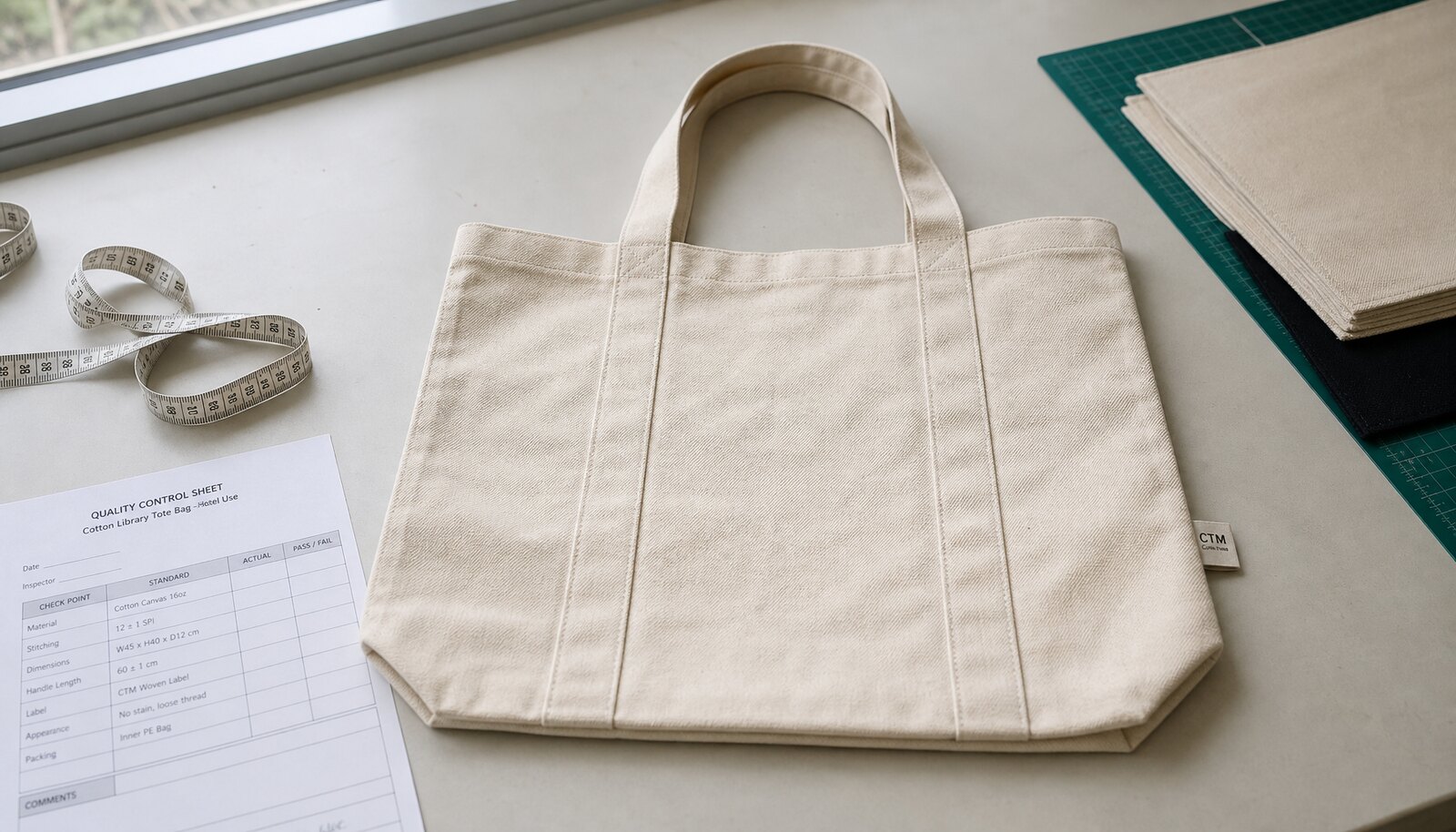
Why hotel buyers need a real inspection checklist, not just a prettier sample
Canvas library tote bags for hotels look simple, and that simplicity hides most of the sourcing risk. A sample can look premium on a desk, then fail in the first real use because the handle stitching is weak, the print starts to crack, or the fabric weight is lighter than the buyer assumed. Hotels do not buy the bag as an accessory only. They buy a working item that has to carry books, gifts, or guest amenities while still matching the property brand.
That is why a procurement checklist has to separate appearance from performance. The right process says what the bag must carry, how often it will be used, what level of finish is acceptable, and what failures are disqualifying. Once those rules are in writing, the hotel can compare suppliers on measurable grounds instead of relying on a polished sample room presentation.
- Treat the tote as an operational item first and a branded item second.
- A clean sample is not proof of bulk consistency.
- If the bag is used in retail, guest gifting, or bookstore service, the inspection standard needs to be tighter than a generic promo tote.
Start with the use case, because the use case drives the spec
The first decision is not the logo or the weave. It is the job the bag has to do. A tote for in-room gifting can be lighter than a tote that carries hardcover books or boxed merchandise. For most hotel library tote bags, 12 oz to 14 oz canvas, or roughly 340 to 420 GSM, is the safest starting point because it gives the bag enough body without making it overly rigid or expensive. Lighter canvas may work for decorative use, but buyers usually regret going too thin once the tote goes into daily service.
Handle design and bottom construction matter just as much as fabric weight. Self-fabric handles with double stitching and reinforced attachment points are usually the most reliable default. If the hotel wants a refined retail look, that can still be done, but the buyer should require reinforcement at the stress points and not assume visual neatness equals durability. For heavier loads, a gusset and bottom reinforcement are usually more valuable than decorative finishing.
- For light gifting, a simpler structure may be acceptable if the bag will not carry weight.
- For books, boxed items, or retail resale, specify reinforcement in the handle and bottom seam area.
- If the tote will be displayed publicly, include consistency of panel alignment and color match in the spec.
Supplier routes are not interchangeable, so compare them side by side
A common sourcing mistake is comparing quotes from different supplier types as if they were the same product. A direct factory, a trader, a local decorator, and a stock importer all package cost and control differently. One quote may include the exact fabric, decoration, packing, and export carton standard. Another may only price a blank bag and leave the buyer to discover later that the label, print, or packing adds cost.
For recurring hotel programs, direct factory sourcing usually gives the best repeatability and the strongest control over fabric weight, stitch quality, and carton spec. Traders and agents are useful when the buyer needs coordination across multiple items or lower internal workload, but the spec still has to be pinned down in writing. Local decorators are useful for urgent runs, but the tradeoff is usually less fabric control and more variation between batches.
- Normalize the quote before comparing price: same fabric weight, same decoration method, same packing, same shipping term.
- Separate one-time setup fees from recurring unit cost.
- If one supplier quote looks far lower, verify whether it excludes reinforcement, labels, or carton marking.
Write the RFQ once, with the details that actually change the price
The RFQ should remove uncertainty, not invite a second round of guessing. Start with the finished size, gusset depth, handle drop, and target load. Add the fabric weight in GSM or oz, and state whether the bag should be greige, dyed, washed, or pre-shrunk. Then define the decoration method, the label treatment, and the packing format. That sequence matters because each of those decisions affects cutting, sewing, printing, and cartonization.
A useful RFQ also asks the supplier to quote the spec in a way that can be audited later. The quotation should identify the fabric basis, the decoration process, the MOQ by color or artwork version, and the sample lead time. If the supplier can only provide a vague quote with no carton or finish detail, the buyer is not buying a fully controlled product yet. They are buying a promise that still needs engineering.
- Include one spec sheet, one artwork file, and one packing instruction sheet in the RFQ package.
- Ask the supplier to state all exclusions clearly, especially freight, samples, labels, and carton art.
- Keep the RFQ version number on the quote, sample, and final PO so the factory cannot quietly swap assumptions.
Decoration and branding choices should be decided by durability, not taste alone
For most hotel logos, screen printing is still the best value when the design is simple and the order is large enough to justify setup. It works well on canvas because the ink has enough body to sit on the fabric, and a clean one-color or two-color logo usually stays readable after normal use. If the design includes gradients, tiny type, or many colors, a woven label or a different application method may be more appropriate, but the buyer should check durability before accepting the tradeoff.
Placement rules should be measurable. Do not approve a logo as centered in general terms. Define the print position in millimeters from the side seam and top edge, and define how much variance is acceptable. For premium hotel programs, a small shift can make the tote look careless even when the bag itself is built correctly. If the bag uses a woven side label, inside label, or care label, those items should be specified in the same approval set as the main artwork.
- Use screen print for simple logos and repeat bulk orders.
- Use heat transfer only if the artwork requires it and the buyer accepts the durability risk.
- Use woven or sewn labels when the brand wants a more understated look and lower ink exposure.
- Approve a strike-off or decorated sample on the actual canvas weight, not on paper or a different fabric.
Inspection thresholds should be concrete, repeatable, and easy to enforce
This is the part that should stop being generic. A hotel buyer should define the inspection standard in numeric terms before bulk starts. Use AQL 2.5 for major defects and 4.0 for minor defects, with critical defects at zero tolerance. That gives the factory a clear gate and gives the buyer a basis for rejection that does not depend on subjective debate after the goods arrive.
Fabric and seam checks should be equally specific. Set a target fabric weight and allow only a practical production tolerance, ideally around plus or minus 5 percent. Main seams should run at roughly 7 to 10 stitches per inch, and the handle attachment should use bar-tacks or equivalent reinforcement at both ends. For color, use Delta E 3 or better if the factory can measure it; otherwise compare the bulk lot against the approved sample under D65 lighting. For print, use a 10-rub dry test and a 10-rub wet test, then check whether any ink transfers or flakes. Those thresholds turn the inspection from a visual opinion into a reproducible test.
- Reject any bag with open seams, missing bar-tacks, or broken handle attachment points.
- Reject any decorated bag that shows peeling, flaking, or visible transfer after rub testing.
- Check finished dimensions, handle drop, and gusset depth against the approved sample and not against a catalog drawing.
- Use a simple load test of 10 kg for 60 seconds as a minimum functional check for hotel use.
Sample approval should test the actual production method, not a showroom version
A pre-production sample is only useful if it matches what will be made in bulk. That means the same canvas, same decoration method, same label application, and same packing method. Many sourcing problems begin when the sample is built with extra care, different labor, or a substitute material. The bag passes approval, then the bulk order arrives with a different handfeel or a weaker seam because the factory treated the sample as a presentation piece rather than a manufacturing reference.
The approval step should cover more than the bag itself. If the order includes a polybag, insert card, size sticker, hangtag, or shipping mark, those items need to be part of the approved sample set. For hotel buyers, packing is not cosmetic. It affects warehouse intake, display readiness, and whether the tote arrives clean and crease-free. Keep one signed sample with the buyer and one with the factory so both sides are working from the same reference.
- Approve one production-matching sample before bulk starts.
- If artwork, label, or packing changes, require a revised sample and new approval note.
- Record the acceptable tolerance for print placement, shade variation, and stitch finish on the approval sheet.
- Do not approve from photos alone when color or print durability matters.
Packing and carton rules affect warehouse labor and hidden cost
Packing is one of the most underrated cost drivers in tote sourcing. A bag that is cheap at factory gate can become expensive if the cartons are oversized, the counts are inconsistent, or the packing format makes warehouse receiving slow. Flat packing is usually the right default for canvas library tote bags because it protects freight efficiency and makes carton counts easier to audit. If the hotel wants retail-ready presentation, the packing spec should say exactly how the bag is folded, whether it is polybagged, and whether it includes tissue or inserts.
Ask for carton dimensions, gross weight, and pieces per carton before order release. Those three numbers affect freight, handling, and storage. The outer carton marks should include style, color, quantity, PO number, and carton sequence. If the hotel distributes through housekeeping or a retail shelf program, clean carton labeling can save real time at the back end. A low-cost bag with poor packing discipline is still a poor buy.
- Specify whether the bag is folded flat, tissue-wrapped, polybagged, or packed with inserts.
- Require carton marks that show style, color, quantity, PO number, and carton number.
- Avoid mixed cartons unless the receiving team has agreed to them in advance.
- Confirm that any packing material will not leave pressure marks, odor, or ink transfer on natural canvas.
Lead time slips usually come from changes, not from sewing itself
The production schedule usually breaks down because the buyer changes artwork, packing, or fabric assumptions after the job is already in motion. Sample development for a custom tote often takes 7 to 14 days depending on decoration complexity and whether labels or inserts are included. Bulk production may take 20 to 35 days after sample approval, but only if the factory already has the right canvas or can source it without delay. A late shade decision or a changed carton spec can cost more time than the sewing line itself.
For repeat orders, the best control is a stable record of the last approved spec. Keep the approved sample, the shade reference, the carton config, and the inspection result together. Then when a reorder comes in, the factory can reproduce the last accepted version instead of treating it like a new development project. If the buyer wants shorter lead time, that repeatability matters more than asking for a general rush commitment.
- Freeze artwork before sample sign-off.
- Confirm whether the factory has the required canvas weight in stock or must source it.
- Allow time for print setup, label approval, and carton art review.
- Treat any spec change after approval as a schedule impact, not a minor revision.
Use landed cost to award the order, not just the lowest unit price
The lowest price on paper is not always the lowest cost to the hotel. A fair comparison has to include the same fabric weight, same decoration method, same packing format, same inspection basis, and the same shipping term. If one supplier quotes FOB and another quotes delivered, or one includes labels while another excludes them, the numbers are not comparable yet. The buyer should normalize the quote into the same basket before making a decision.
A strong award decision also looks at repeatability. If a supplier can hold the same stitch quality, shade, and packing count on reorders, that is often worth more than a small price difference. For hotel programs, the hidden cost of inconsistency is receiving time, replacement orders, guest complaints, and internal rework. A slightly higher quote that is complete and repeatable can be better than a cheap quote that creates surprises later.
- Compare all quotes on the same spec sheet and the same shipping term.
- Separate one-time setup charges from recurring unit costs.
- Check whether the supplier included sampling, label application, packing, and carton marking.
- Award on landed cost plus repeatability, not on unit price alone.
Specification comparison for buyers
| Supplier route | Typical MOQ / lead time | Control over fabric and QC | Cost profile | Best fit / main risk |
|---|---|---|---|---|
| Direct factory | Usually 1,000 to 3,000 pcs per style or color; sample to bulk is often the fastest path once the spec is final | Highest control over canvas weight, stitch standard, carton config, and repeat-order consistency | Best long-run unit price, but setup and sampling discipline matter | Best for recurring hotel programs; main risk is slower onboarding if the buyer has not locked the spec |
| Sourcing agent or trader | Can support lower or mixed quantities; lead time depends on how many factories they must coordinate | Moderate control, but the real factory spec must still be verified in writing | Convenient for multi-item programs; unit price is often higher than direct factory | Best for buyers with limited sourcing bandwidth; main risk is quote opacity across multiple hidden service layers |
| Local decorator or regional print shop | Good for urgent replenishment and smaller runs; lead time is tied to local stock and print queue | Lower control if fabric is sourced separately from decoration | Higher piece cost, especially if the bag body is not already standardized | Best for rush orders; main risk is variation in fabric shade, handle strength, or repeatability between batches |
| Stock program or importer | Lowest friction for small orders; lead time is usually shortest if blank inventory exists | Limited control because base bag options are pre-set | Low setup cost but less flexibility on size, color, and brand application | Best for test orders or temporary programs; main risk is compromise on exact size, fabric, or finish |
| Material | 8-12 oz cotton canvas, 120-220 gsm cotton, recycled cotton, or blended fabric selected by use case and target price | Before price comparison | Different cloth weights, backing, or certification claims make quotes hard to compare | |
| Construction | bag size, gusset, handle drop, seam allowance, stitch density, reinforcement patch, and loading expectation | Before sampling | Weak stress points create returns and failed inspections | |
| Decoration | screen print, heat transfer, embroidery, woven label, or hangtag matched to fabric texture and brand durability needs | Before artwork approval | The wrong method can crack, bleed, pucker, or fail on the chosen fabric | |
| MOQ | Base MOQ plus change drivers | During quote review | Custom colors, trims, and packing can change minimums |
Buyer checklist before sampling
- Define the end use first: book carry, retail resale, amenity delivery, or guest gifting, then write the bag spec around the expected load and look.
- Lock finished size, gusset depth, handle drop, and target carry weight before requesting price quotes.
- Specify fabric weight in GSM or oz and ask the supplier to confirm whether the canvas is greige, dyed, washed, or pre-shrunk.
- Require a quotation that states the decoration method, setup cost, carton count, and whether labels or inserts are included.
- Set the inspection standard in advance: AQL 2.5 major / 4.0 minor, with critical defects at zero tolerance.
- Approve a pre-production sample made from the same fabric, same print process, and same packing spec as bulk.
- Write down acceptable tolerances for color, logo placement, finished dimensions, and stitch quality.
- Compare landed cost using the same shipping term, carton configuration, and MOQ assumption across all suppliers.
Factory quote questions to send
- What is the exact canvas weight in GSM or oz, and what production tolerance do you hold around that spec?
- Will the bag be made from greige, dyed, washed, or pre-shrunk canvas, and does the fabric source change by color?
- Which decoration method will you use for this artwork, and what are the setup charges by color or process?
- What stitch density do you use on the main seams, and where are the bar-tacks placed on the handles and gusset?
- What load test do you run on the finished tote, and what weight do you use for approval before bulk release?
- What AQL standard do you inspect to, and can you share your major, minor, and critical defect definitions?
- What is the color tolerance against the approved sample, and do you measure it with a spectrophotometer or visual standard?
- How many pieces go into each carton, what are the carton dimensions, and what outer marks will appear on the shipping carton?
- Will you supply a pre-production sample, and will that sample use the same fabric, print, label, and packing method as the bulk order?
- What is included in the quoted unit price: freight term, label application, insert card, polybag, hangtag, and carton marking?
Quality-control points to confirm
- Use AQL 2.5 for major defects, AQL 4.0 for minor defects, and zero tolerance for critical defects such as torn seams, missing handles, or severe contamination.
- Fabric weight should match the approved spec within plus or minus 5 percent, with no obvious thin spots, shading bands, oil marks, or broken yarn clusters.
- Main seams should be sewn at roughly 7 to 10 stitches per inch, with no skipped stitches, loose thread nests, seam puckering, or open seam edges.
- Handle attachment must include bar-tacks or an equivalent reinforcement at both ends, with no slippage, asymmetry, or loose attachment points.
- Finished dimensions should stay within plus or minus 5 mm for small totes or plus or minus 0.25 in for larger formats, measured against the approved sample.
- Color match should stay within Delta E 3 or better against the approved standard when instrument measurement is available; otherwise the bulk lot should show no visible mismatch under D65 light.
- Print adhesion should pass a 10-rub dry test and a 10-rub wet test with a white cotton cloth, with no visible transfer, peeling, or cracking at the decorated area.
- Load testing should hold 10 kg for 60 seconds without seam opening, handle breakage, or permanent distortion, and the bag should survive repeated lift cycles without failure.
- Cartons should arrive with the correct count, correct style and color split, readable carton marks, and no crushed corners, punctures, or water damage.