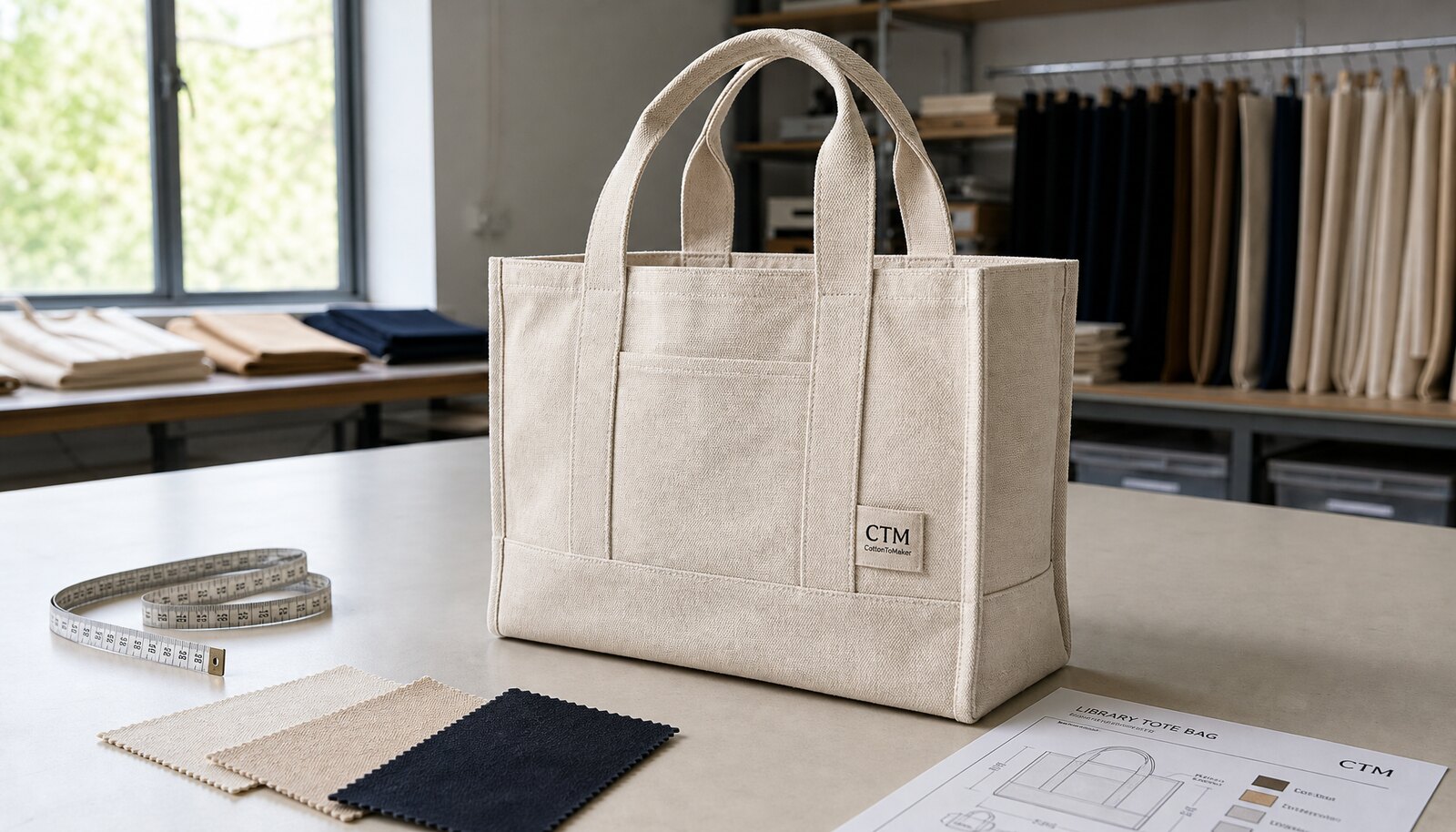
Buying Problem: What Makes a Hotel Library Tote Different
Canvas library tote bags for hotels are not the same as a giveaway tote or a retail fashion bag. A hotel library tote has to work as a room-facing utility item, often carrying books, magazines, tablets, bottled water, or a small guest amenity set. It should feel organized and premium, but the buyer still needs a stable landed cost and repeatable production. If the bag sags, twists at the handle, or arrives with uneven print placement, it reads as a quality miss in a guest-facing environment.
The right spec starts with use case, not fabric fashion. A hotel that uses the tote for in-room reading corners needs structure and a clean silhouette. A property that sells the tote in a gift shop may want stronger branding and a more retail-ready finish. Those two uses can share the same basic shape, but the fabric weight, handle reinforcement, and print method should not be treated as interchangeable.
- Define whether the tote is for in-room use, gift-shop resale, or a library amenity program.
- Treat structure and durability as the primary buying criteria, not just the logo surface.
- Keep the spec simple enough for the factory to quote the same way across reorders.
Choose the Fabric Weight Around the Load, Not the Sample Hand Feel
For hotel library totes, most buyers land in the 10 oz to 16 oz canvas range, which is roughly 340 to 540 GSM depending on weave and finishing. Lighter canvas can work for flat materials or soft amenity packs, but once the tote has books, a water bottle, or repeated guest use, a thin body starts to distort. A premium hotel program often performs better with a mid-heavy canvas that holds shape without becoming stiff and bulky.
Do not specify only a fabric ounce number and assume everyone interprets it the same way. Ask the factory to state the finished GSM, the weave, and whether the weight is before or after washing or shrinking. If the hotel wants a natural, uncoated look, the surface will show more texture and may vary slightly by roll. If the brand wants a smoother, more retail-ready surface, the loom and finishing matter as much as the nominal weight.
- 10 oz to 12 oz canvas is usually enough for lighter room use and lower price targets.
- 14 oz to 16 oz canvas is a safer range for structured library totes and retail-adjacent use.
- Ask for a cut swatch from bulk fabric, not only a pre-production sample made from a different roll.
Match Size and Structure to the Contents
A hotel tote that carries books needs a different footprint than one that carries an amenity bundle. A common mistake is ordering a wide but shallow tote because it looks elegant on paper, then finding that the books roll around or the handles pull awkwardly. Better to define the internal use load first: how many books, whether a tablet sleeve is expected, and whether the tote must fit on a shelf, in a room drawer, or in a gift bag carton.
A practical starting point for many hotel programs is a medium-tall body with a modest gusset and a reinforced base. That shape gives enough room for reading material while still staying neat when placed upright. If the tote is meant to stand in a room corner, consider a slightly heavier fabric plus a bottom panel or boxier gusset. If the bag is being folded and stored by housekeeping, keep the profile simple and avoid oversized bulk that creates handling issues.
- Define target contents in millimeters or in actual item examples.
- State whether the tote must stand upright when empty or only when loaded.
- Use a gusset only when the contents justify it; unnecessary width adds cost and carton volume.
Handles, Reinforcement, and Stitch Density Are Where Bags Fail
A hotel tote often fails at the handle long before the fabric wears out. The handle must take repeated load transfer, especially if guests fill the bag with books, souvenirs, or a laptop. For that reason, the handle width, handle drop, and anchor construction matter more than many buyers expect. A narrow handle on heavy canvas can still feel cheap if the grip cuts into the hand or the stitching bunches near the top edge.
Look for reinforcement at the handle anchors and the top hem, not just a neat outer seam. A good factory will usually specify stitch count or at least show the reinforcement method in the sample. If the tote is intended for premium hospitality use, ask for a handle length that works over the shoulder without dragging on the floor, but not so long that the bag loses structure or hangs awkwardly from a room hook.
- Request a handle pull test or at least a visual reinforcement standard before bulk starts.
- Check that both handles are symmetrical and aligned to the body centerline.
- Reject samples where the top edge buckles or the handle stitches bite into the canvas.
Print Method Choice Should Follow Brand Use, Not Vendor Habit
Hotels often want a clean logo and a restrained feel, which makes print method selection important. Screen print is still the most practical choice for bold logos on canvas when the artwork is simple and the color count is low. It is usually cost-effective, durable, and easy to repeat across reorders. If the design has fine lines or a multi-color illustration, a transfer or digital method may look cleaner, but the buyer should confirm wash resistance and rub-off before approving it for guest-facing use.
Embroidery can work on some hotel programs, especially when the tote is more like a premium gift item than a utility bag. The tradeoff is cost, stitch density, and the risk of puckering on lighter canvas. Woven labels or side labels are often better when the brand wants subtlety and long-term durability. If the logo sits too close to a seam or gusset fold, the print area may distort. That is a layout issue, not just a decoration issue, so the artwork should be set against the actual cut pattern.
- Use screen print for simple logos and repeat orders with stable color needs.
- Use woven or sewn labels when the hotel wants a quieter, premium identity.
- Place artwork away from seams, folds, and handle anchors unless the factory has approved that location in sample.
Supplier Route and MOQ Logic: What Actually Changes the Price
For this product, the cheapest quote is rarely the safest one. A direct factory quote can be the best value if the supplier already makes canvas bags at scale and can control fabric, sewing, and decoration in-house. A trading company may still be useful when the order is mixed with other hotel items or the procurement team needs one consolidated shipment. Stock blanks look inexpensive at first, but they often fail on fabric consistency, imprint quality, or size control once the bag enters a real hotel program.
MOQ is usually driven by fabric dye lots, print screens, and sewing setup rather than by the bag itself. A one-color natural canvas tote with a small logo may have a lower MOQ than a dyed body with custom binding and a woven label. Ask the supplier to break MOQ down by size, body color, and decoration method. That tells you whether a slightly more standard spec will materially lower cost or whether the factory is mainly protecting its cutting and print setup time.
- If price changes sharply at low quantities, the driver is usually setup, not materials alone.
- Ask for separate pricing for 500, 1,000, and 3,000 units to see the real breakpoints.
- Keep one size and one color if you expect reorders inside the same hotel group.
Use Sample Approval to Catch the Hidden Problems
A sample is only useful if it is tied to the bulk spec. A pretty prototype made from better fabric than the production run can mislead the buyer into approving a tote that will not hold its shape later. The pre-production sample should use the intended canvas weight, the final print method, the planned label, and the real packing method. That sample should be measured, weighed, and inspected under the same basic conditions used for bulk approval.
Sample review should focus on the points guests will notice and the points that create production risk. That means checking logo clarity, handle symmetry, stitch density, edge finishing, bottom squareness, and whether the bag stands reasonably well. It also means looking at what is not visible at first glance: inside thread trimming, seam allowance consistency, and whether the seams pinch the fabric into a twisted body. If the sample has to be 'explained,' the spec is probably too loose.
- Approve only a sample made from bulk fabric and final trims.
- Measure finished size, handle drop, and logo position against a written tolerance.
- Keep one annotated reference sample for production matching and one for receiving inspection.
QC Thresholds: What to Reject Before the Bags Ship
A practical QC standard for hotel totes should be strict on symmetry, stitch security, and print alignment. Natural canvas will vary a bit in shade and texture, so buyers should not over-focus on tiny visual differences that are normal to the fabric. What should be non-negotiable is structural consistency. The bag should sit flat, the handles should match, and the logo should not drift across the panel or wrap badly around a seam. If the tote is intended for retail resale, the visual tolerance should be even tighter.
Inspection should also look for carton-level issues, not just individual bag defects. Bags can arrive fine in bulk but show crushed corners, print rub, or fold marks because the packing plan was careless. The factory should state whether each tote is folded with tissue, bundled in sets, or polybagged individually. If the tote has a printed surface, rubbing inside the carton can damage the first impression even when the sewing is correct.
- Set acceptable size tolerance before production starts, not after inspection finds drift.
- Reject bags with loose threads at stress points, skewed handles, or crushed print areas.
- Verify carton labels, SKU marks, and count accuracy on at least one full sample carton.
Packing and Lead Time Can Change the Landed Cost More Than the Bag Price
Many buyers focus on unit price and ignore how the tote is packed. That is a mistake, especially with canvas, because a bag that is packed efficiently can save carton volume, freight cost, and warehouse handling time. If the tote is bulky, a more compact fold may reduce shipping cost but increase wrinkle risk. If the tote is sold in a hotel shop, a cleaner individual pack may be worth the extra labor. The right choice depends on whether the bag arrives as inventory or as a guest-visible product.
Lead time needs to be split into realistic stages: sample approval, fabric booking, bulk sewing, print curing or finishing, inspection, and shipment. For a custom canvas tote, buyers should assume that faster lead times usually require either stocked fabric or a simplified spec. If a supplier quotes an unusually short schedule, ask what part of the process is already on hand. Fabric availability, print screen preparation, and carton production are common schedule bottlenecks that can be hidden inside a too-simple promise.
- Ask for packed carton dimensions because freight cost depends on volume, not just piece count.
- Separate sample timing from bulk timing in the RFQ.
- Expect longer lead time when the order uses dyed canvas, custom labels, or premium packing.
How to Read the Quote and Write a Better RFQ
A clean RFQ for canvas library tote bags should tell the supplier exactly what to price and what to ignore. Include the intended use, target fabric weight, size, handle spec, print method, label type, packing method, and destination market. If the hotel chain has multiple properties, say whether the bags must ship by property or by central warehouse. That affects carton labeling, packing counts, and sometimes even the MOQ. Without this detail, suppliers will quote different assumptions and your comparison will be meaningless.
When quote data comes back, compare more than the unit price. Check whether the quote includes bulk fabric, sample revisions, print setup, internal label costs, carton packing, and basic inspection. Ask the supplier to identify assumptions in writing. A lower quote may simply mean a thinner canvas, a looser tolerance, or a decoration method that will not survive hotel use. The best quote is the one that states its spec clearly enough that procurement can compare it line by line.
- Write one RFQ spec sheet with the same vocabulary for every supplier.
- Compare quote assumptions, not only the final unit price.
- If two quotes look similar, compare carton volume, fabric GSM, and print method before deciding.
Specification comparison for buyers
| Spec decision | Recommended option | When it fits | Buyer risk to check |
|---|---|---|---|
| Direct factory sourcing | Choose a cut-and-sew factory that already makes canvas totes and can show loom, dyeing, sewing, and print control | Best for repeat hotel programs, private-label orders, and buyers who need tighter control on fabric weight and stitching | Confirm that the factory is quoting the actual fabric source, not only the finished bag, and ask for a pre-production sample cut from bulk fabric |
| Trading company or sourcing agent | Use when the order is smaller, has mixed trims, or needs consolidation across several products | Useful if you need one contact for hotel amenity sets or if the buying team lacks factory experience | Check whether the agent can name the real sewing factory and whether the quote includes a transparent margin or hidden handling fees |
| Stock blank tote plus local decoration | Pick if the timeline is short and the tote only needs a simple logo for an event or seasonal hotel campaign | Works for low-complexity orders where brand color matching is not critical | Watch for inconsistent canvas weight, weak handles, and print alignment issues on pre-made goods |
| Domestic decoration on imported blanks | Use when the tote body can be imported economically and branding must be applied close to the hotel opening date | Helps reduce freight risk and gives more control over final print approval | Verify blank quality, shrinkage after printing, and whether the local decorator can handle the tote size without distortion |
| Organic or certified cotton route | Choose when the hotel brand has a sustainability brief or guest-facing ESG claim that must be supportable | Fits premium hospitality groups, eco-lodges, and retail-adjacent hotel shops | Request certificate numbers, scope coverage, and yarn-to-finished-bag traceability before you rely on the claim |
| Heavyweight premium canvas | Select for in-room guest use, book carrying, and retail resale where structure matters | Best when the tote must stand upright and hold books, slippers, or amenity kits without corner collapse | Check whether the weight increase is real across the full roll, not only on the supplier's sample piece |
| Midweight utility canvas | Use for standard hotel library programs where price, durability, and hand feel must stay balanced | Good for large room counts and moderate repeat use | Confirm handle reinforcement and stitch density, because a lighter cloth needs better construction to survive wear |
| Laminated or coated canvas | Choose only when the tote must resist spills or carry damp items in spa or beach-adjacent hotel settings | Useful for wet-area utility, not for a soft library look | Inspect coating smell, cracking after flexing, and whether the finish changes print adhesion |
| Recycled canvas or blended fabric | Use if procurement wants a sustainability story but the hotel still needs a canvas look and stable lead time | Fits broader responsible-sourcing programs when the spec can allow some texture variation | Ask for fiber composition tolerance and color variance rules, because recycled yarn can vary more than virgin cotton |
Buyer checklist before sampling
- Define the use case first: library tote, guest shopping tote, room-drop bag, or retail resale piece.
- Set a target fabric weight in GSM and a minimum finished size with gusset and handle drop.
- Choose one primary print method and one acceptable backup method before quoting.
- State whether the tote must stand upright when empty or fully loaded.
- Specify whether the bag must fit books, tablets, a water bottle, or a hotel amenity kit.
- Approve a sample with bulk fabric, bulk thread, and the final label position.
- Require carton counts, polybag needs, and barcode or SKU marking in the RFQ.
- Ask for the factory's MOQ by color, by print design, and by size variant.
- Request lead time by stage: sample, material booking, bulk production, and final shipment.
- Confirm overage/underage tolerance, carton drop test expectations, and inspection standard before PO.
Factory quote questions to send
- What is the exact fabric construction, yarn count, weave, and finished GSM after washing or finishing?
- Is the quoted price based on bulk fabric, and can you separate fabric, sewing, print, label, and packing costs?
- What MOQ applies by size, color, and print method, and does changing handle length affect MOQ?
- Can you provide photos or a video of a previous tote with the same stitching or print process?
- What are the tolerances for size, color shade, handle length, and logo placement?
- What sample stages are included: blank sample, pre-production sample, and shipment sample?
- How are the bags packed in cartons, and what is the carton size and gross weight?
- What lead time applies after sample approval, and what part of that lead time depends on fabric booking?
- What inspection standard do you follow, and can you share the AQL level or internal QC sheet?
- Are there any extra costs for woven labels, side tags, branded inserts, or polybag changes?
Quality-control points to confirm
- Fabric GSM matches the approved range and is measured from bulk material, not only from a hand-cut sample.
- Canvas weave is even, with no thin streaks, broken yarn clusters, or visible slubs outside the agreed texture level.
- Handle stitching is reinforced at the top edge and stress points, with no skipped stitches or loose thread ends.
- Logo placement stays within the approved tolerance and does not distort across seams, gussets, or top edge folds.
- Finished dimensions stay within the agreed tolerance after pressing, trimming, and packing.
- Seams remain flat and secure at bottom corners, side gussets, and handle anchors.
- Color shade is consistent across sample, bulk lot, and carton units, especially for natural canvas and dyed canvas.
- Packing protects the tote shape, keeps print from rubbing, and matches the approved carton count and labeling.