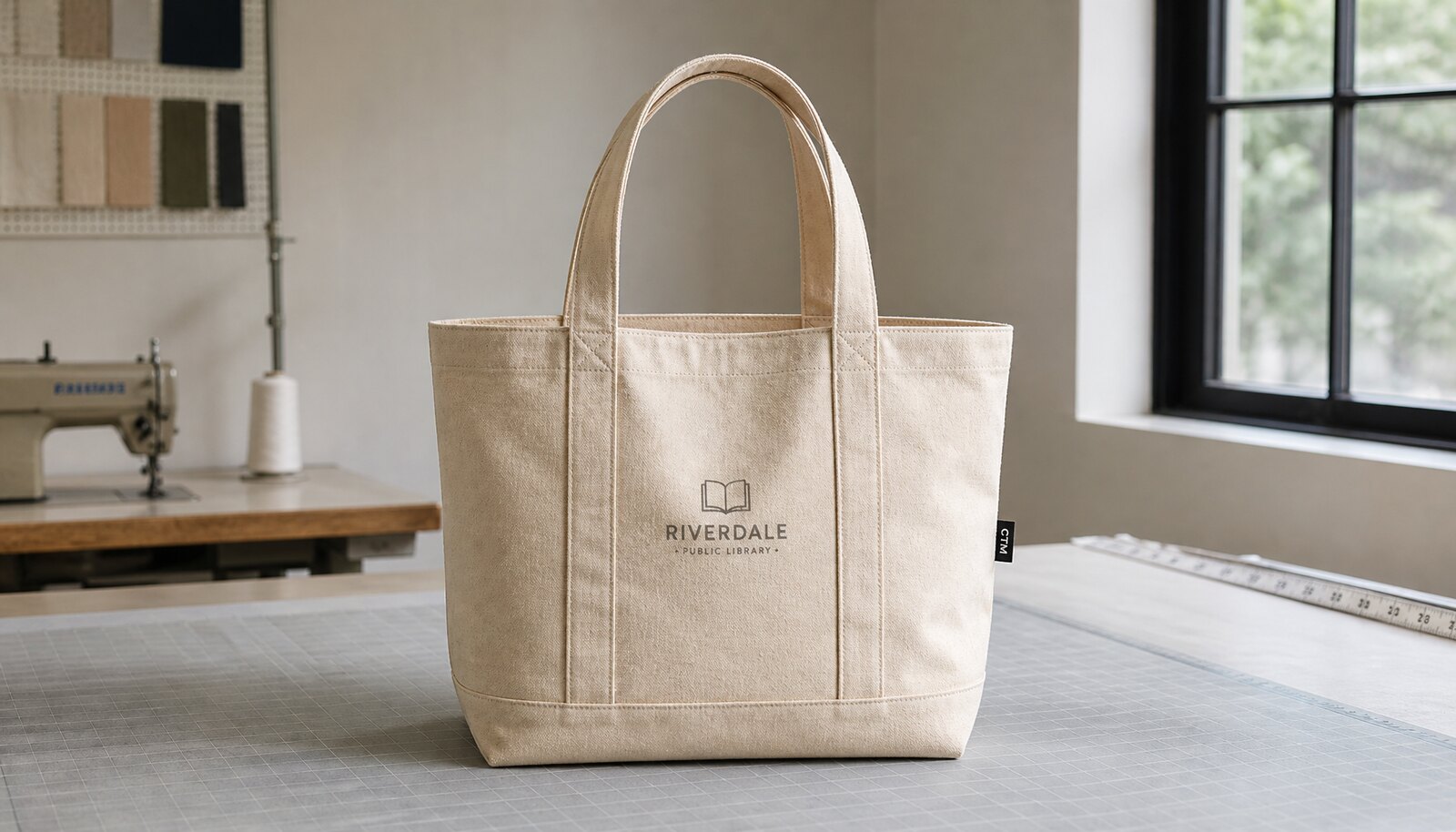
Why Gift Shop Buyers Need a Different Tote Standard
Canvas library tote bags for gift shops are not bought the same way as school totes, conference bags, or warehouse promo items. A gift shop buyer is balancing three commercial demands at once: the bag must look attractive enough to sell from a display table, it must be practical enough for books or boxed gifts, and it must be simple enough to reorder without reworking the whole spec. That combination changes the sourcing logic. A tote that is cheap but unstable in production usually becomes expensive after the first season because the buyer has to fix artwork, packing, or fabric variation before reordering.
For this category, the right question is not just “What is the unit price?” It is “Can this tote be repeated with the same body spec, the same print method, and a stable lead time?” Gift shop assortments often depend on seasonal traffic, tourist peaks, museum visitors, library events, or local landmarks. That means the buyer needs a dependable replenishment plan, not a one-off custom run. If the supplier cannot explain MOQ, sampling steps, and reorder timing in a way that matches retail calendars, the quote is not yet decision-ready.
A strong tote program usually has a fixed bag body and a variable decoration layer. The body should stay the same across seasons if possible, while the graphic, woven label, hangtag, or barcode changes only when needed. This approach lowers training time for the factory, reduces packing errors, and makes it easier to compare later quotes. When a supplier can hold the body consistent and only update the artwork or label, the buyer gets a more controllable program and a more realistic path to reorder pricing.
Pick a Fabric Weight That Matches the Retail Price Point
For canvas library tote bags sold in gift shops, fabric weight has a direct effect on both shelf appeal and complaint risk. A 10 oz canvas can work for light souvenirs, paper goods, or small accessories, but it often feels too soft if the tote is expected to carry books, ceramic mugs, or boxed gifts. In most retail programs, 12 oz canvas is the safer baseline because it gives the bag more body, better vertical shape, and a more durable impression without pushing the cost too far up. If the tote is positioned as a premium keepsake or museum-style souvenir, 14 oz or 16 oz can be justified, but the buyer should expect higher sewing labor, more material cost, and sometimes a stiffer hand feel that changes the customer’s perception of the product.
The right fabric choice also depends on how the bag is displayed and sold. A bag with a gusset stands more neatly on a shelf and makes the front graphic easier to read from a distance. That matters in gift shops, where the customer often buys after a quick visual scan rather than a long comparison. A standard library tote format is often around 15 to 16 inches wide, 14 to 16 inches high, with a 4 to 5 inch gusset and a handle drop that supports hand carry and short shoulder carry. Those dimensions are not mandatory, but they are a useful commercial range because they balance print area, carrying capacity, and shelf presentation.
Buyers should also decide whether the tote needs a self-fabric handle or webbing handle. Self-fabric handles usually keep costs lower and maintain a unified look, while cotton webbing handles improve comfort and can make the bag feel more finished. The tradeoff is not cosmetic only. Webbing often adds a small amount of sewing time and can slightly raise MOQ if the supplier needs a separate trim lot. A buyer should think about the customer’s use case: if the tote is likely to be loaded with books or heavier items, stronger handles matter more than saving a few cents in trim cost.
How MOQ Is Really Set for This Bag Category
MOQ is often described as if it were a single number, but in practice it is usually a combination of several minimums. The fabric supplier may have a minimum for canvas width or dye lot. The print shop may have a minimum for one screen, one color, or one setup. The sewing line may have a minimum cutting quantity. Packing labor may require a minimum carton run to keep the line efficient. When those pieces are combined, the buyer sees one MOQ figure, but the factory is really protecting multiple setup costs at once.
That is why the cheapest-looking quote is not always the lowest-risk purchase. A stock blank tote with a one-color print generally gives the buyer the most flexibility because the fabric is already available and the decoration is simple. Once the buyer adds custom dyed canvas, a custom webbing color, woven side labels, hangtags, or a special retail fold, the order begins to behave like a new program rather than a simple decoration job. MOQ rises because the factory must reserve more material, more labor, and more control points. In other words, the minimum is usually not about sewing the tote body; it is about all the setup around it.
For a first gift-shop launch, it is usually smarter to protect speed and cash flow than to over-customize. A stock or near-stock canvas body with one-color screen print often gives enough margin to test sell-through. If the program performs well, the buyer can then decide whether to raise the perceived value with a better label, a thicker handle, a revised print position, or more premium packaging. This staged approach is practical because it lets the buyer learn the real demand before committing to a higher MOQ on a more complex specification.
Lead Time Has Four Clocks, Not One
A supplier saying “20 days lead time” is not enough information for a buyer planning a gift shop launch. Lead time should be separated into at least four clocks: sample making, sample approval, bulk production, and transit. For imported orders, customs clearance, inland trucking, and freight booking are part of the real schedule too. A quote that only covers sewing time creates a false sense of urgency because the fastest production line in the world still cannot ship a bag that has not been approved or booked onto freight.
The safest method is to work backward from the retail date. If the tote must be on shelf before a holiday or tourist season, the buyer should reserve enough time for one sample revision cycle and enough cushion for artwork changes, packing clarification, or carton corrections. If the factory needs new screens or a new label structure, that work should happen before bulk approval, not after. When the supplier says production will start after deposit, the buyer should still confirm what “start” means: fabric allocation, cutting, printing, sewing, packing, or all of the above. That one word can change the schedule by a week or more.
Regional differences matter here. Domestic suppliers or decorators can often move faster on sampling and urgent replenishment because freight distances are shorter and communication loops are tighter. Nearshore suppliers can offer a useful balance of speed and lower freight complexity. Large export factories in Asia may offer the best unit pricing at scale, but they usually need more time for setup, approval, and shipping. A buyer should not compare lead times without also comparing geography, transit mode, and the complexity of the tote spec.
What Changes the Quote More Than Buyers Expect
In this category, the biggest price differences often come from decoration and packing, not from the canvas body alone. One-color screen print is still the most cost-efficient and repeatable choice for most canvas library tote bags. It prints cleanly on heavier canvas, handles retail handling well, and is relatively easy to repeat for reorders. The moment the art becomes multi-color, fine-lined, or requires registration across a large front panel, the supplier may need more screens, tighter alignment, or a more careful inspection process. That adds setup cost and increases the risk of rejects or rework.
The same logic applies to branding details. A woven label or side seam label can be a smart way to add perceived value without requiring a large or complex print. For gift shop buyers, that can be more effective than trying to force a premium feel through a large, expensive graphic. If the bag is priced as an entry-level souvenir, a simple front print and clean sewing may be enough. If the product needs to sit in a premium museum shop or design-led retail space, the buyer may want a better label finish, a more stable gusset, or cleaner topstitch visibility. The point is to match the construction to the price point instead of assuming that more decoration automatically makes the bag more valuable.
Buyers should also be careful with artwork placement. A design that crosses seam lines, touches the gusset fold, or sits too close to the handle stitch path will be harder to print consistently. That can lead to visible shifts between production cartons. A cleaner layout, with safe margins away from seams and stress points, usually gives better results and lower defect risk. It also makes reorders easier because the factory can run the same setup without fine-tuning placement every time.
How to Compare Supplier Quotes on a True Apples-to-Apples Basis
Many tote quotes look different only because the underlying assumptions are different. One supplier may be quoting 12 oz canvas while another uses 10 oz. One may include folding and carton marking while another treats those as extra labor. One may quote FOB with freight excluded, while another bundles delivery into a CIF or DDP number that is harder to compare. If the buyer compares the headline unit price without normalizing the spec, the cheapest quote can quickly become the most expensive landed order.
The first step is to lock one spec sheet. That sheet should include fabric weight, dimensions, handle type, print method, number of colors, label type, packing method, and carton count. Then ask each supplier to quote the exact same spec on the same trade term. If the supplier refuses to quote the same basis, that is already a sourcing signal. A good factory can explain how much of the price comes from fabric, cutting, sewing, decoration, packing, and freight assumptions. A weak quote often hides the expensive parts in a follow-up message or change order.
For buyers who need real budget control, landed cost is the number that matters. That means adding together factory price, setup charges, internal handling, freight, duty if relevant, and any destination receiving fees. A quote that is lower by 8 cents per bag but adds a separate print setup, a nonstandard carton, and a higher freight charge may lose in total spend. B2B procurement teams should evaluate the full delivered cost per sellable unit, not the price per bag before packing.
A Simple Landed-Cost Example for a Gift Shop Tote
A landed-cost view helps buyers see why low unit price is not always the best decision. Consider a medium-run order of 1,000 canvas library tote bags. Supplier A quotes a domestic decorated bag at $3.20 per piece, including one-color print and retail folding, with freight to the warehouse costing $180. Supplier B quotes an export factory bag at $2.35 per piece FOB, but print setup adds $120, cartons and retail packing add $0.18 per piece, ocean and inland freight total $420, and destination handling adds $75. The factory price is lower with Supplier B, but the total delivered cost changes the picture.
Using that example, Supplier A totals about $3,380 delivered before duty or receiving overhead, while Supplier B totals about $3,155 plus any import-related charges. In this scenario, Supplier B may still be cheaper, but only if the buyer accepts the longer lead time and the added administrative load of import coordination. If the order were smaller, or if the launch date were tighter, the domestic option might actually be the smarter procurement decision even at a higher bag price. The lesson is not that overseas sourcing is better or worse. The lesson is that the right answer depends on the combined effect of setup, freight, and schedule risk.
This is also why buyers should ask each supplier to separate the quote into clear line items. A useful quote should show the bag body, decoration setup, packing, and freight assumptions at minimum. That structure makes it easier to spot whether one supplier is bundling hidden costs into a lower-looking piece price. It also helps when comparing different regions, because a domestic supplier may charge more per unit but save enough on freight and handling to be competitive in total.
What Good Sampling and QC Should Actually Look Like
A sample should do more than confirm the logo is in the right place. It should tell the buyer whether the tote works in a real retail environment. That means loading it with books, bottled goods, or boxed merchandise and checking whether the handles hold comfortably, whether the bag keeps its shape, and whether the print remains visually centered when the bag is filled. A tote can look fine on a flat table and still fail when carried or stacked. For gift shop use, that matters because the customer experiences the bag as a product first and a package second.
The sample stage should also establish measurable limits. For example, finished width, height, and gusset tolerance should be written down before bulk sewing begins. Print placement tolerance should be defined as well, because “centered” means different things to different factories. If the buyer does not define the tolerance, the supplier will apply its own standard, and that standard may be acceptable for promo goods but too loose for a retail shelf. The best practice is to approve a proto sample, then a pre-production sample, and keep one sealed golden sample as the physical reference for bulk production.
During inspection, the buyer should look for more than obvious defects. Common issues include uneven handle alignment, loose thread tails, skipped stitches, weak bartacks, print bleed into seam areas, and top edges that do not sit level when the bag is standing upright. A strong QC plan turns those observations into pass/fail rules. For example, visible stains and oil marks should be zero tolerance on retail-facing surfaces, while loose thread length should be capped and cleaned before packing. If the bags are sold in a gift shop, cosmetic consistency matters almost as much as strength because the customer is buying with their eyes before they buy with their hands.
Packing and Carton Planning Can Make or Break Shelf Readiness
Packing is a commercial issue, not only a logistics issue. A gift shop buyer often wants the tote to arrive in a state that is immediately sellable or at least easy to merchandise. That means the fold should be repeatable, the barcode should be placed in a consistent location, and the bag should not arrive with random creasing that makes the display look sloppy. If the supplier treats folding as an afterthought, the retailer ends up paying staff to fix presentation on arrival. For small shops, that can be a real hidden cost.
Carton planning should be defined before the order is released. The buyer should confirm pack count, outer carton dimensions, gross carton weight, and any moisture protection needed for a sea shipment or humid storage. For example, a carton that is too heavy creates handling problems at receiving, while a carton that is too large wastes freight space. For reorderable SKUs, consistent carton marks and SKU coding are just as important as sewing quality because they protect inventory accuracy. A tote program that mixes colors or assortments in cartons without a written plan can quickly create count errors in the back room.
If the order will be shipped to multiple gift shop locations, ask the supplier whether carton split labeling or inner packing by store is possible. That may add labor, but it can save downstream sorting time and reduce mistakes in distribution. Retail-ready packing is often worth paying for because the cost moves from the store floor to the factory floor, where it is easier to control.
How to Choose the Right Supplier Type by Region and Program
Supplier selection should be based on program shape, not just on catalog browsing. If the buyer needs a quick test order for a new tourist item or a seasonal promotion, a domestic decorator or stock-goods supplier may be the best fit because the turnaround is short and the communication loop is tight. If the buyer needs moderate customization, a regional nearshore factory can provide a practical balance of speed, freight simplicity, and lower unit cost than many domestic options. If the buyer is building a repeatable core SKU for multiple shops or a distributor network, a larger export factory may be more competitive because it can spread setup cost over higher volume.
There are also real tradeoffs by supplier type. Stock programs are fast, but the body spec may not be fully controlled. Domestic cut-and-sew shops often solve problems quickly, but the piece price can be higher. Nearshore factories can be efficient for mid-volume runs, but fabric and trim options may be more limited. Large export factories can be strong on cost and repeatability, but buyers need to manage communication more carefully and allow more time for sample approvals and freight. Trading companies can simplify coordination across multiple items, but the buyer should understand whether they are adding a management margin and whether they can still get factory-level QC visibility.
A buyer should ask one practical question before choosing a supplier: who is best suited to this exact order shape? For example, an urgent 150-piece event order with one-color print and fixed bag body is not the same as a 3,000-piece reorderable line with woven labels and carton coding. Treating them as the same purchase category leads to bad supplier selection. A good procurement process matches region, production model, and lead time to the program’s commercial purpose.
Specification comparison for buyers
| Supplier type | Typical MOQ range | Typical lead time | Best use case | Main buyer tradeoff |
|---|---|---|---|---|
| Stock goods + local decorator | 50-300 pcs | 3-10 days | Fast test launch, tourist-season replenishment | Lowest speed risk, but limited color and size control |
| Domestic cut-and-sew or decorator | 200-1,000 pcs | 10-25 days | Small retail programs, repeat prints, short replenishment cycles | Better communication and faster corrections, but higher base sewing cost |
| Nearshore factory | 500-2,000 pcs | 20-35 days | Regional distribution, moderate customization, mid-volume reorder plans | Good balance of control and cost, but fewer fabric and trim options than major export hubs |
| Large China export factory | 1,000-5,000+ pcs | 30-55 days excluding sea freight | Core SKU programs, multi-season supply, multiple colorways | Lowest unit price at scale, but stricter MOQ rules and longer approval cycles |
| Trading company / sourcing agent | Often mirrors factory MOQ, sometimes split across runs | Varies by factory network | Multi-item buying, vendor consolidation, buyers without direct factory contacts | Convenient coordination, but less direct control over production floor details |
| Warehouse stock program with custom print | 25-200 pcs | 2-12 days | Event shops, museum stores, urgent promo drops | Speed is excellent, but body spec, color, and pack format may be fixed |
Buyer checklist before sampling
- The finished bag size, gusset depth, handle length, and handle drop are written in the RFQ, not left as a reference photo only.
- Fabric weight is stated in GSM or oz, along with whether the cloth is natural, bleached, dyed, or washed, and the tolerance range is defined.
- Artwork is fixed before sampling: print method, number of colors, placement, ink type if relevant, and acceptable color variance are all documented.
- The supplier confirms whether MOQ applies per design, per color, per fabric lot, per print screen, or per carton pack.
- Sample status is defined clearly: proto sample, pre-production sample, or golden sample, with one sealed approved sample retained for production reference.
- Packing requirements are written out: fold method, barcode sticker, hangtag, care label, polybag or no polybag, and carton pack count.
- The quote separates unit price from setup charges such as screen fees, label fees, hangtag fees, and special packing labor.
- Incoterm, destination, required arrival date, and whether lead time starts from order confirmation or sample approval are stated in writing.
- QC limits are set before production: measurement tolerances, print shift allowance, stitch defects, stain limits, and carton error tolerance.
- The buyer requests photos or video of bulk sewing, packing, and final carton marking before shipment if the order is seasonal or time-sensitive.
Factory quote questions to send
- What exact canvas weight, weave, and finish are you quoting, and will bulk production use the same fabric lot or specification?
- Is the MOQ based on one design, one color, one print screen, one fabric lot, or one shipment?
- What is included in the unit price: bag body, handles, screen setup, labels, folding, inner packaging, outer carton, and carton marks?
- How many days are needed for a prototype sample, and is the sample charge refundable or deductible after PO confirmation?
- How many days are needed after pre-production sample approval before bulk goods are ready for packing?
- Can you quote the same specification on FOB, CIF, and DDP terms so we can compare landed cost accurately?
- What are your accepted tolerances for finished dimensions, handle placement, print shift, and color shade?
- What defects are counted as rejectable in bulk inspection: stains, skipped stitches, broken threads, loose handles, or print misalignment?
- How do you pack the bags, what is the carton pack count, and what gross carton weight do you target?
- Can you share photos of a recent packing line or carton mark example for a similar tote program?
Quality-control points to confirm
- Finished width, height, and gusset should stay within ±0.5 cm for small bags and ±1.0 cm for larger sizes unless a stricter spec is required.
- Handle length, handle drop, and left-right symmetry should be within ±0.5 cm, with no visible twist or mismatch when the bag is hung.
- Seam allowance should remain consistent, and edge-to-stitch distance should not vary by more than about 0.3 cm across the same bag.
- Bartacks or reinforcement stitches should be present at handle stress points, with no skipped stitches, open ends, or loose thread tails longer than 1.5 cm on retail-facing areas.
- Print placement should stay within ±0.3 cm to ±0.5 cm of the approved location for front logos, with no blocking, bleeding, cracking, or unapproved color shift.
- Defect limit for visible stains, oil marks, or fabric damage should be zero on AQL critical items; no more than 2 major defects per 100 pcs is a practical ceiling for retail-facing tote programs.
- Loose fibers, frayed edges, needle holes, and missed topstitching should be treated as major defects if they are visible at arm’s length or affect strength.
- Carton count, SKU label, barcode, and color code must match the packing list exactly; mixed assortments should only be allowed if pre-approved in writing.
- One sealed golden sample should be retained and used as the reference for size, print position, handle finish, label placement, and fold style.
- If the order is retail-ready, each bag should open and display consistently after unpacking; wrinkled folding, off-center labels, or uneven stacking should be flagged before shipment.