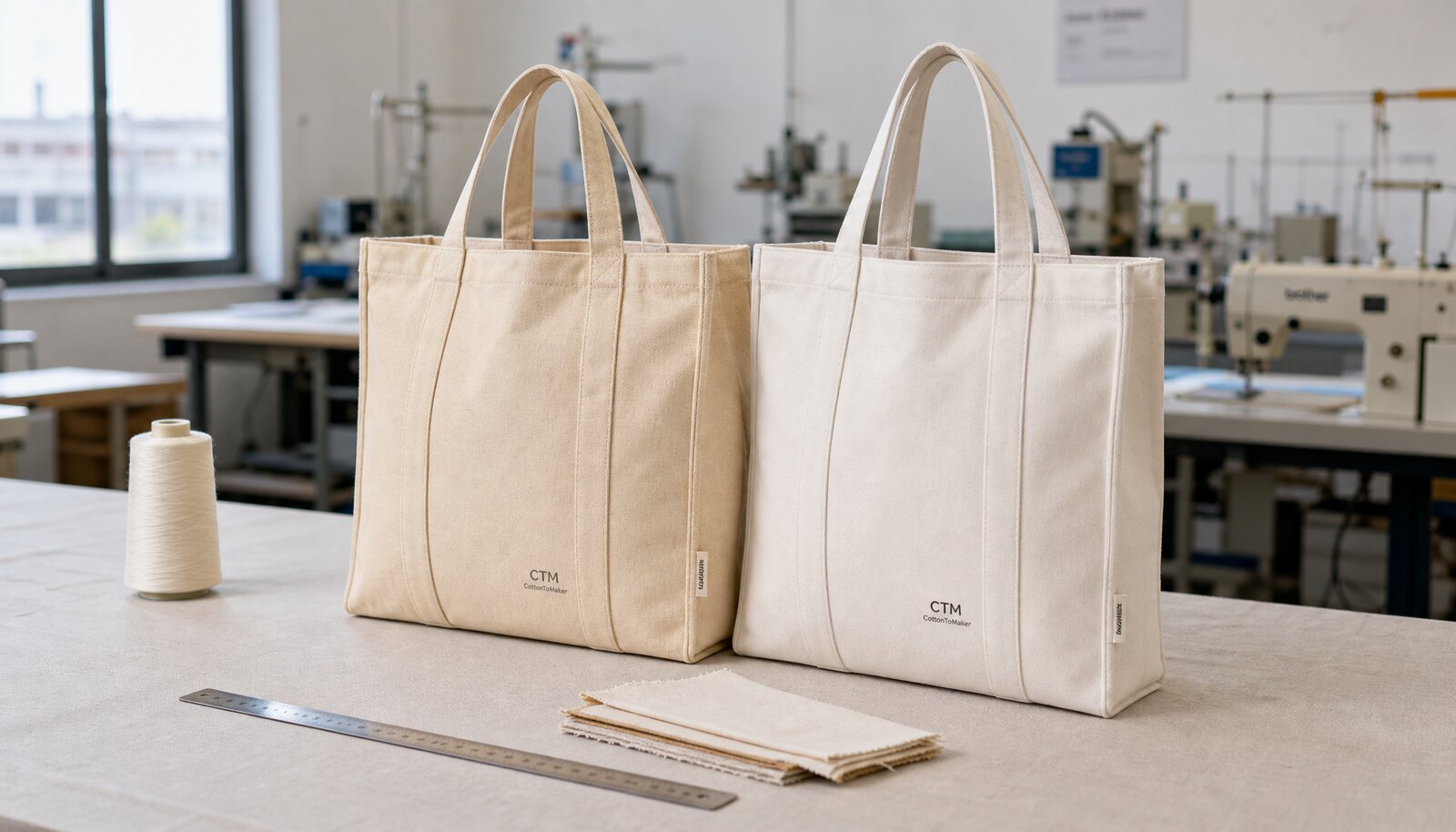
Why material choice decides retail success
For gift shops, a canvas tote is not just a carrier. It is part of the shelf story, the impulse purchase, and the brand impression that leaves the store with the customer. The fabric has to do several jobs at once: it has to look substantial enough to justify the retail price, hold print clearly, survive book weight, and fold efficiently for replenishment. If one of those jobs fails, the item can still be technically usable but commercially weak. That is why the material spec matters more than a generic bag template.
Buyers often start with the artwork and work backward, but procurement works better in the opposite direction. The bag structure should be defined first, because the right fabric weight, weave density, and handle build determine what decoration methods will actually reproduce well. A design that looks strong on a digital mockup can turn fuzzy on a loose weave or become too expensive once the factory adds the reinforcement needed for real carry weight. The goal is not to buy the thickest bag. The goal is to buy the bag that can be repeated without surprises.
- Match the fabric to the retail role, not to a general idea of durability.
- Treat the tote as a shelf item, a carry item, and a packed item at the same time.
- Start with the bag construction, then lock artwork, packing, and freight assumptions.
Pick canvas weight by use case, not by habit
Canvas weight is the first number buyers compare, but the number only matters when it is tied to the bag's use. For most bookstore and gift-shop programs, 10 oz to 12 oz finished canvas, about 340 to 400 gsm, is the most useful range. At 10 oz, the tote stays relatively flexible, packs efficiently, and lands in a price band that works for broad retail. At 12 oz, the bag takes on more structure, reads as more premium, and handles heavier book loads better. Below 8 oz, the bag can start to feel like a freebie even if it is decorated well. Above 12 oz, the item may become too stiff or too expensive for a normal gift shop shelf.
The better buying practice is to ask the supplier for both finished weight and a physical reference sample from the same production system. Raw cloth weight alone can mislead if the mill finish, wash process, or coating changes the hand feel. Two 10 oz canvas bags can feel very different if one uses a tighter weave and the other uses a looser weave that simply carries more mass. For procurement, the practical acceptance question is not just 'how heavy is it?' but 'does the bag hold shape, take ink cleanly, and survive a load test without becoming bulky to pack?'
- 8 oz or about 270 gsm: lighter retail use, lower cost, and easier folding, but less structure.
- 10 oz or about 340 gsm: the best all-around range for most gift shops and museum stores.
- 12 oz or about 400 gsm: better shape and better book-carry behavior, usually for premium lines.
- 14 oz and above: reserve for heavy-duty retail or higher-price souvenir programs, not default tote sourcing.
Fiber, weave, and finish are where quality really separates
A fabric quote that only names 'canvas' is not enough. The fiber mix, weave density, and finishing process all affect how the tote looks and performs. For repeat retail use, 100 percent cotton canvas remains the safest default because it takes screen print predictably, has a familiar natural hand feel, and is easy to merchandise next to books or stationery. A low-ratio recycled cotton blend can be a good option when the brand wants a sustainability message, but the buyer should expect some variation in color fleck, yarn length, and surface texture. Those changes are acceptable if they are planned; they become a problem if the buyer expects exact lot matching across every reorder.
Weave tightness is just as important as fiber content. A tighter weave creates cleaner print edges, less ink sink, and a more refined look on shelf. A loose weave may feel softer, but it can allow the art to blur and can make the bag look less premium under store lighting. Finish matters too. A lightly brushed or calendared canvas can feel smoother and print more crisply, while a heavily washed canvas may shrink more and introduce a more casual look. If the supplier cannot explain the fabric's mill source and finishing step, the buyer does not yet have a controllable spec.
- Use 100 percent cotton when you need clean print, reliable reorders, and a familiar retail hand feel.
- Use recycled blends only when the visual variation is acceptable and documented.
- Prefer a tight, even weave if the art has fine lines or small type.
- Ask whether the finish is raw, washed, calendared, or coated, because that changes shrinkage and print behavior.
Decoration should be chosen for readability and repeatability
For canvas library tote bags for gift shops, screen print is still the main workhorse because it is repeatable, cost-efficient, and durable on canvas. One or two spot colors are usually the best procurement choice. They hold cleanly on a textured surface and keep setup manageable across reorders. If the artwork includes fine type, outline detail, or a destination graphic with a lot of white space, the buyer should ask for a print strike on the actual cloth before approving bulk. Canvas can swallow detail that looks perfectly crisp in a PDF.
Other decoration methods can work, but they should be chosen for a clear reason. Embroidery adds texture and perceived value, but it increases unit cost and can distort lighter fabric if the stitch density is too high. Heat transfer can reproduce detailed art, but on a tactile canvas tote it may feel less authentic and may crack sooner if the print system is weak. Woven labels, side tabs, or a small hem label are often the smarter branding move when the front panel already carries the main graphic. For procurement, the rule is simple: do not over-decorate a bag that will succeed because of its material and useful form.
- Use screen print for simple logos, library marks, destination art, and short retail slogans.
- Use embroidery only when the artwork is bold enough to survive stitch volume and fabric distortion.
- Use heat transfer only when the art cannot be simplified and the supplier can prove durability.
- Keep the print away from seam intersections unless the factory can show stable registration on the same structure.
Compare sourcing routes before comparing prices
A unit price without a sourcing route is incomplete. A direct cut-and-sew factory with in-house printing gives the cleanest accountability because one operation owns fabric booking, sewing, decoration, and packing. That is usually the best route for a repeat gift shop program that needs reorder consistency. A trading company can be useful if you are buying a mixed assortment or need help managing several factories, but the quote often hides margin stacking and makes it harder to identify who owns a defect when something goes wrong. A local decorator using imported blanks may work for very small runs, but the blank bag and the print process can drift apart if they are not controlled by the same spec file.
The buyer-side question is not which route sounds easiest. It is which route can reproduce the approved sample with the least ambiguity. Ask the supplier who controls the fabric mill, who approves the artwork file, and who signs the golden sample. If those answers point to three different parties, reorders become harder to manage. A good procurement file should be able to answer, in one page, who owns the bag body, who owns the print, who owns the packing, and who is responsible for corrective action if the bulk lot misses the spec.
- Direct factory: best for repeatability, clearer accountability, and stable reorder control.
- Trader: useful for coordination, but check whether margins and responsibility are split across unseen parties.
- Local print-on-blank route: acceptable for short lead times, weaker for long-term consistency.
- Hybrid sourcing: only use it if the PO clearly assigns responsibility for each step.
Sampling is where the production standard gets locked
For this category, a sample should do more than confirm the shape. It should lock the fabric weight, weave, seam finish, handle length, handle width, print position, label position, and folded size. The sample is not just an approval object; it is the production reference. The supplier should label one sealed golden sample, and the buyer should retain a matching reference on their side. If the factory does not treat the approved sample as a controlled standard, bulk production can drift even when the order technically matches the PO.
The inspection of the sample should be practical, not cosmetic. Load the bag with realistic books, open and close it, pull the handles firmly, and inspect the top hem and side seams after stress. Compare the print against the art file under daylight and under store lighting if possible. Check whether the bag still folds cleanly after use. Many bags are approved visually but fail in handling because the handles are too narrow, the top edge twists, or the structure collapses after the first heavy load. Sample approval should end with a written note that states what is fixed and what remains open.
- Keep one sealed golden sample and one working reference sample.
- Approve the art on the actual tote, not only on a digital file.
- Test the bag with real weight before bulk signoff.
- Record the approved fabric, color, trim, print, and pack version in the PO or spec sheet.
Use measurable QC thresholds, not general approval language
The biggest procurement gap in tote programs is vague quality language. 'Good stitching' and 'strong handles' are not inspection criteria. They are subjective notes that fail when a factory swaps a thread type, changes stitch density, or shifts a handle reinforcement method. A useful QC spec should name the key measurable points: finished dimensions, fabric weight tolerance, stitch density, handle pull strength, shrinkage limit, print registration tolerance, and carton pack count. When those numbers are defined early, the factory can self-check while production is still running.
For a standard gift-shop tote, a practical starting point is 7 to 9 stitches per inch on the main seams and 6 to 8 stitches per inch on the body, with bar-tacks or equivalent reinforcement at handle joins. Handle pull strength should be tested to a defined threshold, often 15 kgf for a standard retail tote and 20 kgf for a heavier book-carry version, without seam opening or fabric tearing. Shrinkage after finishing should usually stay under 3 percent on length and width, and the buyer should ask whether the factory measures this after wash, steam, or pressing. The more exact the spec, the less room there is for a vague pass/fail decision at final inspection.
- Set a fabric weight tolerance window and make it part of the incoming and finished-goods check.
- Require even stitching, no skipped stitches, and no loose thread tails at the top hem and handles.
- Define a handle pull-test threshold and state what counts as a failure.
- Set a practical shrinkage limit, commonly under 3 percent for finished dimensions unless the design requires otherwise.
- Specify print placement tolerance and keep a sealed artwork reference at the factory.
Packing is part of the spec, not an afterthought
Packing affects landed cost, shelf readiness, and how the store team experiences the product when the carton is opened. Bulk folded packing is usually the right base choice for wholesale gift shop replenishment because it keeps cost low and allows the buyer to control local tagging or display. If the tote needs to be shelf-ready on arrival, then individual polybags, barcode stickers, and insert cards may be justified, but they should be quoted separately. Buyers should not let packing be folded into a vague 'standard packing' line, because that makes the quote impossible to compare across suppliers.
Carton planning matters more than many buyers expect. A tote with a wide gusset or a thick handle fold can reduce carton efficiency and increase freight cost even if the factory unit price looks good. Ask for carton pack count, master carton dimensions, gross weight, and whether the cartons are designed for palletization or direct shelf replenishment. For retail buyers, a clean carton spec also helps store teams count stock faster and reduces damage during unpacking. Good packing is not cosmetic. It is a handling control that protects margin.
- Bulk fold is the default for most gift shop replenishment programs.
- Use polybags only when shelf-ready presentation, dust protection, or scan labeling requires it.
- Ask for master carton dimensions and gross weight before freight is booked.
- Make the carton mark, SKU, color, and quantity match the PO exactly.
MOQ and lead time should be read as a production system
Canvas tote programs fail when the buyer treats MOQ as a single number. In practice, MOQ can be different by fabric color, print design, and pack style. A factory may accept a low total order but still require a minimum per artwork or per shade because the setup cost for cutting and printing is fixed. If a custom label, dyed fabric, or specialty finish is added, the minimum can climb again. That does not mean the quote is inflated; it means the production system has real setup cost. A buyer who understands that structure can compare vendors more accurately and avoid under-ordering on the first run.
Lead time should also be broken into steps, not one promise. Sample approval, fabric booking, printing, sewing, packing, inspection, and shipping each carry different risk. If the bag uses imported fabric or a special dye bath, the schedule can slip even when the sewing floor is efficient. For seasonal gift shop buying, a short delay can be more expensive than a slightly higher unit price. The best control is to freeze the artwork early, approve the sample with clear notes, and avoid changing labels, pack counts, or carton marks once the PO has been issued.
- Ask for MOQ by design, by color, and by pack configuration.
- Request lead time in stages, not just a single number.
- Avoid late changes to artwork, labels, or carton marks after sample approval.
- Keep a reorder file so the next buy starts from the approved spec, not from scratch.
Validate the vendor like a buyer, not a visitor
A credible supplier for canvas library tote bags should be able to describe its process in operational terms, not marketing language. Ask how fabric is stored, how cutting markers are controlled, how stitch operators are trained, and how print registration is checked during production. The supplier should also be able to explain what happens when a lot misses spec: whether it is reworked on site, sorted, or held for buyer review. If the factory cannot describe the corrective-action flow, it is harder to trust them with repeat retail business.
Vendor validation should also include a check on actual capability, not just documents. Ask for photos of current production lines, recent in-process inspection records, and a sample of carton labeling from a real order. If possible, verify whether the factory owns the sewing and printing steps or relies on subcontractors. Subcontracting is not automatically bad, but it must be visible in the quote and the quality plan. For a gift shop program, the risk is not usually a catastrophic failure; it is steady inconsistency across reorders. The supplier with the clearest process is often the lower-risk choice even when the first quote is not the cheapest.
- Ask who owns fabric storage, cutting, sewing, printing, packing, and final inspection.
- Request evidence of how the factory handles nonconforming lots.
- Confirm whether subcontractors are used and where control points sit.
- Use a re-order test: ask the supplier to restate the approved spec in their own words before bulk starts.
Specification comparison for buyers
| Spec decision | Best default for gift shops | Tradeoff when you move up or down | Sourcing note |
|---|---|---|---|
| Source route | Direct cut-and-sew factory with in-house printing | Going through a trader can simplify communication, but it often adds another margin layer and weakens accountability when print, sewing, and packing are split | Ask who owns the fabric booking, who owns the print file, and who signs the golden sample |
| Fabric weight | 10 oz to 12 oz finished canvas, about 340 to 400 gsm | Below 8 oz the bag can feel thin on shelf and may collapse with books; above 12 oz the bag feels more premium but raises cost, stiffness, and carton volume | Confirm whether the quote is raw cloth weight or finished weight after washing, calendaring, or coating |
| Weave density | Tight plain weave with a clean, even face | Loose weave may feel softer, but it can reduce print sharpness and make the bag look less refined in retail display | Ask for weave count or at least a production reference sample from the same mill lot |
| Fiber mix | 100% cotton canvas or low-ratio recycled cotton blend | Higher recycled content can support a sustainability story, but color and fiber-length variation can create lot-to-lot inconsistency | If recycled fiber is used, require lot approval against a sealed bulk reference |
| Color base | Natural unbleached canvas | White or dyed canvas can look more merchandised, but shade control, dye cost, and lead time go up quickly | Natural canvas still needs lot control because beige tone and fleck content can vary between mills |
| Decoration method | 1 to 2 color screen print for core SKU art | More colors, gradients, or tiny type increase setup and registration risk; embroidery adds texture but also cost and distortion risk | Lock mesh count, ink type, and print position in writing before sample approval |
| Handle build | Self-fabric or cotton webbing handles with bar-tack reinforcement | Longer or thicker handles improve carry comfort and book load, but they increase labor and may affect fold size | Require handle width, stitch pattern, and pull-test criteria on the PO |
| Body structure | Flat tote or light gusset, depending on display plan | A gusset improves carry capacity, but a deep gusset increases folding complexity and carton inefficiency | Define finished dimensions after sewing, not only cut size |
| Packing route | Bulk folded with size sticker and carton label | Individual polybags, barcode labels, and insert cards improve shelf readiness but add labor and material cost | Ask for carton pack counts, master carton dimensions, and gross weight before confirming freight |
Buyer checklist before sampling
- Define the end use first: bookstore carry bag, souvenir item, premium gift shop tote, or repeat promotional retail item.
- Specify finished fabric weight in both oz and gsm, and state whether the tolerance applies to raw cloth or finished bag weight.
- Lock bag dimensions, gusset depth, handle width, and handle length before the sample is approved.
- State decoration details: print method, artwork size, number of colors, placement tolerance, and whether the design must cross seams.
- Set the packing spec in the PO: bulk fold, individual polybag, barcode label, hangtag, insert card, or set pack.
- Ask for MOQ by color, by artwork, and by packing configuration, not just one headline order quantity.
- Request a sealed golden sample and a pre-production sample image before bulk cutting starts.
- Get the quote broken out by fabric, sewing, print setup, packing, carton labeling, and any testing or label charges.
- Confirm whether the supplier can hold the same mill, the same thread, and the same print process for reorder runs.
- Define the shrinkage, stitch, and handle-strength limits that will trigger rework or rejection.
Factory quote questions to send
- Is the quoted weight finished bag weight or raw cloth weight, and what tolerance do you allow on the finished lot?
- What is the exact stitch density on the body and handles, measured in stitches per inch or stitches per 3 cm?
- What handle pull strength do you test to, and what is your pass-fail criterion for seam opening or tearing?
- Is the price quoted as FOB, EXW, or delivered, and which items are excluded from the number?
- What is the MOQ by color, by print design, and by carton pack style?
- Which print method is included in the quote, and what counts as a setup charge versus a per-piece charge?
- Can you show a sample approval flow and explain how the golden sample is controlled during bulk production?
- What shrinkage range do you accept after finishing, washing, or pressing, and how do you verify it on production lots?
- What carton pack count, carton size, and gross weight are included in the quoted packing spec?
- Can you provide factory capability details for cutting, sewing, printing, QC, and final packing under one roof or through named subcontractors?
Quality-control points to confirm
- Finished bag dimensions should stay within the agreed tolerance, commonly plus or minus 0.5 cm to 1 cm for small totes and plus or minus 1 cm for larger formats.
- Fabric weight should be within the agreed window, typically plus or minus 5 percent on the finished cloth spec unless the program requires tighter control.
- Handles should pass a documented pull test, such as 15 kgf for a standard retail tote and 20 kgf for a book-carry tote, without seam opening or visible distortion.
- Stitch density on the main seams and handles should match the approved sample, with no skipped stitches, broken thread, or wandering seam lines.
- Print placement should stay within the approved art box, with no major registration shift; a practical buyer tolerance is about 2 to 3 mm for simple one-color logos and tighter only if the factory has proven capability.
- Color variation should stay within the approved shade reference, especially for natural canvas, dyed canvas, and reorders from different mill lots.
- Shrinkage after finishing or steam setting should be controlled, with a typical acceptance target under 3 percent on length and width unless the bag uses a specialty finish.
- Cartons should match the agreed pack count, label copy, barcode, and size mix, with no dampness, odor, crushing, or mixed lots.
- AQL or final inspection should focus on the failure points that matter most in retail: handle strength, print defects, wrong size, wrong label, and carton damage.
- The bulk lot should be traceable to the golden sample, the fabric batch, and the approved artwork revision so that reorder issues can be isolated quickly.