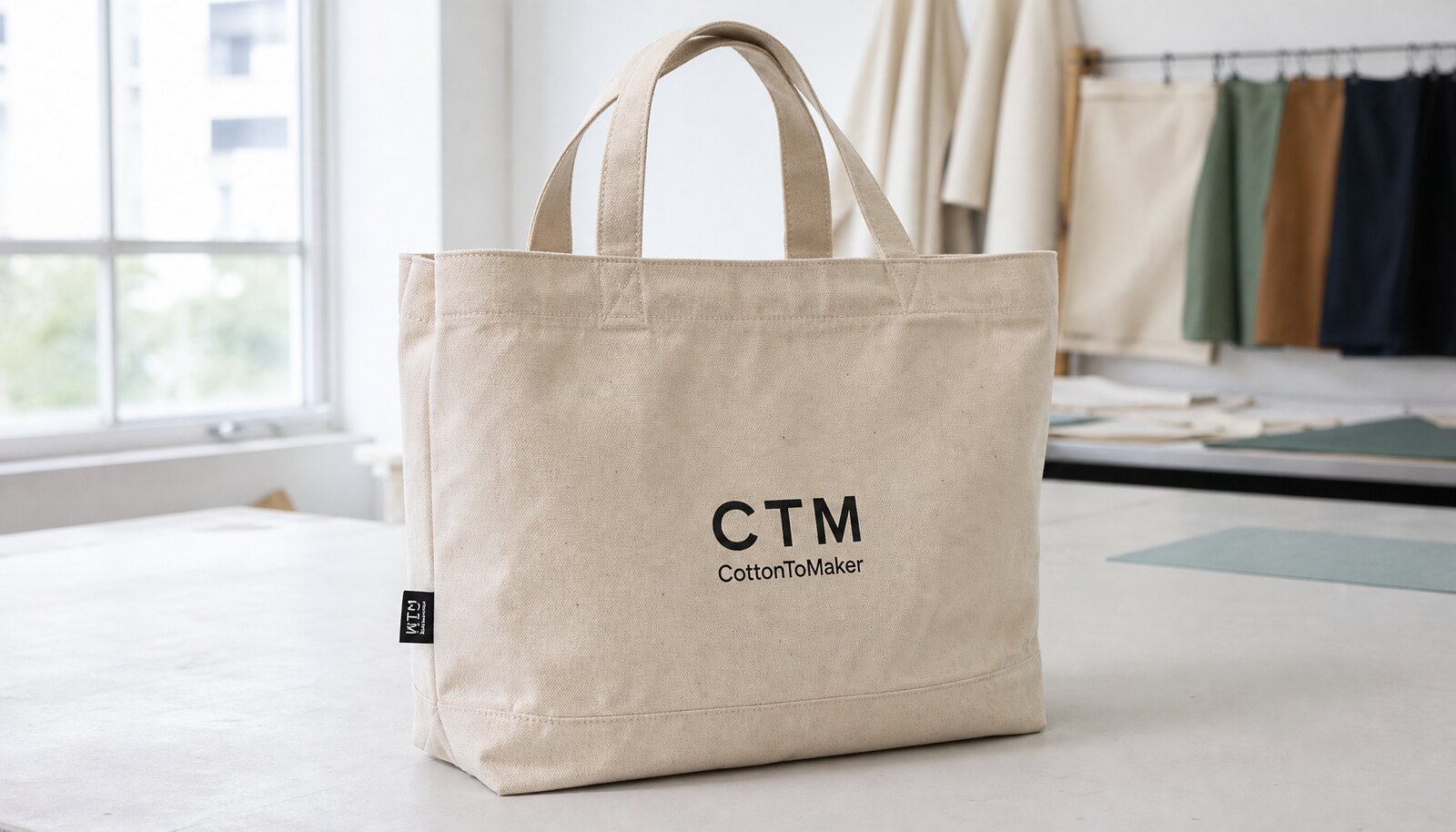
1. Start with the retail job the tote must do
Canvas library tote bags for gift shops are bought for shelf appeal first and utility second. The bag has to look right beside books, postcards, stationery, and souvenirs, then perform well enough that customers will carry it home and use it again. That is a different buying job from a trade-show tote or a school book bag. The spec should therefore start with the retail role, not with the fabric weight or the print method.
A good order brief answers three questions up front: what price point the tote must support, what the customer will carry inside it, and how the bag should look when it hangs or stacks in the shop. A premium museum store can justify heavier canvas, cleaner finishing, and a subtler logo. A tourist gift shop may need a simpler print, easier packing, and a lower landed cost because the bag is sold alongside many impulse items. If those retail expectations are unclear, the factory will fill in the gaps with assumptions, and those assumptions usually show up later as a quote mismatch or sample revision.
The biggest early mistake is over-specifying the bag before the product line is tested. Buyers often start by asking for the heaviest canvas available, but a thick bag can be expensive, bulky in carton, and unnecessary for light souvenir use. Others ask for the cheapest build and then discover the tote feels too thin next to books and hardcovers. The right spec is the one that matches the shop’s actual merchandising environment and can be reordered without redesigning the SKU.
- Define the retail role first: souvenir, bookstore utility, premium shop item, or promo gift.
- Match the bag’s structure to the merchandise it will carry.
- Keep the spec stable enough that future reorders do not require a redesign.
2. Canvas weight, weave, and construction choices that change the whole quote
For most gift shop tote programs, the workable canvas range is roughly 8 to 12 oz for mid-market retail, with 12 to 16 oz reserved for more premium presentation or heavier daily carry. In GSM terms, that often falls around 270 to 420 GSM, depending on the weave and finishing. Weight alone does not tell the whole story. A 10 oz fabric with a tight weave can feel more substantial than a loosely woven 12 oz cloth, so buyers should always approve a physical swatch rather than rely on the nominal number alone.
Construction is where many procurement issues start. Ask whether the bag is single-layer or lined, whether it has a bottom gusset, how the side seams are finished, and how the handles are attached to the body. A box-gusseted bottom improves shelf shape and carrying space, but it also increases sewing time and can reduce carton efficiency. A fully lined bag looks cleaner inside and can support premium pricing, but it adds material and labor. Handle length should match the real customer use case: short carry for a counter display item, or shoulder carry if the shop expects visitors to walk with the tote after purchase.
If the tote is intended for books or catalogs, ask the factory to show seam construction around the handle anchor and the top edge. That area fails first when stitching is weak. If the tote is mostly a souvenir bag, the finish can be simpler, but the bag still needs a neat seam line, consistent size, and a body that sits reasonably flat for display. Buyers should always tie the build spec to the shelf and carry requirements, not to a generic catalog description.
- 8 to 10 oz: simpler retail totes and lower-price gift shop programs.
- 10 to 12 oz: the most balanced choice for many bookshop and museum retail bags.
- 12 to 16 oz: premium hand feel, stronger structure, and better support for heavier items.
- Approve a physical swatch; do not rely on GSM alone.
3. Print method, artwork type, and logo placement deserve separate decisions
Print choice determines cost, visual quality, and long-term use. Screen printing is usually the best default for simple logos on canvas because it is economical on repeat orders, gives strong color coverage, and is easy for the factory to reproduce across lots. Heat transfer or digital decoration can handle detailed graphics, gradients, or small text, but the finish needs more scrutiny because edge lift, cracking, or fold marks can appear after handling. Embroidery and sewn patches create a more premium feel, yet they add needle risk, extra labor, and a different cost profile that may not suit a high-volume gift shop program.
The artwork itself also matters. One-color logos are easy to control and usually present cleanly on natural canvas. Multi-color logos can work, but each added color raises setup complexity and increases the chance of registration drift. Fine lines and small type should be avoided unless the supplier proves the print method can hold the detail on textured canvas. For a buyer ordering canvas library tote bags for gift shops custom logo order guide style programs, the safest move is often to simplify the art rather than force a print method to carry a design that was never built for canvas.
Placement should be approved on the finished bag, not on a flat drawing alone. A centered front print is the easiest to control, but a lower-centered or pocket-height print can feel more premium and leave room for retail hangtags. Side labels, woven tabs, and small rear marks are useful when the front panel should stay uncluttered. Ask the supplier for a decorated sample when the artwork is not a basic block logo. A flat digital proof does not reveal how the print behaves across the woven surface or how it looks once the tote is folded and stacked in a shop.
- Screen print: best for one to three colors and repeat orders.
- Heat transfer or digital: better for detail, but test fold and rub resistance.
- Embroidery or patches: premium look, but higher cost and more production risk.
- Lock logo placement against the finished tote and approved sample.
4. MOQ is a cost structure question, not just a factory minimum
MOQ changes because production has fixed steps. Cutting, print setup, thread changeover, fabric purchase, and packout all create a minimum efficient run. A simple natural canvas tote with one logo color can often be made at a lower MOQ than a lined bag with zipper closure, woven label, and multiple decoration points. If your order includes several artwork versions, MOQ usually rises because each version needs its own setup and quality check. That is why a supplier should quote MOQ by size, color, and decoration method rather than only by total unit count.
Buyers should also distinguish between trial quantity and repeatable quantity. A very small first order may be useful to check shelf response, but if the supplier cannot repeat the same spec later, the initial savings disappear. For long-running retail programs, the more useful question is whether the factory can keep the same canvas lot, same decoration method, same packing style, and same carton mark format on a reorder. If not, the bag may need to be requalified every season.
There is also a sourcing-route effect. Direct factories usually offer the best repeat economics once the spec is stable. Trading companies can help coordinate small batches or multiple factories, but the cost structure is less transparent. Small workshops are flexible on quantity but may struggle with carton discipline, color consistency, or repeatability. For gift shop buyers, the right MOQ is usually the smallest order that still proves the actual retail spec and leaves room for one reorder without redesigning the product.
- Ask for MOQ by style, artwork version, and decoration method.
- Treat first-order MOQ and reorder MOQ as different numbers if the factory works that way.
- Plan the initial buy around a test plus a realistic reorder path.
- A lower MOQ is not a good deal if the same tote cannot be repeated later.
5. Compare suppliers on measurable spec, not on a single headline price
A proper comparison for canvas library tote bags for gift shops has to include the bag build, decoration, packing, and freight assumptions. A factory that quotes a low unit price may be using lighter canvas, fewer stitches, smaller artwork, or a stripped-down packout. Another supplier may quote higher but include better fabric, cleaner sewing, barcode labels, and carton marks that save time at receiving. The buyer who only compares the factory gate price risks selecting the cheapest item that is actually more expensive once rework, inspection, and freight cube are added.
Use the quote to expose the supplier’s operating model. If the factory can list bag size, canvas weight, print method, handle construction, carton count, and packing format in one sheet, they likely understand repeat procurement. If those details are vague, the order will be harder to control in bulk. For chain gift shops and museum stores, consistency matters more than a small unit saving. A bag that arrives with the same dimensions, the same logo placement, and the same folding style is easier to receive, shelve, and reorder.
A useful comparison also asks whether the supplier can support reorders without changing core materials. Some vendors will use whatever canvas lot is available, which can cause shade drift from one shipment to the next. Others maintain better material discipline and can hold the same reference across seasons. That matters when the tote is a permanent retail item rather than a one-off promotion. Procurement buyers should favor the vendor that can prove repeatability, not the one that only looks cheap on the first quote.
- Compare blank bag, decoration, packing, and freight as separate lines.
- Ask each supplier to quote the same spec sheet.
- Prioritize repeatability for permanent retail SKUs.
- Inspect whether the quote hides lighter fabric, lower stitch count, or reduced packout.
6. What a procurement-ready quote should include—and what to ask if it does not
A quote is only useful if it is specific enough to let you approve samples and compare bids. At minimum, the supplier should state the finished size, gusset, handle length, fabric weight, weave or finish, decoration method, logo size, packing style, and carton count. The quote should also note what is excluded. Setup fees, screen charges, sample costs, barcode labels, hangtags, and freight terms can all change the real landed cost. If the supplier gives only a single total number, the comparison is incomplete.
Good buyers also ask for reorder pricing. That number often reveals whether the supplier understands the difference between a first production run and a stable replenishment order. If a vendor cannot quote reorder pricing or cannot explain what changes after the first run, they may not have a repeatable process. For procurement teams managing a store network, the reorder number is often more important than the introductory price because it determines whether the SKU can stay on shelf.
Be specific about what you need to know before approval. Ask which components are factory-made versus sourced out, what color tolerance the factory uses, and whether they can provide pre-shipment photos or inspection records. If the order is for a retail program that needs shelf-ready packing, ask the quote to include fold style, polybag requirement, barcode location, and master carton marks. Those details are not “extra”; they are part of the finished product for a gift shop buyer.
- Require separate lines for bag, decoration, packing, setup, and freight.
- Ask for reorder pricing, not just first-order pricing.
- Confirm what the quote excludes so there are no hidden add-ons.
- Use the quote to test whether the supplier can support repeat retail supply.
7. Sample validation should catch retail failures before bulk production starts
A pre-production sample should be treated as a short functional trial, not a formality. Measure the finished bag after sewing, check the print position on the actual body, and look at the way the bag sits on a counter or shelf. For gift shop programs, retail appearance matters as much as durability. If the bag slumps badly, bulges at the gusset, or looks crooked when hung, it may sell poorly even if the fabric itself is strong.
The sample should also be tested with real merchandise. Put books, notebooks, or the actual retail item into the tote and see whether the handles stay even and whether the body distorts. This is especially important for library-style tote bags because the shopper’s intended use is often carrying printed materials. If the sample is for a tourist shop, test it with souvenirs or boxed goods that match the likely purchase pattern. A tote that works when empty may fail once loaded.
Approval should include written acceptance criteria. Note the approved bag dimensions, handle length, seam appearance, print location, and pack style. If you accept a slight variation, write it down in the sample signoff so the bulk team knows the limit. If the sample has a problem, do not let the order proceed on a vague promise to fix it later. The best sample stage creates a standard the factory can actually reproduce.
- Measure the sewn sample, not only the flat cut panel.
- Test with real merchandise that matches the shop use case.
- Write down the approved tolerance, not just the approval itself.
- Do not move to bulk if the sample still has visible issues.
8. QC needs measurable checkpoints, not general “good quality” language
Quality control for canvas tote bags should be built around measurable checks. Fabric weight should be verified against the approved GSM or oz, and any obvious underweight fabric should be stopped before sewing. Finished dimensions should be checked on a representative sample, with a practical tolerance often around plus or minus 1 cm on body measurements and handle length for standard retail totes. If the order is cube-sensitive or the tote must fit a specific display fixture, the tolerance may need to be tighter.
Stitch inspection matters more than many first-time buyers realize. Check stitch density, skipped stitches, loose thread ends, seam starts, and handle reinforcement. A handle anchor with weak bartacks or uneven reinforcement is a real defect because it fails under normal customer use. For buyers specifying stronger bookseller use, load testing should be part of the quality plan. Put a sample under the intended load and watch for seam opening, handle distortion, or body tearing. The bag should survive the normal carrying scenario without visible failure.
Decoration quality should be checked separately from sewing quality. Print adhesion can be tested with tape pull, rub, and fold checks. The logo should remain clean after the tote is folded and handled. Color should stay within the approved visual range, and there should be no obvious bleed, strike-through, or misregistration. Finally, inspect cosmetic issues such as oil marks, lint, crushed corners, or needle holes. For a gift shop shelf, these minor-looking issues can still be retail rejects.
A simple AQL-style plan helps the buyer decide what to accept, hold, or reject. Define critical defects, major defects, and minor defects before inspection. Critical defects include seam failure, missing handles, or unsafe construction. Major defects include wrong size, broken print registration, or failed adhesion. Minor defects can include slight thread tails or small cosmetic marks if they are within the agreed limit. The value of this approach is not the math itself; it is that everyone knows the rejection triggers before the goods arrive.
- Verify fabric weight against the approved spec before sewing continues.
- Check stitch density, bartacks, and seam integrity at the handle anchors.
- Test print adhesion with tape pull, rub, and fold handling.
- Use an AQL-style plan with clear critical, major, and minor defect definitions.
- Reject obvious underweight fabric, open seams, weak handle reinforcement, or bad print registration.
9. Packing, carton data, and warehouse handling can make or break the shipment
Packing is part of the product when the tote is sold through a gift shop or retail distribution center. Decide early whether the bag ships folded flat, folded with tissue, polybagged, barcode labelled, or packed with a hangtag. If the shop wants shelf-ready presentation, the fold must be consistent and the polybag should not wrinkle the print. If the order goes to a DC, the barcode and carton marks must match the receiving system exactly. A tote that arrives in the wrong pack format creates labor cost and delays even if the bag itself is perfect.
Carton data should be treated as procurement data, not as a shipping afterthought. Ask the supplier for carton dimensions, gross weight, units per carton, and stacking guidance before you approve bulk. A heavier canvas or larger gusset changes carton cube fast, and that affects freight cost. For air shipments, carton size can be the hidden cost driver. For ocean shipments, dense cartons can create handling issues if the pallet pattern is not planned. The factory should know whether the order is going to retail shelving, warehouse intake, or direct-to-store distribution.
Packaging mistakes are expensive because they are hard to fix after export. If the barcode is wrong, the carton count is off, or the fold is inconsistent, the buyer may need to rework the goods after arrival. That cost can erase any savings from a cheaper factory quote. For that reason, packing spec should be approved alongside the sample, not after production is already underway.
- Choose the fold and pack style based on how the goods will be received.
- Approve carton dimensions and gross weight before mass production.
- Confirm barcode location, outer carton marks, and units per carton.
- Do not treat packing as optional; it is part of the retail spec.
10. Lead time, reorder planning, and final buying decision
Lead time risk is usually driven by approvals and scheduling, not by mystery failures. Delays often happen when artwork is not print-ready, when the buyer changes the logo after sample submission, or when the folding and pack spec is still being debated during production. The easiest way to protect the calendar is to freeze the artwork before sampling begins and to route sample approval through one internal owner. Every extra round of comments adds time and increases the chance of a rushed bulk order.
The factory schedule matters too. Ask whether fabric is already in stock, whether printing and sewing happen in the same facility, and whether the production window overlaps with peak season. A plant that cuts, prints, sews, and packs under one roof is usually easier to manage than a split process with outside decoration. If the order must hit a gift shop launch date, measure lead time from artwork lock and sample signoff, not from the purchase order date. That is the only timeline that helps a buyer coordinate marketing, shelf setup, and replenishment.
For the final order decision, the strongest bid is usually the one that balances spec control, repeatability, and landed cost. A slightly higher quote can still be the better procurement choice if it gives you the same canvas lot, the same print finish, clearer carton data, and a lower risk of rework. For canvas library tote bags for gift shops custom logo order guide programs, the best supplier is the one that can repeat the tote without renegotiating the spec every season. That is what makes the SKU commercially useful rather than just cheap on paper.
- Freeze artwork before sample approval begins.
- Measure lead time from sample signoff, not from PO date.
- Prefer suppliers that can keep printing, sewing, and packing under one production plan.
- Choose the quote that best protects repeatability and retail launch timing.
Specification comparison for buyers
| Procurement route | Best-fit use case | Typical spec/price drivers | Tradeoffs and buyer risks |
|---|---|---|---|
| Direct factory, in-house print and sewing | Repeat gift shop orders with one or two logo colors | Lower setup risk, tighter control of canvas GSM, stitch pattern, and print registration; usually better on reorder pricing | Best when the factory can show sample-to-bulk consistency. Risk rises if artwork, printing, and sewing are split between sites. |
| Low-MOQ factory program | Seasonal launch, museum opening, or demand test | Flexible minimums, but higher per-unit pricing, more variation in canvas shade, and less efficient carton packing | Good for testing the shelf appeal of canvas library tote bags for gift shops custom logo order guide programs, but not ideal if you need long-term SKU continuity. |
| Trading company / sourcing agent | Buyers who need consolidated communication or multiple factory options | Service fee, added margin, and sometimes better coordination across sample, packing, and freight | Useful for managing complexity, but the quote can hide the real factory price. Demand a factory-backed spec sheet and sample trail. |
| Integrated tote factory with dedicated QC | Multi-store private label or chain gift shop rollout | Better control of sewing standards, packing counts, and carton marks; may require higher first-order volume | Strong choice when you need stable reorders. Confirm they actually run final QC in-house, not only inspection on a finished pallet. |
| Stock canvas base with custom decoration | Fast-turn promotions or gift-with-purchase programs | Lower mold/tooling burden, faster start, narrower color options, and simpler decoration setup | Works when the tote shape is standard. Risk is limited differentiation and more dependence on available stock colors. |
| Heavier premium build, lined or reinforced | Museum shop, bookstore, or premium souvenir shelf | Higher fabric cost, more sewing minutes, stronger handles, and higher carton weight | Better perceived value, but watch freight cube, hand feel, and whether the finished bag still suits your target retail price. |
| Digital or heat-applied decoration | Artwork with gradients, fine details, or multi-color logos | Decoration cost rises with artwork complexity, and durability depends on adhesion and flex resistance | Sharpened visuals can sell well, but you need test data for rub, fold, and wash behavior before bulk approval. |
| Screen print with limited colors | Most standard gift shop custom logo orders | Lowest setup complexity, strongest repeatability, and easy reorder matching | Usually the best value route, but it is less suitable for gradients or very fine type unless the factory has strong mesh and registration control. |
Buyer checklist before sampling
- Write one spec sheet before you invite quotes: finished size, gusset, handle length, canvas weight, decoration method, and packout.
- Confirm whether the bag is intended for souvenir carry, bookstore utility, premium gift retail, or promotional handout, because the target use changes the spec.
- Ask for fabric in GSM or oz and require the supplier to state weave, finish, and shrinkage allowance.
- Lock the logo method, ink color count, print size, and print placement against the finished bag, not the flat cut panel.
- Request a pre-production sample, then sign off the approved sample with a dated note of what is acceptable and what is not.
- Ask for carton dimensions, carton count, fold method, polybag requirement, barcode placement, and master carton marks before final approval.
- Require sample validation on real merchandise, not only on an empty tote.
- Separate blank bag cost, decoration cost, packing cost, setup charges, and freight term so quotes can be compared line by line.
- Verify lead time from artwork lock and sample approval, not from PO issue date alone.
- Confirm the supplier’s rejection replacement policy for defects, shortages, and carton damage before you place the order.
Factory quote questions to send
- What exact canvas weight, weave, and shrinkage allowance are you quoting for the bag body?
- Is the price based on a blank tote, or does it include logo application, setup, and packing materials?
- What is the MOQ per size, per artwork, and per print color if we split the order across versions?
- What sample charges apply, and can any of them be credited back after bulk confirmation?
- What is the lead time for a pre-production sample and the lead time for bulk after sample approval?
- Which print method do you recommend for this artwork, and what durability limits should we expect?
- What are the standard tolerances for body size, handle length, seam placement, and logo placement?
- Can you quote the retail pack spec, including fold style, polybag, barcode, and carton marks?
- What is the target carton count, gross weight, and carton size for this order?
- Do you run in-house final inspection, and can you share photos or records before shipment?
Quality-control points to confirm
- Fabric weight should match the approved GSM or oz within the agreed production tolerance; if the delivered fabric feels noticeably lighter than the approved swatch, reject or rework it before sewing continues.
- Finished body dimensions should be checked after sewing and after packing. A practical tolerance is typically about +/- 1 cm on body dimensions and handle length for standard retail totes; tighter control is needed if cartons are cube-sensitive.
- Stitch quality should be inspected with a clear minimum standard: even stitch density, no skipped stitches, no open seam starts, no broken thread tails, and clean bartacks at the handle anchors.
- For woven or sewn handle reinforcement, check that the bar tack or reinforcement box is symmetrical and fully catches all load-bearing layers. Any loose or incomplete reinforcement at the handle base is a rejectable defect.
- Print adhesion should be tested with tape pull, rub, and fold checks. The print should not crack, flake, or transfer excessively when the bag is folded, rubbed against itself, or handled repeatedly.
- Color match should be checked against the approved sample under daylight-equivalent lighting. Set a simple acceptance rule: no obvious shade shift, no muddy blacks, and no visible ink strike-through on light canvas unless approved.
- Logo placement should stay within the approved location window. Reject bags with visible skew, off-center placement, oversized artwork, or print bleed that reduces shelf presentation.
- Load testing should be done on a sample basis using the intended retail use case. For bookstore or library-style totes, test with books or equivalent weight; reject if handles distort, seam starts open, or the body tears under normal carry.
- Inspect for foreign matter, oil marks, loose lint, needle holes, and crushed corners. If the bag is sold in a gift shop environment, cosmetic defects matter as much as functional failures.
- Use an AQL-style acceptance plan for bulk inspection. Typical buyer practice is to define critical defects, major defects, and minor defects before inspection, then reject shipments that exceed the agreed limit for critical or major issues.