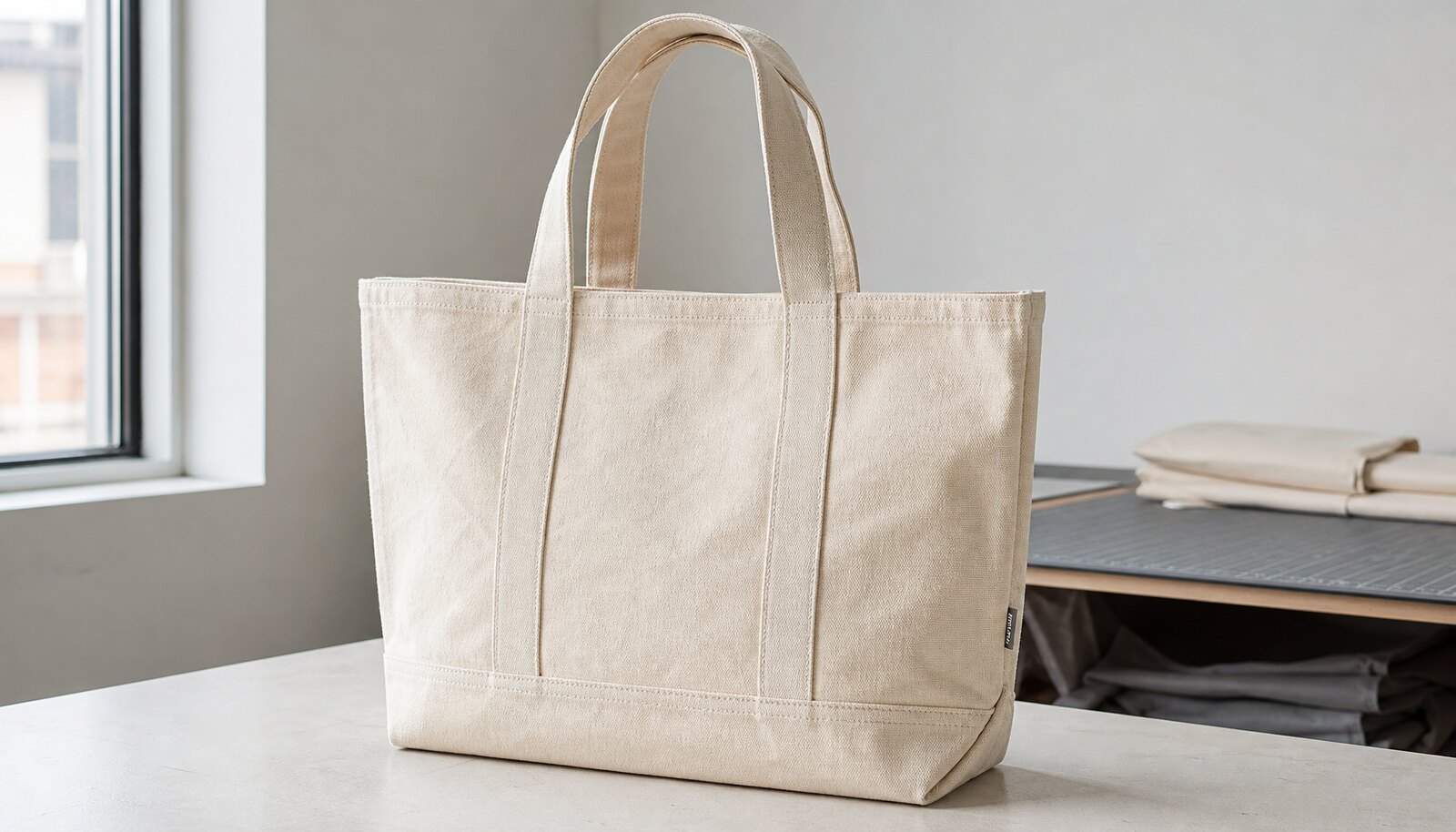
Why This Reorder Needs Tight Control
A farmers market tote is not a throwaway promo item. It gets loaded with produce, bottles, folded flyers, and whatever the shopper buys after the first impulse. If the first order sold through, the reorder has to preserve the approved carrying behavior, the print presentation, and the retail footprint. That is especially true for canvas library tote bags for farmers markets, where the bag shape has to look clean on a table but still function when stuffed and carried home.
The risk on a repeat order is not usually a dramatic failure. It is spec drift. A slightly lighter canvas, a shorter handle drop, a looser hem, or a different folding method can make the bag feel different enough that buyers notice, even if the supplier technically fulfilled the PO. The memo should therefore start by fixing the working spec, then using that spec to compare suppliers and price.
The fastest way to protect the program is to treat the tote as working inventory, not artwork with a handle. The buyer needs a repeatable bag, a repeatable print, and a repeatable pack-out. Once those three pieces are locked, the reorder becomes a controlled procurement task rather than a fresh design exercise.
- Protect the approved silhouette, not just the logo.
- Treat carry strength and pack-out as part of the commercial spec.
- Use the memo to stop spec drift between the first run and the reorder.
Spec The Tote, Not The Mood Board
If the RFQ only includes a reference photo, every supplier will fill in the blanks differently. One will quote lighter cloth, another will use more seam allowance, and a third will quietly simplify the pack format. A usable spec sheet should name the finished size, gusset depth, handle drop, fabric weight, color, print placement, and any reinforcement at the top hem or handle anchors. If the tote needs to stand upright on a market table, say so directly.
For this type of tote, finished canvas weight usually matters more than a vague label like heavy duty or premium. The practical range is often 12 oz to 16 oz, with 12 oz working for lighter brochure loads, 14 oz as a balanced market option, and 16 oz when the bag needs more body for produce or bottles. The right answer depends on what the bag must carry and how often shoppers will reuse it.
Library-style totes are also sensitive to proportions. A slightly different gusset or handle drop can change the way the bag sits on a shelf and how it feels in the hand. If the buyer wants a flat-bottom shape, a specific top finish, or a cleaner retail fold, those details should be written into the spec. The point is to remove interpretation before the quote arrives.
- Write size, gusset, handle drop, fabric weight, and print count into the RFQ.
- Add tolerances for width, height, and print placement so sample review is objective.
- State the use case, because the right build for brochures is not the right build for produce.
Choose The Right Supplier Route
Price is only useful if the supplier route is clear. A direct factory usually gives the cleanest answer on who cuts, sews, prints, and packs the bag. That is valuable for a reorder because the buyer wants the same build to repeat with fewer handoffs. If the factory owns the line and keeps the golden sample on file, the next PO is easier to control.
A trading company or sourcing agent can still be the right answer when the order needs mixed SKUs, consolidated cartons, or help coordinating several tote programs at once. The tradeoff is transparency. The buyer should ask whether the quote separates factory cost from service margin and whether the named factory is actually the one doing the work. If the answer is vague, the quote comparison is weak even if the unit price looks attractive.
Domestic decorators and finisher shops can make sense when the buyer needs a short replenishment run, local packing, or final branding support. They are not usually the best source for the lowest fabric cost, and they may not be the strongest option for custom cloth construction. For canvas library tote bags for farmers markets, the route that reduces handoffs and repeats the approved sample most reliably is usually the safest procurement choice.
- Prefer direct factory sourcing when the spec is stable and the reorder must be repeatable.
- Use an agent only if the quote is itemized and the factory partner is named.
- Ask for line photos, recent production records, and subcontracting disclosure before you compare price.
Compare Quotes On The Same Basis
A low unit price often hides a higher landed cost. The buyer needs to compare sample charges, screen setup, freight basis, customs assumptions, carton packing, and payment terms before making a decision. If one supplier quotes FOB and another quotes DDP, the numbers cannot be compared until duty, brokerage, and delivery are normalized. Otherwise the cheaper quote may become the more expensive invoice after the shipment lands.
Setup is a common cost trap on repeat tote orders. If the artwork has not changed, the supplier should explain whether screens or separations can be reused. If they charge again for every revision, even a small art adjustment can erase the savings from a lower base price. Buyers should also ask whether the approved sample credit applies to the first PO and whether color matching or reproofing is billed separately.
The print method matters too. A one-color screen print on natural canvas is usually the simplest and most repeatable option. Two-color work can still be efficient, but the buyer should ask for clear registration tolerance and a signed strike-off before bulk starts. If the design uses large solid areas or fine line text, ask how the ink coverage will hold on woven canvas rather than assuming the artwork will transfer cleanly.
- Normalize every quote to the same freight and customs basis before comparing price.
- Ask whether screen setup, sample fees, and repeat setup are one-time or recurring charges.
- Require an approved strike-off if the artwork depends on precise color or registration.
Plan MOQ And Reorders Around Market Season
MOQ should follow production efficiency and real demand, not guesswork. A supplier may accept a lower minimum by simplifying the build or reducing options, but the unit price will usually move up. That is acceptable if demand is uncertain. It is less acceptable if the buyer already knows the bag will be needed again for the next market cycle or seasonal event calendar.
Farmers market demand is not smooth. It is weekend-shaped, weather-sensitive, and often tied to event spikes, tourism, and local community calendars. That means reorder timing should be based on sell-through and lead time, not on the date the last carton arrived. A practical trigger is often around 60 percent to 70 percent sell-through if the next PO still has sampling, approval, and transit time ahead of production.
The safer planning model is simple: forecast remaining demand for the next lead-time window, add a buffer for artwork or pack changes, and place the order before inventory drops below that level. If the tote is tied to a seasonal promotion, the real deadline is the last date that still allows the goods to land before the selling window closes. For this niche, that date matters more than the factory's earliest possible ship week.
- Let fabric efficiency, print count, and size drive MOQ discussions.
- Reorder from sell-through rather than from a late inventory panic.
- Keep one buffer for production slippage and another for transit delay.
Sample Review And Golden Sample Rules
A sample only helps if it becomes the production reference. The buyer should review the pre-production sample on the same cloth, print method, thread color, and pack format intended for bulk. A photo is not enough. If the sample was made on a different fabric weight or with a different fold, it does not prove the factory can repeat the approved build.
Once approved, the sample should become a signed golden sample with the measurement sheet, artwork version, color reference, and carton format attached. That packet should also note the allowed tolerance, the label position, and any special handling instructions. If a future team member has to reconstruct the standard from memory, the program is already drifting.
The review should focus on things buyers actually notice and return. Does the bag stand properly? Does the handle drop feel right when loaded? Is the print centered on the panel, and does it stay clean when the tote is folded and reopened? If the sample fails on any of those points, the fix should happen before bulk approval. Reorder discipline is mostly about refusing to let a nearly right sample become the standard.
- Keep one signed golden sample with date, measurements, and artwork version.
- Record any allowed deviation so the factory knows exactly what is approved.
- Review the sample under normal light and strong light, not only in a product photo.
QC Checks That Catch Returns Early
Quality control should be tied to the failure modes that matter for a reusable market tote. The first checks are dimensions, stitching, print position, and handle attachment. A clean-looking bag can still fail if the seam tension is loose, the bar tacks are inconsistent, or the handles distort under load. Buyers should use a named sampling method such as ANSI/ASQ Z1.4 or ISO 2859-1 and agree on the AQL before production starts.
For a tote that will carry produce or mixed retail goods, a static load test is worth defining in advance. Many buyers start around 20 lb to 25 lb for 60 seconds for handle anchors, then adjust the standard to match the actual use case. The purpose is not to create a lab exercise. It is to catch weak stitching before the bag is boxed and shipped into a season where returns are expensive.
Print and pack defects deserve the same attention. Inspect for smearing, pinholes, strike-through, stains, thread ends, odor, and mixed lots. The bulk shipment should match the golden sample on thread color, label placement, handle length, and fold direction. If the receiving team has to sort mixed cartons or relabel packages on arrival, the supplier has already shifted labor downstream.
- Use a named inspection standard and set AQL thresholds before production starts.
- Test handle anchors with an agreed static load instead of relying on visual review.
- Reject mixed lots unless the PO explicitly allows them and the cartons are marked accordingly.
Packing, Cartons, And Warehouse Fit
Packing decisions change freight cost and receiving labor, so they are part of the spec, not an afterthought. A bulk-packed tote usually ships more efficiently, but the fold has to protect the print face and avoid hard creases that change the bag shape. If the tote will go through a warehouse or market distribution point, the carton should also be easy to count, easy to scan, and easy to reopen without damaging the contents.
The buyer should decide whether the order ships loose in cartons, in bundle packs, or on pallets. The right answer depends on how the goods are received, not just on what is cheapest to pack at the factory. If the warehouse needs barcode labels and the factory only provides handwritten carton marks, the order creates extra handling cost before it ever reaches the shelf.
Carton dimensions and gross weight should be confirmed before sewing starts. If the supplier changes pack count after production begins, freight estimates and shelf planning become unreliable. For reorder programs, the safest path is usually to reuse the same pack method that worked on the last run, then change it only if the receiving team asked for a specific improvement.
- Match packing format to the receiving process, not just to shipping cost.
- Protect the print face during folding and bundle handling.
- Confirm carton count, barcode format, gross weight, and pallet pattern before the line starts.
Vendor Qualification Questions That Matter
A supplier should be able to explain the full production path without hesitation. Who buys the cloth, who cuts it, who prints it, who sews it, and who packs it are not side questions. If the answer is vague, the buyer cannot tell where the quality risk sits. That matters more on a reorder than on a first sample because the program depends on repeatability, not just novelty.
The buyer should also ask for recent production capacity, the normal lead time after sample approval, and the supplier's top defect causes on similar tote orders. That gives a more honest picture than a general promise to deliver on time. For canvas tote programs, a supplier that already handles reusable shopping bags or heavier canvas goods is often easier to manage than one that mostly prints lightweight promo bags and hopes the order behaves the same way.
Commercial terms need the same scrutiny. Ask when the deposit is due, whether sample charges are credited, what documents release the balance payment, and how defects are handled after inspection. If the supplier wants full prepayment, the buyer should ask what offset is being offered in price, schedule, or stock commitment. The aim is not to force one payment template. The aim is to make the risk and the leverage visible before the PO is signed.
- Ask who owns each step of production and whether any step is subcontracted.
- Use suppliers with similar canvas or reusable tote experience when the spec is not trivial.
- Document deposit timing, balance timing, sample credit, and defect remedy in the PO.
Approve, Hold, Or Requote
A proper reorder memo ends with a decision. Approve the order when the sample matches the intended bulk build, the quote basis has been normalized, the supplier route is clear, and the lead time fits the season. That is the point where the buyer has enough control to move the order forward without adding avoidable risk.
Hold the order when the sample is close but not signed, when freight or duty assumptions are still open, or when packing needs warehouse approval. Hold is not a delay for its own sake. It is a signal that one commercial or technical assumption still needs to be fixed before the PO can be trusted.
Requote when the supplier changes fabric weight, cannot guarantee screen reuse, hides setup charges, or pushes the MOQ beyond realistic demand. If the build changed, the quote changed. That is normal. The buyer just needs to force the change into the open instead of letting it show up later as a surprise on the receiving dock.
- Approve if the sample is signed, the quote basis is clear, and the timeline fits the season.
- Hold if freight, packing, or sample details are unresolved.
- Requote if the supplier changes the build, MOQ, or commercial terms in a way that breaks the forecast.
Specification comparison for buyers
| Comparison point | Direct factory | Trading company / sourcing agent | Domestic decorator / finisher |
|---|---|---|---|
| Price transparency | Best when the factory separates fabric, sewing, print, and packing line by line | Often blended unless the agent itemizes service margin and factory cost | Can be clear on print and pack, but fabric cost is usually less competitive |
| Spec control | Strongest when the same team handles cutting, sewing, and final packing | Useful if the agent manages multiple vendors, but control depends on disclosure | Good for final branding work, less ideal for custom fabric or construction changes |
| MOQ flexibility | Usually best for stable repeat orders and larger runs | May help combine variants across SKUs or colors | Can sometimes support smaller replenishment orders |
| Setup reuse | Best chance to reuse screens, art files, and golden sample references | Depends on whether the named factory keeps the tooling and records | May redo setup more often if work is split across locations |
| Lead-time visibility | Best when capacity is in-house and scheduling is clear | Can be good if the agent actively manages the production calendar | Can shorten local finishing, but raw-material lead time may still dominate |
| QC traceability | Usually strongest if the line and inspection team are the same site | Varies by factory partner and oversight discipline | Strong on final inspection, weaker if sourcing is fragmented |
| Best buyer fit | Stable reorder, fixed spec, and a need for repeatability | Multi-SKU programs or buyers who need coordination support | Small replenishment runs or domestic finishing requirements |
Buyer checklist before sampling
- Lock finished size, gusset depth, handle drop, fabric weight, and seam allowance before requesting pricing.
- State the use case clearly: produce, bottles, brochures, market sampling, or mixed retail carry.
- Send vector artwork and define print placement, ink colors, and acceptable registration tolerance.
- Ask for one pre-production sample and one signed golden sample reference before bulk approval.
- Compare every quote on the same basis: fabric, setup, sample charge, packing, freight basis, duty assumption, and payment terms.
- Confirm whether the quote is EXW, FCA, FOB, or DDP, and who owns customs cost at destination.
- Set the reorder trigger from sell-through and lead time, not from the last inbound shipment date.
- Require the supplier to say whether screens, plates, and cutting templates can be reused on the next PO.
- Review carton count, carton dimensions, gross weight, and carton label format before production starts.
- Agree the inspection standard, AQL level, and static load test method before the first bulk run is cut.
Factory quote questions to send
- What is the finished fabric weight in GSM or ounces, and is that based on raw cloth or sewn bag weight?
- What is the exact quotation basis: EXW, FCA, FOB, or DDP, and what charges are included in that basis?
- Are screen setup, color matching, artwork separations, and repeat setup on later reorders included or billed separately?
- What is your MOQ by size, by color, and by print design, and can you combine variations in one run?
- What is the sample charge, who pays courier cost, and is any of that credited back on the first PO?
- Will you produce from an approved golden sample and keep that reference on file for future reorders?
- What seam construction do you use on the handles and top hem, and what stitch density do you standardize on load-bearing seams?
- What is your normal production lead time after sample approval, excluding transit, and what typically causes delays?
- What inspection standard do you use before shipment, and at what AQL level do you inspect tote orders?
- Do you subcontract any cutting, sewing, printing, or packing, and if so, which steps stay in-house?
Quality-control points to confirm
- Use a defined inspection method such as ANSI/ASQ Z1.4 or ISO 2859-1, then set AQL thresholds before production starts; many buyers begin at AQL 2.5 for major defects and 4.0 for minor defects.
- Finished width, height, and gusset depth should stay within the approved tolerance so the tote keeps the intended look and carton count stays accurate.
- Handle anchors should pass an agreed static pull test for the intended use case; for many market totes, buyers start around 20 lb to 25 lb for 60 seconds without seam opening or visible distortion.
- Main seams should be consistent in stitch density and tension, with no skipped stitches, broken thread, loose bar tacks, or puckering at the stress points.
- Print placement should match the approved artwork file, with no major color shift, smearing, pinholes, strike-through, or contamination on the print face.
- The bulk run should match the golden sample on fabric hand, thread color, label position, handle length, fold direction, and pack method.
- Cartons should match the declared pack count, gross weight, and carton labeling, and the receiving team should be able to verify quantity without opening every carton.
- Packed cartons should survive a simple drop test after final packing, such as a 24 in or 60 cm corner and flat drop, with no open seams, broken handles, or major scuffing.
- Reject mixed lots that combine different bag sizes, fabric weights, or print placements unless the PO explicitly allows a mix and the cartons are marked accordingly.
- If the tote will be sold through a store or market program, inspect for odor, stains, loose fibers, and any label or hangtag placement errors before shipment release.