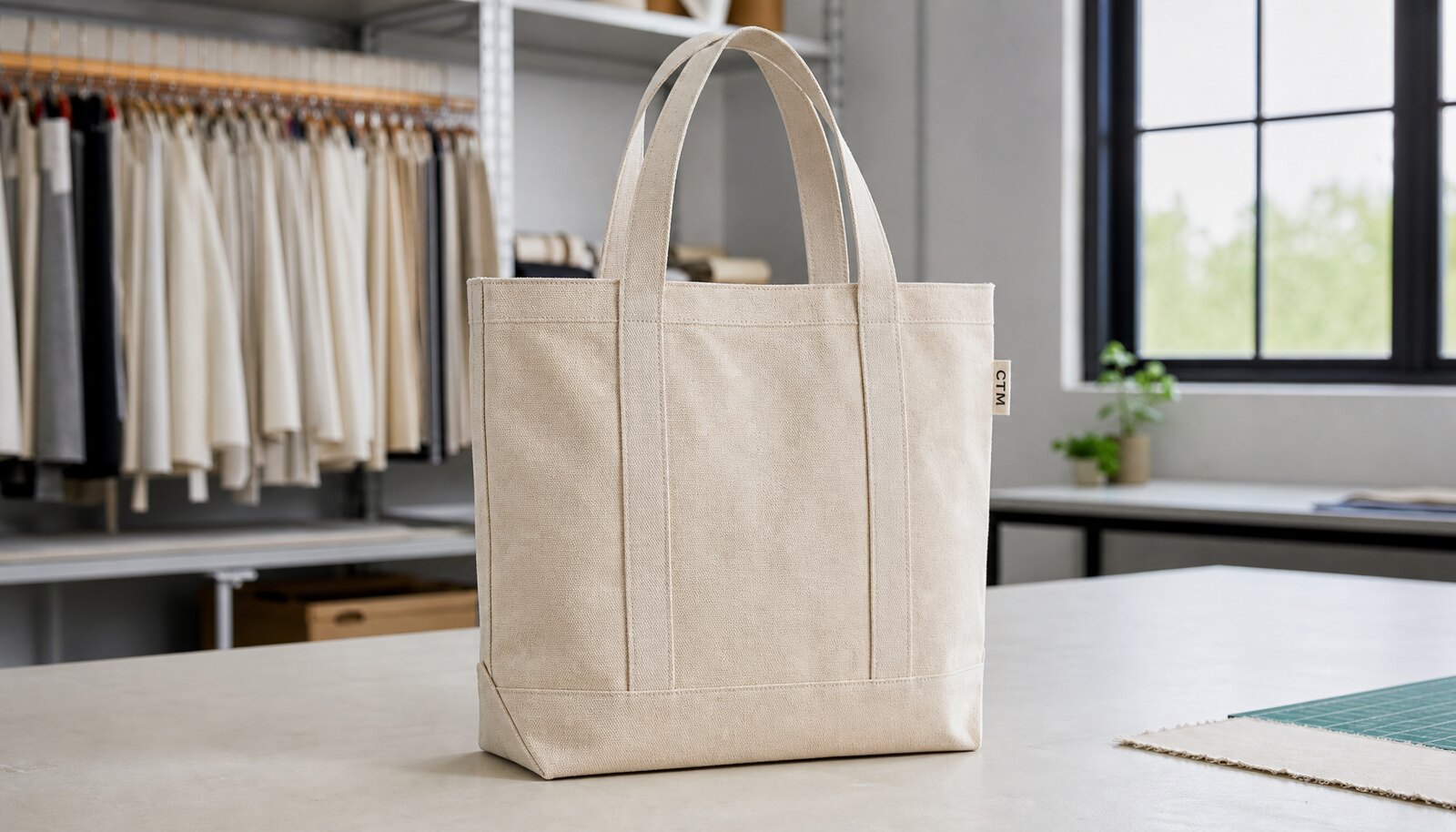
1. Start with the use case, not the tote spec
For ecommerce brands, canvas library tote bags are rarely just simple carry bags. They may be sold as merch, shipped with books or media kits, used as a retail gift-with-purchase, or packed as part of a subscription drop. Each of those jobs changes the construction decision. A tote that only needs to hold a light insert can use a lighter canvas and simpler seam build, while a tote that must carry hard-spined books needs stronger bottom support, firmer handles, and a more controlled packing format.
The most useful RFQ begins with the tote’s actual job. Tell the factory what the bag will carry, how the customer receives it, whether it is a selling SKU or an order insert, and what kind of warehouse handling it will experience. If you skip that context, the supplier will usually quote a generic “canvas tote” instead of a structure matched to the load. That leads to bad comparisons later because the cheapest quote may simply be quoting a lighter bag.
- State the intended load in kilograms or pounds, not only the product type.
- Describe whether the tote ships flat, nested, pre-filled, or with folded insert cards.
- Specify whether it must fit a mailer, shipper box, retail shelf, or fulfillment bin.
- Tell the supplier whether the tote is a revenue SKU, a promo insert, or a merchandising accessory.
2. Choose the right canvas weight, weave, and finish
Canvas weight is important, but it is not the whole story. A strong RFQ should define the canvas in at least three ways: weight, weave, and finish. Weight is commonly quoted in ounces or GSM. Weave affects hand feel, drape, and print clarity. Finish determines shrinkage, surface softness, fiber shedding, and how the bag behaves when it is folded or washed. If the quote only says “canvas,” the supplier has too much room to substitute a lighter or looser fabric.
For ecommerce library tote bags, 10 oz canvas is usually the light promo end of the spectrum, 12 oz is the practical middle ground, and 16 oz is a heavier retail feel. That said, two 12 oz fabrics can behave differently if one is tightly woven and lightly finished while the other is open-weave and heavily washed. Buyers should ask the supplier to name the mill standard or equivalent fabric reference, not just the weight. A named reference reduces the chance of a hidden substitution during bulk production.
- Use 12 oz canvas, roughly 340 gsm depending on construction, as the default starting point for most ecommerce tote programs.
- Move to 16 oz only when the tote must feel substantial, stand upright better, or carry heavier contents repeatedly.
- Ask whether the canvas is greige, bleached, dyed, washed, or coated, because each finish changes cost and behavior.
- Require the supplier to state the expected shrinkage or dimensional change if the tote is washed, steam-pressed, or soft-finished.
3. Build details that matter: seams, handles, gusset, and reinforcement
For a library tote, the bag construction often matters more than the logo. A simple body with poor reinforcement can fail under the weight of books even if the print is perfect. The RFQ should spell out the handle construction, seam allowances, gusset depth, top hem, and any reinforcement at the stress points. Those details are where the bag either survives repeated use or starts opening at the wrong places.
Handle design is especially important. Buyers should specify handle width, handle material if it is not self-fabric, handle drop, and attachment method. A webbing handle behaves differently from a self-fabric handle. A longer drop improves shoulder carry but can weaken the carrying geometry if the handle base is not reinforced. On the body, a bottom gusset gives the tote more volume and better load stability, but it also changes cutting efficiency and sewing time. If the quote does not mention these build elements, the price is not truly comparable.
- Ask for seam allowance by location, not only a general sewing note.
- Specify whether the handle is self-fabric, webbing, cotton tape, or another material.
- Require reinforcement details such as box-X, bar-tack, or double-stitching at the handle base.
- Set a minimum handle width if the tote is expected to carry books or other dense contents.
4. Printing and branding: what changes cost, lead time, and failure risk
Decoration is where canvas tote quotes often diverge. A clean one-color screen print on natural canvas is usually the most economical setup for repeated ecommerce runs. Add a second color, a larger print area, embroidery, patchwork, or a specialty finish, and the quote can change materially because each option affects setup, labor, and yield. Buyers should lock the decoration method before they start supplier comparison, otherwise one factory will quote a simple print and another will assume a premium process.
Canvas texture also affects how artwork reproduces. Fine lines, small text, and tight registration are more fragile on woven fabric than on a smooth coated bag. A buyer should decide the minimum acceptable logo size, the print placement window, and the color tolerance before sending the RFQ. If the logo cannot move a few millimeters or lose minor detail, the factory needs to know that early so it can advise whether the artwork is manufacturable. Otherwise, the buyer gets a quote for a design that may not pass bulk production.
- Use screen print for simple logos and stable repeat runs when unit cost matters.
- Use woven labels, side labels, or sewn patches when the brand mark needs durability or a more premium look.
- Use embroidery only if the artwork can tolerate texture, thicker hand feel, and longer lead time.
- State the print size, position, ink type if known, and acceptable placement tolerance in the RFQ.
- Ask the factory whether print curing, washing, or rubbing will be tested before bulk release.
5. Fabric mill standards and material traceability to ask for
Procurement buyers should not stop at the sewing factory description. For better control, ask where the canvas comes from, which mill standard it follows, and how the lot is identified from receipt to finished bag. A sewing factory that cannot explain fabric origin, incoming inspection, or shade control is a risk when repeat orders matter. This is especially important for natural or lightly dyed canvas, where lot variation is more visible than on printed synthetics.
A useful RFQ asks for the fabric mill reference or equivalent specification, the fabric width, the lot numbering system, and whether the factory can keep one dye lot together for the same PO. If the tote uses a washed or dyed finish, ask how the supplier controls shade banding and pre-shrink. If the factory sources the fabric from multiple mills, request that they disclose whether all mills meet the same weight and finish standard. Traceability is not only a compliance issue; it is a repeatability issue that affects future reorders and color matching.
- Ask for the fabric source, mill standard, or equivalent reference whenever possible.
- Request lot tracking from fabric receipt through sewing and packing.
- Confirm whether the supplier can keep one purchase order within one shade lot when reordering.
- Ask for incoming fabric inspection criteria, including weight check and visible flaw review.
6. Compare supplier routes on commercial terms, not just price
A direct factory, a trading company, a stock-program seller, and a nearby regional workshop can all offer a canvas tote quote, but they do not give you the same commercial outcome. The direct factory usually offers the cleanest cost stack when the tote is simple, repeatable, and built in volume. A trading company can simplify coordination across labels, cartons, and multiple bag types, but it often adds another margin layer and can weaken process visibility. Stock programs are useful when time is tight and MOQ is low, but they limit customization. Regional factories may reduce transit time and improve visitability, but may not have the same range of fabric or printing setups.
The useful buyer question is not “Which supplier is cheapest?” but “Which route gives the best combination of MOQ, tooling exposure, lead time, and landed cost for this exact spec?” A supplier with lower unit price can still be more expensive if they need separate print plates, extra packing labor, or a larger carton footprint. Likewise, a slightly higher unit price may be justified if it avoids rework, reduces freight volume, or shortens the critical path to launch.
- Normalize every quote to the same fabric, print, handle, and packing spec before comparing.
- Treat subcontracted decoration or packing as a schedule and quality risk, not a free capability upgrade.
- Ask who owns the QC failure if the bag is sewn by one party and decorated by another.
- Do not compare a prototype house with a bulk factory as if they were the same commercial route.
7. What a usable factory quote must include
A procurement-ready quote for canvas library tote bags should look like a mini commercial agreement, not a one-line unit price. At minimum, it should show the finished size, fabric spec, handle spec, print method, packing format, MOQ, sample fees, tooling or screen charges, lead time, and the pricing basis such as EXW or FOB. If the quote is missing any of those fields, the buyer cannot reliably calculate landed cost or compare suppliers on equal terms.
The most common gap is hidden exclusions. Some suppliers quote the sewn bag only and leave out the print setup, woven label, carton work, inner polybag, or barcode sticker. Others include these items but assume a different canvas width or a different handle construction. The RFQ should force the supplier to say what is included, what is excluded, and what is optional. That way, later negotiations are about commercial trade-offs instead of correcting incomplete assumptions.
- Demand line-by-line pricing for fabric, cutting, sewing, decoration, packing, cartons, and any special finishing.
- Require the supplier to state MOQ and any minimum repeat-order quantity.
- Ask for quote validity dates so you know how long the price is held.
- Request sample fee, revision fee, tooling fee, and whether these are refundable on bulk.
- Insist on the trade term and destination point so the landed-cost model can be built correctly.
8. Sampling, golden sample, and acceptance criteria
The pre-production sample is the gate between buying and building. For canvas tote programs, it should prove more than appearance. It should validate size, seam behavior, handle comfort, print placement, print durability, folding behavior, and pack format. A sample that looks good in a photo but has weak handles or a poor fold pattern is not ready for bulk approval. Buyers should keep a signed golden sample and treat it as the physical reference for the order.
A strong sample process usually includes a first prototype if the bag is new, then a pre-production sample after material and artwork are finalized, then a golden sample after all corrections are made. If the factory changes any critical part after approval, a new sample should be signed off before bulk begins. That includes fabric changes, handle material changes, print method changes, or packing changes. If any of those move after approval, the original sample is no longer a valid benchmark.
- Measure finished body size, gusset depth, and handle dimensions against the signed spec.
- Check print alignment, color density, and logo placement under normal light, not only in photos.
- Run a practical load test using items that match the real use case, such as books or boxed goods.
- Keep one golden sample with the buyer and one with the factory before bulk starts.
- Require written sign-off for any post-approval change to fabric, artwork, packing, or construction.
9. QC coverage: use AQL, test methods, and clear failure thresholds
Quality control for canvas library tote bags should be specific enough to stop disputes. That means writing acceptance criteria for dimensions, stitching, print quality, load performance, and packing. AQL is useful because it gives the buyer a repeatable inspection framework, but only if the defect definitions are clear. If the buyer says “good quality” without thresholds, the inspector cannot know when to reject a lot. For procurement purposes, the QC plan should define critical, major, and minor defects before production starts.
For dimensions, the acceptance band should be tied to the real use. A tote that is too small may not fit the intended insert, while a tote that is too large may not fit the mailer or retail box. For print, the buyer should define failure conditions such as off-center placement beyond tolerance, visible color mismatch, incomplete coverage, banding, or transfer after a rub check. For load performance, the bag should be tested with the actual expected weight, not an arbitrary lightweight test. If the bag is sold as a library tote, the handle and side seam are the most likely failure points and should be checked accordingly.
- Define critical, major, and minor defects before the PO is issued.
- Use an agreed AQL plan for final inspection by lot and defect class.
- Set explicit reject thresholds for oversize shrinkage, short handles, misprint, missing labels, and seam failure.
- Specify the load test method and minimum pass result for handle and side seam strength.
- Require first-off approval and mid-line checks in addition to final inspection.
- Hold bulk packing until the signed golden sample and the lot inspection both pass.
10. Packing, cartons, and landed cost for ecommerce fulfillment
For ecommerce brands, the tote does not stop being a sourcing problem at the sewing line. Unit pack, carton pack, and pallet or warehouse receiving all affect the landed cost. A tote that is folded neatly with the print protected will arrive with fewer labor issues than a bag that is loose-packed and reworked at receiving. If the supplier is left to choose the pack format, they may choose the simplest manufacturing option rather than the one that best fits your 3PL or distribution center.
Carton efficiency matters because canvas is bulky. A few centimeters of unnecessary carton space can increase freight cost and make receiving slower. The buyer should therefore request carton dimensions, gross weight, carton count per SKU, and carton marks before approving the ship plan. If barcode labels, insert cards, or retail hangtags are required, those instructions should be written into the RFQ, not left for a later email. That avoids mismatched packing assumptions and helps the warehouse receive the goods without manual correction.
- State whether the tote ships folded, nested, tissue-wrapped, or in a polybag.
- Specify carton count by SKU and require carton dimensions before shipment.
- Ask whether the packing keeps the print face protected from scuffing and creasing.
- Give barcode, carton mark, and label placement requirements in the RFQ.
- Align the pack format with your 3PL receiving process and storage footprint.
Specification comparison for buyers
| Spec decision | Recommended option | MOQ / tooling exposure | Lead-time impact | Landed-cost implication |
|---|---|---|---|---|
| Direct factory, standard canvas and one-color print | Best baseline for repeatable ecommerce programs | MOQ often starts lower than custom-dyed programs; tooling is usually limited to print screens or simple labels | Fastest when fabric is in stock and printing is in-house | Lowest conversion cost when the bag is simple and packing is standardized |
| Direct factory with custom dye or washed canvas | Use when the tote is part of a premium retail or gift program | Higher MOQ is common because mill dye lots and finishing runs must be coordinated; setup may include lab dips or strike-offs | Adds fabric lead time and can extend the critical path by one to three weeks or more depending on approval cycles | Higher fabric cost and higher shrink-risk reserves; freight may rise if the fabric has more bulk or the pack format is less efficient |
| Trading company or sourcing office | Useful when the order includes tote, pouch, hangtag, and carton coordination | MOQ can be flexible, but tooling exposure may be split across different factories and vendors | Moderate to slow because approvals and production may pass through another party | Often adds margin layers and can hide the true cost of print, labels, or packing labor |
| Private-label stock program with logo application | Good for very low MOQ and fast launch | Lowest tooling exposure if the body is stock; branding may only require print or label setup | Fastest option, especially when the body style is already available in warehouse | Unit price can look attractive, but SKU fit, carton efficiency, and customization limits can increase total cost |
| Regional cut-and-sew factory near your market | Works when transit speed, visits, or compliance visibility matter | MOQ is often higher per style but lower in communication risk; tooling is usually straightforward | Transit time is shorter, and sampling can be easier to turn quickly | Freight can be lower or more predictable, but fabric and trim choices may be narrower |
| Factory with in-house printing and finishing | Best for quote clarity and fewer handoffs | Tooling is usually more contained because cutting, print, sewing, and packing are under one roof | Less schedule slippage because fewer subcontractor handoffs are involved | Often the strongest balance of unit price and execution cost for one-color or simple multi-color designs |
| Factory outsourcing print or embroidery | Acceptable for specialty decoration or premium effects | Tooling and minimums may be divided between sewing and decoration vendors | Longer and less predictable because the critical path has more handoffs | May raise handling cost, transport between vendors, and rework exposure |
| Sample house or prototype vendor before bulk factory | Smart for new shapes, handle testing, or structural changes | Low tooling commitment for early development, but not a bulk contract route | Fast for first prototypes, then additional time is needed to transfer to the bulk factory | Prototype cost is usually higher per unit and should not be used to judge final landed cost |
Buyer checklist before sampling
- Write the finished size, gusset depth, and handle drop in centimeters or inches, not in loose language like "medium" or "large".
- Specify the canvas construction as weight plus weave plus finish where relevant, for example 12 oz plain weave canvas, unwashed, or 12 oz washed canvas with softening.
- Ask the mill or factory to state the weave type, yarn count if known, and whether the fabric is greige, dyed, bleached, washed, or coated.
- Declare the intended load in kilograms or pounds and whether the tote is for books, retail sets, event kits, or subscription packing.
- Lock the artwork file, logo size, placement dimensions, and print color references before the RFQ goes out.
- Tell the supplier whether the tote must fold flat, ship nested, include tissue, include an insert card, or be polybagged individually.
- Request itemized pricing for fabric, cutting, sewing, printing, labels, packing labor, cartons, and any tooling or screen charges.
- Ask for price breaks at MOQ, a mid-tier reorder volume, and a higher tier so you can see the cost curve.
- Require the supplier to state the pricing basis, such as EXW, FOB, CIF, or DDP, and the destination port or warehouse.
- Confirm whether all critical processes are in-house or whether printing, embroidery, label attachment, or packing is subcontracted.
Factory quote questions to send
- Please quote this tote against the exact finished size, canvas construction, handle spec, print method, packing format, and carton requirement shown in the RFQ.
- What is included in the unit price, and what is excluded, such as samples, screens, embroidery setup, woven labels, hangtags, inner polybags, or cartons?
- Please break out pricing by fabric, cutting, sewing, decoration, packing, and carton work so I can compare suppliers on equal terms.
- What MOQ applies to this exact spec, and what changes the MOQ if I change the canvas weight, color, or print method?
- Do you source the canvas from a named mill or mill standard, and can you confirm the fabric weight, weave, and finish in writing?
- What is your stated shrinkage after washing or finishing, and what test method do you use to measure it?
- What dimensional tolerance do you hold on body width, body height, gusset depth, handle length, and handle drop after pressing and packing?
- What stitch density do you use on the side seams, bottom seams, and handle attachment, and where do you add reinforcement stitching?
- How do you attach the handles: folded-over stitching, box-X reinforcement, bar-tack, rivet, or another method?
- What is your sample process, how many revisions are included, and what is the fee if I need a revised sample or artwork correction?
Quality-control points to confirm
- Fabric must match the approved canvas construction: weight, weave, finish, and shade must correspond to the signed sample or approved spec sheet.
- Canvas weight should be checked by supplier method or independent verification; substitution to a lighter stock is not acceptable without written buyer approval.
- Finished dimensions should be within the agreed tolerance after pressing and packing; reject lots that drift outside the tolerance band for width, height, or gusset depth.
- Handle length and handle drop should be measured on a sample basis from seam point to seam point and compared with the approved golden sample.
- Stitching should be even, with consistent seam allowance and no skipped stitches, broken threads, loose ends, or puckering at load-bearing seams.
- Handle anchoring should include the specified reinforcement, such as box-X, bar-tack, or equivalent, and the reinforcement must be placed consistently on every unit.
- Print alignment must stay within the approved placement window; visible skew, significant off-center placement, or mismatch to the artwork boundary is a failure.
- Print color density should be consistent with the approved sample; obvious washout, banding, ghosting, pinholes, or uneven coverage is a defect.
- Ink or print finish must pass the agreed rub check; excessive smear, transfer, or tackiness is a failure and should block bulk release.
- If the bag is washed, dyed, or steam-finished, shrinkage must remain within the written limit, and any distortion that changes fit or print location must be treated as nonconforming.