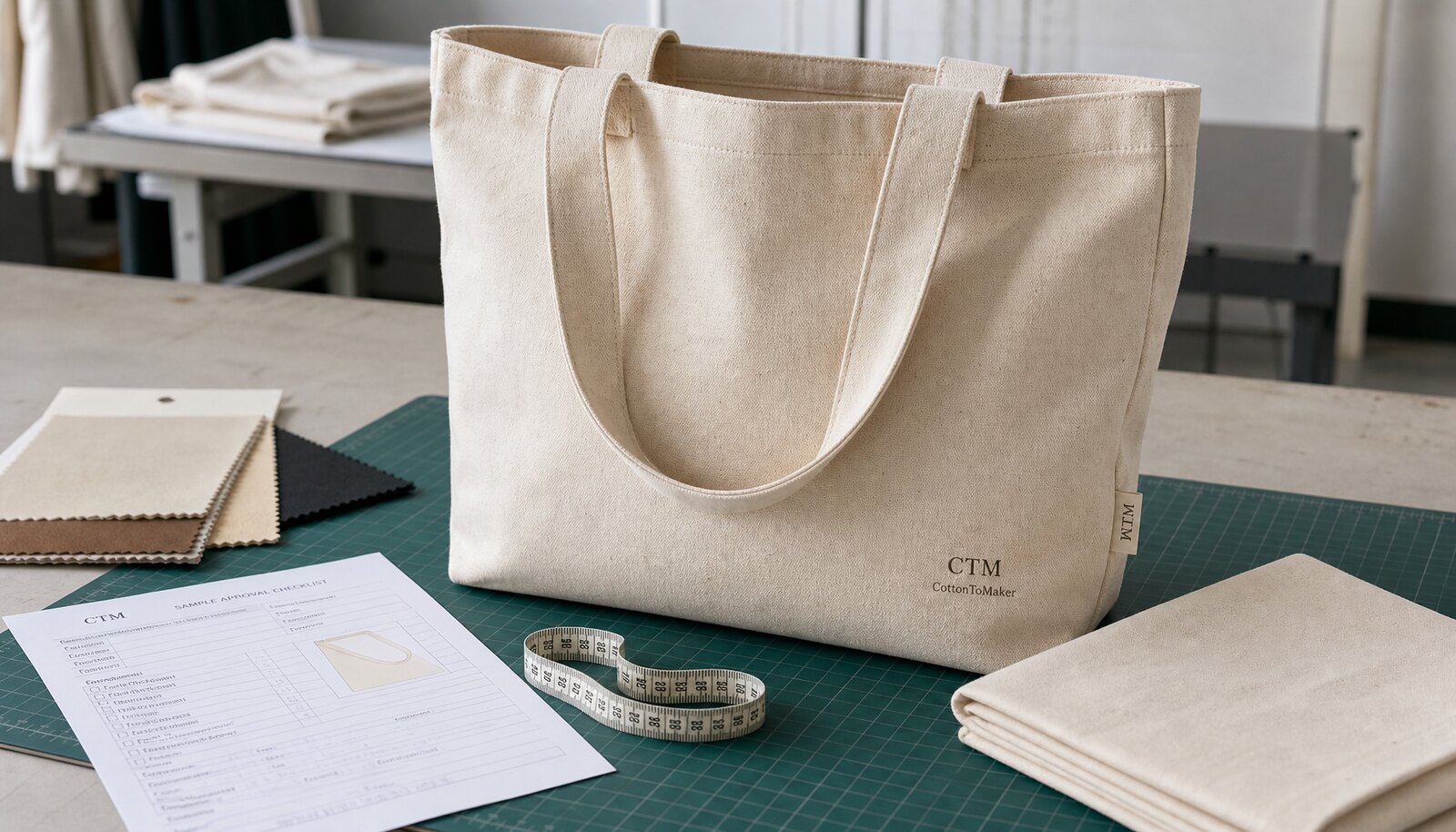
Why the sample is a release gate, not a preview
For canvas library tote bags for cosmetic brands, the sample should be treated as a production gate. These bags often sit inside retail sets, PR mailers, loyalty programs, or launch kits, so the tote is read as part of the brand presentation, not as a standalone accessory. If the cloth is wrong, the print softens, or the handle feels weak, the buyer sees a packaging failure, not a minor tote issue.
That is why a visually clean sample is not enough. The sample has to prove that the factory can repeat the same cloth, the same decoration method, the same construction, and the same packing method in bulk. If the approval piece was made with upgraded material or extra handwork, it is a misleading reference. The release decision should be based on the production route you will actually buy, not on the best version the supplier can build once.
- Treat the tote as part of the brand experience, not as a loose giveaway item.
- Use the sample to prove repeatability, not just appearance.
- Do not release bulk until the sample matches the intended factory route.
Start with the use case and load profile
The fastest way to mis-spec a tote is to begin with artwork. Start with use case instead. A bag that carries a catalog and a sachet does not need the same structure as one that holds boxed skincare, glass bottles, or a full retail purchase. Before quoting, write down what the bag must carry, how often it will be reused, and whether it needs to stand upright on shelf or fold flat for distribution.
That choice drives the whole approval standard. A PR mailer can tolerate a softer body and lighter handle, while a retail tote needs more shape retention and cleaner seam control. If the bag will live at a counter or in a distribution center, note whether it must still look presentable after folding, handling, and stacking. Those details change fabric weight, handle design, reinforcement, and packing.
- Write the actual contents the bag must carry, not a vague use category.
- Decide whether the tote must stand, fold, or do both.
- Set the approval around the heaviest expected fill, not an empty-bag impression.
Lock the base bag spec before you talk artwork
A useful spec sheet removes opinion from the review. For a cosmetic library tote, record the finished size, gusset depth, handle width, handle drop, seam allowance, and reinforcement method. A buyer who only asks for a nice-looking tote gets a quote that is hard to compare and harder to enforce. A buyer who asks for dimensions, tolerances, and construction details gets a production standard.
Fabric weight should be written in GSM or oz, not in loose adjectives. For a structured retail look, 12 oz to 16 oz canvas, roughly 340 to 450 GSM, is a practical starting range. Lower weights usually save cost but can feel limp; higher weights usually add body but can make the bag expensive, stiff, or bulky to pack. Natural canvas can work very well for beauty brands, but its shade variation should be accepted or rejected in writing. If the presentation depends on a clean, consistent tone, ask for a swatch or lot reference before bulk.
- Specify finished dimensions, not cut size only.
- Use GSM or oz for the fabric, then add the finish and color treatment.
- If shade matters, approve the acceptable band before the order is released.
Choose decoration from the artwork and wear path
Decoration choice should come from the artwork, the bag texture, and the expected wear path. Screen print is usually the best fit for simple logos, one to three spot colors, and retail-friendly artwork that needs a clean front face. It is often the most efficient choice when the print area is broad and the logo is not overloaded with tiny detail. Heat transfer is useful when the artwork has fine type, gradients, or too many colors for an economical screen setup, but the buyer should check how it behaves after folding and handling. Embroidery can feel premium, but it is better suited to small marks or accents than to large dense graphics on woven canvas.
The important rule is continuity. If bulk will be screen printed, the sample should be screen printed. If bulk will use a woven label, heat transfer, or embroidery, the sample should use the same method and the same placement window. A sample that looks right in a different process is not a production reference. It is just a design proof.
- Use screen print for simple retail logos and stable unit cost.
- Use transfer only when the art cannot be simplified without losing the brand mark.
- Use embroidery for small premium accents, not for oversized filled artwork.
Compare supplier routes as different commercial models
Do not compare suppliers as if they all produce the same way. A direct factory with an in-house sample room usually gives the strongest control because the same organization can manage cloth, printing, sewing, and packing. That is the most practical route when a launch depends on sample-to-bulk match. A trading company or sourcing agent can be useful if your team wants supplier comparison and coordination, but only if the real factory and material source are disclosed in writing. Otherwise, the sample may not reflect the shipped goods.
Stock-bag converters and domestic decorators have their place too. A stock converter can be the right answer when the design is simple and speed matters more than full customization. A domestic printer or decorator can be useful for very small runs, revisions, or urgent pilot kits. The commercial decision is not just unit price. It is how much variance, lead time, and communication overhead you can tolerate before launch.
- Ask who cuts, prints, sews, and packs the bulk order.
- Reject any quote that hides the real factory or the real material route.
- Compare suppliers by route and risk, not by the opening unit price alone.
Use the comparison table to narrow the route first
The route table is useful because it keeps the conversation commercial. If the order is tied to a retail launch or a cosmetic promotion, the safest option is usually the route with the fewest handoffs and the clearest accountability. If a supplier says they can beat the market price, ask what they are changing to get there. In tote sourcing, the usual tradeoffs are a lighter canvas, a smaller print area, cheaper handles, simpler packing, or outsourcing one step.
That does not make a lower quote wrong. It only means the changes should be visible before you approve. The route decision should be made before the art file is finalized, because the route determines the level of control you can expect over sample fidelity, turnaround, and repeatability.
- Use the route table before you compare line-item pricing.
- Ask what is being substituted if the quote is unusually low.
- Keep one version-controlled spec sheet tied to every quote and sample.
Build the sample approval checklist around version control
A useful approval checklist is short, measurable, and versioned. It should confirm the final fabric, final decoration method, final label, final handle material, and final packing method. If any of those parts change between sample and bulk, the sample is no longer a binding reference. The buyer should also keep a signed golden sample, a dated spec sheet, and the exact approved artwork file together so there is no later dispute about what was agreed.
The sample should be reviewed in the same condition the customer will experience. Check the bag on a table, then after folding it the way it will be packed, then under normal light and brighter light. If the logo shifts, the label sits wrong, or the bag loses its shape once folded, the sample is not ready. Cosmetic buyers do not need more adjective-driven approvals. They need a simple yes or no tied to the final production route.
- Approve the exact fabric, print method, and label placement.
- Record the sample version number, date, and approver name.
- Check the bag after folding and packing, not only when it is flat on the table.
Quote questions that expose hidden cost and hidden substitution
The most useful quote is itemized. If the supplier gives a single blended number, ask for a breakdown by blank bag, decoration, accessories, packing, sample charge, setup fee, and any revision or rush fee. That is the only way to compare a heavier canvas against a lighter one, or screen print against transfer, without confusing process differences with real cost differences.
You also need to ask what changes when the order changes. MOQ by size, color, and artwork matters because many tote programs look simple on paper but become expensive when you add a second colorway or a denser print. Ask whether the sample fee is deductible from the bulk order, whether revision rounds are included, what triggers a re-quote, and whether the same factory line will be used for production. Those answers tell you more than the unit price does.
- Demand a line-by-line breakdown of bag, decoration, accessories, packing, and fees.
- Confirm whether sample charges are deductible from the bulk order.
- Ask what changes if the quantity drops, the artwork changes, or the launch date moves.
QC thresholds that let procurement make a pass or fail decision
Inspection only works if the thresholds are set in advance. For cosmetic tote bags, the most common buyer-side failures are wrong size, wrong artwork, bad label placement, weak seams, and cartons that do not match the PO. A good inspection plan does not say the bag should be nice. It says how much deviation is acceptable and which defects are automatic rejects. If your company already uses AQL, map tote defects into that system instead of building a separate standard.
Use simple, repeatable checks. Measure the finished bag, check the print placement, inspect the stitch line, test the handle under load, and confirm the labels and carton marks. A sample can still fail if it looks fine from a distance but opens a seam during a basic load test or shows obvious print bleed when viewed under stronger light. For launch-critical orders, tighten the thresholds rather than loosening them at the end of the process.
- Use a size tolerance you can measure every time.
- Treat wrong artwork, wrong label, and open seams as major defects.
- Run a load test with the heaviest expected fill before release.
Control packing and carton quality before the tote ships
Packing can change the way the bag looks and how much damage it takes in transit. Confirm the fold direction, whether a polybag is required, how many units go into each inner or master carton, and how the carton will be marked. A tote that looks right when unfolded can still fail commercially if it arrives creased, crushed, or packed in a way that rubs the print.
Carton quality matters as much as carton count. Check for correct PO marks, style codes, color codes, and quantity marks. Record gross weight and carton dimensions so freight can be calculated correctly. Reject wet cartons, crushed corners, or cartons that do not match the approved packing mockup. For beauty programs, moisture damage and poor carton integrity can turn a clean tote into a warehouse write-off.
- Approve the fold method and carton count before bulk starts.
- Check carton marks, quantity marks, and style codes on every shipment.
- Reject cartons that are wet, crushed, or inconsistent with the approved packing plan.
Specification comparison for buyers
| Supplier route | Best fit | Commercial upside | Main risk | When to choose |
|---|---|---|---|---|
| Direct factory with in-house sample room | Repeat programs, launch-critical orders, and buyers who need sample-to-bulk continuity | The same team can usually manage fabric, printing, sewing, and packing, which reduces handoff errors | Needs a clearer spec and may be less flexible on very small MOQs | Choose when approval accuracy matters more than the lowest opening quote |
| Trading company or sourcing agent | Teams that need supplier comparison, coordination, or multi-item sourcing help | Can benchmark multiple factories and manage communication across the order | The sample source can change unless the real factory and material route are disclosed | Choose only if the agent will name the factory, material source, and production route in writing |
| Stock-bag converter with decoration | Simple logo programs, fast launches, and designs that can work within existing blanks | Shorter sampling loop and lower setup cost because the base bag already exists | Size, fabric, and construction options are limited by stock inventory | Choose when the design is straightforward and speed matters more than full customization |
| Domestic printer or decorator | Very small runs, urgent revisions, and local pilot programs | Fast artwork changes and easier in-person review of sample issues | Unit cost is often higher and scale options are narrower | Choose when speed and iteration matter more than landed cost |
| Material | 8-12 oz cotton canvas, 120-220 gsm cotton, recycled cotton, or blended fabric selected by use case and target price | Before price comparison | Different cloth weights, backing, or certification claims make quotes hard to compare | |
| Construction | bag size, gusset, handle drop, seam allowance, stitch density, reinforcement patch, and loading expectation | Before sampling | Weak stress points create returns and failed inspections | |
| Decoration | screen print, heat transfer, embroidery, woven label, or hangtag matched to fabric texture and brand durability needs | Before artwork approval | The wrong method can crack, bleed, pucker, or fail on the chosen fabric | |
| MOQ | Base MOQ plus change drivers | During quote review | Custom colors, trims, and packing can change minimums |
Buyer checklist before sampling
- Define the end use in writing: retail carrier, PR mailer, gift-with-purchase, event handout, or product insert bag. If the tote must hold filled cosmetic products, state the heaviest expected packed weight, not a vague description like light or medium.
- Lock the finished dimensions before sampling. Record width, height, gusset depth, handle width, handle drop, and the tolerance you will accept on each critical dimension.
- Specify the fabric in measurable terms. Use GSM or oz, then note whether the canvas should be natural, bleached, dyed, pre-washed, or enzyme-finished. If shade control matters, ask for a lot reference or approved swatch.
- Approve the exact decoration method that will be used in bulk. Do not sign off on a mockup in one method if the production order will use another method.
- Include all accessories in the sample. If the order has a woven label, care tag, zipper, snap, pocket, or hanging tag, the approval sample should include all of them in final placement.
- Require a versioned spec sheet that matches the sample. The sheet should carry the date, version number, supplier name, and the person who approved it.
- Ask for a packing mockup before release. Confirm folding direction, polybag use, carton count, carton marks, and whether the packed tote still presents correctly after folding.
- Split the quote into clear components: blank bag, decoration, accessories, packing, sample charge, setup fee, and any revision or rush fee. A bundled quote hides the commercial tradeoffs.
- Keep one golden sample with the buyer and one with the factory. If either side updates the sample, reissue the version number and the approval date.
- Define major and minor defects before bulk production starts. If your team already uses AQL, map tote defects into the same inspection plan instead of creating a second standard.
Factory quote questions to send
- What exact canvas specification will you use for both the sample and bulk order, including GSM or oz, weave, finishing process, and any known material tolerance?
- Will the sample be made on the same production line or in the same factory that will run bulk? If not, what is different about the sample route?
- Which decoration method is included in the quote, and is that the same method that will be used for bulk production?
- Can you break the price into blank bag, decoration, accessories, packing, sample charge, setup fee, and any revision or rush fee?
- What MOQ applies by size, color, and artwork? Which cost items change if we reduce quantity or add another colorway?
- If the design needs a revision, what is the fee and how many revision rounds are included before approval?
- Can you make the pre-production sample from the final bulk material rather than a stock blank or a hand-finished one-off sample?
- What tolerances do you work to for finished size, handle length, print placement, and stitch variation?
- How will the bags be folded and packed, how many units go in each carton, and what is the estimated gross weight per carton?
- What documents can you share before shipment, such as production photos, carton photos, measurement checks, or an internal inspection report?
Quality-control points to confirm
- Finished dimensions should match the approved sheet. A common buyer-side rule is plus or minus 0.5 cm on compact totes and plus or minus 1 cm on larger bags, unless your spec is tighter.
- Handle length should be even from left to right. A practical pass/fail rule is no more than 0.5 cm difference between handle lengths, and attachment points should sit at the same height.
- Print placement should fall inside the agreed artwork box. Reject visible blur, bleed, ghosting, broken lines, or off-registration that is obvious at normal viewing distance.
- For screen print, check the logo in both normal indoor light and brighter light. Fine type and thin rules should remain legible without magnification.
- Fabric should match the approved weight and tone. Reject thin spots, severe slubs, punctures, or a shade shift that makes the production lot look different from the signed sample.
- Stitching should be continuous and secure on visible seams. Reject skipped stitches, open seams, or loose exterior thread longer than about 1.5 cm if the buyer standard does not allow it.
- Run a load test using the heaviest expected retail fill or an agreed test weight. After about 60 seconds of hanging, there should be no seam opening, no handle failure, and no visible distortion that changes the bag's shape.
- If the tote includes a zipper, snap, or inner pocket, cycle each function several times. Binding, misalignment, or rough closure behavior on the sample is a warning sign, not a minor issue.
- Labels, care tags, and side branding should match the approved spelling, placement, and orientation exactly. A wrong label is a reject even if the bag body is otherwise acceptable.
- Cartons should arrive with the correct count, style code, color code, and PO mark. Reject cartons that are wet, crushed, missing marks, or packed in a way that differs from the approved carton plan.