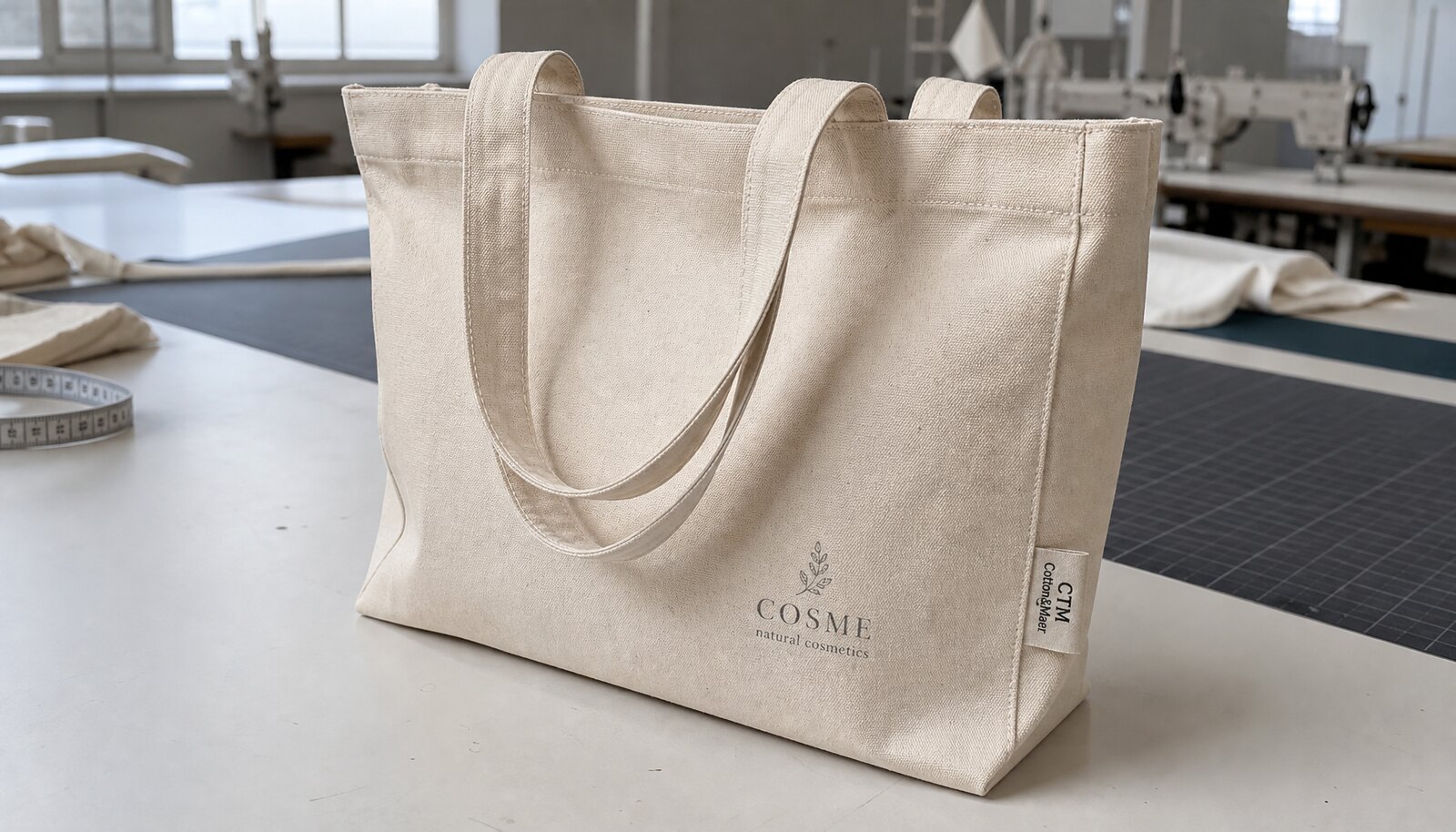
1. What a factory quote must prove for cosmetic-brand tote bags
For cosmetic brands, a quote for canvas library tote bags should prove more than a low unit price. Procurement needs to know whether the supplier can hold the same fabric, logo placement, stitching quality, and packing standard from sample to bulk. If the quote only shows a headline price and a vague description like “canvas tote with print,” it leaves too much room for change later, especially when the bag is used for retail resale, gift-with-purchase programs, or product launch kits.
A good factory quote works like a production summary. It should make the tote measurable: finished dimensions, fabric construction, print method, handle build, sample route, carton plan, and delivery timeline. That is the difference between a quote that helps a buyer compare offers and a quote that merely starts a conversation. Cosmetic brands often care about shelf presentation as much as function, so the quote has to cover appearance, not only capacity.
Procurement teams also need to know where a quote can shift. If the price changes with fabric weight, print color count, packing style, or carton count, those drivers should be visible before approval. Otherwise the lowest unit price may turn into a more expensive landed cost once setup, packing, and freight are added. The commercial goal is not only to buy a tote bag; it is to buy a repeatable branded item that can be reordered without redesigning the spec each time.
One useful way to approach the buying process is to divide the quote into four parts: the bag body, the branding method, the packing method, and the production schedule. When each part is defined in writing, procurement, design, and logistics are all evaluating the same item. That reduces disputes during approval and prevents the factory from treating a loose RFQ as permission to fill in the gaps with its own assumptions.
- Buyer objective: compare like-for-like offers, not just the lowest headline price.
- Minimum quote content: size, fabric GSM or oz, print method, handle spec, packing, MOQ, sample stages, lead time, and carton data.
- Common hidden cost: a quote that looks cheaper because it excludes setup, packing, or color-matching work.
- Best practice: tie the quote to one versioned spec sheet and one approved sample route.
2. Fabric weight, weave, and finish: the first cost driver buyers should lock
Canvas pricing starts with fabric, and the fabric decision should be tied to end use rather than habit. For many cosmetic-brand tote programs, the practical range is 8 oz to 12 oz canvas. An 8 oz body can work for lightweight gifting, event handouts, or packaging inserts, but it will feel softer, wrinkle more easily, and show less structure on a retail shelf. A 10 oz or 12 oz plain weave usually gives a better balance of body, print clarity, and perceived value.
When a bag is meant to carry boxed skincare, sample kits, or heavier beauty items, structure matters. A tote that sags at the bottom can still pass as “usable,” but it may not pass as brand-appropriate. Buyers should ask for the fabric in both familiar market language and supplier language. In practice that means requesting the weight in GSM and oz, plus the weave type, finish, and whether the fabric is pre-shrunk. If the supplier uses only one unit system, ask for the conversion in writing so everyone is quoting the same material.
A rough conversion that helps procurement compare offers is useful here: 8 oz canvas is commonly around 270-290 GSM, 10 oz around 340-360 GSM, and 12 oz around 410-430 GSM, depending on weave density and finish. These are not universal standards, but they are useful buyer-side checkpoints when a factory quote seems too light for the use case. If a quote claims a premium tote but the fabric weight sits in the range for a lightweight giveaway, that is a spec mismatch worth correcting before sample approval.
Finish matters nearly as much as weight. Greige fabric can keep cost down, but it may bring shade variation, lint, or shrinkage risk. Bleached or dyed fabric can improve presentation, yet each finish affects cost and lead time. Pre-shrunk fabric is usually safer for repeat orders because it reduces the chance that dimensions move after finishing or after end-user washing. For cosmetic brands, size stability is a real procurement issue because the bag often has to fit product bundles, catalog inserts, or boxed sets consistently.
The quote should also identify whether the bag body uses a single layer or a reinforced construction. If the design includes a bottom gusset or side gusset, buyers should ask how the panels are cut and stitched, because gusset geometry changes both appearance and sewing time. A well-structured tote can justify a higher unit price if it improves print flatness and shelf presentation, but only if that structure is actually specified in the RFQ.
- 8 oz: lower cost, softer body, better for lightweight giveaway programs.
- 10-12 oz: stronger balance of structure, retail feel, and logo print performance.
- Pre-shrunk canvas: preferred for reorders and size consistency.
- Ask for finished fabric weight and weave type, not only a marketing description like “heavy canvas.”
3. Stitching and handles: the quiet quality drivers that separate a reliable tote from a cheap one
A cosmetic-brand tote can look fine in a product photo and still fail in use if the stitching is weak. Buyers should treat seam construction as a commercial spec, not a visual detail. The areas that matter most are the handle joins, the bottom seams, the side seams, and any points where the bag takes repeated stress. If the tote will hold boxed skincare or sample kits, these are the areas that will show failure first.
The quote should state how the handles are built. Self-fabric handles are common and cost-efficient, but the quote should define width, folded thickness, attachment point, and reinforcement pattern. Cotton webbing handles can feel more robust and may improve comfort, but they can add cost and change the visual style. Whatever the choice, the buyer should ask whether the handle attachment uses bar-tacks, X-box reinforcement, or another defined stitch pattern. Generic wording like “reinforced handle” is not enough for procurement review.
Stitch density is another detail that often goes unreported. Not every factory will quote stitches per inch in the same way, but the buyer should still ask for a consistent stitch target or seam standard. A higher stitch density can improve seam stability and presentation, but excessively dense stitching can pucker lighter fabric. The quote should also identify thread type and color, especially when the tote uses contrast stitching as part of the brand look. If thread color is important and not stated, the bulk batch may arrive with the wrong visual effect.
For B2B buying, a tote should also be judged by how it is sewn under load. The buyer can ask the factory to describe a basic carry test: how much weight the bag should hold, whether the handles are checked for stretch or tear, and how long the load is held. That is especially relevant for cosmetic launches where a tote may be stuffed with multiple products, samples, and printed collateral. A cheaper stitch spec can save pennies per unit and create expensive replacements later.
If the supplier offers embroidery or a woven label, confirm how the decorative element interacts with the seam. Decorative branding placed too close to a stress point can cause puckering or thick seam buildup. The quote should show the label location and whether the application is sewn before or after main assembly. Small process choices like that affect both the finished look and the reject rate.
- Ask for handle width, handle drop, attachment method, and reinforcement pattern in writing.
- Confirm seam allowance and whether critical seams are single-needle, double-needle, or reinforced.
- Request the supplier’s basic load test method for carry durability.
- Do not accept “reinforced handle” as a complete spec; require the actual stitch structure.
4. Print method and logo durability: what a buyer should verify before approving artwork
Artwork is where tote buying becomes visual, and visual approval is not enough. The print method changes the cost, the tactile feel, and the durability of the bag. Screen printing is often the best choice for simple logos on medium or higher volume programs because the result is repeatable and the unit cost is efficient once setup is spread across the run. The quote should name the number of colors, screen count, ink type, and whether the setup fee is included.
Transfer print can work for short runs or more detailed artwork, especially when the design uses gradients or small text that would be hard to hold cleanly in screen print. But transfer methods need extra verification. Buyers should ask how the print behaves after flexing, rubbing, or washing if washing is relevant. A tote that looks sharp on day one but cracks or peels too early will create avoidable complaints, especially if it sits in a cosmetic retail channel where appearance carries brand value.
Embroidery and woven labels sit at the premium end of the spectrum. They often signal quality, but they also change the build process. Embroidery can add thickness, affect stitching around the logo area, and introduce placement variation if the design sits near a seam. Woven labels are usually more controlled, but they still need placement rules and trim approvals. The right choice depends on art complexity, order volume, and the brand’s target positioning. There is no universal “best” method; there is only the method that matches the program requirements without unnecessary cost or durability risk.
Procurement should also make the supplier state the print area size and the artwork file standard. A quote that omits the actual print dimensions invites confusion over scaling. Cosmetic brands often care about subtle, centered placement rather than a large promo-style print. If the brand is asking for a minimalist mark, the supplier should confirm exactly where the logo sits in relation to the top edge, side seam, and handle join.
A practical buyer check is to require one strike-off or small print sample before bulk approval, especially when color matching matters. The strike-off should be reviewed for color density, edge sharpness, and the way ink behaves on the chosen canvas finish. This is where an RFQ becomes a production control tool rather than a pricing exercise.
- Screen print: good for simple logos and repeat orders.
- Transfer print: useful for short runs, but test rub and flex durability.
- Embroidery or woven label: premium look, but more placement control needed.
- Quote should list artwork dimensions, number of colors, and setup charges separately.
5. MOQ, colorways, and quote ladders: why the same tote can have three different unit prices
MOQ is usually where buyer expectations and factory economics meet. A supplier is not only quoting a bag; it is quoting a production setup that includes fabric reservation, cutting, printing, sewing line changeover, and packing materials. That is why the same tote can have very different prices at 1,000 pieces, 3,000 pieces, and 5,000 pieces. The unit price changes because setup is spread over a different volume, not because the bag itself is fundamentally different.
For cosmetic-brand programs, it is important to separate MOQ by colorway, by print version, and by packing format. A factory may accept a lower tote quantity if the fabric is standard and the print is a single color, but require higher minimums when the order includes multiple colors, special trim, or retail-ready packing. If the supplier does not break MOQ down this way, the quote can look flexible on paper but become restrictive during order confirmation.
A useful procurement approach is to ask for a three-step price ladder: a test order, a core reorder level, and a scale run. The test order helps validate the bag body and print; the core reorder level reflects the most likely replenishment volume; the scale run shows what happens when the program matures. This gives the buyer better visibility into whether the supplier is truly competitive or only offering an attractive entry price. If the jump between tiers is unusually steep, procurement should ask which cost driver is responsible: screens, fabric procurement, labor, or packing.
Surcharges are another area to watch. Common triggers include extra print colors, split packing, customized barcode labels, folded inserts, mixed SKUs, and changes after artwork approval. The quote should state what is included and what counts as an extra. Without that clarity, the buyer may compare two offers that only look similar. One may include packaging and one may not; one may assume a single artwork version and one may assume multiple versions.
The most useful question is not simply “What is the MOQ?” but “What changes the MOQ and the price?” That is the level procurement needs for a real purchase decision.
- Separate MOQ by bag color, artwork version, and packing style.
- Ask for prices at three volumes: test order, reorder, and scale run.
- Identify surcharge triggers before PO release.
- Low MOQ can be expensive if it carries extra setup, packing, or split-shipment fees.
6. Supplier route comparison: factory, trading company, or stock program
Source route matters as much as spec. A direct factory, a trading company, and a stock program solve different problems, and treating them as equivalent usually leads to bad comparisons. The right route depends on how much control, speed, and change flexibility a cosmetic brand needs. If the tote is part of a launch kit or a gift-with-purchase program, control over print placement and packing is usually more important than shaving the last cent off the unit price.
Direct factory sourcing is usually strongest when the buyer needs a stable repeat product. It gives better access to fabric sourcing, sewing methods, and quality controls. It is also easier to lock a golden sample with the actual production line. The tradeoff is that the buyer has to manage the spec more tightly. If the RFQ is vague, the factory may make reasonable assumptions that do not match the brand’s expectations.
A trading company can be useful when the procurement team wants one contact point, mixed product bundling, or lower day-to-day coordination load. Trading companies often make communication easier and may coordinate multi-item kits better than a factory. The tradeoff is visibility: the buyer must work harder to confirm where the tote is actually made, whether the same factory will handle bulk, and how changes are passed down. Without that visibility, it is easier for samples and bulk production to drift apart.
Stock programs can be the fastest route, but they should be treated as a different product category, not as a custom tote program. They are best when the brand needs speed, basic customization, or event inventory. The limitations are obvious: less control over size, fabric shade, and retail finishing, and fewer options for repeat matching later. For a cosmetic brand that expects reorders or wants the tote to look like part of the brand system, stock is usually a temporary solution rather than a long-term sourcing strategy.
A good procurement decision compares the routes on four dimensions: spec control, lead time, cost transparency, and reorder stability. If the business needs the same tote every quarter, a factory route is usually stronger. If the need is short-term or mixed with other items, a trading company may be more efficient. If the deadline is urgent and the design is simple, stock can be acceptable. The key is to choose the route intentionally rather than by habit.
- Factory: best for control, repeatability, and custom spec discipline.
- Trading company: useful for coordination, mixed sourcing, and smaller teams.
- Stock program: fastest option, but limited in customization and reorder consistency.
- Compare routes on control, lead time, cost transparency, and reorder stability.
7. What a useful comparison table should show before procurement chooses a quote
A comparison table should not just repeat the spec. It should show the commercial tradeoff between what the buyer gets and what the buyer risks. For tote sourcing, procurement often compares offers that differ in fabric weight, packing format, print method, and shipping efficiency. If the table does not make those tradeoffs visible, it is not helping the decision.
For example, a bulk-packed tote may have the lowest piece price, but if your cosmetic brand sells through retail or ecommerce, the internal repacking cost may offset the savings. Likewise, a 12 oz canvas may cost more than a 10 oz body, but it can reduce customer complaints and improve perceived value. A proper comparison table should show where the unit price is low and where the operational cost may be higher downstream.
The table below is a buyer-side decision matrix. It is designed to help procurement decide not just which quote is cheaper, but which route is less risky for the final use case. It also gives the RFQ team a list of follow-up checks: carton loading logic, defect sensitivity, durability expectations, and how much variation the brand can actually accept.
Use this approach when comparing a factory quote, a trading company quote, and a stock-led quote. If one quote is missing sample path detail or carton data, do not try to normalize it by guesswork. Ask the supplier to complete the missing fields so the table can be used to compare real offers rather than partial documents.
- A useful table should show tradeoffs, not just specs.
- Include downstream cost drivers such as repacking, freight efficiency, and reorder consistency.
- Do not compare a full custom quote against a partial stock quote without equalizing the data fields.
8. Sample approval: how to lock the production standard before bulk sewing starts
A sample is only useful when it becomes the production reference. For canvas library tote bags for cosmetic brands, the sample path should be formal: fabric confirmation, print strike-off, pre-production sample, then golden sample. A photo approval alone is too weak unless the tote is entirely standard stock and the brand does not care about exact shade, size, or finishing details. In most branded programs, those details do matter.
The fabric swatch or fabric photo should be approved first if the order involves special color or finish. That prevents the supplier from using a similar-looking but commercially different fabric. The print strike-off should then confirm logo size, color, and placement on the chosen fabric. The pre-production sample should use the actual production method, not a shortcut. Finally, the golden sample should include the final trim, packing, labels, and any retail accessories such as insert cards or hangtags.
The golden sample should be sealed and referenced in the production file. This is especially important if the order includes multiple stakeholders: design, procurement, merchandising, and logistics. Each team may care about different details, but the final production standard has to be one object, not several verbal interpretations. The supplier should know which sample is controlling if the factory has a pre-print sample, a pre-pack sample, and a sealed golden sample. Otherwise approval conflicts become hard to resolve later.
It is also wise to make sample approval measurable. Buyers should measure the sample against target dimensions, inspect logo placement from the top edge and seam lines, and check the handle drop with a ruler rather than only by eye. The sample should be treated as an instrument of procurement control, not as a nice-looking object on a desk.
- Use a four-step path: fabric, strike-off, pre-production sample, golden sample.
- Seal the golden sample and tie it to the PO/spec version.
- Measure size, placement, and handle drop against written targets.
- Do not approve by photo alone if the bag has any custom construction or finish requirement.
9. QC for cosmetic-brand totes: AQL, defects, and testing that should be in the quote
QC is where a buyer protects the brand from avoidable errors. A tote that is technically functional can still be unacceptable if the print is off-center, the seam is crooked, or the bag arrives dirty. For cosmetic brands, presentation matters, and QC has to reflect that. The quote should not just say “QC by factory”; it should state the inspection method, the defect classes, and the tests used before shipment.
AQL-based inspection is a common and practical way to manage textile accessories. The buyer should ask which AQL level the factory will use and how defects are categorized. Critical defects are the ones that make the bag unusable or unsafe, such as a broken seam or a major size failure. Major defects are appearance or function issues that would trigger customer complaints, such as visible stain marks, a badly shifted print, or missing reinforcement. Minor defects are small imperfections that do not affect core function but still matter to presentation, such as a tiny thread end or slight packing misfold. The important part is to define these categories in advance so the factory knows what will be rejected.
A sensible tote inspection plan also includes a pull test or load test. The buyer should specify the test weight or use case, the hold time, and the acceptance result. If the bag is for cosmetic kits, the load should reflect how the tote will actually be used, not just a generic light carry check. For print durability, ask for dry rub testing at minimum, and wet rub or wash testing where the program requires it. Not every tote needs every test, but the quote should clarify which tests are included and which are only available on request.
Fabric inspection is another important layer. Buyers should ask whether the factory inspects the cloth before cutting or only checks finished bags. Pre-cut inspection can catch weave defects, oil stains, holes, or shade variation before labor is wasted. Finished-bag inspection is still necessary, but it should not be the only line of defense. Packaging QC also matters: the wrong count per carton, unreadable barcode labels, or missing inserts can create receiving issues even when the tote itself is acceptable.
The QC question that saves the most trouble is simple: what exactly does the factory reject, and at what stage? If the answer is vague, the inspection standard is probably vague too.
- Use AQL with clearly named critical, major, and minor defects.
- Define a load test that matches the tote’s actual use case.
- Include print durability checks such as dry rub, wet rub, or wash testing where relevant.
- Check fabric before cutting, not only finished bags before shipping.
10. Packing, carton loading, and freight logic: how to avoid hidden cost in the last mile
Packing can change landed cost more than many buyers expect. A bulk-packed tote is usually cheaper to produce and uses less material, but a retail-packed bag with individual polybag, barcode label, and insert card may be required for store presentation or ecommerce fulfillment. The quote should make packing a separate line item or a clearly defined included item. If it is left vague, buyers may discover that the lowest bag price comes with the most expensive handling cost.
For procurement, the key is not only the unit price; it is the carton logic. Buyers should ask how many pieces fit in a master carton, what the gross weight is, and whether the carton size is optimized for freight and warehouse handling. Too much empty space wastes freight. Too much compression can crease the tote body or distort the print area. A well-packed carton should protect the bags without overpressing the fabric. That balance is often missed when the quote is written too quickly.
If the brand needs retail presentation, ask for a quote on both bulk packing and individual retail packing. Compare the cost of the pack change, but also compare the labor saved downstream. Sometimes the higher factory price is still the better total cost because it removes repacking work at the warehouse or distribution center. On the other hand, if the bags are going straight into a kit build or distributor inventory, bulk pack may be the smarter choice.
Carton markings should also be part of the contract language. The buyer should confirm carton dimensions, gross weight, carton count, shipping marks, and barcode placement. If the bags are split across multiple cartons or SKUs, the packing plan must show how the counts are tracked. Carton errors are a common source of receiving disputes because they can be hard to correct once the shipment is on the water or already in transit.
A practical rule: if packing affects where the tote can be sold, stored, or scanned, then packing is part of the product spec, not a logistics afterthought.
- Quote bulk pack and retail pack separately when possible.
- Confirm pieces per carton, gross weight, carton dimensions, and shipping marks.
- Check whether packing causes wrinkles, print damage, or barcode scan issues.
- Treat packing as part of the product spec if it affects retail use.
Specification comparison for buyers
| Sourcing route | Best fit for | Typical strengths | Main tradeoffs | Quote checks that matter most |
|---|---|---|---|---|
| Direct factory | Brands that need spec control, repeat reorders, or custom construction | Better control over fabric, stitching, print method, and carton packing; clearer path to sealed sample and golden sample approval | Usually requires clearer RFQ detail and longer coordination if the factory is busy or the product is highly customized | Ask who owns fabric sourcing, whether print setup is in-house, how samples are approved, and whether the quote includes inspection and export cartons |
| Trading company | Brands that want one contact point, mixed product sourcing, or smaller internal sourcing teams | Easier communication, broader product bundling, sometimes faster response on small programs | Less visibility into the actual factory, more chance of markup on setup or packing, and weaker control over process details unless spec discipline is strong | Request the factory name, production location, change-control rules, and proof that sample and bulk will come from the same line or equivalent line |
| Stock program / ready stock | Urgent promotions, event giveaways, and simple designs with limited customization | Fastest delivery, lowest development effort, simple order placement | Limited size/fabric/logo options, less consistency for future reorders, and weaker brand differentiation | Confirm exact stock color, available sizes, print method if any, carton count, and whether a reorder can be matched later |
| Hybrid custom + stock base | Brands that want lower tooling risk while keeping some customization | Can reduce development time by starting with a standard tote body and adding brand print or label | Customization is constrained by the base bag spec, and carton/presentation options may be limited | Check which elements are fixed, which are custom, and what happens if artwork changes after approval |
| Material | 8-12 oz cotton canvas, 120-220 gsm cotton, recycled cotton, or blended fabric selected by use case and target price | Before price comparison | Different cloth weights, backing, or certification claims make quotes hard to compare | |
| Construction | bag size, gusset, handle drop, seam allowance, stitch density, reinforcement patch, and loading expectation | Before sampling | Weak stress points create returns and failed inspections | |
| Decoration | screen print, heat transfer, embroidery, woven label, or hangtag matched to fabric texture and brand durability needs | Before artwork approval | The wrong method can crack, bleed, pucker, or fail on the chosen fabric | |
| MOQ | Base MOQ plus change drivers | During quote review | Custom colors, trims, and packing can change minimums |
Buyer checklist before sampling
- Finished bag size with tolerance in cm or inches, including body width, body height, gusset depth, and handle drop
- Fabric weight in GSM or oz, with the conversion clearly stated if the supplier uses only one unit system; ask for both raw fabric weight and finished bag weight if the factory tracks them separately
- Canvas type: plain weave, twill, bleached, dyed, pre-shrunk, or greige, plus whether the bag will be washed after sewing
- Handle specification: self-fabric or webbing, width, length, attachment method, reinforcement pattern, and target load use case
- Stitching specification: seam allowance, stitch density or stitch-per-inch range where applicable, reinforcement points, and thread color
- Print details: method, number of colors, artwork size, print location, Pantone reference, and whether the design must pass rub and wash checks
- Sample path: swatch, strike-off, pre-production sample, golden sample, and who signs each approval
- Packing format: bulk pack, folded insert pack, polybag pack, barcode label, carton marks, and master carton dimensions
- MOQ by color, artwork version, and packing style, plus surcharge triggers for mixed SKUs or split deliveries
- Lead time broken into material prep, sample approval, bulk sewing, QC, and dispatch window
Factory quote questions to send
- What is the exact finished size, gusset, and handle drop used in this quotation, and what tolerance do you guarantee after production?
- Please state the fabric in GSM and oz, plus whether the quote is based on pre-shrunk, bleached, dyed, or greige canvas.
- Which print method is included, how many colors are covered, and what setup charge or screen charge applies if artwork changes?
- Does the unit price include sewing, logo application, inner packing, carton packing, and barcode labels, or are any of those separate line items?
- What is the MOQ by colorway, by print version, and by packing style, and what happens to price if we move from one color to two colors?
- Can you quote both bulk packing and retail packing so we can compare landed cost, carton count, and warehouse handling cost?
- What sample stages are included before mass production, and which physical sample becomes the golden sample for the order file?
- What is the bulk production lead time after sample approval, and which steps depend on fabric stock, printing capacity, or packing materials?
- What carton size, gross weight, and loading estimate do you recommend for this tote, and how many units fit per master carton?
- What inspection standard do you follow, and can you share the defect classes you treat as critical, major, and minor?
Quality-control points to confirm
- Critical dimensions should be checked on finished bags from multiple cartons, with a written tolerance for body width, height, gusset depth, and handle drop; many buyers use ±1 cm for standard tote programs, but the spec should state the actual acceptance band before production starts.
- Stitching should be checked at side seams, bottom seams, handle joins, and any reinforcement areas; no skipped stitches, open seams, loose thread bundles, or uneven bar-tacks should appear on the approved inspection sample.
- Print quality should be checked under normal daylight or color-balanced inspection lighting for misregistration, edge blur, pinholes, color shift, and visible cracking after bending; the quote should name the print method and acceptance standard, not just the artwork file.
- Durability tests should include a simple handle pull test and a loaded carry test using the intended use case; if the tote is for boxed cosmetics or sample sets, the buyer should define the test load and the hold time in the RFQ.
- Wash and rub checks should be defined where relevant: dry rub for surface transfer risk, wet rub if the brand expects handling in humid or retail conditions, and a wash test if the bag may be washed by end users or if pre-shrunk claims matter.
- Fabric inspection should cover weight consistency, weave defects, slubs, holes, oil spots, and panel shade variation; ask the factory whether they inspect fabric before cutting or only inspect finished bags.
- Packaging QC should verify piece count, correct fold direction, barcode legibility, carton marks, and whether all accessories are included; count errors are a common reason a purchase order fails at receiving even when the bag itself is acceptable.
- Use an AQL-based inspection plan tied to defect severity. For many branded textile orders, buyers set separate rules for critical, major, and minor defects and require the factory to state which AQL level will be used before bulk shipping.
- Golden sample control should be explicit: the approved sample must match final fabric, print, trim, label, and packing. The factory should keep one sealed sample with the production file and use it for line-side reference.
- Carton load logic should be validated before shipment: confirm the count per carton, gross weight target, and whether carton dimensions are efficient for export freight or domestic distribution. Overpacking can deform bags; underpacking can raise freight cost.