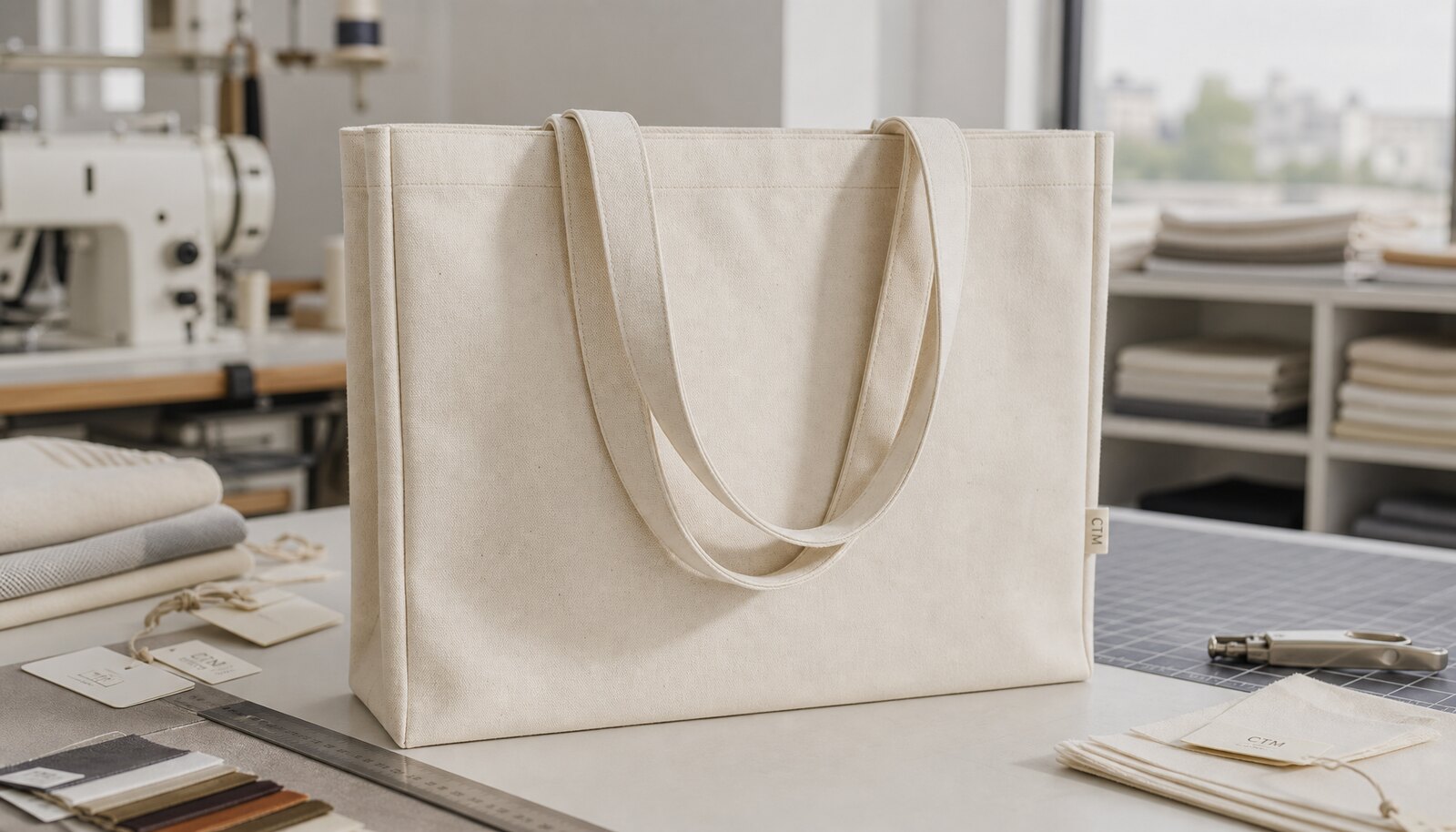
Start With the Use Case, Not the Tote
Cosmetic brands buy canvas library tote bags for different jobs, and the job changes the spec. A tote used for a retail gift-with-purchase only needs to carry a few light items, while a tote used for a skincare set, glass bottles, or a paid retail bundle needs a stronger body, more stable handles, and a better shape when filled. If the buyer does not define the product load, the factory will guess, and the quote will not be comparable across suppliers.
Write the use case into the RFQ in plain terms. State whether the bag will carry sample sachets, palettes, jars, bottles, or a mixed promo set, and include the heaviest item or target load in grams. That single line changes fabric weight, handle reinforcement, print area, and packing method. A useful spec is not "sturdy" or "premium". It is a measurable bag that can survive the exact customer use without overbuying material.
- Define the bag's job first: retail add-on, PR mailer, event handout, or product carrier.
- State maximum load in grams or by product type, not just a general strength claim.
- Keep the tote style fixed before asking for quotes so suppliers are pricing the same use case.
Choose Canvas Weight and Construction That Match the Load
For canvas tote bags, buyers should speak in GSM as well as ounce weight. As a working range, 10 oz canvas is roughly 340 GSM, 12 oz is around 400 GSM, 14 oz is near 470 GSM, and 16 oz is around 550 GSM. For cosmetic brands, 10 to 12 oz is often enough for light retail sets and branding programs. If the bag will carry heavier products or needs a more premium feel, 12 to 16 oz gives more body and reduces the chance of seam distortion or handle pull-out.
Construction matters as much as fabric weight. Self-fabric handles usually keep the look clean and price controlled, while webbing handles add strength but change the appearance. A bottom gusset helps the tote stand and hold boxed products, and reinforced handle ends with bar tacks or extra stitching are worth the cost if the bag will be reused. If the bag must hold size consistency across reorders, ask for pre-shrunk or washed canvas and define the final dimensions after wash or after steaming, not only before.
- Use GSM in the RFQ and ask the supplier to confirm the fabric weight in writing.
- Require bar tacks, double stitching, or another named reinforcement method at stress points.
- Lock the post-production size tolerance so the bag does not become smaller after finishing.
Pick a Print Method That Fits the Artwork and the Order Size
Screen printing is usually the best default for bulk cosmetic-brand totes when the art is one or two solid colors and the logo area is clean. It gives better unit economics at scale and works well on natural canvas, especially when the buyer wants a crisp brand mark rather than a complex image. Water-based ink gives a softer hand feel, while plastisol may improve opacity on darker or denser fabric. If the design has fine detail, gradients, or many colors, the quote should separate the print method from the fabric spec so the buyer can see what the art is actually costing.
Heat transfer and digital transfer are useful when the run is smaller or the art is too complex for screen printing, but they are not interchangeable with screen print. Transfers can crack, shift, or feel heavier on the tote if the base fabric is thick or heavily textured. Embroidery is a premium look, but it adds cost, increases the risk of distortion on light canvas, and can be too slow for volume programs. For cosmetic brands, the best finish is often the simplest one that stays sharp, repeats cleanly, and survives normal handling.
- Provide vector artwork, exact logo size, and Pantone targets before asking for a price.
- Ask the factory to quote the same art through the relevant print methods so the tradeoff is visible.
- Define the acceptable logo shift, edge blur, and color variation before sample approval.
Read the Quote Like a Buyer, Not a Catalog Reader
A useful bulk quote should be split by quantity tier, usually 1,000, 3,000, and 5,000 pieces, with the same spec repeated on every line. If the supplier only gives one unit price, the buyer cannot see where the setup cost is hiding or whether the pricing actually improves at volume. The quote should separate unit price, sample charge, screen or plate charge, packing charge, carton cost, and any overrun allowance. It should also state whether the price is EXW, FOB, or something else, because freight and inland delivery can swing the landed cost more than the bag itself.
MOQ is rarely one number. There is usually a body MOQ, a print MOQ, and sometimes a packing MOQ. A natural canvas body with one-color print is usually easier to scale than a custom dyed fabric, a multi-color print, or a special woven label program. Ask the supplier which item is driving the MOQ: fabric roll size, print setup, sewing efficiency, or packaging labor. That answer tells you whether the quote is real or only low because it is missing a cost center that will appear later.
- Demand pricing at multiple quantity tiers so the buyer can see the real break points.
- Separate sample fees, setup fees, packing costs, and cartons from the bag unit price.
- Ask whether the MOQ is driven by fabric, print setup, or packing, not just by the sales team.
Make the Sample Prove the Final Bag, Not Just the Shape
A pre-production sample should use the final canvas weight, the final print method, the final handle construction, and the final packing style. A blank sample only proves that the dimensions are close and the shape is acceptable. It does not tell the buyer whether the ink bleeds, whether the fabric shrinks after pressing, whether the handle stitches hold, or whether the carton size wastes freight. For cosmetic brands, those missing details are exactly where a quote can look fine and still fail in bulk.
Use sample approval to set acceptance criteria, not just to say yes or no. Measure the finished bag against the drawing, check the logo placement against the centerline, verify that the handle drop feels correct in hand, and inspect the bag under normal retail lighting. If the bag has a scent, loose fibers, or shade variation across the sample, those issues usually become larger in bulk. The sample should be judged as a production reference, not as a display item.
- Approve dimensions, print placement, color tone, and handle feel on the same sample.
- Reject any sample that uses a different fabric weight or print process than the final order.
- Record the approved sample as the production standard so later disputes are not subjective.
Packing Choices Can Change Landed Cost More Than Buyers Expect
Flat-folded bulk packing is usually the best starting point for a canvas tote order because it keeps carton volume low and simplifies warehouse handling. Polybagging, barcode stickers, insert cards, hangtags, or retail sleeves each add labor and material, and they also increase carton size. For a cosmetic brand using the tote as a promotional carrier, simple bulk packing is often enough. If the tote is being sold as retail merchandise, then the packing spec needs to be designed around shelf presentation instead of only freight efficiency.
Packing also affects moisture risk and damage control. Canvas can carry moisture from finishing or transit, especially in sea freight, so a sealed carton without any moisture plan may arrive with odor or slight surface marks. The buyer should define carton count, master carton dimensions, gross weight target, and any label or barcode location. Ask the factory to confirm how the bag will be folded, whether the print will face in or out, and whether the carton can survive stacking without deforming the bag body.
- Choose flat-fold bulk packing unless the tote is a retail shelf item.
- Define carton count and carton dimensions before shipping, not after production starts.
- Use moisture protection only where the route or climate justifies the extra cost.
Lead Time Depends on Fabric, Print, and Queue, Not Just Bag Count
For a standard natural canvas tote, a realistic schedule usually includes sample development first, then bulk production after the sample is signed off and the deposit is received. Many factories can turn a simple sample in about 7 to 15 days if the artwork and spec are already clear. Bulk can often move in roughly 25 to 45 days for a straightforward order, but that window changes fast if the buyer adds custom dyeing, embroidery, special packing, or external testing. The schedule should be written in milestones, not as one vague delivery promise.
The biggest schedule risk is not sewing speed. It is the queue around the sewing line, print setup, and material arrival. If the factory is buying fabric to order, the lead time may move more than the actual manufacturing time. Holiday congestion, carton supply delays, and late art changes also create avoidable slippage. Buyers should ask whether the factory holds a stock body fabric, whether the print screens or labels are already ready, and what date the art must be frozen to avoid moving the ship window.
- Use milestone dates for artwork freeze, sample approval, bulk start, and carton close.
- Ask what part of the schedule is fabric-driven, print-driven, or packing-driven.
- Treat any promise that skips sample approval as a risk, not a shortcut.
Compare Supplier Routes Before You Compare Price
Direct factory sourcing, trading company sourcing, domestic decoration, and offshore conversion do not cost the same way. A direct factory often gives the best control over fabric, sewing, and packing, but the buyer has to specify the order clearly and verify who actually owns each process step. A trading company may offer more convenience and a broader product menu, but the margin layer is less visible and the rework path can be slower. Domestic decorators are useful for urgent small runs, yet they usually cannot match factory pricing once the order becomes repeatable and the specs are stable.
The right way to compare routes is by landed cost, not just by unit quote. Include freight, duty, inland delivery, rework risk, packaging changes, and the cost of delays. A quote that looks low on paper can become expensive if the supplier cannot hold the sample standard, requires last-minute repacking, or misses the shipping window. For cosmetic brands, consistency matters because the tote often sits next to a product launch, and a weak bag can make the whole promotion look underdeveloped.
- Compare at least two sourcing routes with the same spec and same quantity tier.
- Separate product cost from logistics, duty, and rework so the true landed cost is visible.
- Ask for evidence of who cuts, prints, sews, and packs before choosing the route.
Build an RFQ That Gives Comparable Bulk Quotes
A clean RFQ for canvas library tote bags should read like a production instruction, not a marketing brief. Start with finished size, canvas weight, color, handle length, gusset depth, print method, print size, and reinforcement details. Add the target quantity by tier, the packaging requirement, the desired Incoterm, and the shipping destination. If the bag includes a side label, woven label, or any embossed mark, show the placement on a sketch so the supplier cannot guess where the branding goes. The clearer the RFQ, the less room there is for quotes that are cheap only because they are incomplete.
When suppliers respond, compare them line by line. The cleanest quote is not always the lowest number; it is the one with the fewest hidden assumptions. If one factory quotes a lower bag price but adds screen charges, packing charges, or a larger MOQ later, the buyer is not comparing the same product. Keep the approved sample, the written spec, and the quote tied together in one file so procurement, design, and logistics are all working from the same version.
- Attach vector artwork, a dimensioned sketch, and one reference photo of the target tote style.
- Require tiered pricing, setup charges, and packing details in the same reply.
- Keep the approved sample, final spec, and quote together so reorders do not drift.
Specification comparison for buyers
| Spec decision | Recommended option | When it fits | Buyer risk to check |
|---|---|---|---|
| Fabric weight | 10-12 oz canvas, around 340-400 GSM | Standard cosmetic gifting, retail add-on bags, and light product sets | Too light for glass jars or heavy kits; confirm actual GSM and shrinkage, not only ounce wording |
| Handle construction | Self-fabric handles with bar-tack reinforcement | Clean library tote look and better landed cost control | Check handle drop, stitching density, and whether the handle can hold repeated retail use |
| Print method | 1-2 color screen print for volume, heat transfer for short runs or complex art | Most cosmetic logos, taglines, and simple brand marks | Color registration, cracking, or weak wash/rub performance if the method is mismatched to the artwork |
| Supplier route | Direct factory with cutting, sewing, printing, and packing in one workflow | Repeat programs and buyers who need tighter spec control | Verify who actually makes the bag and who handles rework; middle layers can hide delays and cost |
| Sample route | Pre-production sample using final fabric, print, and packing method | Any bulk order that needs sign-off before mass production | A blank sample cannot prove print density, shrinkage, carton fit, or final appearance |
| Packing format | Flat-folded bulk packing in master cartons, with polybag only if required | Warehouse-friendly shipments and cost-sensitive programs | Retail packing adds labor, material, and carton volume; moisture control may still be needed for ocean freight |
| MOQ strategy | One standard body with controlled color or print variation | Launch programs and seasonal cosmetic promotions | Too many SKUs split fabric lots and can push the unit price up quickly |
| Quote basis | FOB with separate freight, duty, and inland delivery assumptions | Cross-border sourcing comparisons | Bundled logistics can hide the true landed cost and make supplier quotes look cheaper than they are |
Buyer checklist before sampling
- Final use case is clear: gift-with-purchase, retail add-on, PR mailer, or event giveaway.
- Finished size, gusset depth, and handle drop are fixed with tolerances.
- Fabric weight is specified in GSM and the buyer has approved the hand feel.
- Artwork is final in vector format, with Pantone references or approved color targets.
- Print method, print size, and number of colors are locked before sampling.
- Reinforcement points, stitch type, and any side label or woven label are defined.
- Packing format, carton count, and barcode or carton mark requirements are agreed.
- Quote tiers are requested at the same spec, same Incoterm, and same packing assumption.
Factory quote questions to send
- What exact fabric GSM, weave, and finish will you use for the approved bag body?
- Is your quote EXW, FOB, or another term, and what cost items are excluded?
- What is the unit price at 1,000, 3,000, and 5,000 pieces using the same spec?
- What setup charges apply for screens, plates, woven labels, embossing, or embroidery?
- What is the MOQ for the body, decoration, and packing configuration separately?
- What is the sample fee, sample lead time, and what does the sample include?
- What packing method, carton size, and carton count per case are included in the quote?
- What QC records, in-line photos, and final inspection evidence can you provide before shipment?
Quality-control points to confirm
- Measure finished width, height, gusset, and handle drop against the approved spec with clear tolerances.
- Verify fabric weight, weave density, color tone, and shrinkage behavior against the approved swatch or lab sample.
- Inspect print alignment, opacity, edge sharpness, and color match under normal light, not only on a screen.
- Pull-test handle attachment points and reinforce areas to confirm the bag can survive repeated retail use.
- Check for loose threads, skipped stitches, seam puckering, needle damage, and uneven topstitching.
- Confirm there are no stains, holes, odor issues, or visible shade variation across the lot.
- Review carton count, carton marks, inner packing, and any barcode or label placement before sealing.
- Sample units from the top, middle, and bottom of cartons to catch packing variation before shipment closes.