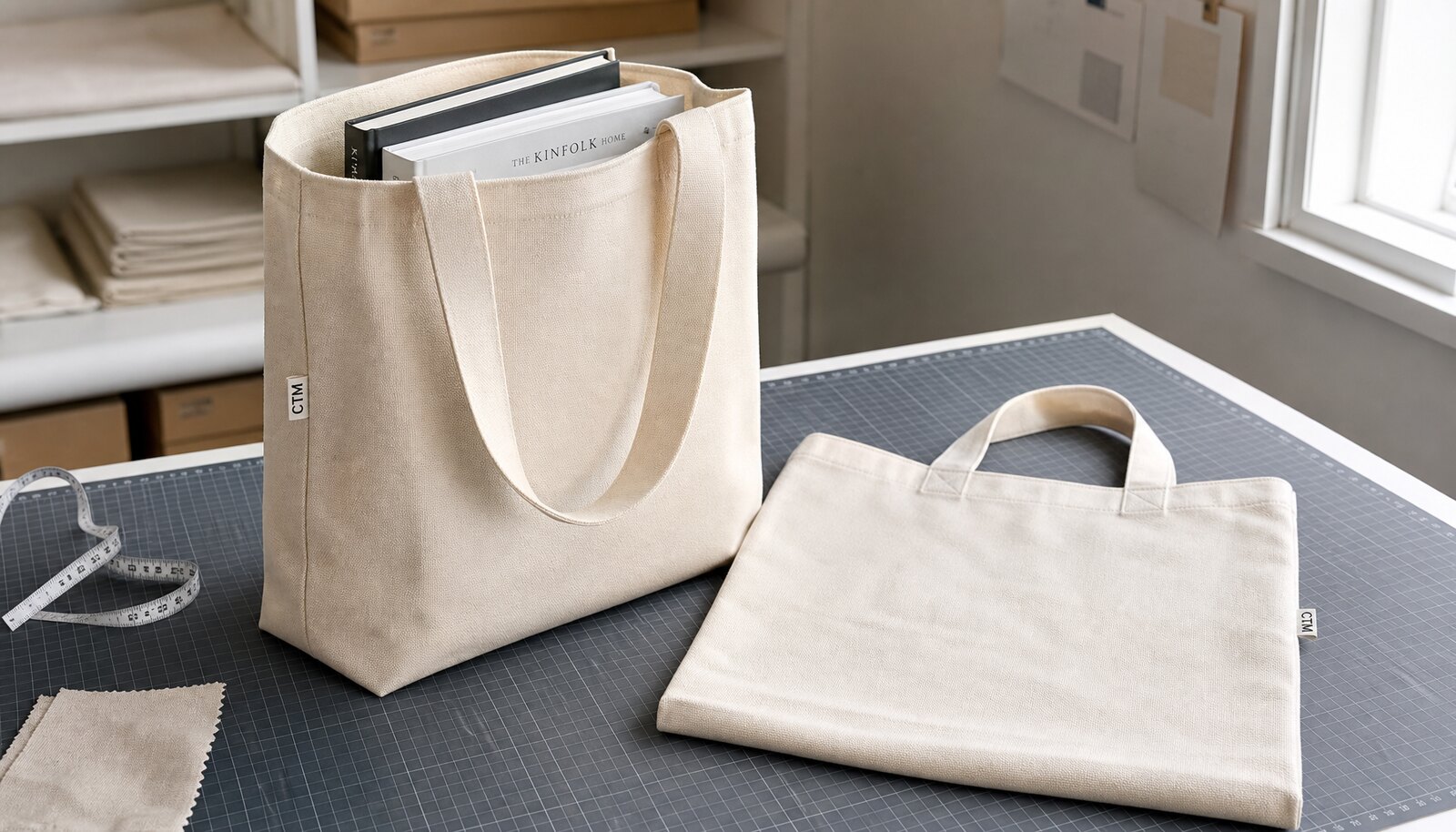
Why the library tote format works for event kits
A library tote for a corporate event is doing two jobs at once: it carries books, notebooks, and inserts on the day of the event, then it keeps working as a reusable bag after the event. That is why this format is more useful than a thin promotional shopper. The vertical body gives you a clean front panel for branding, while the open top and flat base make it easier to pack a catalog, a paperback, and a brochure stack without the bag collapsing. For a procurement team, that means the bag has to be specified as a working item, not only as a logo carrier.
The buying mistake is treating it like a cheap giveaway and not a working bag. If the tote is too light, the seams distort as soon as someone puts in a hardcover or a bottle. If the print area is squeezed by the handle stitch, the logo looks small and the bag loses event value. For corporate events, the spec has to match the actual load, the distribution method, and the visual role the bag plays on the floor. The right tote should feel stable in the hand, stack cleanly in cartons, and still look presentable after it has been unfolded a few times.
- Best for book launches, conferences, HR onboarding kits, training packs, and library outreach tables.
- Not ideal for loose sharp items unless you add a lining or a pouch.
- Keep the front artwork clear of side seams and handle reinforcement.
- Design the bag around the heaviest item in the kit, not the lightest flyer.
Choose fabric weight, gusset, and handle construction together
For corporate events, 10 oz / 340 gsm canvas is usually the practical starting point. It holds shape, prints cleanly, and feels substantial without becoming bulky on freight. If the tote will carry only paper goods, 8 oz / 270 gsm may be acceptable, but it reads more like a disposable promo item. If you want a bag that people keep, 12 oz / 400 gsm gives better structure and a stronger hand. The right weight also affects how much the tote wrinkles after folding, which matters when the bag is opened in front of attendees.
Size matters as much as fabric. A common library tote format is around 14 x 16 x 4 in or 15 x 16 x 4 in, with a flat bottom and enough gusset for books and catalogs. Handle length should create a comfortable shoulder or hand carry, usually with a drop around 10 to 12 in depending on the tote height. Reinforce the handle top with box-X stitching or bartacks, and specify whether the canvas is raw, washed, or pre-shrunk, because that changes both the final hand feel and the print behavior. If your event kit includes a book plus a notebook plus a bottle, the tote should be chosen around that full load, not around a flat sample on a table.
- 8 oz / 270 gsm: light handouts and low-cost conference packs.
- 10 oz / 340 gsm: default balance of structure, price, and printability.
- 12 oz / 400 gsm: premium reuse, heavier inserts, and better shape retention.
- Ask for the finished size after sewing, not only the cut size.
Pick a print method that fits the artwork and volume
Screen print is still the most practical choice for most corporate event totes. On natural canvas, it gives strong color, good opacity, and stable unit economics once you move beyond a very small run. A one-color logo with a clear edge is easier to keep consistent than a detailed full-color illustration. If the design is simple, screen print usually beats digital methods on both cost and durability, especially when the bag will be folded, stacked, and handled by different people before the event opens.
Use transfer or DTF only when the artwork forces it, such as multicolor logos, fine gradients, or variable names for internal team bags. Even then, the sample must be tested for edge lift, abrasion, and how the print feels after folding. For premium programs, a woven label or a sewn side label can support the brand, but it should not replace the main decoration unless the bag is intentionally understated. Keep print placement far enough from the seams that the bag can be sewn and folded without cutting into the design, and keep the artwork size realistic for the tote width you are buying.
- Use one or two spot colors when you want clean quotes and low risk.
- Keep the logo clear of the handle stitch and side gusset.
- Request a strike-off or decorated sample from the actual production fabric.
- If the bag will be folded into a kit, avoid thick ink builds that crack on the fold line.
Compare sourcing routes before you compare unit prices
The same tote can come to you through very different sourcing routes, and the quote only makes sense if you know which route you are buying. A direct factory is usually the best fit for repeat programs or larger event orders because you get control over fabric, sewing, print, and packing. A regional converter can be better when you need faster communication and fewer internal handoffs. A local decorator may win on speed, but the unit cost and available canvas options are usually narrower. If you compare those routes as if they were the same offer, the lowest number can hide a very different amount of risk.
MOQ logic follows the process, not just the bag. If the factory has to buy a custom fabric color or set up a new print plate, the minimum goes up. If you stay on standard natural canvas with a simple one-color logo, the MOQ can be more flexible. The right move is to match the route to the event profile: one-time launch, recurring conference, internal onboarding, or a retail resale program. Then compare quotes only after the route is fixed, otherwise you are comparing different risk structures and different control points, not the same product.
- Direct factory: best for 2,000+ units and repeat replenishment.
- Regional converter: useful for 300 to 2,000 units with mixed services.
- Local decorator: good for rush jobs and smaller internal events.
- Blank import plus local print: useful when timing matters more than one-vendor convenience.
Write an RFQ that makes quotes comparable
A usable RFQ removes the guesswork that usually bloats a quote round. Put the finished bag size, canvas weight, handle size, gusset, print method, artwork count, and packing method in the same document. Add the target event date and the destination warehouse or port so the factory can work backward from real logistics. If you leave any of those out, the supplier will fill the gap with assumptions and the quotes will not compare cleanly. That is the point where procurement loses time, because every revision creates another version of the same bag.
The best quote format breaks out the cost drivers instead of hiding them in a single number. You want to see blank bag cost, decoration cost, setup or screen charges, sample charge, packaging spec, and shipment assumptions. If a supplier prices a bag as 'standard' but another supplier prices the same bag as 'custom', there is usually a mismatch in sewing, print, or packing that will surface later. Force the bid to state the same baseline and the same output, then compare the offers by landed cost and by production control, not by the first line item alone.
- State the artwork file type and whether the logo is one color, two colors, or full color.
- Specify whether the bag is raw canvas, washed canvas, or dyed canvas.
- Include carton count, carton size, and whether individual polybags are allowed.
- Ask for lead time from approved sample, not from PO date only.
Approve samples against measurable quality points
Sample approval should test the production version, not a showroom version. A hand-made sample from different cloth or a different print method can hide the exact problems that show up in bulk: loose weave, color shift, crooked artwork, or weak handle stitching. The cleanest workflow is a pre-production sample made from the actual fabric, actual thread, actual print plate or transfer, and actual packing method. That is the sample you sign, because it is the closest thing to the bulk order you will actually receive.
QC should use measurable points, not vague language like 'good quality.' Measure the finished size, compare the print position to the approved artwork, and inspect each handle attachment for skipped stitches or loose thread ends. If the tote will carry books, add an internal load test on a small batch before approving the whole run. A bag that passes visual inspection but fails when loaded is still a bad bag. The sample stage is where you prevent the common mistakes that become expensive once the cartons are already made.
- Approve the color against the same light source you will use for final sign-off.
- Require one signed golden sample and one production reference photo set.
- Reject loose weave, print smearing, or seam puckering around the gusset.
- Verify that handle drop and bag depth match the agreed spec on both sides.
Plan packing for receiving, not just for shipment
Packing affects both freight and event-day usability. For bulk distribution, flat-folded totes in standard cartons are usually the cleanest option because they reduce volume and make warehouse receiving easier. If the bag must go straight into attendee kits, ask whether the factory can pre-insert literature or a notebook without crushing the tote shape. That labor should be priced and approved before production, not discovered when the cartons arrive. If the bag is going into a retail display after the event, the pack method may need a cleaner fold and a better surface finish than a pure bulk shipment.
Carton planning matters more than many buyers expect. A carton that is too tight can crease the bag and weaken the print line; a carton that is too loose invites damage and carton count errors. Outer marks should show PO number, style, color, quantity, carton number, and destination in a format your warehouse team can scan quickly. If humidity is a concern, specify moisture protection and keep the packing method consistent across all cartons so the event team does not receive a mixed condition shipment. The box spec is part of the product, not an afterthought.
- Decide whether bags ship bulk folded, individually polybagged, or with inserts.
- Confirm carton count against the receiving team's distribution plan.
- Use the same packing spec for all colors and sizes in one order.
- If the bag is pre-packed with inserts, add a tolerance for labor time and carton volume.
Build schedule buffer into the event calendar
Lead time risk is usually created by approvals, not sewing. The biggest delays come from artwork changes, sample revisions, and packing changes after the order has already started. Back-plan from the event date and create a buffer for the things that actually slip: sample sign-off, production queue, print curing, carton booking, and export or domestic transport. If your event date is fixed, treat every revision as schedule impact, not as a cosmetic detail. A small change in print size or carton pack can move the release date more than buyers expect.
A sensible schedule separates the project into gates. First lock the spec, then approve the sample, then release bulk. If the supplier cannot show you where your order sits in the queue, ask for the batch timing in plain language rather than a vague assurance. For corporate events, a bag arriving on time but with unresolved print or packing defects is still a failed delivery, so schedule should be managed together with QC, not separately. The buying discipline is to protect both the date and the bag spec at the same time.
- Reserve buffer time for artwork approval and sample corrections.
- Do not release bulk until the sample and carton spec are signed.
- Get the factory to confirm the process step that is most likely to slip.
- If the event date is immovable, avoid late changes to print size or packaging.
Compare landed cost, not ex-factory price
The cheapest ex-factory quote is not always the cheapest landed result. Freight volume, carton count, packing method, decoration setup, and import handling can move the final cost more than the headline unit price. Two suppliers can quote the same tote and still land very differently if one includes tighter cartons, better printing, or more efficient packing. Compare like for like, then add your shipping and receiving costs before you award the order. If one supplier quotes a loose pack and another quotes a tighter, more controlled pack, those are not the same commercial offer even if the unit price looks close.
For procurement, the right award decision is usually the quote that balances spec stability, communication quality, and realistic lead time. If one supplier is cheaper but cannot explain the packing or sample process, that lower price often turns into rework or rush freight. If another supplier is slightly higher but can hold the same fabric lot, reproduce the print, and match the approved sample, that quote may be the safer commercial choice. For event giveaways, consistency is usually worth more than a marginal unit saving, especially when the bag is part of a visible corporate program and has to look right in the room.
- Compare unit price only after normalizing fabric, print, packing, and freight assumptions.
- Include sample charges, setup charges, and carton changes in your landed-cost view.
- Favor the supplier that can repeat the same spec on the next event without redesigning the bag.
- Award based on total risk, not only on the first invoice.
Specification comparison for buyers
| Spec decision | Recommended option | When it fits | Buyer risk to check |
|---|---|---|---|
| Sourcing route | Direct factory with in-house sewing and print | 2,000+ units, repeat event program, and a need to control fabric, stitching, decoration, and packing | Lead time can slip if artwork or packing approvals are late; confirm who owns each process step |
| Sourcing route | Regional converter or decorator with managed production | 300 to 2,000 units, moderate customization, and a tighter internal deadline | Higher unit cost and fewer fabric choices; verify whether they are subcontracting sewing or print |
| Sourcing route | Blank tote import plus local print or finishing | Late campaign timing, multi-city events, or a need to finish close to the distribution point | Two vendors create split responsibility; incoming inspection must catch blank bag defects before decoration |
| Fabric weight | 10 oz / 340 gsm canvas | Standard corporate giveaway bags carrying brochures, notebooks, and a light book load | Too soft for heavy kits; validate seam strength and how the bag sits when filled |
| Fabric weight | 12 oz / 400 gsm canvas | Premium reusable tote, heavier event kits, or a bag expected to stay in use after the event | Higher freight weight and a stiffer hand; require stronger handle reinforcement and a tighter size tolerance |
| Print method | One-color or two-color screen print | Simple logo, large volume, and a clean front panel with stable repeat orders | Registration, ink coverage, and cure quality must be checked on the actual canvas lot |
| Print method | Heat transfer or DTF transfer | Short runs, multicolor artwork, or variable personalization for internal teams | Edge lift, fold cracking, and abrasion resistance need testing before bulk release |
| Sample route | Pre-production sample made from production fabric and final decoration | Any custom order with a fixed event date or a new bag specification | A sales sample or hand-built mockup can hide bulk defects in cloth, stitch, or print |
| Packing method | Flat-folded bulk cartons with fixed carton count and clear outer marks | Warehouse receiving, conference distribution, or orders that will be kitted later | Carton count errors, moisture protection, and pack density must be locked before PO |
Buyer checklist before sampling
- Finished bag size is written in both inches and centimeters, including body depth and gusset.
- Canvas weight is stated as GSM and whether the cloth is raw, washed, pre-shrunk, or dyed.
- Handle length, handle width, and reinforcement stitch pattern are defined on the tech pack.
- Artwork file, print method, print color count, and placement drawing are approved before sampling.
- The pre-production sample uses the same fabric, thread, print method, and packing as bulk production.
- Packing method, carton count, carton dimensions, and outer mark format are listed on the quote.
- The target ship date is back-planned from the event date with room for sample revision or rework.
- The quote separates bag cost, decoration cost, packaging, sample charge, and freight assumptions.
Factory quote questions to send
- What exact GSM are you quoting, and is that based on raw fabric, washed fabric, or finished bag weight?
- Is your unit price for a blank tote or a fully decorated tote, and what decoration setup cost is included?
- What is the exact handle construction, including webbing width, stitch pattern, and reinforcement at the attachment point?
- What print method are you proposing, and what is the maximum safe print area on the front panel?
- Can you make a pre-production sample from the actual fabric and actual production decoration method?
- What is the MOQ by color, by print setup, and by packing configuration?
- What packing method and carton count are included in the quote, and can you hold that spec through bulk production?
- What are your lead times for sample approval, bulk production, and final shipment, and where is the main schedule risk?
Quality-control points to confirm
- Finished dimensions should stay within the agreed tolerance, typically plus or minus 0.5 in for a small tote and tighter if the bag is part of a kit.
- Canvas GSM should match the approved spec within a reasonable production tolerance, and the cloth should feel consistent across the order.
- Handle lengths must match each other, and the handle attachments should show full box-X stitching or equivalent reinforcement with no skipped stitches.
- Print placement should stay aligned to the approved artwork position, with no visible skew, smudge, bleed, or under-cured areas.
- Color should be checked against the approved sample under the same light source used for sign-off, not under mixed warehouse lighting.
- The bag should pass an internal load test at the agreed weight without seam opening, handle pullout, or major distortion.
- No stains, oil marks, needle holes, loose threads, or raw-edge fraying should be visible on front panels or seams.
- Carton count, carton labels, and outer marks should match the purchase order exactly, including style, color, quantity, and destination.