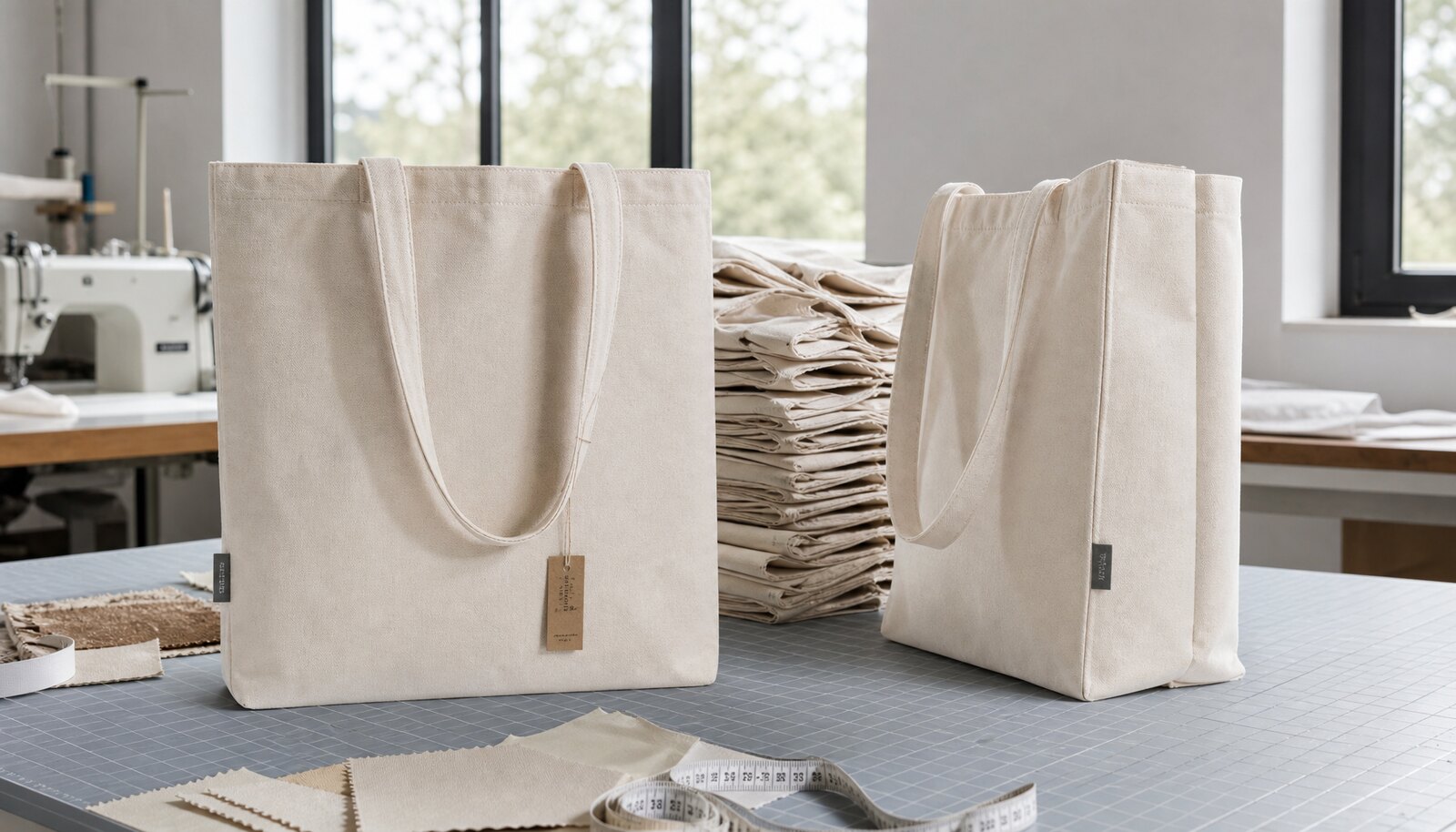
Start with the campaign job, not the bag category
A charity campaign tote is not just a canvas bag with a logo on it. The right spec depends on what the bag will carry, how it will be distributed, and what the organization expects the bag to communicate about the campaign. A tote handed out at a donor breakfast has a different job from a tote used to carry library materials, volunteer handouts, or retail fundraiser items. If the bag will hold books, brochures, notebooks, or boxed inserts, the body size, gusset, and handle reinforcement matter more than saving a few cents on fabric. If it is only carrying flyers and a small giveaway, you can often reduce fabric weight without harming the campaign outcome.
The buying brief should describe the use case before it describes the artwork. Procurement teams get better quotes when they specify the load, destination, and distribution channel up front. A useful line item spec might read: natural canvas, 12 oz, open top, 15 x 16 x 4 in finished size, 23 in self-fabric handles, one-color front print, bulk packed 100 per carton. That gives the supplier enough information to price the right product and gives the buyer enough detail to compare quotes without guessing. If the brief says only canvas library tote, suppliers will fill the gaps differently, and the cheapest number usually hides a different bag, different packing, or different print method.
For charity campaigns, the commercial risk is not just product failure. It is also brand mismatch, late delivery, and downstream handling cost. A tote that arrives on time but cannot be packed efficiently into donor kits may cost more overall than a slightly pricier bag with a better carton plan. Treat the tote as part of the campaign operating system, not as a loose commodity purchase.
- State the maximum realistic load, such as a literature pack, a few books, or a donor kit.
- Decide early whether the tote is a giveaway, a donor premium, or a resale item.
- Keep the spec stable across suppliers so one quote does not hide a smaller, lighter, or less durable bag.
Choose fabric weight and construction for load, reuse, and print quality
For most wholesale charity runs, 10 to 12 oz canvas is the practical range. Ten oz usually keeps the cost in reach for high-volume distribution and still feels substantial enough for a campaign tote. Twelve oz is the safer default when the bag needs to carry books, catalogues, or mixed literature without looking flimsy. If the campaign positions the tote as a long-life reusable item, 14 to 16 oz can make sense, but the buyer should expect a stiffer hand feel, a higher freight weight, and a higher landed cost. The key is to avoid paying for weight that does not improve the actual use case.
Construction matters as much as the fabric number on the quote. A flat tote without a gusset is cheaper, but it holds less volume and is harder to use as a library carrier. A 4 to 5 in bottom gusset usually gives a better fill shape and better shelf presence in campaign photos or donor kits. Handle design is a major failure point. Self-fabric handles can work well on lighter builds, but cotton webbing or reinforced self-fabric handles with bar-tacks are safer when the tote will carry books or a dense literature pack. If the supplier changes seam type, stitch count, or handle width without flagging it, the bag can feel much weaker even when the headline fabric weight is unchanged.
Do not let the quote reduce the bag to one number. Ask how the canvas is woven, whether the fabric is pre-shrunk or washed, and whether the finish changes the feel or print uptake. If the buyer wants the bag to stay consistent across repeat orders, the material description needs to be detailed enough that the next run can match the first run instead of drifting over time.
- Use 10 oz for lower-cost bulk giveaways and 12 oz for the most balanced charity-campaign option.
- Ask whether the gsm is measured before or after washing or finishing.
- Require bar-tacks or equivalent reinforcement at handle stress points if the tote will carry books or files.
Lock the dimensions and tolerances before you ask for pricing
Size is where procurement gets trapped by vague quotes. A tote described as standard can mean several different body sizes, different gusset depths, and different handle drops depending on the supplier. That creates false price comparisons and usually becomes visible only when the bags arrive and the campaign team tries to pack them. A serious RFQ should fix the finished dimensions and tolerances before any price is accepted. For most canvas library tote bags for charity campaigns, a practical tolerance target is plus or minus 0.5 in on body width and height, plus or minus 0.25 in on handle length, and plus or minus 0.25 in on gusset depth, unless the design is unusually tight or decorative.
Print placement also needs a tolerance, not just a location description. If the logo sits too close to the side seam or top hem, the final run can look uneven even when the print quality is technically acceptable. A useful rule is to define the logo center point from a fixed edge and allow only a small positional window, then approve that as part of the master sample. If the artwork includes small text, reverse type, or thin lines, the RFQ should ask the supplier to confirm minimum line thickness and minimum type size before sampling. That avoids a run of bags that technically prints the artwork but does not reproduce it cleanly.
When buyers leave these details open, suppliers make different assumptions and the procurement team ends up comparing apples to oranges. Tight dimensional control is one of the cheapest ways to reduce risk because it turns a subjective tote order into a measurable one.
- Define finished body dimensions, not cut-panel dimensions, unless the factory also supplies the pattern sheet.
- State the print placement from a fixed edge and not by eye.
- Write the tolerance range in the RFQ so the supplier knows when a deviation becomes a defect.
Match the decoration method to the artwork and campaign life cycle
Screen print remains the default choice for most charity tote programs because it scales well, holds up on natural canvas, and is easy to quote. It works best with one or two solid colors, large type, and simple logos that do not depend on fine gradients or photographic detail. If the design has thin lines, small reverse text, or multi-color shading, the buyer should either simplify the artwork or use another decoration method. A design that is easy to approve on a screen is not always easy to reproduce on canvas at volume.
The right print method depends on the tote's role in the campaign. If the bag is a mass giveaway, the goal is durability and cost control, so screen print often wins. If the order is short run or the artwork is more complex, a digital transfer or another hybrid method may be better, but the buyer should weigh wear resistance and hand feel carefully. Embroidery can be appropriate for a small premium mark, but it is usually not the best fit for broad distribution. A woven label, side patch, or sewn-on brand tab can also work well when the organization wants a subtle identity cue instead of a large printed field.
Procurement should also ask how the print will age. For a tote that will be reused often, abrasion resistance matters more than how it looks on day one. Ask the supplier how the ink behaves after folding, whether the print cracks at the fold line, and whether the method changes the stiffness of the fabric. These are practical questions, not aesthetic ones, because a charity campaign tote that looks good for one event but fails after a month has not delivered full value.
- Keep the print area large enough that text does not crowd the seams or gusset edges.
- Ask for artwork reduction guidance if the logo has small reverse text or fine serif fonts.
- If the tote will be reused, ask the supplier how the print resists abrasion and folding.
Build the RFQ so every supplier prices the same product
Most weak tote quotes start with incomplete RFQs. If the buyer sends artwork and asks for a price, the supplier fills in missing details with its own defaults. One quote may assume a lighter canvas, another a larger print area, and another may include packing or label work that the rest left out. That creates the illusion of a price gap when the real issue is a spec gap. A usable RFQ should include finished dimensions, fabric weight, color, decoration method, print size, handle details, pack count, carton size, sample assumptions, and shipping basis.
The quote should be itemized, not rolled into a single number. Ask for the blank bag cost, the decoration charge, the sample cost, packing labor, carton cost, and freight basis separately. If there is a setup fee for screens or a one-time tooling charge for labels, that needs to be visible before award. For charity campaign buyers who manage multiple destinations, it is also important to ask whether the supplier can keep the bag spec unchanged while adjusting carton marks, ship-to labels, or kit counts. This matters because some suppliers can only quote well if they are controlling every detail, while others are comfortable with partial work.
The point of the RFQ is not to collect many prices. It is to make every supplier quote the same commercial and physical product. Once the comparison is clean, the buyer can see which supplier is actually efficient and which is simply quoting less because the spec is weaker.
- Quote the same shipping basis across all suppliers, such as EXW or FOB, and do not mix terms.
- Separate printed bag pricing from packing and freight so landed cost is visible.
- Ask for overrun and underrun tolerance before you approve the order quantity.
Vet the supplier route and region tradeoffs before chasing the lowest unit price
The supplier route matters as much as the factory price. A direct factory is usually the best fit when the organization needs stable spec control, repeat orders, and a clear owner for sewing, printing, and packing. A factory-led sourcing partner can also work well if the program includes multiple components or the buyer wants one party to coordinate across several production steps. A trading layer can be useful when speed, consolidation, or regional flexibility matters, but it can also make defect responsibility less clear if the quote does not separate the actual factory from the middle layer. That matters when the buyer later needs a claim for print defects, wrong pack counts, or late shipment.
Region choice should be treated as a commercial tradeoff, not a shortcut. Mainland China often gives buyers broad capability, mature print options, and strong scale for repeat programs, but shipping lanes and tariff treatment must be checked on each order. India and Pakistan can be attractive for cotton-heavy sourcing and sewing depth, while buyers should still verify lead times, export readiness, and quality consistency for the specific factory. Vietnam and Turkey may make sense when proximity to the destination, route timing, or program complexity favors them, but the buyer should never assume capability from geography alone. The practical question is not where the country ranks overall; it is whether the specific factory has the sewing, printing, packing, and documentation control your campaign needs.
The best vetting signal is not a polished sales deck. It is the supplier's ability to show named factory details, recent production photos, a clear line of responsibility, and realistic capacity for the exact item being quoted. If the supplier cannot explain where the work happens or who signs off on final inspection, the price should not be treated as complete.
- Ask who owns sewing, printing, packing, and final inspection, and get the answer in writing.
- Request the factory name, address, and recent production photos before awarding a sample.
- Do not compare a factory quote with a distributor quote unless the same service scope is shown on both sides.
Approve the sample against production reality, not presentation quality
A sample is useful only if it predicts the bulk order. Start with a blank sample when the structure is still under discussion, then move to a decorated pre-production sample with the final artwork, label, and packing method. The sample should be measured, not just reviewed visually. Check body dimensions, gusset depth, handle length, handle drop, stitch alignment, and print position against the approved spec. The tote should also be partially loaded so the buyer can see how it stands, folds, and balances under real use conditions. A bag can look fine on a table and still twist or collapse when it carries brochures or books.
A practical sample review also checks material behavior. Note the hand feel, canvas stiffness, print edge clarity, and whether the ink shows stress when the bag is folded. Compare the fabric shade to the master reference rather than to a screen image. For repeat programs, keep one approved physical master sample with the purchase file and attach dated photos so the next run starts from a known benchmark instead of memory. That is the best defense against quiet spec drift across reorders.
If the sample needs changes, issue the changes clearly and reapprove the new sample. The goal is to make the sample a production part, not a display item. A clean approval process reduces arguments later because everyone can refer back to one physical standard.
- Reject the sample if the handle stitching is uneven or the bar-tacks are misaligned.
- Measure print position from a fixed edge and document the result.
- Keep one approved master sample in the order file for every reorder.
Use inspection standards and test documents to control quality
Procurement should not rely on a generic quality checked promise. A tote program needs an explicit inspection standard and a document package that supports the claim the supplier is making. The usual starting point is a pre-shipment inspection at AQL General Inspection Level II with AQL 2.5 for major defects and 4.0 for minor defects, unless your organization uses a different standard. Critical defects should be zero tolerance and should include wrong size, wrong artwork, missing handles, open seams, or any condition that makes the bag unusable. Put that language into the PO or quality agreement so the supplier knows what release means.
The document request should match the risk profile of the campaign. At minimum, ask for a final inspection report, packing list, commercial invoice, and carton marks. If your procurement policy or destination market requires it, ask for factory audit evidence, material composition confirmation, chemical compliance evidence, or test reports for fabric and ink. For organizations with environmental or social compliance requirements, the relevant certificates should be requested before award rather than after shipment. Do not over-specify documents that the factory cannot credibly support, but do insist on the records that will matter if there is a customs question or a quality dispute.
A useful control is to ask for one finished piece from the first cartons before the rest of the lot is released. That early look is often enough to catch packing mistakes, label issues, or print drift before the whole shipment is locked.
- Use AQL General Inspection Level II with 2.5 major and 4.0 minor as a practical default unless your policy differs.
- Treat wrong size, wrong artwork, open seams, and missing handles as critical defects with zero tolerance.
- Ask for the final inspection report and carton marks before shipment release.
Control packing, cartonization, freight, and duty exposure before the bags leave the factory
Packing is where a well-priced tote order can become expensive. If the bags will go to a warehouse for later fulfillment, bulk carton packing is usually the cleanest choice because it reduces labor and avoids unnecessary polybags. If the bags are being inserted into donor kits or direct mail packs, set packing can be worth the extra labor because it saves downstream handling. The buyer should decide this before pricing, not after production starts. For natural canvas, packing should protect the print face and avoid deep creasing that makes the bags look used on arrival.
Carton details need to be part of the quote. Ask for pack count per carton, carton dimensions, gross weight target, and outer label content. If the order will split across multiple recipients, carton numbering and pallet labels matter because receiving teams need to match cartons to destinations quickly. If the shipment is going by ocean freight, ask the factory how it protects against moisture and carton compression. If it is shipping by air, ask whether the pack count is optimized for cube without overstressing the tote shape.
Freight and duty risk should be managed with eyes open. Buyers often prefer FOB or another controlled term because it keeps the freight quote visible and makes comparison cleaner, but smaller or urgent programs sometimes justify a different term if the vendor truly owns the end-to-end shipment. Regardless of the term, confirm who is responsible for export paperwork, origin marking, customs value, and inland delivery. Do not assume the supplier's default lane is the best one for your destination. A quote that looks lower at origin can become more expensive once freight, duty, and receiving labor are added.
- Use bulk cartons when the next step is warehouse fulfillment, not retail presentation.
- Use set packing only when the campaign benefits from pre-bundled kits or direct mail.
- Confirm who handles export paperwork, country-of-origin marking, and inland delivery before the PO is issued.
Calculate landed cost and lock the PO terms that protect the campaign date
The right procurement decision is the one that protects the total campaign outcome, not the lowest first price. For canvas library tote bags for charity campaigns, landed cost should include the bag, print, sample charges, packing, carton prep, freight, duty, receiving labor, and any repacking or insertion work at destination. A lower ex-works quote can become the most expensive option once shipping, customs, and handling are included. To compare suppliers fairly, put every quote on the same commercial basis and the same carton assumptions before ranking them.
Lead time needs the same discipline. The production clock should start from sample approval and deposit, not from the first inquiry. If artwork is not frozen, if packing is not fixed, or if the destination is split across more than one location, the schedule needs a buffer. Ask the supplier for the latest safe approval date and the latest ship date that still protects your campaign. If the event date is immovable, build a backup path for freight delay or rework. That is especially important when the order must cross borders or move through more than one receiving point.
The purchase order should be specific enough that the factory can produce without interpretation. It should reference the approved sample, the agreed tolerances, the inspection standard, the carton count, the shipping term, and the document set required for release. The cleaner the PO, the less the campaign depends on memory or email threads when a problem surfaces.
- Compare all quotes on the same shipping basis and the same carton pack count.
- Include freight, duty, receiving labor, and rework when estimating true cost.
- Treat a slightly higher unit price as acceptable if it reduces the risk of damage, delay, or packing errors.
Specification comparison for buyers
| Spec decision | Recommended baseline | When it fits | What to lock in |
|---|---|---|---|
| Supplier route | Direct factory with in-house sewing and printing, or a factory-led sourcing partner | Best for repeat charity programs, stable specs, and clear responsibility for defects | Ask who owns sewing, printing, packing, and final inspection; avoid hidden trading layers unless they are transparent |
| Fabric weight | 10 to 12 oz canvas, roughly 340 to 405 gsm | Best for most giveaway, literature, and donor-kit use cases | Confirm whether the quoted weight is before or after finishing or washing |
| Finished size | Typical library tote range such as 15 x 16 x 4 in or similar campaign-specific size | Best when the bag must carry brochures, books, or mixed inserts | Set a finished tolerance target such as plus or minus 0.5 in on body dimensions and plus or minus 0.25 in on handle length |
| Handle build | Cotton webbing or self-fabric handles with bar-tacks | Best when the tote carries heavier loads or will be reused often | Specify handle width, drop, stitch count, and reinforcement method |
| Decoration method | 1 to 2 color screen print for simple logos, woven label or patch for minimal branding | Best for volume runs with clean artwork and controlled cost | Define print size, placement tolerance, ink type, and whether the back panel stays blank |
| Inspection standard | Pre-shipment inspection to AQL General Inspection Level II with AQL 2.5 major and 4.0 minor, unless your policy differs | Best for buyers who need a measurable release gate | State critical defects as zero tolerance for wrong size, wrong artwork, open seams, or missing handles |
| Packing format | Bulk carton packing unless the tote is inserted into kits or direct mail | Best for warehouse receiving and lower labor cost | Specify pack count per carton, carton marks, and whether polybags are allowed |
| Commercial term | FOB or another controlled shipping basis with freight quoted separately | Best when procurement wants a clean landed-cost comparison | Keep duty, inland freight, and destination handling visible before award |
Buyer checklist before sampling
- Write the use case first: giveaway tote, donor premium, library carrier, resale item, or literature bag.
- Fix the finished size, gusset depth, handle length, and expected load before requesting prices.
- Specify fabric weight in oz or gsm and state whether you want natural, bleached, dyed, or printed canvas.
- Define the decoration method, artwork size, number of colors, and whether the back panel is blank.
- Set practical tolerances in the RFQ: body dimensions, handle length, print position, and carton count.
- Ask for a blank sample if the structure is still open, then a decorated pre-production sample with final packing.
- Request a quoted inspection standard, not just a statement that goods are quality checked.
- Compare all quotes on the same shipping basis, carton count, and sample assumptions.
- Ask for the compliance file your organization needs, such as material test reports, factory audit evidence, or region-specific chemical compliance.
- Build the purchase order around the approved master sample and keep one reference piece on file for reorders.
Factory quote questions to send
- What fabric weight, weave density, and finishing are you quoting, and is the weight measured before or after finishing?
- What are the exact finished dimensions, gusset depth, handle length, and handle drop you will produce?
- What tolerance can you hold on body size, handle length, and print placement without rework?
- Which print method are you using, how many colors are included, and what setup or screen charges apply?
- What is the MOQ by color, by artwork version, and by packing format?
- Can you quote blank bags, printed bags, and kit-packed bags separately?
- What is your sample cost, sample lead time, and refund policy if the bulk order is placed?
- What overrun or underrun range do you allow on the production quantity?
- What carton size, carton pack count, gross weight target, and outer label content will you ship?
- What inspection standard will you follow before shipment, and can you share the final QC report?
Quality-control points to confirm
- Measure body width, height, and gusset against the approved spec using the agreed tolerance window.
- Check handle length, handle drop, and bar-tack placement on both sides of the tote.
- Verify seam consistency at the bottom corners, side seams, and handle attachment points.
- Inspect print registration, edge sharpness, ink coverage, and color consistency across the batch.
- Confirm the fabric shade, texture, and stiffness match the approved master sample.
- Reject bags with twisted handles, open stitches, loose threads, or uneven top hems.
- Check for needle damage, puckering, skipped stitches, and seam stress at loaded points.
- Review carton pack count, carton marks, and protection against creasing or print scuffing.
- Use AQL General Inspection Level II with AQL 2.5 major and 4.0 minor unless your sourcing policy requires a different standard.
- Release the shipment only after the first carton or first piece check matches the approved sample and document set.