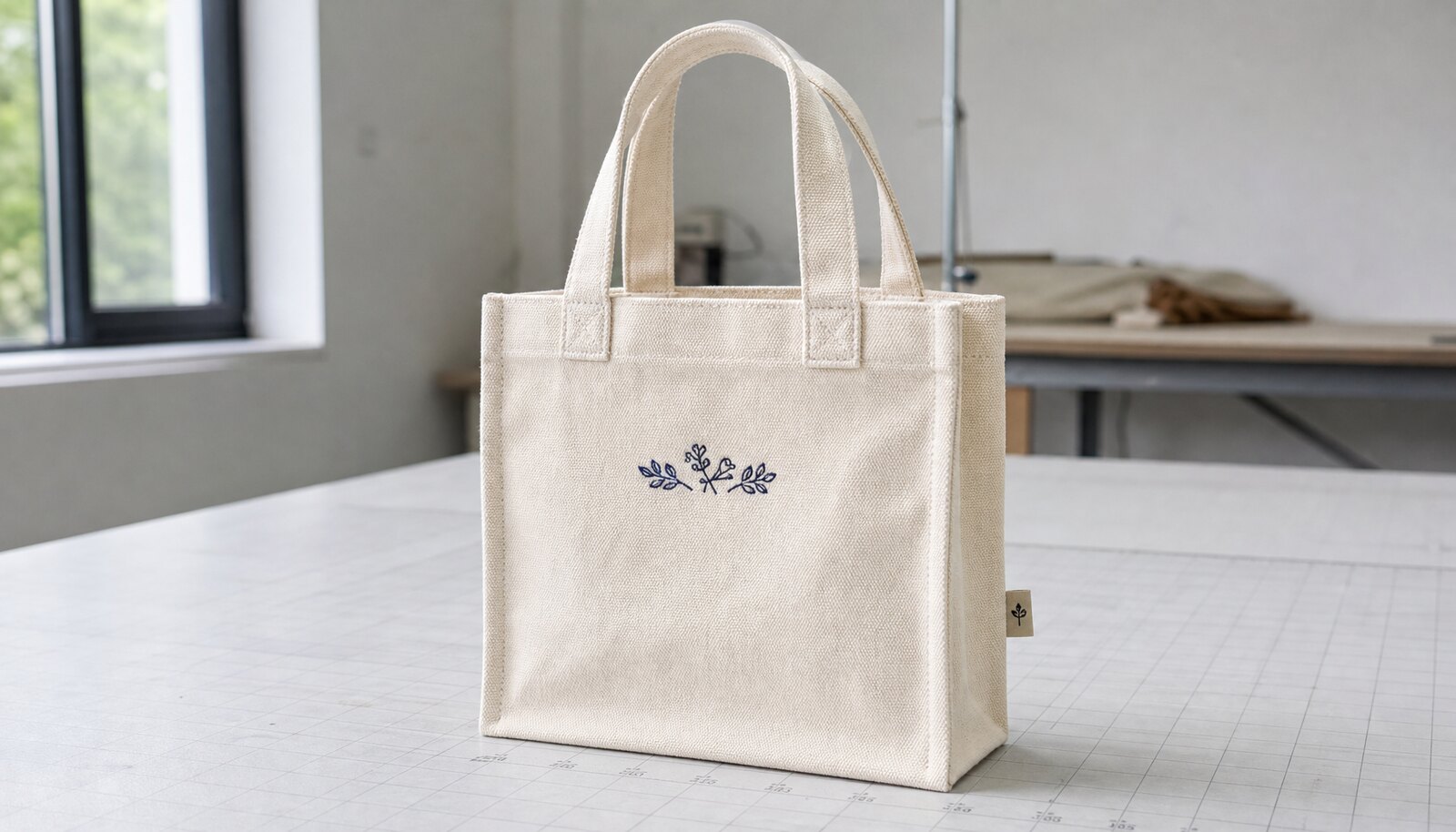
Start With The Use Case, Not The Logo
Canvas library tote bags for boutiques event giveaway planning go wrong when the buyer starts with artwork and ends with a bag that cannot do the job. The right first brief is operational: what will be carried, how long the bag should last, and where it will be handed out. A tote for a boutique launch, a book-heavy library event, and a retail purchase add-on are not the same item even if the front panel carries the same logo.
If the bag is expected to leave with catalogs, books, boxed samples, or a multi-piece gift set, the spec needs real structure. If it only carries cards, flyers, or a slim insert pack, a lighter bag may be enough. The carry load drives the gusset, the stitch pattern, and the handle reinforcement. The appearance target matters too: some programs need a plain natural canvas bag that feels practical, while others need a more retail-ready look with clean folding and a centered logo.
A useful internal brief fits on one page. It should say who gets the bag, what goes inside, whether it is meant to be reused, how the team wants it to fold on a table or shelf, and what event date is fixed. That brief becomes the baseline for all quotes and samples. Without it, the supplier will fill in the gaps with assumptions, and those assumptions usually become cost or delay later.
- Describe the bag in use, not in marketing language.
- List the actual contents and approximate weight.
- State whether the bag is a giveaway, a purchase add-on, or a retail item.
- Fix the event date and the latest acceptable arrival date.
- Identify whether the team values low cost, repeatability, or presentation first.
Choose Fabric Weight With Procurement Context
Fabric weight is the main performance and cost lever, but it should be treated as a finished specification, not a casual preference. In buyer screening terms, 8 oz canvas is often around 270 to 280 GSM, 10 oz around 340 to 350 GSM, and 12 oz around 400 to 410 GSM. Those are useful reference bands, not universal truths. Weave density, yarn type, washing, and finishing can shift the hand feel enough that two fabrics with the same nominal weight behave differently in use.
For most boutique and event giveaway programs, 10 oz is the safest default because it balances hand feel, durability, and freight weight. Eight ounce can work for lighter handouts, but it is easier for the contents to show through and easier for the bag to feel flimsy if it carries books or boxed items. Twelve ounce gives a more premium hand and stronger structure, but it raises sewing time, carton weight, and sometimes the risk that the tote feels too stiff for a quick event handoff.
Do not approve a bag on ounce alone. Ask whether the cloth is pre-shrunk, washed, or otherwise stabilized. A raw canvas may look fine in the sample room and still shrink enough to affect gusset depth or handle placement after packing or heat exposure. If the buyer wants a bag that stands upright, the fabric spec must be paired with a construction spec. Weight without stability is not a complete sourcing decision.
- Ask for finished fabric weight and the method used to measure it.
- Confirm whether the canvas is pre-shrunk, washed, or stabilized.
- Use the same fabric lot for the sample if possible; if not, document the substitution.
- Compare hand feel and opacity on the approved sample, not just the spec sheet.
Specify Construction, Not Just Dimensions
Construction is where a tote stops being generic. A flat bag with no gusset is cheaper and easier to pack, but it is a different product from a tote that must hold books and stand on a counter. If the bag must support a retail purchase, a deeper gusset and controlled panel squareness matter more than a vague request for sturdy construction. Size by itself does not tell the factory how the bag is supposed to perform.
Handle construction deserves the same level of specificity. The spec should state handle width, handle drop, attachment style, and reinforcement method. A short handle drop can make the bag look neat for hand carry, while a longer drop supports shoulder carry when the bag is loaded. Bartacks or a box-and-cross reinforcement pattern reduce the risk of pull-out, but they also require the factory to follow a defined stitch plan. If the buyer does not name that plan, the supplier may choose a cheaper version that still passes visual review but does not hold up in use.
Top hem width, seam allowance, and bottom reinforcement also influence the final bag more than many RFQs admit. A tote intended for books or product samples should not be approved from a flat sketch alone. The buyer should review a measured sample, loaded with the same contents the event team will actually carry. That is the fastest way to find out whether the tote is simply printable or genuinely usable.
- Lock handle width, handle drop, and reinforcement method before sampling.
- Ask whether the bag needs to stand upright when empty or when loaded.
- Check seam allowance and top hem width if the bag must look square and retail-ready.
- Test the sample with real contents, not just empty hand inspection.
Keep Decoration Simple And Repeatable
For this category, simple usually wins. A single-color screen print is still the workhorse choice because it gives strong contrast, predictable unit cost, and easier reordering. It also gives procurement a cleaner comparison because the setup cost is easy to see. For many boutique programs, a crisp logo on natural canvas does more for presentation than a complicated graphic that looks good on screen but prints weakly on fabric.
The buyer should control artwork like a production input. That means specifying print dimensions, placement window, file format, color reference, and whether the artwork appears on one side or both. The approval standard should not be 'looks centered.' It should say how far the print may move from the approved location, how opaque the ink must be, and what curing standard prevents rub-off. If the design includes fine lines or small type, ask the supplier whether the chosen screen mesh or print process can hold the detail cleanly.
If the brand wants a more retail feel, a woven label, side tab, or small patch can work better than a full-panel print. That does not make the bag cheaper or easier, so it should be quoted separately. Labels add sewing labor, can affect folding, and may change packing efficiency. A disciplined buyer treats decoration as part of the manufacturing spec, not as a last-minute design upgrade.
- Use one-color screen print unless the brand brief clearly justifies more complexity.
- Specify print placement tolerance and curing standard in the RFQ.
- Ask for a print proof on the same fabric and finish that will be used in bulk.
- Quote labels, patches, and other trims separately so the base tote price stays comparable.
Screen Suppliers By Region And Freight Term
The best supplier route depends on geography, freight structure, and who owns the risk. A direct factory is usually the strongest option when the buyer has a stable spec and enough volume to justify sample work. A trading company or sourcing agent can help when the order has multiple items, multiple pack formats, or a need for one coordinated contact. A domestic converter or regional decorator is often the right answer when the event date is tight and the order cannot absorb import lead time. None of these are automatically better; each one shifts cost, visibility, and control differently.
Region matters because it changes how you screen the supplier. In East Asia, buyers often need to verify whether sewing, cutting, and printing are really done in-house or pushed to subcontractors. In South or Southeast Asia, you may need to check whether fabric is locally sourced or imported, because that affects repeatability and lead time. In Mexico or other nearshore routes, the critical question is whether the converter can meet short lead times without losing consistency on fabric weight and print placement. In domestic programs, the main risk is less customs complexity and more limited material choice, higher unit price, and a narrower range of stock canvas weights.
Freight terms should be treated as part of supplier screening, not afterthoughts. EXW is useful only if your team can control pickup and export. FOB is often the clearest option for experienced importers because responsibility shifts at the port. CIF can be convenient, but the buyer should still verify how freight is booked and whether the numbers are realistic. DAP or DDP may work for smaller teams, but the customs and duty assumptions need to be documented in writing so the landed cost is not a surprise.
- Ask which factory owns each step of production if the supplier is not the sewing line itself.
- Verify whether the supplier can repeat the same material sourcing on reorder, not just the first run.
- Match the freight term to your internal logistics capability, not to the lowest quoted number.
- For import orders, confirm the destination-country compliance documents and the HS-code assumption early.
Write An RFQ That Produces Comparable Quotes
A useful RFQ does not try to be creative. It simply removes ambiguity. The supplier should receive the finished dimensions, fabric weight, print method, color count, packing format, delivery destination, and freight term in one package. If those items are missing, the quote will include hidden assumptions, and the team will end up comparing different products as if they were the same bag.
The quote should separate the price drivers. Ask for the base tote price, print setup, packaging labor, sample cost, and freight assumption as separate lines. Then ask for pricing at MOQ, at 2x MOQ, and at reorder volume. That structure tells you whether the factory is pricing the setup honestly or burying it in the unit cost. It also makes it easier to compare direct factory, trading company, and domestic converter quotes on a like-for-like basis.
A strong RFQ also asks what the supplier needs in order to hold the same spec next time. If the supplier cannot name the fabric source, the print process, or the packing pattern, the first quote may look attractive but be hard to reproduce. For procurement, repeatability is part of value. A tote that cannot be reordered without reworking the brief is more expensive than it first appears.
- Keep the RFQ to one specification sheet and one artwork file set.
- Ask for the same quote in MOQ, 2x MOQ, and reorder tiers.
- Require separate lines for setup, sampling, packing, and freight assumptions.
- State whether the supplier should quote with or without customs clearance and duties.
Approve Samples As A Manufacturing Gate
Sampling is not a courtesy step. It is the gate that decides whether the bulk order can be controlled. The pre-production sample should use the same fabric weight, thread, ink, and packing method planned for bulk. If any of those elements change, the sample no longer proves that the factory can repeat the item. A visually nice sample made from different inputs is not a meaningful approval tool.
The buyer should measure the sample against the written spec and then test it with the actual event load. A tote that looks balanced when empty can distort badly once it carries books, catalogs, or boxed samples. Handle stretch, seam pull, bottom sag, and print placement all need to be checked in the same review. If the sample is approved with dimensional drift, the production team usually carries that drift into the bulk run and then calls it normal variation.
Approval should be documented. Save the sealed sample, note the date and lot information, and state whether the bulk run must match that reference exactly or may use an approved substitution. If the supplier wants to change fabric source, ink formula, or packing format after approval, the buyer should treat that as a change request, not a routine production adjustment. That keeps the process clean and prevents 'small' substitutions from becoming quality complaints.
- Approve only after measuring the sample against the written spec.
- Test the sample with the actual contents the tote will carry.
- Keep a sealed reference sample and record the approved lot details.
- Treat any material or process substitution as a formal change request.
Set Quality Control Thresholds Before Bulk Starts
Quality control works only when the thresholds are written before production starts. For canvas totes, the first controls are dimension, fabric weight, stitch quality, print placement, and pack-out accuracy. The supplier should know exactly what counts as acceptable variation. If the factory is forced to guess, the inspection will turn into a negotiation after the bags are already made.
Use practical test methods. A dry rub test should show no visible ink transfer after 20 to 30 firm strokes on white cloth. A load test should use the actual event contents and hold for 10 to 15 minutes without seam opening or handle failure. For programs where the bag will be reused, repeated lift checks are useful because some construction passes one static test but fails after a few customer carries. If the buyer uses AQL or an internal inspection plan, tie those standards to the tote defects that matter most: seam failure, major print shift, wrong size, wrong pack count, and visible stain or shade variation.
The dimensional thresholds should be realistic and tied to the approved sample. For many programs, body dimensions within plus or minus 0.5 cm on smaller totes and plus or minus 1 cm on larger bags is a workable starting point, but the supplier should not treat that as a license to drift. More important is whether the final bag still folds correctly, carries the load, and keeps the logo positioned where the brand expects it. A technically acceptable bag that looks crooked on a table is still a bad procurement result.
- Use the sample as the physical reference for inspection.
- Define critical defects in advance: seam failure, major print shift, wrong size, wrong count, and visible staining.
- Check both first cartons and middle cartons so the run is not judged by only the best-packed units.
- Ask for photo inspection or third-party inspection if the order is large enough to justify it.
Plan Packing, Cartons, And Distribution Early
Packing format is a cost driver, not a warehouse detail. A bulk-packed event tote is much cheaper to handle than a retail-ready bag with a polybag, barcode, folded logo-out presentation, or insert card. Every extra packing step adds labor and sometimes increases carton volume. For boutique giveaways, bulk folded packing is often the cleanest route; for retail or shelf display, the supplier may need a different format. Those choices should be priced upfront instead of added after the sample is approved.
Carton count and carton dimensions must be specified before freight booking. A mid-size tote program might land in a carton roughly around 50 x 40 x 30 cm depending on the fold and count, but that example should never be treated as a default. Ask for gross weight, inner-pack count, and master carton count so the warehouse, freight forwarder, and event team all work from the same packing plan. If the shipment will move by air, volumetric weight can make carton size more important than unit price.
Distribution also matters. If the event team needs pallets, carton labels, barcodes, or split shipments to different locations, say so early. A bag that is cheap at the factory can become expensive when the supplier has to repack it to match a venue's receiving rules. The buyer should treat packing as part of the product spec, not as an operational footnote after the PO is issued.
- State the intended pack format: bulk, retail-ready, polybagged, or mixed.
- Ask for carton dimensions, gross weight, inner packs, and master carton counts before booking freight.
- Confirm whether palletizing, barcode application, or split shipment support is required.
- Make sure the pack count matches the event team’s distribution plan exactly.
Decide On Landed Cost And Reorder Risk
The cheapest ex-factory quote is not always the best buy. Once freight, duties, brokerage, sampling, packing labor, and possible rework are added, the lowest unit price can become the highest landed cost. This is especially true when the event is fixed and any delay forces rush freight. Procurement should compare landed cost, not just bag price.
The other hidden cost is reorder risk. A tote that is slightly cheaper on the first run but difficult to reproduce later is a poor choice for a boutique or event series. If the fabric hand changes, the print shifts, or the carton pattern changes on the next order, the buyer spends time requalifying what should have been a repeat item. A better supplier is the one that can repeat the approved bag with the same look, the same fit, and the same packing logic without reopening the entire brief.
For teams running recurring events, a simple scorecard helps. Track on-time sample approval, first-pass QC pass rate, claim response time, and reorder consistency. Those metrics are more useful than a single unit price because they tell you which supplier can actually support a purchasing program. For a tote that will be used repeatedly across events, consistency is part of the economics.
- Compare quotes on a landed-cost basis, not just an ex-factory basis.
- Keep the same fabric, print, and packing logic if the bag is meant to be reordered.
- Score suppliers on sample speed, QC pass rate, and repeatability, not only on price.
- Treat late freight or rework risk as part of the sourcing cost.
Specification comparison for buyers
| Buyer route | When it fits | Cost profile | What to verify before award |
|---|---|---|---|
| Direct factory in the source market | Stable repeat programs, enough volume for setup, and a team that can manage sample approval directly | Usually the best ex-factory price, but only if the spec is tight and the factory actually owns the sewing and print steps | Confirm which steps are in-house, who approves materials, what the production tolerance is, and whether the supplier can repeat the same fabric lot on reorder |
| Trading company or sourcing agent | Multi-item programs, buyers who want one contact, or teams that need help coordinating packaging and freight | Often higher than a direct factory, sometimes offset by cleaner coordination and fewer handoffs | Ask for the named factory, the exact production chain, and written responsibility for defects, delays, and QC follow-up |
| Domestic converter or regional decorator | Rush events, small runs, and jobs that cannot absorb import lead time | Highest unit price is common, but logistics and communication are simpler | Check print-area limits, stock fabric availability, delivery timing, and whether the decorator can match the same canvas weight on repeat orders |
| Material | 8-12 oz cotton canvas, 120-220 gsm cotton, recycled cotton, or blended fabric selected by use case and target price | Before price comparison | Different cloth weights, backing, or certification claims make quotes hard to compare |
| Construction | bag size, gusset, handle drop, seam allowance, stitch density, reinforcement patch, and loading expectation | Before sampling | Weak stress points create returns and failed inspections |
| Decoration | screen print, heat transfer, embroidery, woven label, or hangtag matched to fabric texture and brand durability needs | Before artwork approval | The wrong method can crack, bleed, pucker, or fail on the chosen fabric |
| MOQ | Base MOQ plus change drivers | During quote review | Custom colors, trims, and packing can change minimums |
| Sample | Physical sample with close-up photos | Before bulk cutting | Photo-only approval can miss hand feel and seam issues |
Buyer checklist before sampling
- Write the end use in one sentence: what will be carried, by whom, and whether the bag is a giveaway, retail add-on, or event handout.
- Lock the finished size, gusset depth, handle length, handle drop, and fold format before asking for prices.
- State the fabric as a finished spec, not a loose preference: basis weight, weave, finish, and whether the cloth must be pre-shrunk or washed.
- Give the supplier the artwork file, print size, Pantone or approved color reference, print sides, and the exact placement window.
- Tell the supplier the destination country, the intended freight term, and who is responsible for customs clearance and duties.
- Ask for MOQ, overrun and underrun tolerance, sample cost, setup cost, packing cost, and price breaks at 2x MOQ and reorder volume.
- Request a pre-production sample that uses the same fabric, thread, ink, and packing method planned for bulk.
- Define the load realistically with examples such as books, catalogs, boxed samples, or retail purchases.
- Specify packing details: bulk packed, folded logo-out, polybagged, barcode applied, inner pack count, and master carton count.
- Ask for the supplier's compliance documents and inspection method before awarding the order, not after production has started.
Factory quote questions to send
- What is the finished fabric weight, weave, and finishing, and what tolerance do you hold against the approved sample or mill spec?
- Which steps are in-house and which are outsourced for cutting, sewing, printing, packing, and freight coordination?
- Please quote the unit price at MOQ, 2x MOQ, and reorder volume, and separate setup, sample, packing, and freight assumptions line by line.
- What incoterm are you quoting, from which port or warehouse, and what customs, duty, or brokerage assumptions are included or excluded?
- What are your standard tolerances for body width, body height, gusset depth, and handle drop after production and after packing?
- What is the exact handle construction, including width, stitch pattern, bartack count, and reinforcement method?
- Which print method will you use, how many colors are included, and what placement tolerance will you guarantee?
- What load test, seam test, and rub test do you use for this bag construction, and can you share the inspection record or method?
- What carton count, carton dimensions, gross weight, and pallet pattern do you expect for the approved packing format?
- What documents can you provide for material composition, country of origin, and any destination-market compliance requirements that apply to this order?
Quality-control points to confirm
- Treat the approved sealed sample as the control standard unless the supplier can prove that a different lot is identical in weight, finish, and hand feel.
- Use finished fabric weight, not just nominal ounce claims, as the acceptance basis. As a screening reference only, many buyers treat 8 oz as roughly 270 to 280 GSM, 10 oz as roughly 340 to 350 GSM, and 12 oz as roughly 400 to 410 GSM, but weave and finish can change the feel enough that the sample still governs.
- Check body dimensions after the tote is folded and recovered, not only while it is flat on a table. For smaller totes, plus or minus 0.5 cm is often workable; for larger bodies, plus or minus 1 cm may be acceptable if packing still works.
- Measure gusset depth separately from total width so a hidden change in cut does not slip through as a general size pass.
- Inspect handle attachment for skipped stitches, thread breaks, uneven bartacks, or asymmetric placement. The handle should not visibly twist or creep after loading.
- Run a load test using the actual contents the bag will carry. Suspend the tote for 10 to 15 minutes, then check for seam opening, handle stretch, or permanent distortion.
- For reusable retail programs, add repeated lift checks so a bag that passes once does not fail after a few customer carries.
- Confirm print placement against the approved artwork window. A practical control band is often 3 to 5 mm for small logos and 5 to 8 mm for larger panels unless your brand standard is tighter.
- Perform a dry rub test after curing. A correct print should not smear, crack, or transfer visible ink after 20 to 30 firm strokes on white cloth.
- Inspect side seams, bottom seams, and top hems for puckering, raw yarns, needle cuts, shade variation, and oil marks. Any defect visible on the front panel should be treated as a real rejection risk, not a cosmetic preference.