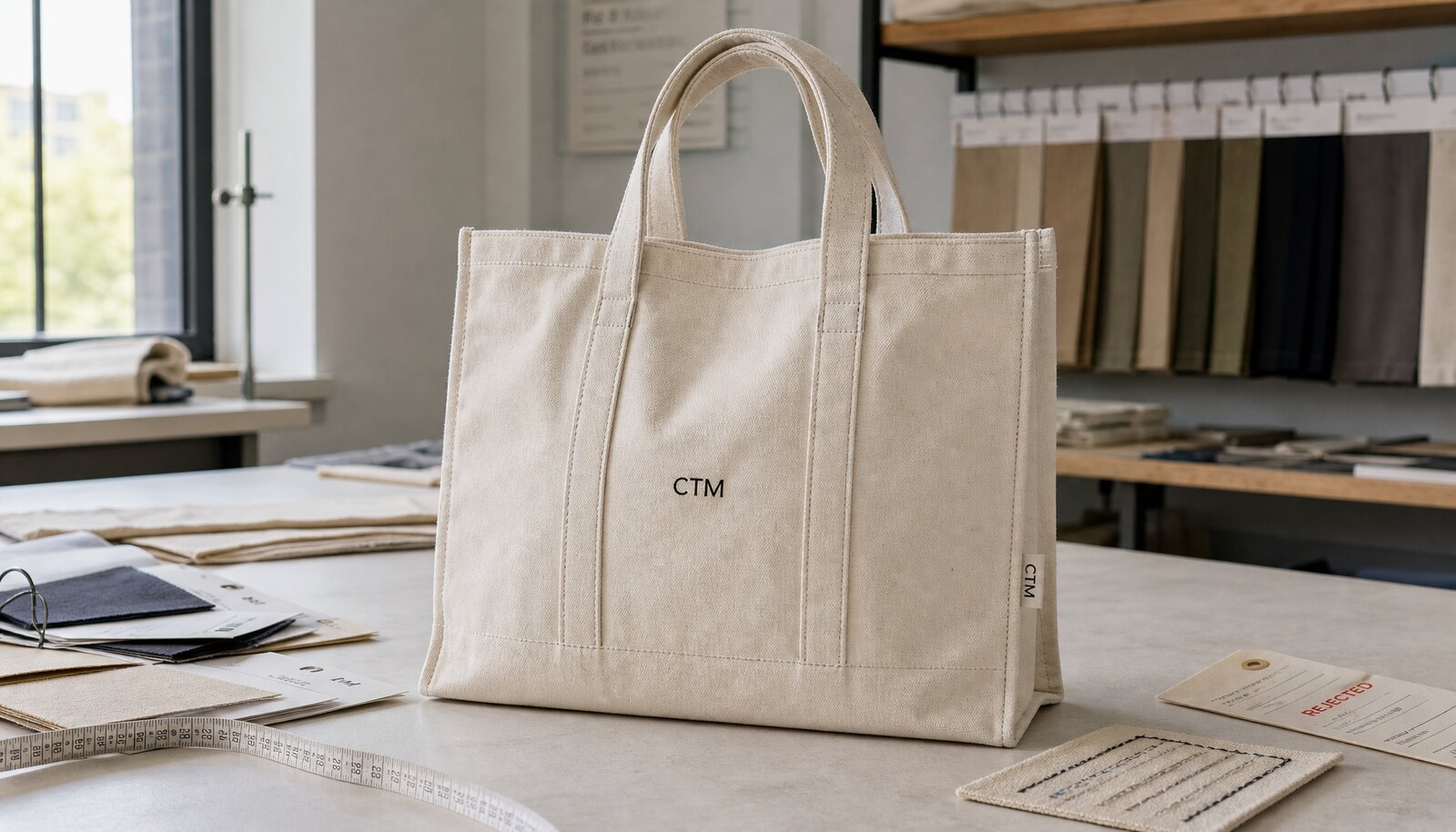
Why bookstore tote bags need a tighter QC spec
Canvas library tote bags for bookstores sit in a different category from ordinary promotional totes. They are sold at the counter, hung on pegs, photographed in product listings, and carried home with hardcovers, paperbacks, notebooks, and impulse purchases. That means the buyer is not just checking whether the bag exists. The buyer is checking whether it looks retail-ready, feels sturdy in hand, and stays visually consistent across the whole order.
The usual failure mode is not dramatic. It is a bag that looks acceptable in a supplier's sample photo but arrives with thinner cloth, looser stitching, a crooked logo, or handles that feel slightly too short once the tote is loaded. Those differences are enough to turn a reusable retail item into a complaint. A useful QC system for bookstore totes starts with one golden sample, one written spec sheet, and one defect list that both sides agree to before bulk production begins.
- Treat the tote as a retail product, not only as a carry bag.
- Use one sealed golden sample as the visual and dimensional reference.
- Reject any quote that cannot be tied back to measurable construction details.
Start with the use case, not the unit price
Bookstore tote programs are not all the same. A counter-sale tote needs shelf appeal and repeatability. A membership gift bag needs a clean print and good perceived value. An event tote can be lighter if the price point is low, but the handle still has to survive being filled with books or catalogues. If you do not define the use case, the factory will fill in the blanks with its cheapest assumption, and that is where most procurement mistakes start.
The load target matters because books create a dense, rectangular stress pattern. Unlike soft apparel, books push on the bottom seam, side seam, and handle anchor at the same time. Write down whether the tote must carry two books, a few hardcovers, or a heavier mixed stack. Then define whether the bag must stand on its own, fold flat for shelf display, or be packed as a retail item with a barcode and insert card. Those decisions change fabric, handle build, and packaging.
- Counter-sale and gift bags should prioritize shelf appearance and repeatability.
- Heavy book carriers need stronger handles and a more disciplined seam spec.
- If the bag is sold as a retail item, packing becomes part of quality.
Compare tote spec options before you compare factories
A useful buyer table should compare product decisions, not sourcing routes. The right question is not only who can make the bag. It is which tote construction best fits the bookstore program. For most buyers, the core choice is between lighter promo canvas, a balanced retail weight, and a heavier premium build. The wrong weight makes the bag either feel flimsy or become bulky and expensive to sew and pack.
Handles and decoration are the other two major spec drivers. Self-fabric handles usually keep the look clean, but they need more attention at the anchor point. Cotton webbing handles give better carry comfort and usually hold up better under load. For decoration, screen print is still the default for simple artwork because it is predictable at scale. Woven or sewn labels can be a better retail cue when the front panel is meant to stay visually clean.
- Use 10 oz / about 340 GSM only when the tote is intentionally light-duty.
- Use 12 oz / about 400 GSM as the default retail starting point.
- Use 14 oz / about 475 GSM when the bag needs a heavier hand and stronger structure.
- Choose webbing handles when durability matters more than a fully matched fabric look.
- Choose screen print when the art is simple and repeat orders are likely.
Fabric weight, weave, and sewing targets set the baseline
Do not accept words like 'heavy canvas' or 'good quality cotton' in a quote. Those phrases do not tell you whether the bag will be repeatable. Ask for GSM or ounce weight after finishing, the weave type, and any shrinkage allowance already built into the cut size. For a bookstore tote, a 12 oz or roughly 400 GSM canvas is a practical default because it balances body, cost, and sewing speed. A lighter 10 oz build can work for a promo tote, while a 14 oz build is better when the bag needs a more premium feel or a heavier load target.
Sewing quality should be written as a measurable standard. Main seams should target 7 to 9 stitches per inch, and handle anchors should be tighter at 8 to 10 stitches per inch if the supplier can hold that without puckering. Keep seam allowance consistent with the approved sample, commonly around 1 cm, and call out the reinforcement pattern at the handle anchor. A box-X or bartack is not optional on a load-bearing tote; it is the part that prevents a low-price bag from failing at the exact point customers stress first.
- Ask whether the fabric weight is measured before or after finishing.
- Require the supplier to state the stitch density on the body seam and the reinforcement area.
- Set a consistent seam allowance and inspect it against the golden sample.
- Reject visible skipped stitches, broken thread, or needle damage near load points.
Print and branding need their own durability rules
Print quality is a separate procurement topic, not a cosmetic extra. A bookstore tote often carries a logo, a quote, a title treatment, or line art that has to stay readable after folding and handling. Screen print is usually the cleanest option for simple artwork because it gives predictable ink laydown and cost control. If the design has small type or multiple colors, ask how the supplier keeps registration stable and whether the art will still be legible on the actual canvas texture, not only on a flat proof.
Heat transfer and similar decoration methods can work, but they need more scrutiny. On canvas, the question is not only whether the artwork looks sharp at first delivery. It is whether the print survives folding, rubbing, and normal retail handling without cracking, peeling, or becoming overly stiff. For that reason, ask for a simple dry-rub and fold test on the approved print. If the bag includes a woven label or side label, inspect label edge finish, placement tolerance, and whether the label sits straight after packing.
- Use screen print for flat logos and repeat programs.
- Use heat transfer only if the supplier can show durability on the same canvas construction.
- Require print placement tolerances for centering and top-seam distance.
- Check small text on the actual fabric, not only on the artwork file.
Dimensions and load testing stop most buyer disputes
Finished dimensions need to be written in the RFQ and measured on the approved sample, not left open to interpretation. Set the body width, height, gusset width, and handle drop, then decide what tolerance you can actually live with. For a retail tote, a body dimension tolerance around plus or minus 0.5 cm is usually reasonable when the bag must look consistent on a shelf. Handle drop should be tighter if shoulder carry matters, because a difference that looks minor on paper becomes obvious when the tote is full.
The bag should also be tested with real weight, not just visual inspection. A sensible internal test is a static hang at the intended load for at least 5 minutes, with 10 kg as a common baseline for standard retail use and 15 kg for heavier-duty programs if that matches the intended application. The exact number is less important than consistency: the test weight should match the way bookstore customers actually use the bag. Reject any sample that shows seam opening, handle elongation that changes the carry feel, or permanent distortion that makes the tote lose its retail shape.
- Measure both the flat bag and the bag after one real load cycle.
- Keep the handle drop consistent enough that the tote hangs evenly on the shoulder or peg.
- Define whether the bag must stand upright, fold flat, or relax into a softer shape.
- Treat visible distortion after the load test as a functional defect, not a cosmetic one.
Use AQL properly instead of treating QC as a slogan
A good inspection plan for canvas tote bags should name the standard, the sample logic, and the defect thresholds before production starts. The cleanest approach is to use ANSI/ASQ Z1.4 or ISO 2859-1, General Inspection Level II, with a single-sampling plan unless your company already uses a different method. Critical defects should have zero tolerance. For major and minor defects, write the AQL levels into the PO or quality agreement so the factory cannot reinterpret them after a problem appears.
The important part is classification. Critical defects are the ones that make the bag unsafe, unusable, or unfit for sale, such as torn load-bearing seams, missing handles, severe contamination, or the wrong SKU or color. Major defects are the ones customers will notice immediately or that weaken function, such as crooked logos, short handles, off-spec dimensions, or weak reinforcement. Minor defects are small issues like loose threads or light fold marks, but even those should be capped through the AQL table rather than handled informally. If this is a pilot order, inspect more aggressively or fully inspect the first lot before releasing the full program.
- Use a named standard such as ANSI/ASQ Z1.4 or ISO 2859-1.
- Set critical defects to zero tolerance.
- Write major and minor AQL limits into the PO, not into a separate conversation.
- For pilot runs, consider 100% inspection or extra first-carton checks.
Approve samples as production evidence, not as marketing props
A pre-production sample only helps if it matches what the bulk line will actually make. That means the sample should use the final fabric, final thread color, final print method, final label, and final packing method. A prettier hand sample that hides production shortcuts is not an approval sample. It is a misleading reference. The supplier should submit the sample with the same PO number, revision, and construction notes that will govern the bulk order.
Once the sample is approved, lock it down. Keep one sealed reference at your end and one at the factory line if possible. Record dimensions, stitch density, handle drop, print placement, and packaging details on the approval sheet. If the supplier changes fabric lot, decoration method, or packing format later, require explicit signoff before they proceed. That simple control prevents a surprising number of disputes because the conversation is anchored to a physical sample instead of a vague email trail.
- Approve only the final construction, not a nicer prototype.
- Record measurements and construction notes on the signed sample sheet.
- Treat any material or packing change as a formal revision.
- Ask for first-off photos when the line starts sewing and packing.
Packing details can damage retail value before the box is opened
Packing is part of product quality for bookstore totes. A crisp print can still arrive with hard fold lines, scuffed surfaces, or mixed units if the packing standard is loose. Write the fold direction, whether the bag is polybagged, where the barcode sits, and whether an insert card or hangtag is included. If the tote is meant for direct retail, its first impression on opening the carton should be clean and repeatable, not just protected enough to survive transit.
Carton discipline matters as much as the bag itself. Ask for carton count, carton dimensions, gross weight, and master carton marks before the order ships. If the route is ocean freight or long warehouse storage, request moisture protection that fits the material and packing method. Most of the problems buyers see in receiving are not catastrophic failures. They are mixed sizes, mixed colors, crushed folds, or cartons that are packed so tightly that the tote never fully recovers its shape. Those are avoidable problems, and the spec should say so.
- Specify fold method, carton count, and label placement.
- Do not over-compress a retail tote just to fit more pieces per carton.
- Ask for carton photos from the packing line before shipment closes.
- Make sure warehouse teams know the expected gross weight and carton size.
Use quote questions to expose hidden cost and risk
A comparable quote should show the construction, the decoration, the inspection standard, and the packing detail. If it does not, the supplier is not quoting the same product you are buying. Low unit price can hide lower fabric weight, fewer stitches, simpler reinforcement, or packing that will cost money later in rework. The only safe comparison is a quote that lists the exact fabric, stitch standard, print method, carton pack, and inspection method in a way you can line up side by side.
Lead time should be broken into stages, not delivered as one vague number. Ask for the time needed for sample approval, material booking, sewing, printing, packing, and shipment handoff. That matters because custom dyeing, multi-color print, extra labels, or retail-ready packing can each move a schedule. Whether you buy from a direct factory or through an agent, ask who owns sewing, who owns printing, and who signs off on QC. The right supplier is the one that can show process control, not just a low quote.
- Compare quotes only after the fabric, print, stitch, and pack spec is fixed.
- Require stage timing instead of one all-in lead time.
- Ask who owns the sewing line, print line, and final inspection.
- Push back on any quote that excludes overage, testing, or packing labor.
Specification comparison for buyers
| Spec decision | Recommended option | When it fits | Buyer risk to check |
|---|---|---|---|
| 10 oz / about 340 GSM canvas | Best for lighter bookstore merch, event giveaways, or entry-price programs | You want a lower-cost tote and do not expect heavy daily book loads | Check for seam show-through, softer handle feel, and weak body recovery after loading |
| 12 oz / about 400 GSM canvas | Best all-around retail spec for most bookstore programs | You need a balance of hand feel, durability, and acceptable sewing speed | Confirm the actual finished weight, not just the supplier's generic 'heavy canvas' description |
| 14 oz / about 475 GSM canvas | Best for premium bags or heavier book loads | You want a more substantial retail feel and better structure on the shelf | Watch fold bulk, sewing speed, and whether the supplier can still hold clean seam lines |
| Self-fabric handles | Clean look and lower material cost | You want the tote to look cohesive and are not pushing extreme load use | Verify handle stretch, edge finish, and reinforcement at the anchor points |
| Cotton webbing handles | Strongest carry feel and better resistance to edge wear | You expect repeated use, heavier books, or long handle life | Check webbing width, hand feel, and whether the anchor stitch pattern is wide enough |
| Screen print | Best for simple logos, quotes, and repeat orders | Your artwork is flat, one- to two-color, and needs predictable cost | Inspect registration, cure quality, opacity, and whether the print cracks when folded |
| Woven or sewn label | Good for shelf appeal and brand control | You want a more retail look without relying on a large front print | Check label edge finish, placement tolerance, and whether it frays after handling |
Buyer checklist before sampling
- Write the use case first: counter sale, gift item, membership perk, event tote, or heavy book carrier.
- Lock the fabric spec in GSM or oz weight, weave type, finish, and acceptable shade range before asking for pricing.
- Set finished body size, gusset width, handle length, and handle drop in the RFQ so suppliers do not quote different constructions.
- Define the load target in plain terms, such as standard retail load or heavy-book load, and convert that into a test weight.
- Choose the print method by artwork complexity and durability need, not by unit price alone.
- Require a pre-production sample made from the final fabric, final thread, final print method, and final label or side tag.
- Write stitch targets into the spec: main seams, reinforcement areas, and any visible topstitch lines.
- State the seam tolerance, dimensional tolerance, and acceptable shade variation before production starts.
- Specify folding method, polybag use, barcode placement, carton pack count, and master carton marks.
- Ask for lead time split into sample, bulk sewing, decoration, packing, and ship-out so delays are visible.
Factory quote questions to send
- What is the exact fabric weight after finishing, and how was it measured?
- What is the weave, finish, and shrinkage allowance for the approved fabric?
- What are the finished dimensions, gusset width, handle length, and handle drop on the sample?
- What is the main seam stitch density, and what stitch pattern is used at the handle anchors?
- What seam allowance do you hold in production, and what tolerance can you actually maintain?
- What print method will be used, how is the ink cured, and what durability test do you run on the print?
- What is the exact packing method, including folding, polybag, barcode, insert card, and carton count?
- What inspection standard do you use, such as ANSI/ASQ Z1.4 or ISO 2859-1, and what AQL levels apply to critical, major, and minor defects?
- What sample size logic do you use for the first inspection, and when would you switch to 100% inspection on a pilot lot?
- What is the MOQ at 500, 1,000, 3,000, and 5,000 pieces, and what changes at each tier?
Quality-control points to confirm
- Fabric matches the approved weight and no thin spots are visible at the seam folds or handle anchors.
- Main seams hold at 7 to 9 SPI, and handle reinforcement holds at 8 to 10 SPI unless your approved spec says otherwise.
- Body seam allowance stays consistent to within the approved sample, and the seam line does not wander visibly on the front panel.
- Finished body dimensions stay within the written tolerance, commonly tighter on premium retail bags than on promo bags.
- Handle length and handle drop stay within the written tolerance, and both handles match each other within the same bag.
- Reinforcement at the handle anchor uses the approved pattern, such as box-X or bartack, and no skipped stitches appear in that area.
- Print is centered, aligned, and cured properly, with no ghosting, flaking, bleeding, or incomplete opacity.
- Visible retail surfaces are clean, dry, and free of oil marks, contamination, odor, or obvious needle damage.
- A static load test at the target weight shows no seam opening, handle tear, or permanent distortion that affects resale value.
- Critical defects have zero tolerance, and the sample is rejected if any critical defect appears.