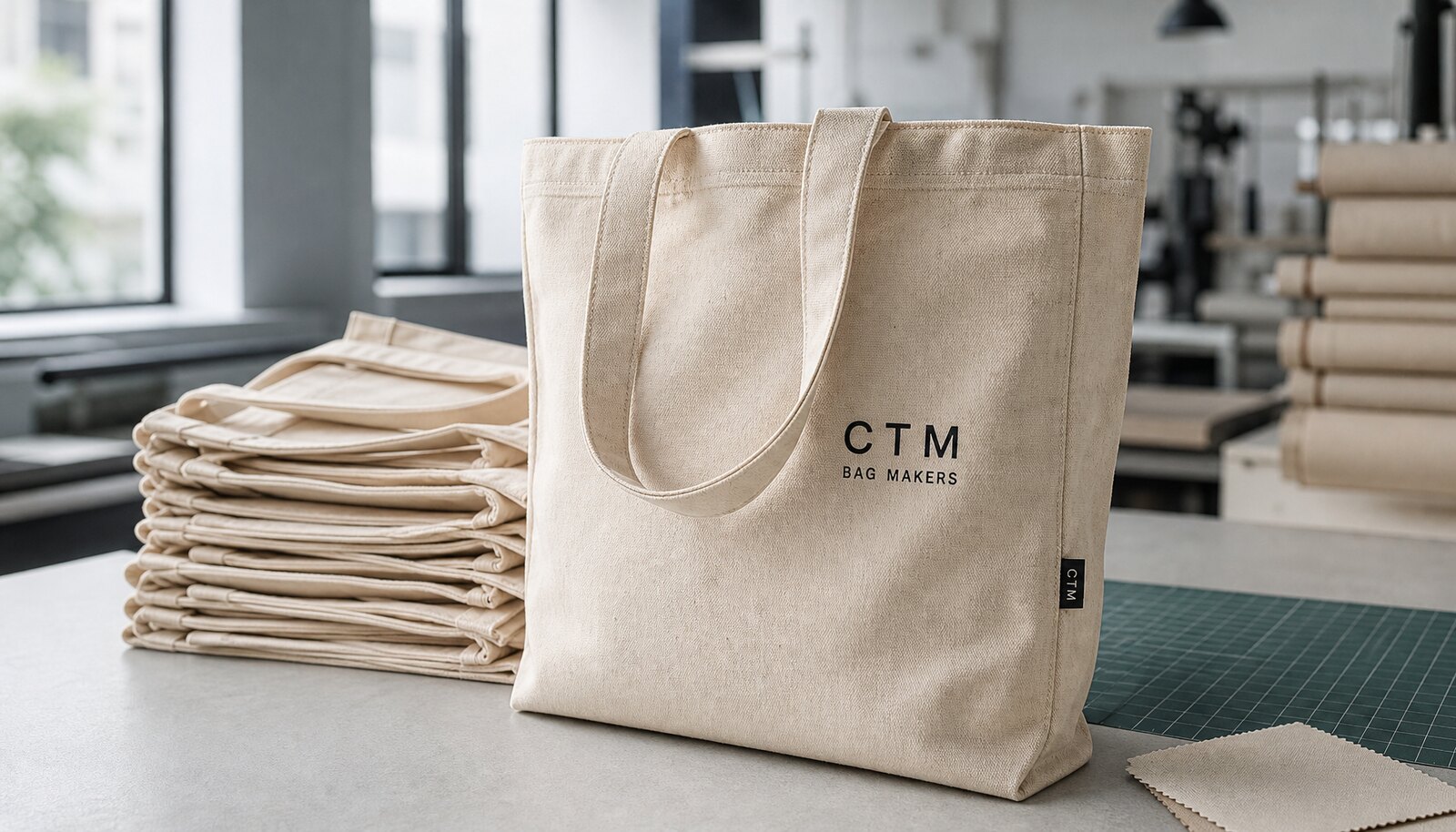
Why these totes are easier to spec than to source well
A canvas library tote bag looks simple from the outside, but for a bookstore buyer it is a small manufacturing program. The artwork is usually uncomplicated. The real sourcing variables are the ones that sit underneath the artwork: fabric weight, seam reinforcement, handle construction, print method, pack style, and whether the order is built from stock blanks or cut and sewn from fresh fabric. Those choices drive the commercial outcome far more than the logo file does.
That is why MOQ and lead time need to be reviewed together. A low MOQ can hide a slow schedule if the factory has to source fabric or set up decoration from scratch. A short lead time can hide a higher MOQ if the supplier only accelerates standard stock. The right question is not which supplier gives the smallest number. It is which route gives the bookstore a repeatable spec, a credible schedule, and a clear path to reorders.
For a buyer, the first task is to separate what is fixed from what is flexible. If size, fabric weight, and print placement are still moving, a quote is only a placeholder. If those items are locked, the factory can price the order, estimate the production slot, and tell you whether the project belongs in a stock-decorated route or a true cut-and-sew program.
- Treat the tote as a production spec, not only as branded merchandise.
- Separate production time from ocean or domestic transit time.
- Lock the physical spec before you compare unit prices.
What a defensible bookstore spec usually looks like
For bookstores, a practical starting point is a medium-weight tote with enough structure to carry hardcovers without collapsing. A common planning band is 35-38 cm wide by 40-42 cm high with an 8-10 cm gusset, natural canvas around 12 oz, and a single front print. If the tote will be sold at retail rather than given away, 14 oz canvas or a more substantial handle can improve shelf presence and make the bag feel less promotional.
Handle drop matters as much as the bag body. A tote can look correct when laid flat and still feel wrong on the shoulder if the drop is too short or too long. Buyers should specify the finished handle drop, not only the handle length or the artwork zone. The same logic applies to the front panel: if the logo has to sit above the bottom seam or clear a gusset fold, the quote should reference that location in centimeters rather than using vague language like centered or aligned.
Canvas color is another decision that looks minor but affects both quality and price. Natural or unbleached canvas gives a softer, more organic feel and usually works well for bookstore branding. Bleached or white canvas provides cleaner color contrast for print, but it may introduce more shade control and slightly more process sensitivity. If the tote is meant to feel premium on a shelf, the fabric finish and print contrast need to be selected together.
- Specify finished dimensions and handle drop in centimeters.
- State the print safe area relative to seams and folds.
- Decide whether the tote is a utility bag, a retail item, or both.
Choosing the supplier route without getting a false apples-to-apples quote
The sourcing route determines how much of the tote is already decided before you ask for a quote. A direct factory can hold a spec tightly, but it usually wants a cleaner order and less variation. A stock blank decorator can move fast and lower the first-order quantity, but the buyer is limited by what is already on hand. Trading companies can bridge smaller orders and multiple factories, but they add another layer where sample ownership, revision control, and delivery accountability have to be managed carefully.
Local printers and converters are useful when speed matters more than manufacturing flexibility. They are often the fastest path for a simple logo on a blank tote, especially if they already hold stock. They are not the best route when you need a specific canvas weight, custom handle reinforcement, or a repeatable factory-style carton pack. If the tote is going into bookstore retail inventory, the supplier type should be chosen around shelf quality and reorder discipline, not only around the first invoice.
The comparison table below is most useful when you read it as a production map. It shows where the MOQ is actually coming from, how much schedule risk is built into the route, and where the buyer loses or gains control. The cheapest quote is not always the best quote if the underlying route cannot reproduce the same bag twice.
- Direct factory is usually the best path for repeatable SKUs.
- Stock blank decoration is usually the fastest path for a small test order.
- Trading routes add convenience, but they also add another layer of spec management.
The spec choices that move price and schedule fastest
Fabric weight is the first big lever. A 10 oz tote can be acceptable for flyers, paperbacks, or light promo use, but it starts to feel thin once the bag is expected to carry heavier books. Twelve ounce canvas is usually the middle ground for bookstore use because it keeps the bag upright without being unnecessarily heavy. Fourteen ounce canvas gives a more substantial hand feel and better shape retention, but it increases material usage and usually slows sewing slightly because the fabric is stiffer to handle. If the supplier can quote GSM as well as ounce weight, that makes cross-comparison easier.
Print method is the second major lever. One-color screen print is still the most stable and procurement-friendly option for simple bookstore branding because the setup is predictable and the finish is durable. Adding a second color means another screen, another alignment step, and more reject risk if the artwork is tight. Heat transfer and digital methods can be useful for short runs or more complex art, but they can feel less natural on textured canvas and may need a stricter review of adhesion and rub resistance.
Handle and reinforcement decisions can swing both cost and user experience. Self-fabric handles may keep the look clean, while cotton webbing handles usually feel more robust in daily use. Either way, the bag should specify the reinforcement at the attachment point, not just the handle material. Ask whether the factory uses bartacks, X-box reinforcement, or another stitch pattern, and define the expected load class if the tote is meant to carry hardcover books or bundled merchandise.
- Heavier canvas improves structure but usually adds cost and sewing time.
- Each extra print color adds setup, alignment, and inspection effort.
- Handle reinforcement should be part of the spec, not left to factory preference.
How MOQ is actually built in a tote program
MOQ is not a random number. It comes from changeover cost, material planning, and how much the factory has to interrupt its normal line to make your bag. Cutting new panels, making screens, reserving canvas rolls, sewing custom handles, and inserting labels all create setup work. The more of those items that are custom, the less likely the factory is to accept a very small run at a clean price.
For planning purposes, it helps to think in bands rather than in one universal minimum. A stock blank decorated order can often live in the 100-500 piece range because the bag body already exists. A standard factory-direct custom tote often starts to make sense around 1,000-3,000 pieces when the bag is simple, the print is one color, and the packing is basic. Once dyeing, lining, multiple labels, or special folding enter the spec, the factory may need 3,000 pieces or more to keep the line efficient. Those are planning bands, not universal rules, but they are useful when a buyer is trying to estimate whether a first run is realistic.
The cleanest way to reduce MOQ is to reduce variation. Keep the shape standard, choose natural canvas, print one side only, and avoid adding trims that require extra labor. If you need to test the market, separate the pilot into a blank sample plus a small decorated run rather than asking the factory to treat a pilot as a fully bespoke program. That approach usually produces a better quote and a faster answer.
- Reduce variation if you want the lowest practical MOQ.
- Custom dye, lining, and multiple labels push minimums up quickly.
- Use stock blanks for test orders when speed matters more than full spec control.
Lead time review, stage by stage, instead of as one vague promise
A standard custom canvas tote with one-color print often moves from sample approval to ex-factory shipment in roughly 25-40 days when the fabric is available and the factory is working from a settled spec. That range is more useful than a single headline number because it reflects the real steps that must happen before the cartons leave the line. If the order uses stock blanks, a decorated run can be faster, sometimes 7-20 business days after art approval. If the tote needs fresh fabric, multiple print colors, or custom labels, the schedule usually expands.
A buyer should ask the factory to break lead time into stages. Spec lock and costing often take 1-3 days if the brief is complete. A blank sample may take 3-7 days when no custom fabric is involved. Screen preparation and decorated sample work can take another 3-7 days depending on the art and the factory's queue. Sewing and printing often take 10-20 days for a normal run, followed by 2-5 days for final inspection and packing. That does not include freight, customs, or inland delivery, which should always be written separately.
The main schedule risks are predictable. Fresh dye lots, wash processing, retail folding, special label sewing, and peak-season factory workload all add time. The other common risk is approval delay on the buyer side. If the decorated sample sits waiting for internal sign-off, the production slot can slip even if the factory is ready. A clear approval deadline protects both parties and keeps the tote from missing a seasonal bookstore launch.
- Write lead time as sample approval to ex-factory, not order date to arrival date.
- Treat transit, customs, and inland delivery as separate line items.
- Expect longer schedules when the spec adds dyeing, lining, or retail-ready packing.
Sample approval should catch the cheap mistakes before mass production
The sample process should start with structure, not decoration. A blank sample confirms the bag size, gusset, handle feel, seam geometry, and fold. Only after the structure is accepted should the buyer spend time reviewing the decorated sample. This matters because some print methods change the hand feel or slightly alter the visible panel width, especially on textured canvas. If the tote will sit on a shelf in a bookstore, the fold and front-panel presentation are part of the product, not just packaging detail.
The most useful sample checks are practical. Load the bag with a known set of books or a comparable weight, then check whether the handles sit comfortably in the hand and whether the bag still looks square when filled. Measure the size after the sample has relaxed, not only immediately after unboxing. Look at the print from normal viewing distance and also up close for pinholes, ink bleed, or edge fuzz. If the design depends on precise placement, record the distance from seam to logo on the approved sample so the production team has a clear reference.
The approval note should distinguish between what was accepted and what still needs control. A buyer can approve the bag structure while still asking for better print centering or tighter thread trimming. That separation prevents the factory from treating one sample as a blanket approval for every aspect of the tote.
- Approve the blank sample first if size or structure is still in question.
- Use a real book load or a fixed test weight for every sample you compare.
- Record the approved measurement, print location, and fold format as the control reference.
QC and inspection details that belong in the purchase order
Buyers get better results when tolerances are written into the spec sheet before production starts. Critical dimensions should have a numeric band, not a vague note that the bag must be accurate. A half-centimeter class tolerance on width and height is a practical starting point for many tote programs, while gusset tolerance can be slightly wider depending on the sewing method. Print position should be referenced from seam and centerline in centimeters so the decorator knows what centered actually means in production terms.
Defect classification should also be settled in advance. Major defects usually include broken seams, missing reinforcement, wrong size outside tolerance, wrong color, or print misregistration that is obvious at normal viewing distance. Minor defects are the smaller issues that do not change use but do affect presentation, such as loose threads, small ink specks, or slightly uneven folding. If the tote is going directly onto a retail shelf, carton condition matters too. Moisture, odor, crushed handles, and distorted folds can turn a technically acceptable tote into a poor retail item.
Ask the factory what inspection system it uses and whether it can provide a final report tied to the exact style, carton count, and production date. If the buyer uses AQL internally, align the major and minor defect limits before the first run. The goal is not to create paperwork for its own sake. The goal is to stop arguments over whether a warped seam or a shifted logo should have been caught on the line.
- Write dimension, print position, and fold tolerances into the spec sheet.
- Define major and minor defects before production starts.
- Ask for carton-level checks, not only bag-level inspection photos.
Reading a quote line by line instead of comparing only the bag price
Two tote quotes can look similar until the full cost stack is visible. One supplier may quote a low base bag price but add separate charges for print setup, label insertion, packing, carton marks, or sample handling. Another may have a slightly higher bag price but include a cleaner process with fewer surprises. For bookstore buyers, the only useful comparison is total landed cost on the same spec sheet. If one quote hides packing inside the unit price and another breaks it out, the prices are not directly comparable until you normalize them.
The most common cost drivers are easy to name once you know where to look. A second print color adds another screen and another setup step. A large ink flood area uses more material and increases reject risk. Woven labels, barcode stickers, and retail hangtags all add labor. Individual polybags and retail folding add both cost and time. Custom dye, wash processing, and special thread color add still more. None of those items is inherently bad, but each one should be a conscious choice rather than a surprise buried in a unit price.
A useful quote request asks for three price breaks by quantity and states exactly what changes at each break. That lets the buyer see whether the price is dropping because the factory is genuinely more efficient or because it is assuming a looser spec, a cheaper pack method, or a different decoration approach. If the factory cannot itemize the quote, it is harder to compare suppliers and harder to protect the reorder.
- Compare base bag, decoration, packing, labels, and carton marks separately.
- Ask for three quantity breaks instead of one target price only.
- Check whether the quote includes ex-factory only or any inland charges as well.
The buyer checklist before sign-off
Before you issue a purchase order, the tote needs a spec sheet that a factory can actually build from. The point is not to create more paperwork. The point is to make the production path obvious enough that the factory can quote accurately and the buyer can verify what should arrive. If the bookstore plans to reorder the same tote later, this document also becomes the control point for repeat business, so it should be specific enough to survive a change of salesperson or supplier contact.
The checklist below is the shortest path to that level of control. It covers the physical spec, the print method, the pack method, and the quality standard. If any of those items are left open, the factory will fill the gap with its own default, and the quote may look fine while the delivered bag misses the bookstore's actual requirement. The better the brief, the fewer sample loops and the cleaner the reorder.
- Finished size, gusset depth, and handle drop in centimeters
- Fabric weight and fabric finish, including natural, bleached, or dyed canvas
- Handle material, handle width, and reinforcement pattern
- Print method, number of colors, print placement, and safe area from seams
- Artwork file plus brand color reference if color matching matters
- Label and trim requirements, including woven label, care label, barcode, or hangtag
- Packing method, carton quantity, carton marks, and whether polybags are required
- Tolerance band for size, print position, stitch alignment, and fabric shade
- Sample approval sequence: blank sample first, decorated sample second if needed
- Lead time written as sample approval to ex-factory, with transit excluded
Specification comparison for buyers
| Supplier route | Typical MOQ behavior | Typical lead-time behavior | Operational tradeoff |
|---|---|---|---|
| Direct factory | Often 1,000-3,000 pcs for a standard 12 oz tote with one-color print; can be lower if the factory already stocks a matching blank | Usually 25-40 days after sample approval when fabric and screens are ready | Best control over fabric lot, seam detail, and reorder consistency; less flexible on very small pilots |
| Stock blank decorator | Often 100-500 pcs because the base tote is already made | Usually 7-20 business days after art approval if the blank stock is on hand | Fastest route for seasonal tests; limited by available bag colors, sizes, and handle styles |
| Trading company | Can sometimes piece together smaller lots, often 300-1,000 pcs, by placing the order with a partner factory | Lead time depends on the downstream factory and may be harder to lock until the order is placed | Useful when you need one contact and broader sourcing options; spec control and change tracking must be tight |
| Local printer or converter | Best for short runs, often 50-300 pcs, especially if the decorator owns blank stock | Very fast for simple print jobs, but sewing or custom fabric changes can slow them down | Good for urgent promotions; less suitable when you need detailed sewing control or repeatable factory-scale pricing |
| Material | 8-12 oz cotton canvas, 120-220 gsm cotton, recycled cotton, or blended fabric selected by use case and target price | Before price comparison | Different cloth weights, backing, or certification claims make quotes hard to compare |
| Construction | bag size, gusset, handle drop, seam allowance, stitch density, reinforcement patch, and loading expectation | Before sampling | Weak stress points create returns and failed inspections |
| Decoration | screen print, heat transfer, embroidery, woven label, or hangtag matched to fabric texture and brand durability needs | Before artwork approval | The wrong method can crack, bleed, pucker, or fail on the chosen fabric |
| MOQ | Base MOQ plus change drivers | During quote review | Custom colors, trims, and packing can change minimums |
Buyer checklist before sampling
- Lock finished bag width, height, gusset, and handle drop in centimeters before asking for price.
- State fabric weight in oz/yd2 or GSM and note whether the canvas is natural, bleached, or dyed.
- Specify handle material, handle width, and the reinforcement style at the handle attachment point.
- Give the print method, print colors, print size, and the exact placement relative to seams and centerline.
- Flag whether the artwork includes small type, thin lines, halftones, or a large flood area that may affect print quality.
- Define any label requirements, including woven label, care label, barcode sticker, hangtag, or none.
- Write the packing requirement clearly, including bulk pack, individual polybag, retail fold, carton quantity, and carton marks.
- Ask for a blank sample first when size and structure are still under review, then a decorated sample if the print method changes the hand feel.
- Set acceptable tolerances for finished dimensions, print position, stitch alignment, and fabric shade variation.
- Separate production lead time from transit time and state the target as sample approval to ex-factory date.
Factory quote questions to send
- What is the MOQ for this exact size, fabric weight, handle spec, and print method, and what changes if we add a woven label or change the packing style?
- Can you itemize the quote by base bag, cutting, sewing, printing, labels, packing, carton marks, and any inspection or sample charge?
- What lead time do you commit to from sample approval to ex-factory shipment, and which step is most likely to extend the schedule?
- Are the bags made from the same fabric lot, and how do you control shade variation across cartons and reorders?
- What tolerance do you hold for finished dimensions, handle drop, and print placement, and how do you measure them in production?
- What load test or seam-strength check do you use for tote bags that carry books, and can you share the method rather than only a pass or fail note?
- Can you provide both a blank pre-production sample and a decorated sample before mass production starts?
- Do you retain the artwork file, spec sheet, carton pack, and approved sample reference for repeat orders?
- What AQL or inspection standard do you use for major and minor defects, and can you show the defect list before production?
- If we reorder later, what items stay fixed and what items will need a new approval or new cost?
Quality-control points to confirm
- Set critical dimension tolerances in the spec sheet rather than leaving the factory to interpret 'close enough'; a half-centimeter class on width and height is a practical starting point for many tote programs.
- Measure the bag after trimming and sewing, not on a flat cut panel, because the sewn product is what the buyer receives.
- Define print position from seam and centerline in centimeters so the decorator can reproduce it consistently across cartons and reorders.
- Ask the factory which load test it uses for book totes and require the method to match the expected use case rather than a generic pull check.
- Check for stitch consistency, skipped stitches, and reinforcement quality at the handle attachment points, especially where the tote will take a heavy stack of books.
- Inspect the print under normal viewing distance for registration, ink coverage, pinholes, and edge fuzz, and add a dry rub test if the artwork uses dark ink on light canvas.
- Classify defects as major or minor before production starts so the final inspector is not making judgment calls on the line.
- Check carton condition, moisture, odor, handle crush, and fold quality on top, middle, and bottom cartons from the lot before accepting the shipment.