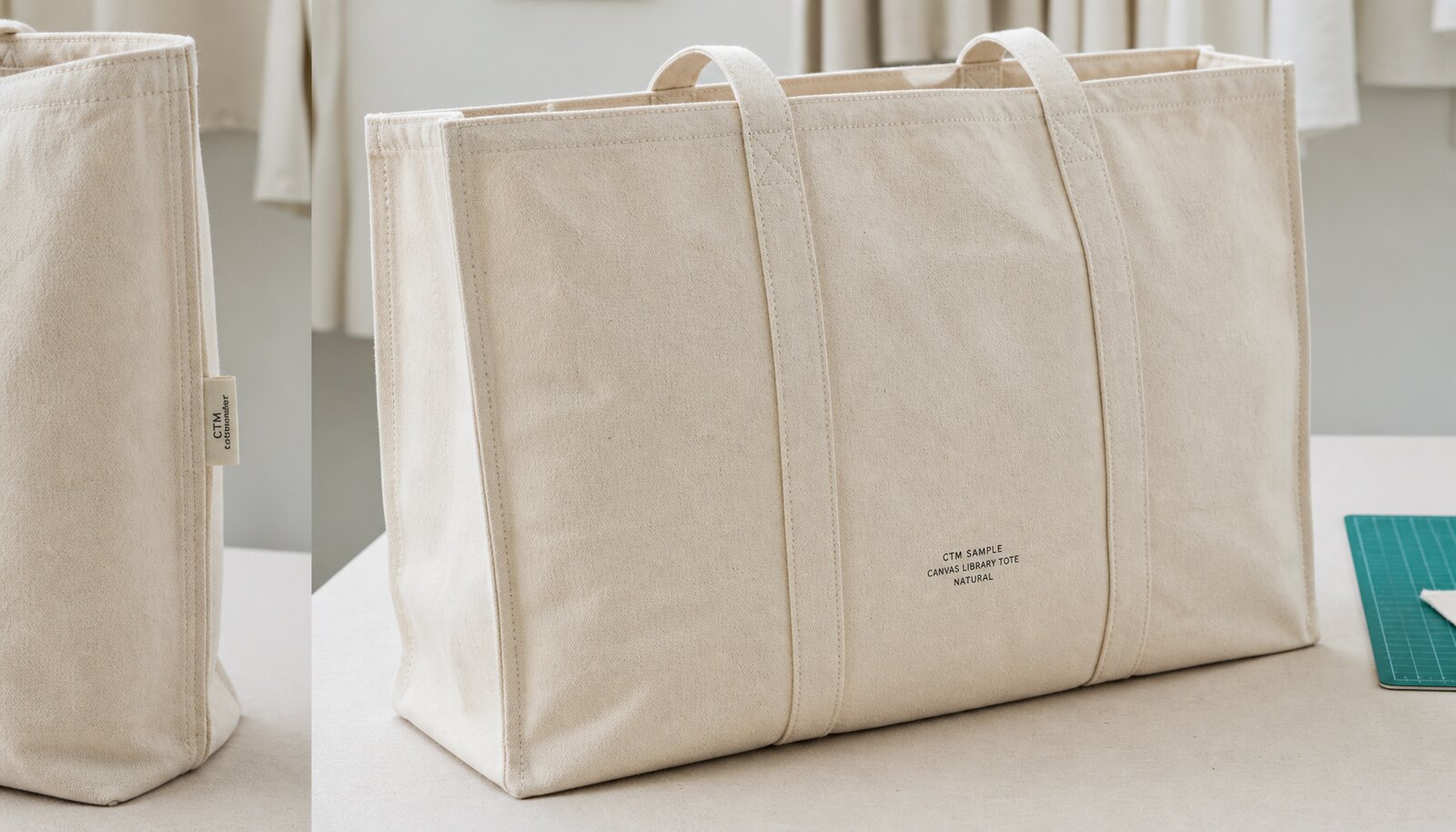
Why bookstore tote sourcing needs a different spec than a promo bag
A canvas library tote bag sold through a bookstore is not the same buying problem as a free event giveaway. Retail customers pick it up, compare weight and feel, and expect it to survive daily use with books, notebooks, and a mixed checkout basket. That means the fabric, sewing, print finish, and packing all affect sell-through. A bag that looks fine in a design proof can still fail if it feels flimsy in hand or arrives packed poorly.
For a retail launch, the spec has to support merchandising, not just branding. Buyers should define whether the tote is a checkout add-on, a premium seasonal item, or a durable everyday carry bag tied to a bookstore or library program. That decision changes the right fabric weight, handle length, print method, and carton plan. Once those use cases are clear, supplier quotes become easier to compare because the commercial target is explicit instead of implied.
- Retail buyers care about hand-feel, seam finish, and shelf presentation more than one-off sample appeal.
- The same tote can be priced very differently depending on whether it is meant for impulse checkout, premium retail, or membership gifting.
- Bookstore use usually requires better packing and stronger seams than a promotional tote meant to be handed out once.
Lock the product brief before you ask for quotes
The fastest way to get unusable quotes is to leave the brief too open. A useful RFQ for canvas library tote bags should already define finished size, fabric weight, print area, handle style, closure choice, and pack format. Without that structure, suppliers fill gaps with their own assumptions, and procurement ends up comparing different products under the same name. In practice, many quote problems are spec problems.
A strong brief starts with the retail promise. If the tote must feel premium, do not under-spec fabric and expect print alone to carry the product. If the launch is price sensitive, simplify the design and keep the bag body standard so setup cost does not consume margin. For bookstore retail, the easiest spec to control is a natural or bleached canvas base with one or two logo colors, standard handles, and clean retail packing. That gives the buyer a stable baseline to test demand before adding more variations.
- Define the SKU tier first: value checkout item, mid-tier retail tote, or premium bookstore accessory.
- Write the brief in measurable terms: size, weight, color count, packing count, and target price range.
- Avoid launching multiple variables at once unless the demand is already proven.
Fabric weight is the biggest driver of how the tote feels in store
Fabric weight sets the first impression. For most bookstore retail launches, 12 oz or roughly 340-360 GSM canvas is the safer choice because it has enough body to stand up visually, prints cleanly, and feels closer to a retail product than a promotional freebie. It is also more forgiving when customers load hardcovers or carry the bag by one handle. If the tote needs to support a higher perceived value, this is usually where the money should go.
A lighter 10 oz or 280-320 GSM option can still work, especially for test programs or lower price points, but only if the bag structure is reinforced. Buyers should not assume a lighter canvas will still feel premium just because the artwork is strong. In practice, a thin bag often telegraphs cost cuts at first touch. If you use lighter canvas, offset it with stronger handle attachment, tighter stitching, and conservative carton packing so the bag does not arrive creased or distorted.
- 12 oz / 340-360 GSM: best balance for retail presence, durability, and print clarity.
- 10 oz / 280-320 GSM: acceptable for value launches if handle and seam reinforcement are upgraded.
- Ask for actual swatches and verify weight by range, not only by supplier description.
Construction details determine whether the bag survives real bookstore use
A tote can look strong in a product photo and still fail at the seams. The details that matter are the stitch density, the top edge finish, the reinforcement at the handle join, and whether the bottom panel is cut and sewn in a way that keeps the bag square after loading. For bookstore retail, the bag needs to feel neat when empty and stable when filled. Customers notice when the body twists, the handle digs in, or the bottom sags under books.
The most practical construction choices are not the most elaborate ones. A box-X or cross-stitch reinforcement at handle attachment points is usually more reliable than a decorative stitch pattern that looks nicer but distributes less load. Ask the supplier how they finish raw edges, how they control seam allowance, and whether they can keep the opening even after pressing. If the factory cannot describe those details clearly, it is a sign that the quote may be shallow even if the sample looks acceptable.
- Specify handle reinforcement at both the upper attachment and the seam interface.
- Agree on a stitch density target before bulk production, not after inspection.
- Ask whether the bag uses self-fabric handles, webbing, or a hybrid and compare comfort and cost accordingly.
Match print method to artwork complexity and reorder plan
Screen print is usually the right default for bookstore totes when the artwork is simple, bold, and likely to reorder. It gives strong opacity on natural canvas and is cost-efficient once setup is absorbed across enough units. It also tends to feel more integrated with the fabric, which matters for retail perception. The downside is that it handles fine detail poorly if the supplier does not control mesh, ink deposit, and curing closely.
Digital print and transfer methods are more flexible when the artwork has gradients, many colors, or small typography. They are useful for seasonal programs, author features, or launch tests where design variety matters more than the lowest unit cost. The tradeoff is that buyers need to watch edge lift, rub resistance, and how the print behaves after folding and packing. For a retail launch, ask the supplier to show a similar print on the same canvas weight, not just a generic sample on different material. That reduces the chance of approving an effect that does not translate to your actual bag.
- Screen print is strongest for 1-3 spot colors, bold logos, and repeat orders.
- Digital or transfer methods fit complex graphics and short runs, but need tighter durability approval.
- Require artwork placement dimensions from the top edge and side seam so the print does not drift in bulk.
Compare supplier routes before you compare unit price
A direct factory quote gives the cleanest view of how the tote is built. You can see fabric, sewing, printing, and packing as separate operational decisions instead of a blended commercial number. That makes it easier to control spec and reorder later. The risk is that not every factory is equally strong on retail packing, barcode labeling, or consistent carton counts. A factory that is excellent at sewing may still be weak at launch-ready presentation.
A trading company or sourcing agent can be useful for smaller pilots or mixed-SKU programs because they handle coordination and can simplify communication. The downside is opacity. If the quote does not separate margin, setup, and actual production cost, procurement loses the ability to judge what is driving price. For a bookstore launch, the best supplier route is the one that gives you line-of-sight into the spec and can prove repeatability from sample to bulk. A cheap quote is not useful if the supplier cannot reproduce the approved sample at scale.
- Direct factory works best when you need control over fabric, sewing, print, and packing.
- Trading company or agent is useful when you need coordination, but insist on spec transparency.
- Compare equal terms only: same fabric, same print area, same packing, same carton count, same trade term.
Use MOQ logic to protect the first retail launch
MOQ should be treated as a set of variables, not a single number. For canvas library tote bags, MOQ usually rises when you add custom fabric color, multiple print positions, specialty closures, or retail packing requirements. Natural canvas with one-color print is usually easier to launch than dyed fabric with several graphic elements. The buyer should isolate the parts of the design that drive setup cost and keep the first order simple enough to prove demand.
A sensible launch plan often uses one base tote and one or two artwork versions rather than a broad range of sizes or finishes. That keeps the production line stable and reduces the chance of hidden charges. If the supplier pushes for a larger MOQ because of a custom element, ask what happens if that element is removed. In many cases, the order becomes more efficient without harming the retail story. The guiding principle is to protect the launch from excess complexity, then expand only after the bag proves itself on shelf.
- Lower MOQ usually comes from standard fabric, a simple print, and standard packing.
- Each added variable can raise cost: extra print side, custom label, closure hardware, or special carton marks.
- If demand is uncertain, keep the base tote standard and vary artwork only.
Sample approval should test retail feel, not just artwork
A useful sample process has three stages: blank sample, printed sample, and pre-production sample. The blank sample proves the fabric hand, the body shape, the seam finish, and the actual finished size. The printed sample checks color, placement, and readability. The pre-production sample is the only one that should be treated as the bulk reference because it should reflect the actual production fabric, trims, print process, and packing method. Skipping that step is one of the fastest ways to create avoidable rework.
The sample should be tested like a real retail item. Load it with mixed hardcovers, check whether the handles sit flat on the shoulder, and inspect how the bag opens and closes when full. If the tote will be displayed folded in store, verify that the fold does not crush the print or distort the body panel. Buyers should also check color under neutral light, not only under warm showroom lighting, because canvas can look different depending on the room. That kind of review is more useful than a flat approval based on a single product photo.
- Approve finished dimensions after pressing, not only cut size.
- Test the bag with actual books and not just by holding it empty.
- Review color, print edge, and seam alignment under neutral light.
Packing and carton specs decide whether the launch arrives retail-ready
Packing is not a back-end detail for bookstore totes. It is part of the product. If the bag is sold as a retail SKU, the customer and the store team should receive it clean, identifiable, and ready to merchandise. That usually means individual polybagging, a barcode or SKU sticker, and carton markings that match the receiving list. If the bag uses light-colored canvas or printed artwork, a protective polybag becomes even more important to prevent scuffing and dust during transit.
Carton planning should balance freight cost with handling risk. Overstuffed cartons can crush the tote and make store receiving slower, while cartons that are too light increase labor and may waste freight space. A practical target is to keep carton gross weight in a range that warehouse teams can handle comfortably, then confirm the exact carton dimensions against pallet and receiving constraints. Ask the supplier for alternative pack counts so you can compare cost and damage risk instead of accepting the first number they offer.
- Treat barcode labels, SKU marks, and carton marks as part of the RFQ.
- Use polybags when the bag needs to arrive shelf-clean or when print abrasion is a concern.
- Set carton counts to protect shape and still fit warehouse handling rules.
QC needs measurable acceptance criteria, not generic promises
Quality control is where many sourcing guides stay vague, but buyers need hard numbers. For canvas library tote bags, set a dimensional tolerance, a stitch target, a load test, and a print standard before bulk production starts. A common acceptance approach is to allow finished dimensions within +/- 0.5 in or +/- 1.3 cm of the approved sample, with no open seams, major panel skew, or uneven handle length. If the tote is supposed to look consistent across shelf inventory, the supplier needs that standard in writing.
For load performance, ask for a static test that holds 15 kg for 60 seconds without seam opening, handle detachment, or visible distortion beyond the agreed limit. For print, agree on a Delta E target, typically Delta E <= 3.0 under neutral light, and define the acceptable placement window from the top edge and side seam. Stitch density should also be set before production, because loose seams often show up only after the first customer use. Carton and pack QA matter too: carton count should be exact, barcode labels should scan cleanly, and any overpack or underpack should be treated as a failure, not a minor exception.
- Agree on finished size tolerance, print placement tolerance, and a load-test target before bulk cutting.
- Use a static handle test of 15 kg for 60 seconds as a practical acceptance benchmark.
- Reject cartons with count errors, unreadable labels, or mixed SKUs unless the exception was pre-approved.
Specification comparison for buyers
| Spec decision | Recommended option | When it fits | Buyer risk to check |
|---|---|---|---|
| Fabric weight | 12 oz / 340-360 GSM natural or bleached canvas | Bookstore retail launches where the tote must feel substantial, hold hardcovers, and justify a merchandising price point | Light fabric can wrinkle, collapse on shelf, and show seam stress after first use |
| Fabric weight alternative | 10 oz / 280-320 GSM canvas with reinforced seams and handles | Lower-price retail tests, checkout add-ons, or promotional retail programs with lighter carry loads | If reinforcement is weak, the bag may stretch, twist, or lose shape once filled with books |
| Weave and finish | Tight plain weave with stable pre-shrink or controlled wash finish | When print clarity, hand-feel, and dimensional consistency matter more than the lowest possible fabric cost | Loose weave can cause fuzzy print edges, uneven ink absorption, and size drift after pressing |
| Print method | Screen print for 1-3 spot colors and repeat orders | Logo-driven bookstore graphics, quotes, and bold front-panel art with strong opacity | Fine detail, small type, and color registration can fail if mesh count, ink deposit, or curing is not controlled |
| Print method alternative | Digital print or transfer for multi-color art and short launches | Test runs, seasonal artwork, or designs with gradients, illustration detail, or many ink colors | Edge lift, rub-off, and a less fabric-integrated hand-feel can create retail complaints if durability is not specified |
| Handle construction | Self-fabric or webbing handles with box-X or cross-stitch reinforcement | Customers are expected to carry books, notebooks, and mixed retail items | Short drop or weak reinforcement creates comfort complaints and seam failures even if the bag looks good on sample |
| Closure and extras | Open top as the default; add snap, zipper, or inner pocket only when they support the retail price | Fast checkout merchandising and simple retail presentation | Each added component raises labor, lead time, and failure risk if fatigue and alignment are not tested |
| Supplier route | Direct factory with sample approval, packing spec, and pre-production sign-off | Buyers who need control over fabric, sewing, print, and carton discipline | Factories that are weak on retail packing may overfill cartons, mislabel SKUs, or ship inconsistent fold dimensions |
| Packing format | Individual polybag, barcode sticker, and export carton with exact inner count | Retail-ready programs that need clean inbound receiving and shelf presentation | Overpacking can trap moisture and crease the bag; underpacking can lead to scuffs, crushed corners, or carton collapse |
Buyer checklist before sampling
- Confirm the fabric weight in GSM or oz and ask for a swatch, not just the word canvas.
- Lock the finished size based on actual bookstore use: paperback, hardcover, or mixed carry.
- Specify handle length, strap width, and reinforcement style in the quotation.
- Choose the print method based on artwork complexity and reorder plan, not sample appearance alone.
- Require a blank sample, printed sample, and pre-production sample if the launch is meaningful.
- Define packing: polybag or no polybag, barcode placement, carton count, and carton mark format.
- Ask the supplier to separate sample cost, setup cost, unit cost, carton cost, and freight.
- Set an approval timeline that includes artwork, sample review, and one correction round.
- Compare landed cost on equal spec terms, not just ex-factory unit price.
Factory quote questions to send
- What exact fabric are you quoting by GSM or oz, weave type, and finish, and can you provide a physical swatch or mill reference?
- Is the canvas natural, bleached, dyed, or pre-shrunk, and what shrinkage range should we expect after production or light use?
- Which print method are you quoting, how many colors are included, and what setup or screen charges apply per side?
- What is the handle construction, strap width, stitch density, and reinforcement pattern at the top join and stress points?
- What is your MOQ by fabric color, print color count, and packing format? Please split the MOQ drivers if they differ.
- What is included in the sample stage: blank sample, printed sample, pre-production sample, and how long does each step take?
- How will the bags be packed for retail launch, including polybag type, barcode label, carton count, and carton dimensions?
- What is the production lead time after sample approval, and what items can delay the schedule if artwork or packaging changes?
- Can you quote setup, packaging, inland freight, export carton cost, and any special handling separately so we can compare suppliers on equal terms?
- What inspection standard do you normally follow for tote bags, and can you support a third-party pre-shipment inspection if required?
Quality-control points to confirm
- Finished dimensions should stay within +/- 0.5 in or +/- 1.3 cm of the approved spec, measured after pressing.
- Stitch density on major seams should be agreed before bulk production, with no skipped stitches, loose thread bundles, or open seam gaps.
- Handle reinforcement should use a visible box-X, cross-stitch, or equivalent locked pattern at each attachment point.
- A static load test should hold 15 kg for 60 seconds without seam opening, handle detachment, or obvious elongation beyond the agreed limit.
- Printed color should match the approved standard within an agreed Delta E target, typically Delta E <= 3.0 under neutral light.
- Print placement should remain within the agreed tolerance from top edge and side seam, with no major misalignment between units.
- Fabric should show no weak weave patches, oil stains, needle holes, or shade bands in the body panel.
- Carton pack count must match the packing list exactly, with no mixed SKU cartons unless explicitly approved.
- Barcode labels, SKU marks, and carton marks should be readable, correctly positioned, and consistent across all cartons.
- Polybags should be clean, sealed, and sized so the bag is protected without excessive compression or trapped moisture.