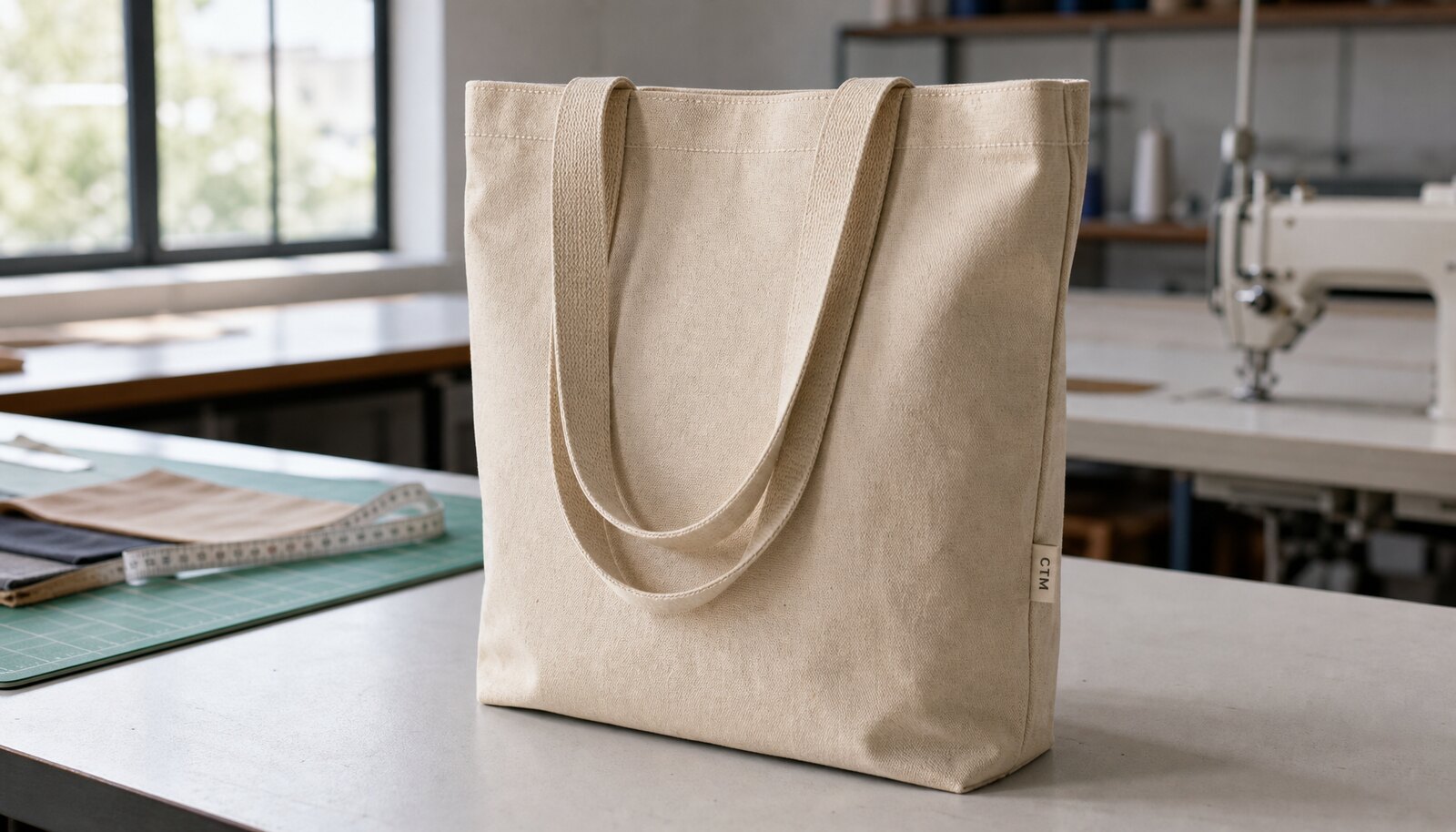
Why apparel brands need a tighter tote spec than a generic canvas bag
A canvas library tote bag for an apparel brand is usually doing more than carrying purchases. It may be a retail add-on, a branded resale item, a seasonal gift-with-purchase, or a packaging layer that appears in product photography and social content. That means the bag is part of the merchandise standard, not just a utility item. Buyers need to think about shelf presence, print clarity, carry comfort, and how the bag will look after a customer actually uses it.
That is why a generic tote spec often fails. A bag can look acceptable in a sample room and still disappoint in stores if the canvas is too limp, the handles twist under load, or the print sits too deep in the weave. In procurement terms, the question is not “What is the cheapest tote we can source?” It is “What fabric, construction, and packing spec will hold up in the channel we sell through, at the margin we need?”
For apparel brands, the tote often sits beside garments in a set. A lightweight fashion brand may want a softer, more natural handfeel. A premium streetwear drop may want a structured, heavier bag that feels collectable. A wholesale program may care more about carton efficiency and repeat consistency than about artisanal texture. The right material selection guide starts by naming the use case before it talks about price.
- Retail resale needs cleaner edges, stronger topstitching, and more stable color than a freebie bag.
- Bundle inserts and mailer add-ons need flat packing and low carton weight.
- Display bags for apparel stores often need a structured body so the logo sits flat in merchandising photos.
Start with the fabric weight, but define it properly in the RFQ
For canvas library tote bags, the fabric weight is the first serious procurement lever. In practice, most buyers compare 10 oz, 12 oz, and 14 oz canvas first because those ranges usually track with body, cost, and print performance. A 10 oz bag can be enough for lightweight retail use or internal promotions. A 12 oz bag is often the most balanced option for apparel brands selling to consumers. A 14 oz or heavier bag usually makes sense when the bag itself is a premium item or when the program expects heavier content such as books, garment bundles, or repeated daily use.
The important detail is that oz or GSM means little unless you know how it is measured. Ask whether the figure refers to finished fabric, pre-wash fabric, or a mill’s greige specification. Also ask whether the bag fabric is pre-shrunk, bio-washed, or finished with any coating that changes handfeel. A supplier can quote a number that looks right on a spreadsheet but still deliver a lighter-feeling bag after washing, dyeing, or finishing.
Procurement teams should ask for the actual weight basis used by the mill or factory. If one supplier quotes a finished 12 oz canvas and another quotes a pre-finish 12 oz canvas, those are not equivalent options. The same is true for GSM conversions. Always compare the measurement basis, not just the headline number.
- 10 oz: suitable for lighter-use programs, lower cost, and softer drape, but limited structure.
- 12 oz: usually the best all-around balance for apparel retail and resale.
- 14 oz+: better for premium shelf presence, heavier fill, and a firmer bag body.
- Ask whether the quoted weight is measured before or after washing, finishing, or coating.
Compare weave, yarn, and fiber content before you compare decoration options
Canvas is not a single material. The weave tightness, yarn size, and fiber blend all affect how the bag looks, prints, and ages. A tighter plain weave usually gives cleaner logo edges and a flatter appearance for text. A looser weave can feel more casual and natural, but it may show slubs, absorb ink unevenly, and make fine artwork look less crisp. If your brand mark includes small type, thin lines, or precise registration, weave quality matters as much as fabric weight.
Fiber content changes both the feel and the production risk. 100% cotton is still the most common choice when a brand wants a classic canvas look, a soft hand, and a natural merchandising story. Cotton-poly blends can reduce creasing, help the tote hold shape in cartons, and sometimes lower dimensional variation. The tradeoff is that blends can print differently and may not match a pure cotton reference sample exactly. That matters if your design team has approved a cotton mockup and your supplier later substitutes a blended fabric to hit price.
Buyer teams should also ask about yarn count, weave density, and raw cotton variation if the bag uses natural unbleached fabric. These are not technical extras for the mill only; they explain why two “same weight” totes can look and feel different. If the final bag is sold in the apparel channel, those differences are visible to the customer, not just the buyer.
- 100% cotton: softer hand, natural look, and easier brand storytelling.
- Cotton-poly blend: more stable dimensions and less creasing, but confirm print behavior and final handfeel.
- Tighter weave: better for small logos, fine text, and a cleaner retail look.
- Loose weave: lower-cost feel may be acceptable only when artwork is bold and simple.
Use a side-by-side spec table to narrow the right material path
The fastest way to waste sourcing time is to ask for samples before you know what tradeoffs matter. For canvas library tote bags for apparel brands, the real procurement comparison sits across fabric weight, weave, finish, structure, and print method. One supplier may offer a heavier fabric at a lower unit price, but that same fabric can raise sewing difficulty, carton weight, and freight cost. Another may quote a softer bag that looks elegant but does not hold a logo cleanly.
Use the comparison below to align buying, design, and operations before requesting quotes. It is not a ranking of best or worst. It is a practical guide to which specification belongs in which channel.
If you are comparing suppliers, ask each one to quote against the same base spec, then provide optional upgrades line by line. That lets procurement see the cost of lining, reinforced handles, custom dye, retail inserts, and alternative print methods instead of getting one bundled number that is hard to audit.
- Write decisions in measurable language, not only descriptive wording.
- Ask for sample photos plus one physical approval sample for important orders.
- Keep quotation, sample approval, and inspection notes tied to the same spec version.
Supplier route matters because it changes traceability, not just price
A direct factory and a trading company can both deliver usable tote bags, but the buyer’s control over the order is different. A direct factory is usually better when you need to verify fabric source, manage repeat color consistency, and keep the sewing and printing process in one place. That makes it easier to line up claims with actual production. A trading company can be useful when you need flexibility, multiple product types in one shipment, or local commercial support. The risk is that the real production path may be split across subcontractors, which makes root-cause analysis harder if there is a quality issue.
For apparel brands, supplier route affects repeatability. If the bag is a one-season merch item, a flexible sourcing route may be acceptable. If the bag will be replenished each quarter or tied to a permanent retail line, procurement should prefer a supplier that can show stable fabric sourcing, a repeatable print setup, and a controlled packing standard. Ask where the fabric is woven, who cuts the panels, who prints the artwork, and who signs the pre-production sample.
A quote that does not identify the production path is not complete enough for a serious buyer comparison. If the supplier cannot tell you whether printing is in-house or outsourced, whether the canvas is stock or mill-booked, and whether packaging is done on the sewing line or later in a packing workshop, you do not yet have a procurement-grade quote.
- Use direct factory sourcing when repeat consistency and process visibility matter most.
- Use trading support only when they can document fabric source, print ownership, and QC responsibility.
- Treat vague sourcing language as a risk signal, not a negotiation win.
Print method affects cost, durability, and the look your customers see first
Decoration is often the most visible part of a canvas library tote bag, but it should never be chosen before the fabric is settled. Screen printing is usually the default for apparel brands because it gives strong color on canvas, handles simple logos well, and remains cost-efficient for repeat orders. It tends to be the best fit for one- to three-color artwork, particularly when the logo needs to be read quickly on retail shelves or in branded packaging photography.
Digital printing, heat transfer, or other transfer methods can be more useful for short runs, complex graphics, or seasonal art that changes often. These methods may help when a buyer wants a smaller MOQ or more visual detail than screen print can handle at the same setup cost. The tradeoff is that print feel, durability, and consistency can vary more widely depending on substrate, curing, and handling. For procurement, the key question is whether the tote is meant to feel like a fashion accessory or simply a branded carrier.
Embroidery can be effective for a small chest-style logo or a premium woven badge effect, but it is not the easiest route for large graphics or thin type on heavy canvas. It also changes the cost structure because setup, digitizing, and stitch time can outweigh the bag cost on modest volumes. In quote comparison, ask the factory to state whether the price includes artwork setup, screens, plates, embroidery digitizing, or color-change fees. Those extras are where “cheap” quotes often become expensive after sampling.
- Screen print: best for simple, durable artwork and stable repeat orders.
- Digital/transfer: better for short runs, seasonal art, or multi-color graphics.
- Embroidery: best for small premium marks, not for large filled artwork.
- Confirm whether setup charges are included or billed separately.
MOQ is really a question about setup, waste, and customization depth
MOQ is not just an arbitrary factory rule. It is usually the point at which fabric booking, print setup, cutting loss, and packing labor become economically viable. If the factory is using stock canvas, standard webbing, and one print location, the MOQ can be relatively low. Once you add custom-dyed fabric, a lined construction, woven labels, special zipper pockets, or retail packaging, the MOQ rises because every extra component requires its own ordering, staging, and inspection.
The best way to negotiate MOQ is to reduce spec complexity before you negotiate volume. For example: one fabric color, one logo location, one handle width, one carton size, and one packing format. That gives the factory fewer variables and gives procurement a cleaner quote. If you need a lower MOQ for a launch test, ask what parts can be simplified without changing the customer-facing look. Sometimes the answer is not “buy less,” but “use stock fabric and standard handles for the first run, then move to custom details after sell-through proves out.”
When you compare suppliers, separate “true MOQ” from “best price MOQ.” Some suppliers will accept a lower quantity but only at a price that changes the business case. Others will quote a more realistic volume because that is the point at which they can hold fabric and quality stable. A buyer should know which one they are seeing.
- Standard stock fabric plus one-color print usually supports the lowest practical MOQ.
- Custom dye, lining, or woven labels usually increase the MOQ because each item adds setup.
- Ask whether the MOQ is based on total units, per color, or per size variant.
- Low MOQ can hide a unit price that is not sustainable for repeat programs.
Sampling should validate construction and production behavior, not just artwork
A useful sample program starts with the right sample type. A digital mockup can confirm artwork placement, but it cannot tell you how the fabric feels, how the handles sit, or how the seams behave under load. For canvas library tote bags, the sample set should usually include at least one pre-production sample made from the intended bulk material and the intended production method. If the supplier also offers a fabric swatch or strike-off, use it to confirm the handfeel and shade before full production starts.
During sample review, the merchandising or buying team should check more than the logo. Put the bag on a table and see whether it stands cleanly or collapses. Load it with a realistic item set and evaluate handle drop. Fold it the way your warehouse or store team will fold it. Look at the seam allowance, the top edge, and the inside finish. This is the moment to catch twisted handles, poor gusset alignment, or print that sits too close to a seam.
A pre-production sample should be approved against a written reference: finished measurements, fabric weight, print size, color target, handle spec, packing method, and any label or barcode position. Without that written baseline, sample approval becomes subjective and hard to enforce later. Procurement teams should treat the approved sample as a production control document, not just a nice reference item on a shelf.
- Request a pre-production sample after fabric and print approval, not only a printed mockup.
- Measure dimensions on the sample and record the acceptable tolerance range.
- Rub-test the print, inspect for tackiness or ghosting, and check handle alignment under load.
- Approve the sample only after the packing method matches the intended bulk pack.
Ask for QC thresholds that a factory can actually inspect to
The most expensive tote complaints usually sound simple: the bag feels thinner than the sample, the handles fail, the print looks crooked, or the carton count is wrong. Those problems can be controlled if the order includes clear, inspectable acceptance criteria. Buyers should avoid vague statements like “good quality” or “premium finish.” Instead, write the tolerance and the test method. That gives the factory something it can measure before shipment.
Fabric weight tolerance is one place where buyers often under-specify. It is better to approve a target with an acceptable percentage range than to rely on a verbal description. For dimensions, define how the bag should be measured: flat, seam-to-seam, after finishing, and whether handle drop is measured from the top edge or from the seam point. Those small definitions matter when you inspect bulk cartons later.
Handle construction deserves special attention. Ask whether the factory uses bar tacks, X-box reinforcement, or straight stitch only, and specify the minimum stitch count range or reinforcement layout if the bag is expected to carry weight. For print, define what will fail: visible misregistration, poor opacity, wash-off, tacky ink, or color drift beyond the approved sample. The factory should know the rejection trigger before the line starts sewing.
- Define accept/reject limits for weight, size, stitch quality, and print alignment.
- Require reinforcement at handle joins and other load points, not only cosmetic topstitching.
- Specify the test method for print rub resistance, adhesion, or wash performance.
- Use a master sample or shade band for natural canvas and dyed canvas alike.
Packing and carton planning can move landed cost more than the bag spec itself
Packaging is part of the procurement decision because it affects freight, warehouse handling, and how the bag arrives to the end customer. A canvas tote packed flat in efficient cartons can reduce carton count and help distribution centers receive stock faster. A tote that is overpacked with tissue, oversized polybags, or too much air in the carton may look more presentable in a photo, but it can quietly increase cost at every stage after production.
For apparel brands selling through retail or wholesale channels, carton planning should be reviewed before production. Ask how many pieces fit per carton, what the gross weight is, whether cartons are export grade, and whether the bag ships flat or lightly stuffed. If the tote is a standalone retail SKU, also confirm whether hangtags, barcodes, care labels, or warning statements are required in your target market. If the bag is a secondary packaging item, prioritize stacking efficiency and dust protection.
The goal is to prevent a mismatch between the quote and the real supply chain. A supplier quote that looks low may exclude retail labels, individual polybags, or special master cartons. Compare landed cost on the full packing spec, not just the sewn bag price.
- Confirm units per carton, carton dimensions, and gross weight before approval.
- Decide whether individual polybags are necessary or just adding cost.
- Make sure retail labeling is included if the bag is sold as a standalone SKU.
- Ask for carton drop protection only if the route or storage conditions justify it.
Specification comparison for buyers
| Spec decision | Recommended option | When it fits | Buyer risk to check |
|---|---|---|---|
| Fabric weight | 10–12 oz canvas for standard retail use; 14 oz+ for premium or heavier-fill programs | Apparel brands that want enough body for daily carry, in-store resale, or packaged merchandise sets | Ask whether the oz figure is finished weight, greige weight, or post-wash weight; light canvas can wash out print coverage and feel underbuilt |
| Weave and yarn count | Tighter plain weave for sharper logos; looser weave only if a softer, more casual texture is acceptable | Programs with small logos, fine text, or brand marks that need clean edges | A loose weave can cause ink sink, visible slubs, and less consistent panel appearance across lots |
| Fiber content | 100% cotton for natural handfeel and a classic canvas look; cotton-poly blend for less creasing and better dimensional stability | Natural lifestyle brands, capsule collections, and bags that need flatter panels in packing | Blends may print differently and can drift from a cotton reference sample; confirm exact fiber percentages and finishing |
| Print method | Screen print for 1–3 spot colors and repeat programs; digital/transfer for short runs with many colors; embroidery only for small premium marks | Most apparel brands with simple logos or seasonal art | Check ink curing, registration, and opacity on dark canvas; poor print prep often looks fine in photos but fails after handling |
| Bag structure | Single-layer unlined for lower cost; self-lined or partial lining for cleaner interiors and better shape retention | Merch drops, retail resale, and premium gift-with-purchase programs | Lining adds labor, can raise MOQ, and may change carton efficiency; confirm whether seams are bound or left exposed |
| Handle style | 25–30 mm cotton webbing with reinforced X-box or bar-tack stitching | Programs expecting shoulder carry or heavier inserts such as apparel bundles, books, or catalogs | Thin handles dig into the hand; weak reinforcement is a common failure point during sample approval and in first use |
| Color strategy | Natural, black, or lab-dipped custom shades with strike-off approval before bulk | Brands that need easy palette matching across apparel and accessories | Natural canvas varies by cotton lot; dyed canvas can shift under different lighting and across repeat orders |
| Supplier route | Direct factory with confirmed fabric source and in-house printing when control matters most | Buyers who need repeatability, traceability, or tighter landed-cost control | Trading-only quotes may hide outsourced printing, fabric substitution, or incomplete packing specs |
| MOQ logic | 500–1,000 pcs for standard specs; lower only if fabric, handles, and print are already in stock | Seasonal tests, first-time tote launches, and limited retail pilots | Very low MOQ can mean stock blanks, fewer customization options, or higher hidden costs per carton |
Buyer checklist before sampling
- Confirm the finished bag size, gusset depth, handle drop, and realistic usable loading weight, not just the outside dimensions.
- Specify fabric type, weave style, weight in oz or GSM, whether the figure is finished or unfinished, and the acceptable shrinkage range.
- Provide vector artwork, Pantone references, print placement, logo size, and any minimum line thickness or text size requirements.
- Request a physical pre-production sample made from the actual bulk fabric, not only a printed mockup or photo proof.
- Confirm packing format, carton count, carton dimensions, gross weight, and whether the bags ship flat, folded, or lightly stuffed.
- Record inspection checkpoints for stitching, print adhesion, odor, stains, measurement tolerances, and label/barcode placement.
- Ask the supplier to name the mill, printing method, and reinforcement stitch pattern in the quotation so the comparison is apples to apples.
Factory quote questions to send
- What is the finished fabric weight in oz or GSM, and is it measured before washing, after washing, or after any coating or dyeing step?
- Is the canvas stock fabric or custom woven, and can you share the mill name, fabric construction, and lot-to-lot variation range?
- What is the exact fiber composition, yarn count, and weave type, and can you provide a spec sheet or mill proof that matches the quoted fabric?
- Which print method is included in the quote, what is the maximum printable area, and how many colors are covered at the quoted price?
- What handle width, handle length, handle drop, and reinforcement stitch pattern are standard in the quote?
- What are the MOQ by fabric color, print color, packing format, and any extra MOQ required for custom labels or special cartons?
- What are the sample charges, sampling lead time, and whether sample charges are refundable against the bulk order?
- How many units fit in one carton, what is the carton size and gross weight, and are the cartons export-grade or retail-ready?
- What is the bulk lead time after sample approval, and which step usually causes delays: fabric booking, printing, sewing, or packing?
- If we request a repeat order, how will you match the original shade, print position, and packing standard from the first production run?
Quality-control points to confirm
- Fabric weight tolerance should stay within an agreed range, typically around ±5% of the approved sample or written spec, unless the channel calls for tighter control.
- Bag dimensions should be measured flat after seam finishing, with written tolerances for body width, height, gusset, and handle drop.
- Handle stitching should be even, with no skipped stitches, loose thread tails, or twisted webbing; reinforcement should be consistent at both handle joins.
- For load-bearing bags, request a pull test on handle attachment and seam points on a sample basis; define the load and hold time in advance rather than using vague language.
- Print registration should stay within a visible but acceptable tolerance, with no smearing, pinholes, ghosting, or tacky ink after cure.
- Set an adhesion check: rub test, tape test, or wash test should be specified by method and pass/fail expectation before bulk starts.
- Inspect seam quality at corners, gusset joins, and top edges for puckering, skipped stitches, broken thread, or excessive seam allowance exposure.
- Use shade bands or a master sample for natural canvas, since fiber speckling and raw material variation can change lot appearance.
- Rejection triggers should include out-of-tolerance dimensions, uneven handle length, major print misplacement, oil stains, broken stitches, odor issues, and carton count mismatch.