Why Packing Is a Buying Specification, Not a Warehouse Detail
A canvas library tote bag is often judged twice: first by the buyer reviewing the sample, and later by the librarian, bookstore staff, school team, or retail customer unpacking it from a carton. Many RFQs describe fabric, size, and logo clearly but leave packing as a loose line such as bulk packing or standard export carton. That is where avoidable problems start. Heavy canvas folded the wrong way can crease the logo. Too many pieces in one carton can create edge wear, distortion, or crushed handles. Weak cartons can fail because book bags are heavier than promotional nonwoven bags.
For procurement teams, packing affects landed cost, inspection criteria, warehouse receiving, retail presentation, and claims handling. A lower unit price may not be cheaper if the carton is too heavy for manual handling, if every bag needs to be re-folded at destination, or if printed panels show fold marks. A useful canvas library tote bag packing checklist should connect product design, production method, and logistics instead of treating packaging as the final afterthought.
- Packing method should be approved at sample stage, not after mass production is finished.
- Carton size and gross weight influence freight, palletization, and warehouse labor.
- Fold lines must be checked against the print area before production approval.
- Institutional buyers may prefer low-plastic bulk packing, while retail programs may need individual presentation.
Define the Library Use Case Before You Ask for a Quote
Library tote bags are not all used the same way. A public library summer reading bag may carry two paperbacks and flyers. A university bookstore tote may carry textbooks, a laptop sleeve, and merchandise. A publisher giveaway bag may be used once at an event, while a school reading program bag may be reused by students for months. These differences change fabric weight, handle strength, gusset depth, print durability, and packing requirements.
Before asking factories to quote, write a short use case in the RFQ. Include the likely load, whether the bag must stand on a shelf or counter, and whether it will be distributed from cartons, mailed in kits, or sold at retail. A factory can then recommend a realistic construction instead of quoting the thinnest canvas that matches the target price. This also makes supplier comparisons cleaner because each quote is based on the same performance requirement.
- Light reading program: 8-10 oz canvas, flat or small gusset, simple screen print.
- Bookstore retail tote: 10-12 oz canvas, bottom gusset, better finishing, optional hangtag.
- Textbook or hardback use: 12 oz or heavier canvas, wider handles, reinforced stitching.
- Gift kit packing: confirm folded size, polybag needs, barcode labels, and carton sequence.
Fabric Weight and Construction Choices That Affect Packing
Fabric weight is usually the first cost driver. For canvas library tote bags, 10 oz canvas is a common middle point because it has better body than light promotional cotton but does not create excessive carton weight. 12 oz canvas gives a stronger hand-feel and better shelf presence, especially with a gusset, but it increases material cost, carton volume, and shipping weight. Buyers should ask for both oz and GSM because suppliers may use different measurement habits. A practical reference is that 10 oz is roughly 340 GSM and 12 oz is roughly 407 GSM, but finishing can change the actual result.
Construction also changes how the bag packs. A flat tote stacks more tightly but may not carry thick books as comfortably. A bottom gusset helps the bag stand and improves usability, but it adds sewing time and carton volume. Self-fabric handles match the body fabric but can become bulky when folded. Cotton webbing handles can be cleaner and stronger, but shade matching must be checked. These decisions should be made before packing approval because the same carton count may not work after changing gusset or handle type.
- Request fabric swatches for each quoted weight, not only photos.
- Confirm whether canvas is natural, bleached, dyed, washed, or pigment dyed.
- Ask if shrinkage affects finished size after ironing, washing, or garment finishing.
- Keep carton gross weight under a practical handling limit for your warehouse or retailer.
Print Method and Fold Line Control
Most canvas library tote bag logos are screen printed because screen printing works well on cotton canvas for solid logos, one-color marks, school names, bookshop graphics, and sponsor artwork. It is usually more cost-effective than digital printing for bulk orders and gives a durable result when the ink and curing are controlled. However, canvas texture can make small text, thin lines, and large ink blocks difficult. If a buyer provides artwork without print size, Pantone reference, and position tolerance, each supplier may quote a different result.
Packing and printing must be checked together. A logo that looks good on an unfolded sample may be damaged by a fold line through the ink. This is especially important for dark screen print, large solid print areas, puff ink, metallic ink, and heat transfer. Ask the factory to fold the pre-production sample exactly as it will be packed, leave it folded for a reasonable test period, then open and inspect for cracking, pressure marks, or ink transfer. If the logo cannot avoid the fold, consider changing fold direction, reducing print height, or using tissue separation for retail programs.
- Screen print: best for solid logos and predictable bulk pricing.
- Heat transfer: useful for gradients but check hand-feel and cracking after folding.
- Digital print: possible for complex art, but texture and color control need sample approval.
- Embroidery: premium for small logos, not ideal for large library graphics or tight budgets.
MOQ Logic: Why Packing Choices Can Change the Real Minimum
Buyers often ask for the minimum order quantity as if it is one fixed number. In practice, MOQ depends on fabric availability, dye lot, print setup, cutting efficiency, label sourcing, and packing materials. If the bag uses natural canvas in a standard weight, a factory may support a lower MOQ because fabric is easier to source. If the order requires custom dyed canvas, custom webbing, multiple logo versions, individual barcode stickers, or special retail cartons, the practical MOQ becomes higher even if the sewing line can produce fewer pieces.
Packing can quietly change MOQ. Individual polybags, printed belly bands, hangtags, barcode labels, and custom inner cartons all have their own minimums. A buyer may think they are ordering 800 canvas library tote bags, but the label printer or packaging supplier may require 1000 or 3000 pieces. To avoid surprise charges, include packing components in the RFQ and ask which parts are stock, which are custom, and which require extra setup. This is especially important for distributors combining several library branches, school names, or sponsor logos in one purchase.
- Lowest MOQ: stock natural canvas, one size, one print color, bulk packing.
- Medium MOQ: stock fabric with custom print, hangtag, and carton labels.
- Higher MOQ: dyed fabric, custom webbing, multiple artworks, retail packaging.
- Cost risk: many small logo versions create repeated screen, setup, and packing work.
Sample Approval Should Include a Packed Sample
A product sample alone is not enough for a bulk canvas library tote bag order. You need to approve the bag and the way it is folded, stacked, bundled, labeled, and cartoned. A pre-production sample should use the actual canvas weight, actual thread, actual handle material, actual print method, and actual logo size. If the factory sends a beautiful sample made with substitute fabric or a different print process, it is only a design reference, not a production approval.
Ask for sample photos in three stages: open bag, folded bag, and packed carton or packing simulation. For large orders, the best practice is to approve a packing sample or at least a detailed packing photo before mass packing starts. This protects both buyer and factory. The buyer has a clear inspection reference, and the factory avoids repacking thousands of pieces after the final inspection finds an issue with fold direction, carton quantity, or label placement.
- Measure finished size after the bag is sewn and pressed.
- Check print position from top edge, side seam, and bottom seam or gusset line.
- Load the sample with the agreed book weight before approving handle construction.
- Keep one signed or sealed sample as the production and inspection reference.
Carton Packing: Piece Count, Weight, and Moisture Control
Canvas bags are heavier than many promotional products, and library tote bags are often made from medium or heavy canvas. Carton planning should therefore start before production is completed. A carton that holds too many pieces may look efficient in a spreadsheet but can become difficult to lift, crush lower bags, or fail during sea freight handling. The factory should provide pieces per carton, carton dimensions, net weight, gross weight, and estimated CBM. Procurement should share any warehouse or retailer limit for carton gross weight.
Moisture control also matters because cotton canvas can absorb humidity. Export cartons should be clean, dry, and strong enough for stacking. An inner poly liner is common for sea freight protection, even when buyers avoid individual polybags. If the order uses natural or light-color canvas, cartons should not be dirty, damp, or over-compressed. For long transit or humid routes, ask how the factory stores finished goods before loading and whether cartons are protected from floor moisture.
- Use 5-ply export cartons for heavier canvas orders unless your routing guide says otherwise.
- Confirm carton sealing method, inner liner, and carton mark layout.
- Avoid carton weights that exceed your receiving team or retailer requirement.
- Do not approve final shipment without carton dimensions and gross weight data.
Packing Checklist for Retail, Library, and Distributor Orders
The correct packing method depends on the selling or distribution channel. A public library may want bulk packed bags that volunteers can quickly distribute. A retail bookstore may need each bag folded consistently with a hangtag and barcode. A distributor may require carton labels by branch, SKU, or purchase order. If these requirements are not written clearly, the factory will use its standard method, which may be acceptable for production but wrong for your receiving process.
A useful packing checklist should include both product protection and information control. Product protection covers folding, dust prevention, moisture barrier, and carton strength. Information control covers SKU labels, carton marks, PO number, country of origin marking, barcode, carton sequence, and assortment details. Many disputes are not about sewing quality; they are about wrong carton labels, mixed versions, or warehouse teams unable to identify which carton belongs to which location.
- Bulk institutional packing: 50-100 pieces per carton depending on fabric weight and carton limit.
- Retail folded packing: consistent fold size, hangtag or belly band, barcode sticker if required.
- Branch distribution: separate carton marks for each library, school, store, or distributor account.
- Mixed artwork orders: pack by logo version and list carton sequence on the packing list.
Quote Data Buyers Should Request Before Comparing Suppliers
A low quote without technical data is not a complete quote. For canvas library tote bags, the buyer should be able to compare fabric specification, finished size, handle construction, print method, packing method, carton data, sample cost, production lead time, and payment terms. If one supplier includes individual polybags and another quotes bulk packing, the unit prices are not comparable. If one supplier quotes 12 oz canvas and another quotes 10 oz canvas, the lower price may simply be a lower material spec.
Ask suppliers to separate optional costs where possible. For example, quote the base bag, then add costs for hangtag, barcode sticker, individual polybag, custom carton mark, extra print color, and upgraded carton. This helps procurement make commercial decisions without forcing the factory to guess what matters most. It also prevents late-stage changes that delay production because the packing material was never sourced or priced.
- Base quote: fabric, size, handles, logo method, quantity, and Incoterm.
- Packing quote: pieces per carton, carton size, gross weight, polybag or no polybag.
- Branding quote: print screens, color count, label, hangtag, and barcode application.
- Timeline quote: sample days, production days after approval, packing days, and shipping handover.
Lead Time Planning and Production Mistakes to Prevent
Lead time for a canvas library tote bag order is not only sewing time. It includes fabric sourcing, fabric inspection, cutting, printing, curing, sewing, trimming, ironing, folding, packing, final inspection, and cargo handover. Custom dyed fabric, multiple artwork versions, or special packaging can add time. Buyers should ask for a timeline by stage and identify which approval gates control the schedule. The most common delay is not production capacity; it is waiting for artwork confirmation, print strike-off approval, or packing label details.
The preventable mistakes are usually simple. The buyer approves a sample but not the fold. The factory prints too close to the bottom seam and the logo disappears when the bag is packed. Cartons are marked with the factory item number instead of the buyer SKU. The bag is strong enough, but the carton is too weak. These issues are avoidable when the RFQ includes acceptance criteria and the final inspection uses the approved sample and approved packing photo.
- Approve artwork, print size, and Pantone before screen making.
- Approve packing labels and carton marks before mass packing starts.
- Reserve time for print curing before folding printed bags tightly.
- Do not book inspection until production is finished and at least 80% is packed unless your process allows in-line inspection.
Specification comparison for buyers
| Spec decision | Recommended option | When it fits | Buyer risk to check |
|---|---|---|---|
| Fabric weight | 10 oz or 12 oz cotton canvas, about 340-407 GSM before washing | Library books, catalog sets, school reading kits, and retail bookshop use | Confirm whether weight is quoted in oz/sq yd or GSM, and whether finished weight changes after washing or dyeing |
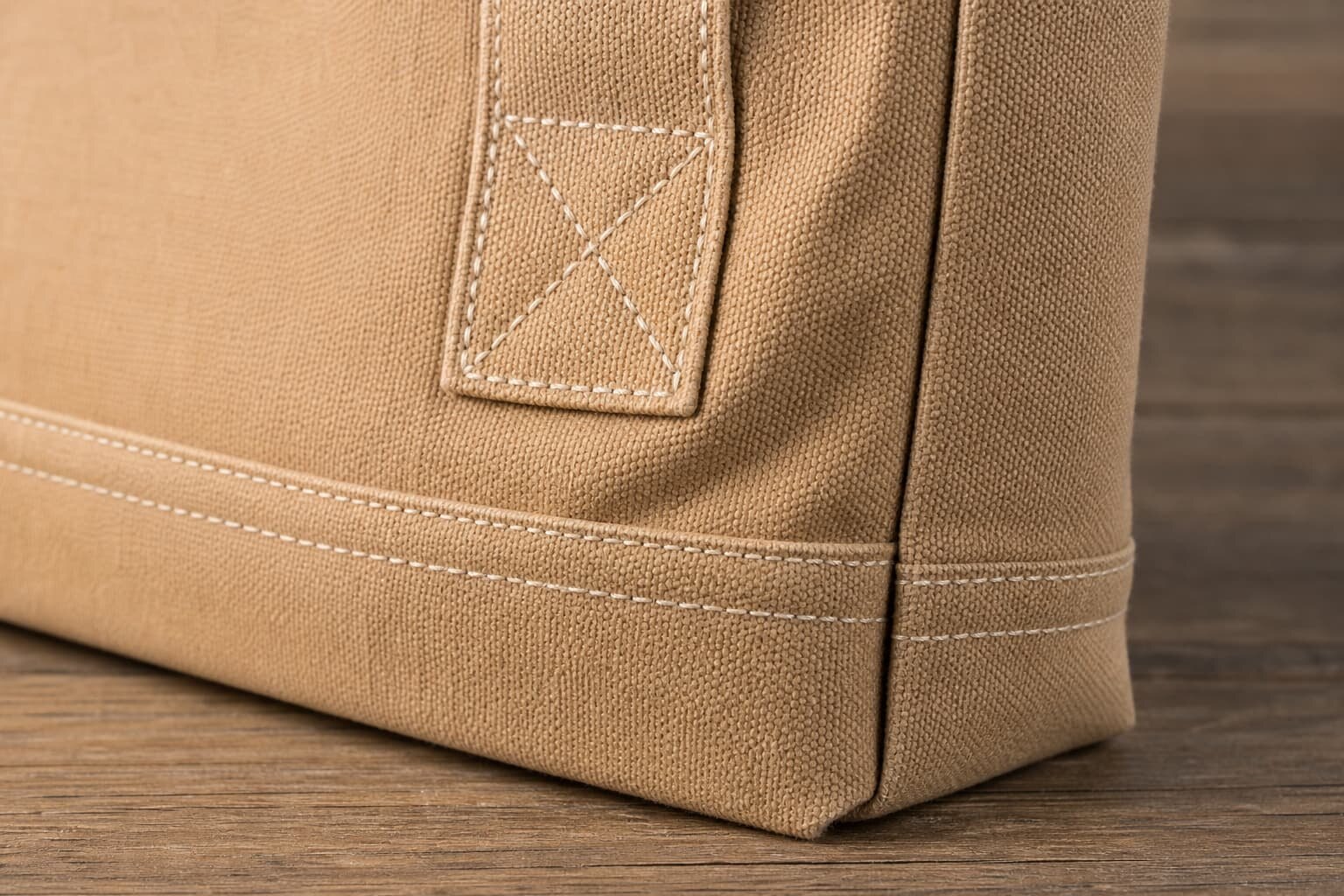
| Bag structure | Flat tote with 8-10 cm bottom gusset and reinforced cross-stitch handles | Bulkier books need a standing base and better load distribution | A low-cost flat bag may look acceptable empty but distort when packed with hardback books |
| Print method | Screen print for one to three solid colors; heat transfer only for complex art or gradients | School, library, and publisher logos usually need durable solid-color decoration | Check ink hand-feel, cracking after folding, and registration on textured canvas |
| Packing method | Individually folded only if retail presentation matters; otherwise bulk packed flat in lined export cartons | Distributor and institutional orders often prefer lower packing cost and less plastic | Over-folding across the print can cause crease marks, especially on dark ink or coated transfers |
| MOQ planning | Plan one fabric color and one print setup per MOQ tier | Keeps sampling, printing, and cutting efficient for 500-3000 piece programs | Too many artwork versions under one small order can push unit cost higher than expected |
| Carton specification | 5-ply export carton with inner poly liner and carton marks matching PO | Sea freight, mixed container loading, and warehouse receiving | Weak cartons collapse under book-bag weight and create disputes at destination receiving |
Buyer checklist before sampling
- Define the intended load: number of books, average book weight, and whether the bag must stand upright when filled.
- Specify fabric in both oz and GSM, including whether the canvas is greige, bleached, dyed, washed, or unwashed.
- Confirm finished bag size, gusset depth, handle length, handle width, and reinforcement stitching method.
- Choose print method by artwork type, not only by price: screen print for solid logos, transfer for fine gradients, embroidery only for small premium marks.
- Request a pre-production sample made with the actual fabric weight, actual print method, actual handle construction, and actual packing fold.
- Set acceptance criteria for size tolerance, print position tolerance, handle strength, seam strength, color shade, and carton packing.
- Confirm if bags are packed flat, half-folded, individually polybagged, bundled, or bulk packed with an inner liner.
- Ask for carton dimensions, gross weight, net weight, pieces per carton, and pallet loading estimate before approving mass production.
- Review carton marks, barcode labels, country of origin labels, suffocation warnings if polybags are used, and any retailer routing guide requirements.
- Keep one approved sample and one approved packing photo as reference for final inspection and shipment release.
Factory quote questions to send
- What fabric weight are you quoting in oz and GSM, and is the weight measured before or after dyeing, washing, or finishing?
- What is the finished bag size tolerance and handle length tolerance for this canvas library tote bag?
- Can you quote both 10 oz and 12 oz canvas with the same bag size so we can compare durability and freight impact?
- What print method is included in the quote, how many colors are counted, and what is the maximum print area?
- Is the quoted MOQ based on fabric stock, fabric dyeing, print setup, or total order value?
- Are handles made from self-fabric canvas or cotton webbing, and what reinforcement stitch is included?
- How many pieces are packed per carton, what are the carton dimensions, and what is the estimated gross weight per carton?
- Does the packing include individual polybags, master polybags, tissue paper, hangtags, barcode stickers, or carton labels?
- What sample types are available before production: fabric swatch, print strike-off, pre-production sample, and packing sample?
- What production lead time applies after sample approval and deposit, and what may change the lead time?
Quality-control points to confirm
- Measure fabric weight from approved material or cutting waste instead of relying only on supplier quotation.
- Check finished bag dimensions after sewing and pressing, not only cut panel dimensions.
- Load test the bag with the agreed book weight for a defined holding time, then inspect handle stitches and side seams.
- Check print adhesion, print position, color match, registration, and whether print cracks along the approved packing fold.
- Inspect handle attachment for box stitch or cross stitch consistency, loose threads, skipped stitches, and back-tacking.
- Verify that folded bags match the approved packing method and do not create permanent creases through the logo.
- Confirm carton count, pieces per carton, carton marks, barcode labels, PO number, SKU number, and destination information.
- Check carton strength, inner liner, carton sealing, and whether carton gross weight is realistic for warehouse handling.
- Pull samples from top, middle, and bottom cartons because packing compression can hide print transfer, dust, or moisture issues.
- Photograph the approved packed carton, open carton, folded bag, unfolded bag, and carton mark before shipment release.