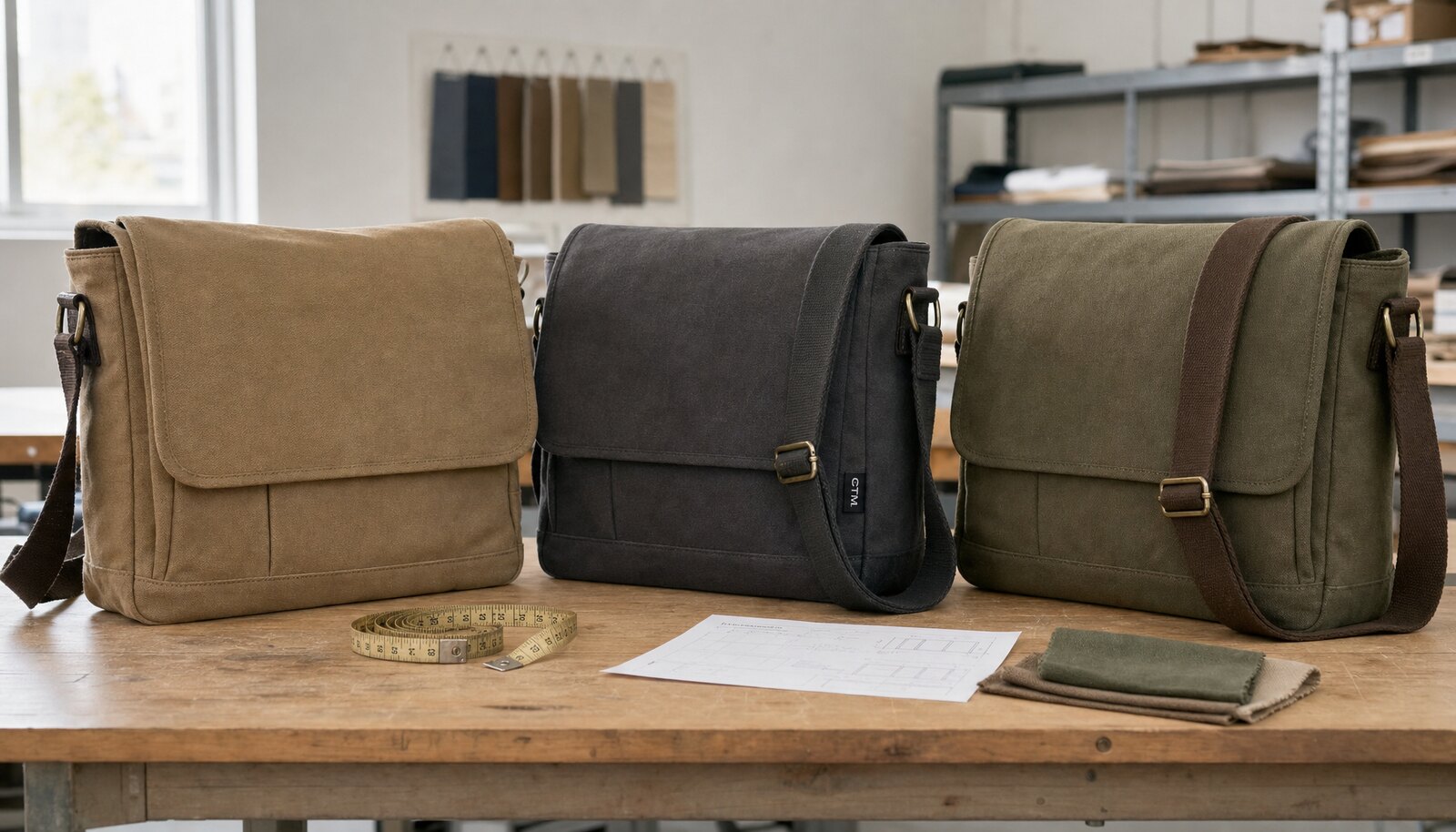
What a university bookstore actually needs from a canvas laptop messenger bag
A university bookstore buyer is not buying a generic messenger bag. The product has to work in a campus setting where students carry a laptop, charger, notebook, water bottle, and often one or two textbooks at the same time. That means the bag has to look retail-ready on the shelf, survive repeated shoulder carry, and still feel like a branded campus item rather than a giveaway with a zipper attached.
The first procurement mistake is to start with decoration before function. The better starting point is a simple commercial brief: target laptop size, daily load, expected retail price, fabric weight, closure type, strap width, and whether the bag must support textbook carry or only a laptop and accessory set. Once those are fixed, suppliers can quote the same build on a like-for-like basis.
For university bookstores, the bag often sits in a middle zone between promotional merchandise and a real carry solution. That middle zone is where clarity matters most. If the brief is vague, the factory will fill the gaps with its own assumptions, and those assumptions are usually where margin, quality, and lead time problems appear later.
- State the use case in one sentence: resale item, orientation bundle, staff bag, or campus gift shop line.
- Define the average payload, not just the laptop size. Books and chargers drive load more than screen size does.
- Keep one PO focused on one approved spec version so the factory can price and pack without guessing.
Set the size, fit, and internal layout before asking for unit prices
Sizing is not just a measurement exercise. A bag can be technically long enough for a 15-inch laptop and still fail because the sleeve opening is too tight, the corner clearance is too small, or the closure compresses the device. For campus programs, you should specify the usable laptop compartment dimensions and the kind of sleeve ease required, not only the external height and width.
If the bookstore expects mixed use, the layout should support more than one item category. A good student messenger bag usually needs a laptop sleeve, one front pocket for small accessories, and at least one internal organizer pocket for a charger, pen, or ID card. Too many compartments can make the bag fussy and expensive; too few make it feel generic. The best balance depends on the price point and whether the item is sold as practical gear or campus-branded merchandise.
The fit brief should be written against real devices. Ask the supplier to confirm which laptop sizes were used in the sample fit test. If your program is built around 13-inch and 14-inch devices, say that. If the bookstore needs a bag that also handles a 15-inch laptop with a sleeve, that should be explicit. The difference affects pattern size, seam placement, and foam coverage.
- Measure usable sleeve width, height, and depth with a real device and sleeve allowance.
- Specify whether the compartment must fit a laptop with or without a protective case.
- Ask for a pocket map with dimensions so the number of pockets is tied to the actual pattern.
Fabric, lining, and structure: where the quote starts to move
For this category, 12 oz canvas is often the practical baseline. It gives enough body for shelf presentation, holds print well, and does not usually create an overly heavy bag. A 14 oz or 16 oz shell can make sense for a premium campus line or a bag expected to carry heavier books, but the cost increase is not only in fabric. Thicker canvas can slow sewing, increase needle wear, and create more variation at corners and seams.
Do not compare fabric quotes by ounce alone. Two suppliers can both say 12 oz and still deliver different results because of weave density, yarn quality, dye process, finishing, and shrink behavior. Ask for both oz and GSM, and ask whether the cloth is pre-shrunk, bio-washed, or greige. Also ask whether the outer shell will be lined. A lined interior makes the bag feel more finished and protects the laptop compartment, but it reduces internal volume slightly and adds labor.
Padding is another place where broad wording causes trouble. A buyer should ask whether the bag uses a continuous foam back panel, a sleeve only, or foam limited to the main contact area. Thickness in millimeters matters, but so does coverage. Thin foam over a large area can be better than a thicker patch that stops short at the corners. For bookstore sales, the impression of protection is part of the value story, but the protection still has to be functional.
- Use 12 oz as a starting point for standard resale; move to 14 oz or 16 oz only if the retail story justifies it.
- Ask for GSM, weave type, shrink status, and finishing method so two quotes can be compared properly.
- Check whether the lining is bonded, loose, or absent, because each version changes finish and price.
Build the bulk pricing plan around real tiers, not arbitrary volume breaks
A useful bulk pricing plan should reflect how a bookstore actually buys. The cleanest structure is usually a test order, a semester launch order, and a reorder or annual volume tier. That may look like 500 units, 1,500 units, and 3,000 or 5,000 units, but the exact numbers should match the campus calendar and stock plan. The point is to create price steps that show how the bag behaves when the order gets larger, not to force the buyer into a random MOQ.
The price should be split into visible components. At minimum, ask for unit manufacturing cost, setup charges, sample charges, packaging cost, and freight assumptions. If the factory gives only one lump sum, it is harder to see whether the difference comes from fabric grade, artwork complexity, or pack-out. For procurement work, itemized pricing is not a luxury; it is the only way to compare two suppliers who may be quoting different materials under the same product name.
The biggest cost drivers are usually shell fabric, lining, padding, closure style, strap reinforcement, and logo method. A one-color screen print on a simple flap bag is very different from a multi-location decorated bag with a padded sleeve and woven label. Savings usually come from simplifying the build, not from squeezing a factory by a few cents. For a university bookstore, that matters because the retail selling price often has limited room to move.
- Request a tiered quote at 500, 1,000, 3,000, and 5,000 units, or at tiers that reflect your buying cycle.
- Separate sample cost, setup cost, pack-out cost, and freight from the unit price.
- Ask the supplier to show the cost drivers that change between tiers, not just the final number.
Comparison table: choose the build that fits the campus merchandising plan
Use the table below as a buying tool, not a marketing chart. It helps separate the decisions that affect retail presentation from the ones that mainly change cost. For bookstore buyers, the goal is to know which features are necessary, which are optional, and which look useful but add complexity without much return.
If the assortment is meant to sit on a retail floor, the most important question is not only whether the bag works, but whether the design can be produced consistently across a semester’s worth of replenishment. That is why the product options should be tied to repeatability, not just appearance.
- Prefer the option that is easiest to repeat at reorder time.
- Avoid splitting the same style into too many color and logo variants unless the shop floor truly needs them.
- Treat every added feature as both a merchandising decision and a manufacturing decision.
Source selection: direct factory, trading company, or decorator finishing blanks
For a university bookstore program, the sourcing route affects more than price. It affects spec control, artwork fidelity, lead time, and the ability to hold the same material standard on a reorder. A direct factory quote is usually better when the order needs clear control over canvas weight, strap reinforcement, and pack-out. A trading company can still be useful if the order is small, mixed, or needs coordinated sourcing across multiple items, but the buyer has to verify who actually cuts, sews, prints, and packs the bag.
The main diligence step is simple: identify the production chain. Ask where the fabric is sourced, where cutting happens, where printing happens, and whether any step is outsourced. If the supplier cannot explain the flow without hand-waving, the risk is not only quality. It is also invisible substitution. A quote that starts from one spec can quietly drift to another if the production route is not controlled.
Origin control matters because a campus program often depends on reorders. If the first order succeeds but the second order changes fabric hand, trim color, or strap webbing, the store ends up with an inconsistent shelf set. Ask whether the supplier can reserve the same fabric roll family or trim set for the reorder window. Even if they cannot guarantee exact continuity, the question reveals whether they understand repeat business or only one-off transaction pricing.
- Ask who owns cutting, sewing, printing, and packing instead of assuming the first contact is the factory.
- Request sample photos plus one physical approval sample for higher-risk orders.
- For repeat campus lines, ask how they manage dye lots, trim continuity, and reorder matching.
Sampling and art approval: where most avoidable mistakes are caught
A sample is not just for visual approval. It is the only practical way to verify whether the chosen fabric, padding, closure, and artwork placement actually work together. The pre-production sample should use the same shell fabric, strap webbing, lining, foam, print method, zipper grade, and label construction planned for the bulk run. If the factory sends a lookalike made from substitute materials, the sample is useful only as a style reference, not as an approval gate.
Campus buyers should test the sample in use, not only on a desk. Put in a laptop, charger, notebook, and one textbook. Check whether the flap closes without strain, whether the strap sits comfortably, whether the bag retains shape, and whether the logo stays centered relative to seam lines. This is also the right time to verify art placement. A logo that is visually acceptable at arm's length may still be off by enough to look inconsistent on a retail wall or display hook.
The approval process should end with written confirmation. Record the approved fabric description, print location, logo size, lining color, hardware color, strap width, and packing format. If changes are made after approval, they should be logged as a revision. That sounds procedural, but it is the simplest way to prevent a bulk order from being built against an outdated assumption.
- Use the sample to test fit with a real laptop and books, not just a visual review.
- Measure logo placement against seam reference points and centerlines.
- Ask the supplier to sign off the sample as the reference for bulk production, with the revision number noted.
QC standards: define acceptance criteria before production starts
Quality control becomes much more effective when the buyer defines measurable limits. For canvas laptop messenger bags, the most important areas are load-bearing seams, strap anchors, zipper function, logo placement, and overall consistency of shape. If the QC note only says 'good quality,' the factory will interpret it in its own favor. If the note says the strap anchor must include full bar-tacks, the zipper must run cleanly under load, and the logo must stay within a defined placement window, the inspection is much easier to enforce.
A useful QC approach is to separate visual checks from functional checks. Visual checks cover shade, print clarity, stitching neatness, seam symmetry, and fold quality. Functional checks cover load-bearing performance, zipper cycle behavior, and fit. For bulk school orders, minor cosmetic variation may be acceptable, but anything that affects carrying comfort, closure security, or brand presentation should be treated more strictly.
Packing belongs in QC because many defects happen after sewing is complete. A good bag can arrive as a poor retail unit if the cartons crush corners, the polybags trap moisture, or the barcode stickers are placed inconsistently. The goal is not perfection in every stitch. The goal is predictable acceptance within a written tolerance so the bookstore can receive, shelve, and sell the product without rework.
- Reject missing or weak bar-tacks at strap and handle stress points.
- Reject zipper snagging, twisting tape, or failed closure under normal opening and closing.
- Reject major logo drift, obvious color mismatch, or seam misalignment that is visible on shelf.
- Reject crushed packing, distorted panels, or carton counts that do not match the PO.
- Use a written AQL or equivalent inspection plan if the order is large enough to justify it.
Packing, cartons, and shelf-ready receiving
Packing affects cost, freight, and receiving speed at the bookstore warehouse. If the bag ships too loosely, cartons become bulky and freight rises. If it is over-compressed, creases and panel deformation can make a new bag look used before it reaches the shelf. The right approach is controlled folding with enough protection to preserve shape, while still keeping carton dimensions efficient.
For bookstore inventory, individual polybagging is usually the most practical format because it makes barcode scanning and receiving much easier. Ask for the polybag thickness, suffocation warning requirement if applicable, and sticker placement. Carton marks should show the PO number, style, color, size, and pack count. If the receiving team can identify the product without opening every box, the order moves faster and errors are easier to spot.
Carton dimensions should be part of the quote, not an afterthought. They affect freight cost, storage space, and whether the store can handle the delivery on a busy receiving day. If the supplier knows the target destination and freight method, they should be able to give a credible cubic volume estimate. That number helps a buyer compare landed cost, not just sewing cost.
- Specify fold direction and any insert needed to protect the laptop panel.
- Require carton marks by style, color, size, and quantity.
- Ask for gross weight and carton dimensions before final approval so freight can be estimated correctly.
Lead time, semester timing, and reorder discipline
University bookstore programs are tied to academic calendars, which means timing is not optional. A bag that is good but late can still fail the business objective. The lead-time plan should include sample development, artwork approval, material booking, production, final inspection, and freight. If any of those steps are compressed, the risk usually lands on the buyer through either delay or spec compromise.
The safest strategy is to work backward from the selling date and leave room for at least one correction cycle. That is especially important when the bag has custom artwork, a nonstandard fabric, or a premium packing requirement. If the product must be on shelf before orientation or the first month of term, the order should be placed early enough that the factory does not need to rush material sourcing. Rushed production usually exposes weak specs more than strong ones.
For repeat programs, reorder discipline matters as much as the first run. Keep the approved spec, sample photos, and QC notes in one file so the next buyer or the next season starts from the same version. If possible, ask the supplier whether they can preserve the same trim colors and fabric family for the reorder window. You do not need a promise that every roll will be identical. You do need a process that makes repeatability a realistic goal.
- Build the calendar around campus milestones, not supplier convenience.
- Do not change artwork after bulk production has started unless you are prepared to absorb delay and rework.
- Store the approved spec version so the reorder uses the same dimensions, materials, and decoration rules.
Specification comparison for buyers
| Spec decision | Recommended option for bookstore buying | What it changes in cost or risk | Buyer check before quoting |
|---|---|---|---|
| Outer canvas | 12 oz cotton canvas for standard resale; 14 oz to 16 oz for a heavier premium line | Heavier canvas improves shelf structure and abrasion resistance, but increases material cost, sewing effort, and shipping weight | Ask for both oz and GSM, plus whether the fabric is pre-shrunk, dyed, or piece-washed |
| Laptop protection | Padded back panel with a dedicated sleeve, or a full padded laptop compartment for premium programs | A true laptop compartment adds fabric, foam, and sewing time but reduces damage complaints and improves perceived value | Confirm usable internal dimensions, not just outside measurements |
| Closure style | Zipper top under flap, or flap with hidden snap and internal zip pocket | Zipper top adds security and student utility; a simpler flap build can lower cost and speed production | Check whether the zipper is covered, exposed, or partially recessed |
| Strap build | 38 mm to 50 mm webbing strap with bar-tacks and a shoulder pad for heavier loads | Wider webbing and reinforcement reduce returns, but add sewing time and hardware cost | Ask where the bar-tacks sit and whether the strap length is adjustable for crossbody wear |
| Logo method | Screen print for simple logos; woven label or embroidery for small premium marks | Print is usually cheaper and cleaner for larger artwork; embroidery and woven labels can increase setup and unit cost | Approve artwork size, placement, and color count before sample production |
| Pocket layout | One front pocket plus one internal organizer pocket | Each added pocket increases material consumption, labor, and inspection points | Request a pocket map with dimensions and zipper or velcro details |
| Lining | Simple polyester or cotton-blend lining for standard programs; lighter unlined interior only for very cost-sensitive lines | Lining improves finish and protects the laptop sleeve, but can add cost and slightly reduce internal volume | Ask for lining weight, color, and whether it is bonded or loose |
| Packing method | Individual polybag with barcode sticker and carton count by SKU | Retail-ready packing makes receiving easier and reduces miscounts, but increases packing labor and materials | Confirm polybag thickness, label location, and carton marks |
| Order structure | One style, one size range, one color family, one decoration method per PO | Simpler orders usually price better and reduce sample risk; fragmented orders push up cost and delay approvals | Build the RFQ around a single approved spec version before requesting a tiered quote |
Buyer checklist before sampling
- Define the campus use case first: daily class carry, bookstore resale, orientation bundle, staff use, or alumni store merchandise. Each one changes the target retail price and the build spec.
- Write the fit requirement in practical terms: laptop size, notebook thickness, charger pocket, and whether the bag must also hold one or two textbooks.
- Lock the shell fabric in oz and GSM, and note whether the hand-feel should be soft, crisp, or structured.
- Specify the print method, logo size, color count, and exact placement with a dimensioned mockup rather than a brand guideline alone.
- Ask for a pre-production sample that uses the same fabric, padding, zipper, strap webbing, lining, and label construction as the bulk order.
- Require a bill of materials or at least a line-item quote for fabric, padding, lining, closure, strap, print, packing, and carton costs.
- Set measurable QC limits for stitching, seam alignment, logo placement, shade variation, zipper function, and packing damage.
- Request landed-cost assumptions for freight mode, carton dimensions, gross weight, and destination handling so the unit price is comparable.
- Confirm whether the supplier is the actual factory, a decorator finishing blanks, or a trading company. The same role does not carry the same quality control.
- Tie sample approval to a spec version number so any later changes to pocket count, strap width, or logo size are visible in writing.
Factory quote questions to send
- What is the exact shell fabric in oz and GSM, and can you state whether it is plain weave, twill, or another weave structure?
- What are the usable internal dimensions for the laptop sleeve, and what laptop size has actually been tested against the sample?
- What padding thickness are you using in the back panel or sleeve, and is the foam continuous across corners and edges?
- What is the seam allowance, stitch density, and bar-tack placement on the strap anchors and flap stress points?
- What print method are you quoting, how many colors are included, and what is the setup charge for each artwork location?
- What is the MOQ by one style, one size, one color, and one decoration method, and how does the unit price change at 500, 1,000, 3,000, and 5,000 units?
- What is included in the quoted price: sample, molds or screens, woven labels, hangtags, polybags, barcode stickers, and export cartons?
- Can you provide carton dimensions, gross weight, and packing count per carton so we can estimate freight and warehouse space?
- What inspection standard do you use before shipment: AQL level, in-line checks, final random inspection, or 100 percent visual sort for logo-critical orders?
- Who actually owns cutting, sewing, printing, and packing in your supply chain, and can you identify any outsourced steps?
Quality-control points to confirm
- Fabric weight should match the approved sample within an agreed tolerance, and the finish should not vary so much that the bag changes shape or appears underbuilt on shelf.
- Logo placement should be measured from seam reference points, not judged by eye alone. A campus logo that drifts panel to panel looks unprofessional in retail display.
- Stitching at strap anchors, side seams, flap corners, and pocket joins should show full bar-tack reinforcement or an equivalent load-bearing finish.
- A zipper should open and close smoothly without catching lining, twisting tape, or snagging at the corners after repeated cycles.
- Laptop protection should cover the main contact zones: back panel, bottom edge, and any area where a laptop corner can press through the shell.
- Internal dimensions should be checked with a real device and sleeve allowance. A bag that measures correctly on paper but refuses a common laptop is a production failure.
- Shade consistency should be checked under daylight and warehouse light, since canvas can appear different across dye lots and store lighting.
- Cartons should keep the bag flat enough for efficient packing but not so compressed that the flap creases permanently or the padded panel deforms.
- Polybag and carton labeling should match the PO, SKU, size, color, and case count exactly. Receiving errors are often pack-out errors, not warehouse mistakes.
- Any sample approval should list the exact approved material set, print location, hardware color, strap width, and packing format so the bulk run cannot drift silently.