Define the Buying Problem Before You Quote
A university bookstore usually needs a canvas grocery tote to do more than carry a logo. The bag may sit at checkout, hold textbooks, move through online fulfillment, support campus sustainability messaging, and still look retail-ready at a price students will accept. If the RFQ only says custom canvas tote with logo, suppliers will quote different bag styles and the lowest price may be based on a flat lightweight tote instead of a true grocery tote.
The cleanest way to control quoting is to define the use case in operational terms. A grocery tote should have a gusset, stable carrying capacity, reinforced handles, and enough body stiffness to stand or fold neatly for shelf display. The buyer also needs to decide whether this is a core reorder item, a seasonal promotion, or an event bag. That decision affects fabric, MOQ, print setup, packing, and how much sample work is worth paying for.
- Write the RFQ around intended load, not only dimensions; books and bottled drinks stress handles differently from apparel.
- Separate retail merchandise orders from one-time giveaway orders because inspection standards and packing needs are not the same.
- State whether university licensing approval is required before production so the supplier can build approval time into the schedule.
- Use one approved technical spec sheet for all suppliers; otherwise quote comparisons become misleading within the first round.
Canvas Weight and Construction Choices
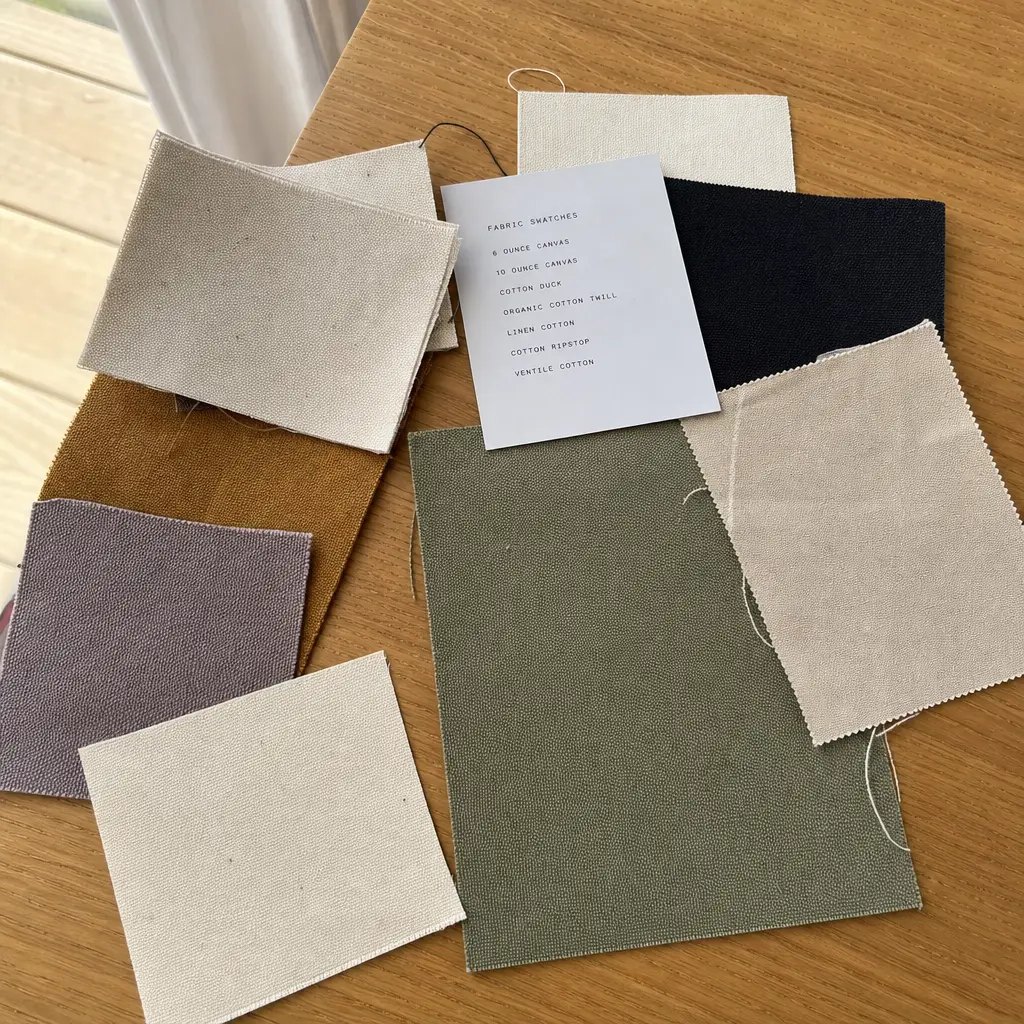
For canvas grocery totes, fabric weight is one of the first cost and performance drivers. Many bookstore buyers see descriptions such as 8 oz, 10 oz, or 12 oz, but factories may also work in GSM. As a practical guide, 10 oz canvas is often around 340 GSM and 12 oz can be around 410 GSM, although exact conversion depends on weave and finishing. A lighter 8 oz fabric may be acceptable for event handouts, but it can feel weak for retail grocery-style use when the bag carries books or packaged goods.
Construction matters as much as fabric weight. A 12 oz body with narrow handles and weak top stitching can fail faster than a 10 oz tote with good reinforcement. For university bookstores, the most reliable specification is a medium-heavy cotton canvas body, a bottom or side gusset, a folded top hem, and self-fabric handles sewn with box or cross reinforcement. If the tote needs to stand better on a shelf, a wider gusset and heavier canvas help, but they also increase carton volume and freight cost.
- Common retail range: 10 oz to 12 oz cotton canvas for reusable grocery-style totes.
- Budget/event range: 8 oz to 10 oz when load expectations are low and the bag is mainly promotional.
- Premium range: 14 oz canvas only when the buyer accepts higher cost, heavier cartons, and reduced folding efficiency.
- Handle drop: define shoulder carry or hand carry; do not leave it to the factory default.
- Tolerance: include finished size tolerance, fabric weight tolerance, and acceptable shrinkage if washing is involved.
Size, Gusset, and Handle Details That Affect Use
A grocery tote for a bookstore should not be specified like a flat conference tote. The gusset is what makes the bag useful for textbooks, boxed gifts, snacks, drinkware, and folded apparel. A practical starting size is about 14-16 inches wide, 15-17 inches high, with a 5-6 inch gusset. Buyers should adjust these dimensions to fit the store’s merchandise mix and display fixtures, not just copy a competitor’s bag.
Handle design needs equal attention. If the tote will carry heavy books, the handle width should be comfortable and the attachment must be reinforced. A 1.25-1.5 inch wide self-fabric handle usually feels better than a narrow webbing handle on heavier canvas. Long shoulder handles improve convenience, but they may drag near the floor for shorter users and can change the front print layout. The approved sample should be loaded with realistic merchandise before sign-off.
- Use a real fill test: two textbooks, one hoodie, one bottle, and a small boxed item is a useful bookstore simulation.
- Keep logo placement clear of gusset folds and handle stitch areas to avoid distortion.
- Specify whether the bottom gusset is boxed, folded, or formed by side gussets only.
- Require handle length measured as finished drop from the top edge, not total strip length before sewing.
Print Method and Artwork Control
Most university bookstore canvas grocery totes use screen printing because it is durable, cost-efficient, and suitable for solid campus logos. Water-based ink gives a softer hand and a more natural feel on cotton canvas, while plastisol can give stronger opacity on darker fabrics. Heat transfer may work for detailed multi-color designs or short runs, but it can feel less integrated with the fabric and needs careful adhesion testing on textured canvas.
The print decision should be made after reviewing the actual artwork. Small type, thin mascot details, gradients, and tight Pantone matching are harder on coarse canvas than on paper or polyester. A print strike-off on the production fabric is more useful than a digital mockup. The strike-off should show the exact logo size, ink color, print position, and edge definition. For licensed university marks, the supplier should not proceed to bulk printing until the buyer confirms trademark approval.
- Best for simple logos: 1-3 color screen print with vector artwork and Pantone references.
- Best for dark canvas: high-opacity ink system tested for coverage and cracking.
- Best for photo-like art: transfer or digital method only after wash, rub, and adhesion review.
- Approval standard: compare strike-off to the production fabric under normal daylight and store lighting.
- Risk point: natural canvas has shade variation, so logo color contrast should be judged on a real sample.
MOQ Logic and Cost Drivers
MOQ is not only a supplier preference. It is linked to fabric purchasing, cutting efficiency, print setup, labor scheduling, and packing. Natural canvas grocery totes usually support a lower MOQ than custom-dyed canvas because the fabric may be available from stock. Dyed canvas, special handle colors, private woven labels, and multiple artwork versions push MOQ higher because they create more setup work and more chances for leftover material.
When comparing quotes, buyers should request price breaks at realistic quantities, such as 500, 1,000, 3,000, and 5,000 pieces. The lowest unit price may not be the best decision if it forces excess inventory beyond the bookstore’s selling season. On the other hand, ordering too close to the minimum can make the per-piece setup cost high, especially for multi-color screen printing. A good factory quote should separate major cost drivers instead of hiding every decision inside one unit price.
- Fabric cost changes with GSM, dyeing, washing, and whether the order uses stock fabric or new weaving.
- Printing cost changes with number of colors, print size, screen setup, and artwork versions.
- Sewing cost changes with gusset complexity, inner seams, labels, pocket options, and reinforcement.
- Packing cost changes with individual polybags, hangtags, barcode labels, carton count, and store assortments.
- Freight cost changes with carton cube; heavy canvas can still ship inefficiently if cartons are too bulky.
Supplier Route and Evidence to Request
A direct manufacturer is usually the better route when the bookstore or distributor plans repeat orders with stable specifications. The factory can control fabric purchase, cutting, sewing, printing coordination, and packing data. This route also makes it easier to investigate defects because the production steps are not hidden behind multiple middle layers. For a one-time small event order with many assorted products, a distributor or trading company may still be practical if speed and consolidation matter more than factory-level customization.
Supplier evidence should be production-specific. A polished catalog does not prove the factory can make the tote in your GSM, size, print method, and packing format. Buyers should request photos or videos of similar canvas grocery totes, sewing lines, print equipment, carton packing, and inspection records with confidential information removed. If a supplier cannot explain fabric weight, handle reinforcement, or carton CBM clearly, the quote may not be reliable enough for import planning.
- Useful evidence: similar tote samples, fabric swatches, print strike-offs, sewing detail photos, and carton packing photos.
- Factory capability: cutting, sewing, printing coordination, label application, packing, and export carton marking.
- Commercial evidence: clear MOQ logic, payment terms, sample fees, tooling or screen charges, and lead time assumptions.
- Risk signal: a supplier quotes immediately without asking about GSM, gusset, artwork colors, or packing.
Sample Approval Workflow
A reliable sample workflow reduces expensive disputes later. Start with a construction sample if the bag size, gusset, and handle structure are new. Then approve a print strike-off on the same canvas texture that will be used in production. The final pre-production sample should combine fabric, sewing, print, label, hangtag, barcode, and packing method. This is the sample the factory should keep on the line as the production reference.
The sample should be evaluated like a retail product, not a souvenir. Load it, hang it, fold it, place it on a shelf, scan the barcode if used, and compare the print position to the brand guideline. If the university licensing office requires artwork approval, build that step into the calendar before bulk fabric cutting or printing. Written approval should include photos with measurements, not only a message saying sample looks good.
- Blank sample: confirms size, gusset, handle drop, stitch pattern, and fabric hand feel.
- Print strike-off: confirms ink color, edge sharpness, opacity, adhesion, and placement.
- Pre-production sample: confirms all materials, labels, hangtags, barcode, and packing.
- Approval file: keep dated photos, measurement notes, Pantone references, and any accepted deviations.
- Do not approve mass production from a digital mockup when artwork registration or color matters.
Packing, Cartons, and Bookstore Distribution
Packing can change the landed cost and the store experience. Bulk flat packing is usually the most efficient for campus bookstore floor stock because it reduces material cost and carton volume. Individual polybags may be required for online fulfillment, warehouse handling, or barcode control, but they add cost and can conflict with campus sustainability expectations. A compromise is folded bundles with a paper band, hangtag, or carton-level barcode if the store system allows it.
Before issuing the PO, the buyer should collect carton dimensions, gross weight, net weight, pieces per carton, and total CBM. These data points affect ocean freight, air freight, warehouse receiving, and store allocation. Heavy canvas totes packed too tightly can crease; packed too loosely, they waste freight. Carton marks should match the buyer’s receiving instructions, especially for multi-campus programs or distributor shipments going to several bookstore locations.
- Bulk pack: lower cost and less waste, best for in-store display and backroom replenishment.
- Individual polybag: cleaner handling for ecommerce, but higher cost and larger carton volume.
- Hangtag or belly band: useful for retail storytelling if the buyer accepts extra setup and labor.
- Carton mark: include PO number, SKU, color, quantity, gross weight, net weight, carton number, and destination if needed.
- Receiving risk: incorrect carton counts create shortages that are expensive to resolve after import.
Lead Time and Schedule Risk
Lead time should be broken into stages: artwork preparation, sample production, sample shipping, approval, material purchase, cutting, sewing, printing, packing, inspection, and shipment booking. A supplier promising a short total lead time may be assuming stock fabric, simple one-color printing, no licensing delay, and no packaging customization. If any of those assumptions are wrong, the schedule can slip quickly.
University bookstore demand is often tied to immovable dates such as welcome week, graduation, homecoming, move-in, and holiday retail windows. The production plan should include approval cutoffs and buffer time. If the buyer needs goods for a fixed event, it may be better to simplify the specification than to chase a complicated custom color or multi-color print that compresses inspection and shipping time.
- Sampling often takes longer when the first sample must include exact fabric and exact print method.
- Custom dyeing can add schedule risk because lab dips, dye lots, and color approval are separate steps.
- Screen printing capacity can tighten before peak promotional seasons, so artwork approval timing matters.
- Inspection should happen after packing but before shipment release; skipping it saves days but increases receiving risk.
- Air freight can rescue a date, but heavy canvas grocery totes are rarely cheap to fly.
Landed-Cost Comparison and Final PO Controls
The right comparison is landed cost per sellable tote, not the cheapest FOB unit price. A heavier canvas tote may cost more at the factory but produce fewer returns and stronger retail value. A lighter tote may be acceptable for giveaways but disappointing as paid merchandise. Buyers should compare unit price, setup charges, sample fees, packing cost, inspection cost, freight cube, duty classification, and expected defect allowance before selecting the supplier.
The final purchase order should freeze the specification in measurable terms. Include fabric weight, finished dimensions, handle length, print method, artwork file name, Pantone references, packing format, carton marks, inspection standard, shipment terms, and approved sample reference. When the PO is vague, production teams make practical decisions on the line, and those decisions may not match the bookstore’s retail expectations.
- Compare each quote at the same quantity, fabric GSM, print colors, packing method, and trade term.
- Add one-time screen, sample, label, or artwork setup charges into the first-order cost comparison.
- Calculate carton CBM and estimated freight impact before choosing heavier canvas or individual packing.
- Define defect categories and remedy terms before deposit, not after receiving flawed goods.
- Keep one signed approved sample or sealed reference sample for inspection and reorder matching.
Specification comparison for buyers
| Spec decision | Recommended option | When it fits | Buyer risk to check |
|---|---|---|---|
| Fabric weight for retail grocery use | 10 oz to 12 oz cotton canvas, roughly 340-410 GSM depending on weave | Good balance for bookstore merchandise, orientation giveaways, and campus grocery trips | Suppliers may quote lighter 8 oz canvas while describing it as heavy duty; require GSM and physical sample weight |
| Bag size and usable volume | Approx. 14-16 in W x 15-17 in H x 5-6 in gusset | Fits textbooks, apparel, water bottles, packaged snacks, and bookstore checkout items | Flat tote dimensions can look similar on paper but lose capacity if the gusset is too narrow |
| Handle construction | Self-fabric handles, 1.25-1.5 in wide, cross-stitched or boxed at stress points | Needed when the bag may carry books, groceries, or multiple retail items | Long handles without reinforcement can tear at the top seam; request stitch pattern photos |
| Print method for bookstore graphics | Water-based or plastisol screen print for 1-3 solid colors; heat transfer only for complex short runs | Works for university marks, mascots, department logos, and seasonal artwork | Fine lines and registration gaps can fail on coarse canvas; approve strike-off on production fabric |
| MOQ planning | Factory MOQ tied to fabric dye lot, print setup, and carton efficiency, often lower for natural canvas than dyed canvas | Best for annual bookstore programs, alumni events, welcome week, and reorderable core SKUs | Very low MOQ quotes may use stock blanks with limited control over size, GSM, and handle strength |
| Supplier route | Direct manufacturer for repeat programs; trading company or distributor for very mixed small lots | Direct factory fits stable specs, private label packing, and cost control across reorders | Middle layers can hide fabric substitutions and make corrective action slower after inspection |
| Retail packing format | Flat folded bulk pack with barcode sticker or individual polybag only when required by store operations | Bulk pack reduces waste and freight cube; polybag helps online fulfillment and multi-store distribution | Polybagging adds labor, material, carton volume, and sometimes campus sustainability objections |
| QC acceptance threshold | AQL inspection with defined critical defects, color tolerance, print adhesion, seam strength, and carton count | Useful when importing full cartons for multiple bookstore locations or distributor warehouses | Without written defect categories, inspectors may pass bags with crooked logos or weak handle stitching |
Buyer checklist before sampling
- Define the tote as a grocery-style canvas bag, not only a flat promotional tote, including width, height, gusset, handle length, and target carrying load.
- Specify fabric by oz and GSM, such as 10 oz/340 GSM or 12 oz/410 GSM, and require the final quote to state whether the fabric is greige, bleached, dyed, or washed.
- Choose natural, dyed, or recycled cotton canvas based on bookstore positioning, artwork contrast, colorfastness risk, and budget tolerance.
- Provide artwork as vector files with Pantone references, logo placement dimensions, printable area, and any university trademark spacing rules.
- State the expected retail channel: campus bookstore floor display, online order fulfillment, event giveaway, alumni merchandise, or distributor replenishment.
- Set sample approval stages: blank construction sample, print strike-off on production fabric, pre-production sample with packing, and final shipment inspection.
- Require handle reinforcement details, including stitch pattern, stitch density, thread color, and whether the handle is sewn into the top hem or attached outside.
- Confirm packing data before PO release: pieces per inner pack if any, pieces per export carton, carton dimensions, gross weight, net weight, and barcode location.
- Compare quotes using landed cost per sellable tote, not only FOB unit price, because fabric weight, packing cube, inspection cost, and duty classification can change the result.
- Include tolerance rules for size, fabric weight, print position, color variation, carton shortage, and acceptable cosmetic flaws before production starts.
Factory quote questions to send
- What exact fabric will be used, including cotton content, oz weight, GSM, yarn style if available, and whether the fabric is stock or freshly woven for this order?
- Is the quoted price based on natural canvas, bleached canvas, dyed canvas, or washed canvas, and what color tolerance will apply to repeat orders?
- What is the minimum order quantity for this tote size and print, and which cost items change if we order 500, 1,000, 3,000, or 5,000 pieces?
- Can the handle be load tested with the intended construction, and what reinforcement stitch pattern will be used at the stress points?
- Which print method do you recommend for our artwork on this canvas texture, and what setup charges, screen charges, or color change charges apply?
- Will the pre-production sample be made with the same fabric, thread, handle, print ink, and packing method as mass production?
- What are the production lead time, sampling lead time, print approval cutoff date, and expected carton ready date after deposit and artwork approval?
- What are the export carton dimensions, carton weight, pieces per carton, and estimated CBM for the quoted quantity?
- Which defects are considered critical, major, and minor during inspection, and what AQL level do you recommend for bookstore retail stock?
- Can you provide production photos for fabric cutting, sewing, printing, packing, and final carton marks before shipment booking?
Quality-control points to confirm
- Measure finished width, height, gusset, and handle drop against approved tolerance, not against a loose website description.
- Weigh a cut fabric sample or finished tote to confirm the quoted canvas weight is not substituted with a lighter material.
- Inspect handle attachment for skipped stitches, loose backtacks, weak box stitching, and seam slippage after a reasonable load test.
- Check print position from the top edge and side seams, especially if the university logo must align with brand standards.
- Perform dry rub and light wet rub tests on printed areas when the tote may contact apparel, books, or white packaging.
- Review inside seams, thread trimming, top hem consistency, and gusset corners because grocery totes fail first at stress points.
- Confirm each carton count, carton mark, barcode label, and assortment ratio before goods leave the factory.
- Reject oil stains, fabric holes, mold odor, heavy color variation, misprinted logos, and contaminated cartons as shipment-level risks.