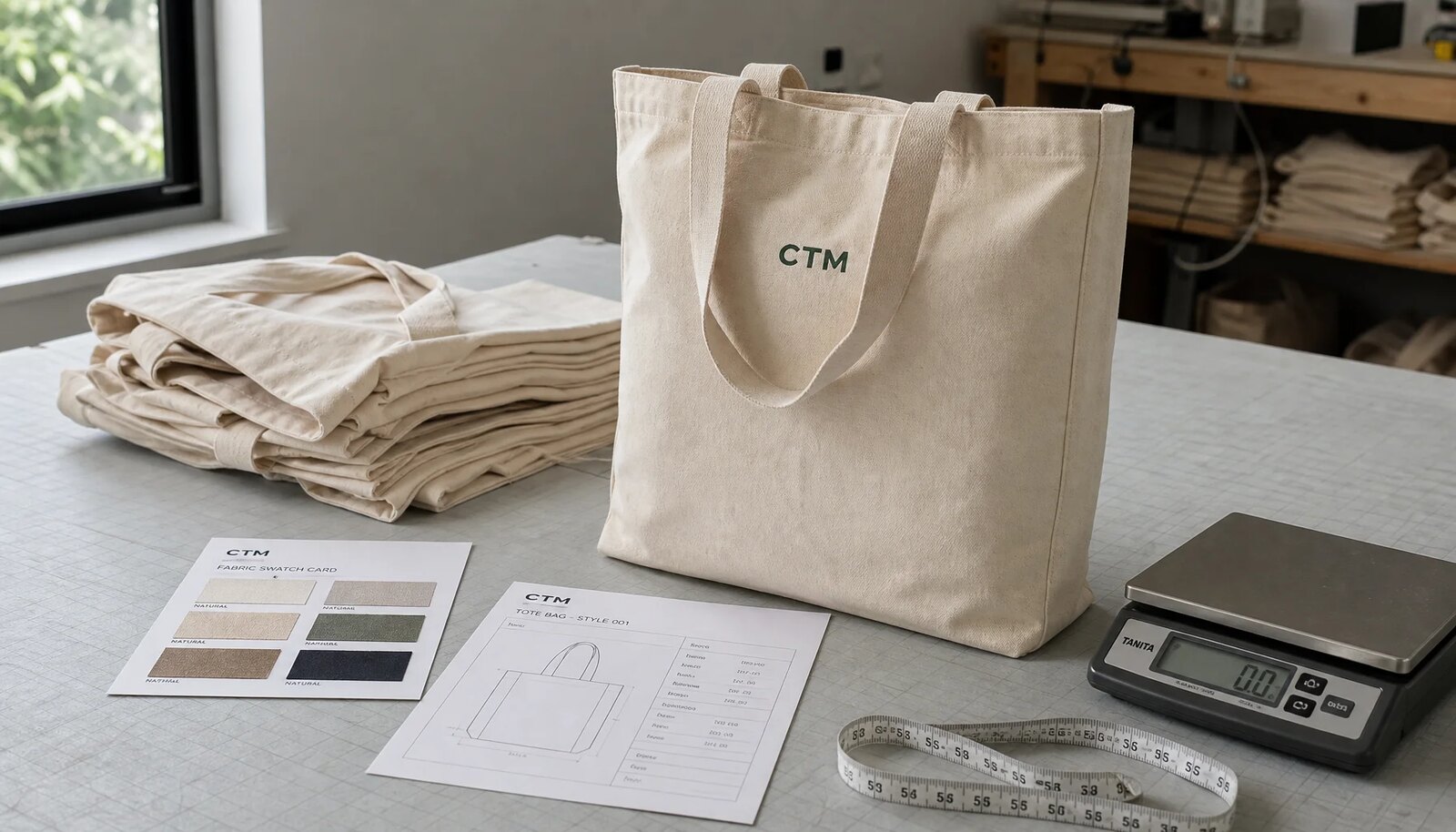
Why a wholesale canvas grocery tote needs a product-grade spec
A canvas grocery tote looks simple, but from a procurement perspective it is a textile product with many variables: fabric weight, weave density, shrinkage, pattern dimensions, seam type, handle reinforcement, print process, packaging, and inspection criteria. When a buyer sends an RFQ that says only "natural canvas grocery tote with logo," the supplier has to fill in too many blanks. One quote may be based on 8 oz stock canvas and basic handle stitching, while another may include 12 oz canvas, reinforced web handles, screen setup, export cartons, and a pre-production sample. The numbers will not be comparable because the products are not the same.
For eco apparel brands, the tote often carries more value than a disposable giveaway. It may be sold as a retail accessory, used as reusable packaging, included with a minimum purchase, or presented as part of a sustainability message. That means the tote has to survive real handling and also support the brand's claims. A loose spec can lead to returns, inconsistent shade, weak handles, print complaints, overpacking, or freight surprises. A precise spec turns the buying conversation from "lowest quote" to "best controlled product at the right landed cost."
The most useful starting point is a one-page technical RFQ supported by artwork, packing instructions, and an inspection checklist. The RFQ should make the supplier state what is included, what tolerances apply, and which approvals are required before bulk production. This prevents the common problem where a nice sample is approved, but bulk production changes because the factory used a different fabric lot, a different handle tape, or a faster print process.
- Treat the tote as a textile accessory with measurable requirements, not as a generic promo item.
- Make every supplier quote the same spec version, artwork version, and packing method.
- Use written tolerances so the approved sample can be enforced during final inspection.
- Separate brand claims, such as organic cotton or recycled content, from visual "eco" styling unless documentation supports the claim.
Start with the use case, channel, and load before you choose fabric
The right build depends on what the tote must carry and where it will be sold. A light event tote holding brochures may work with a thinner canvas and basic stitching. A grocery tote carrying bottles, produce, books, or boxed apparel needs stronger fabric, better handle reinforcement, and more attention to gusset corners. Before asking for price, define the expected load and frequency of use. Many buyers use practical load ranges, such as 6-8 kg for lighter retail and promotional use, 10-12 kg for stronger everyday grocery use, and 15 kg or more only when the construction is deliberately engineered and tested for heavier loads.
Capacity is not only about size. A tote with no gusset can look clean but may not handle boxy grocery items well. A 4-6 inch gusset is common for grocery-style totes because it gives the bag a more useful base without making it too bulky. If the tote is intended for apparel packaging, the gusset may be narrower so garments sit neatly and the bag folds flat. If it is a retail SKU, it may need a balanced shape, a consistent fold, a hangtag location, and a barcode that will scan after packing.
Procurement should also identify where failure would be most expensive. A giveaway tote can tolerate more cosmetic variation than a retail accessory sold with a premium apparel collection. A bag used in a flagship store may require tighter shade, print, and packing standards than a bulk event item. Write this risk level into the inspection plan so the supplier understands whether the order is being judged as promotional merchandise or as retail product.
- State the intended load range and use frequency in the RFQ.
- Choose gusset depth based on the actual contents: groceries, folded apparel, books, or event materials.
- Specify whether the tote must stand upright, fold flat, hang on a retail fixture, or ship inside another package.
- Set tighter cosmetic standards for retail SKUs than for low-cost promotional distribution.
Fabric weight, weave, finish, and shrink behavior: the core spec decisions
Canvas weight is commonly quoted in ounces per square yard, while many mills and factories also use GSM. As a practical reference, 8 oz canvas is roughly 270 GSM, 10 oz is roughly 340 GSM, and 12 oz is roughly 407 GSM, though conversions can vary slightly by fabric construction. For canvas grocery totes wholesale programs, 10-12 oz is usually the safer range for retail-quality use. 8 oz can be appropriate for light-duty programs, but it is more likely to sag, show print distortion, and feel less durable when loaded.
Do not rely on weight alone. A tighter, more stable weave can perform better than a loosely woven fabric with a similar nominal weight. Ask the supplier to state the allowed fabric weight tolerance. A common commercial tolerance may be around +/-5% to +/-8%, but the buyer should approve the exact range. If fabric weight is a key selling point, the tolerance must be written into the PO and checked during fabric receiving or final inspection.
Finish affects appearance, shrinkage, and print behavior. Natural unbleached canvas gives the familiar off-white eco look, but shade can vary between lots and may include slubs or cotton seed flecks. Bleached canvas gives a cleaner base for bright prints but changes the sustainability story and cost. Dyed canvas needs shade control and colorfastness checks. Pre-washed or pre-shrunk canvas can reduce first-wash movement and soften the hand feel, but it adds processing time and may change dimensions. If the tote may be washed, request shrinkage data and set a target, often under 3-5% depending on the product requirement and test method.
If your brand plans to claim organic cotton, recycled cotton, recycled polyester blend, or any certified material, ask for documentation before confirming copy or packaging. A natural-looking cotton tote is not automatically organic, low-impact, or certified. Procurement should keep fiber content, certification scope, and transaction documents aligned with marketing language.
- Quote fabric in both oz and GSM when suppliers use different unit systems.
- Use 10-12 oz canvas for most retail grocery tote programs; reserve 8 oz for light-duty use.
- Write the fabric weight tolerance into the PO instead of accepting an open-ended "about 10 oz" description.
- Approve fabric shade and hand feel from a physical swatch, not only a photo.
- Request shrinkage data if the tote may be washed or if print placement must remain stable after laundering.
Size, pattern, gusset, and dimensional control are where bulk consistency is won or lost
Finished dimensions must be specified with measurement points. A tote described as 15 x 16 inches with a 5 inch gusset can still vary depending on whether the supplier measures before pressing, after folding, from seam edge to seam edge, or across the open body. For wholesale orders, define width, height, gusset depth, top hem width, bottom seam position, and handle drop. For retail-quality totes, buyers often set key dimension tolerance around +/-0.5 cm to +/-1 cm depending on the size and feature. Larger panels may allow slightly more tolerance, but print placement and handle drop usually need tighter control.
The pattern should support the use case. A boxed bottom or well-formed gusset improves grocery capacity. A flat tote without gusset may be better for folded apparel or documents. A reinforced base panel or bottom board can improve stability, but it adds material, sewing time, packing complexity, and freight weight. If the bag needs to stand upright for merchandising, confirm this at sample stage with the actual contents or a realistic load.
Small pattern details affect cost and QC. A wider top hem can make the opening feel more premium and support handle attachment, but it consumes more fabric. Interior pockets, exterior pockets, contrast handles, binding, snaps, labels, and base inserts all create additional sewing operations. If these features are not in the RFQ, suppliers may omit them from the quote or interpret them differently. A clean line drawing or tech pack is more reliable than a written description alone.
For reorders, dimensional drift is a real risk. Factories may replace a pattern, switch cutting teams, or use a new fabric with different shrink behavior. Keep a sealed sample, measurement chart, and production photos from the approved order so the next purchase order can be checked against the original standard.
- Define measurement points for width, height, gusset, top hem, and handle drop.
- Use tighter tolerances for print placement and handle drop than for large body panels.
- Call out every pocket, label, closure, insert, binding, and reinforcement feature as a separate line item.
- Keep an approved sample and measurement record for reorder control.
Handles, stitching, and load testing deserve their own line in the RFQ
Handles are where many canvas grocery totes fail first. The body fabric may be strong enough, but the attachment points can tear if the handle is too narrow, the insertion depth is short, the stitches are loose, or the top hem is not reinforced. Specify handle material, width, total length, handle drop, attachment depth into the bag, and reinforcement method. Cotton webbing is common for heavier reusable totes because it spreads load and feels comfortable. Self-fabric handles give a coordinated appearance but can stretch or twist more if construction is not controlled.
Reinforcement language must be specific. "Reinforced handles" can mean one extra stitch row, a bar-tack, a box-X pattern, or a different internal construction. For grocery use, bar-tacks or box-X stitching at the handle ends are common choices. The buyer should also request stitch density, such as stitches per inch or stitches per centimeter, and confirm whether lockstitch is used. Very low stitch density can reduce strength; poor tension can create puckering or weak seams.
A practical load test gives better information than appearance alone. The exact test should match the order's use case. For example, the buyer may require a sample to hold the target load, such as 10 kg, for a defined period, then inspect for handle tearing, seam opening, or excessive distortion. For stronger programs, the buyer may request a higher static load or repeated lift test. The important point is to define the load, duration, number of samples, and pass/fail criteria before bulk production.
Do not test only the golden sample. Random finished units from multiple cartons should be checked during final inspection. Handle failures can be caused by inconsistent sewing operators, fabric flaws, or skipped reinforcement, so carton-level sampling matters. Record photos of the handle attachment inside and outside the tote, especially if the bag is being reordered later.
- Specify handle width, length, drop, material, attachment depth, and reinforcement method.
- Do not accept vague language such as "strong handles" without stitch and reinforcement details.
- Require a practical load test at sample stage and repeat random checks during final inspection.
- Inspect handle ends inside the bag as well as from the outside front view.
Decoration rules: screen print, transfer, digital print, and color control on canvas
Screen printing is usually the most economical and durable method for simple logo artwork on wholesale canvas grocery totes. It works best with solid shapes, limited colors, and artwork that can tolerate the texture of canvas. Each print color normally requires a screen and setup, so a one-color logo is much simpler to price and control than a four-color design. If the order is split across multiple artwork versions, each version may create separate setup charges and MOQ requirements.
Canvas is not a smooth paper surface. Thin lines, small text, and tight negative spaces can fill in because of the weave. Ask the supplier to confirm minimum line width and minimum text size for the chosen fabric and print method. If the logo includes fine detail, distressed texture, gradients, or photographic elements, consider whether transfer or digital print is more appropriate. However, those methods must be tested for adhesion, hand feel, cracking, and rub resistance on the actual canvas, not on a smooth test substrate.
Color control needs a standard. Use PMS references where appropriate, but remember that ink on natural canvas may look warmer or duller than the same color on coated paper. For higher-control programs, buyers may approve a physical strike-off rather than relying only on a PMS number. Define print placement tolerance, such as +/-0.5 cm to +/-1 cm depending on the design and panel size, and define registration tolerance for multi-color prints. If the logo must align with a pocket, seam, or fold line, state that clearly in the artwork placement sheet.
The approval chain should be swatch, strike-off, pre-production sample, and then bulk. A strike-off confirms print only; it does not confirm handle construction, dimensions, packing, or carton labeling. A pre-production sample should use the final fabric lot or approved production fabric, final print method, final thread, final handles, final labels, and final packing fold.
- Use screen print for simple repeat logos and limited color counts.
- Approve print on the actual canvas texture, not on a smooth substitute fabric.
- Set PMS or color target, print size, placement tolerance, registration tolerance, and minimum line width.
- Keep artwork version, print placement sheet, and approved strike-off linked to the PO.
MOQ, quote comparison, and hidden cost items in B2B tote sourcing
MOQ is usually driven by fabric buying, cutting efficiency, print setup, sewing line changeover, and packing configuration. A factory may offer one attractive MOQ for a single natural canvas tote with one print, but the economics change when the buyer splits the order across three fabric colors, two logo colors, individual polybags, or multiple barcode labels. Ask for MOQ and price by size, fabric color, print design, print colorway, and packing method. This prevents the common surprise where the quote is valid only for the simplest version of the program.
A like-for-like quote sheet should include more than unit price. Compare fabric weight and tolerance, fabric finish, handle construction, stitch reinforcement, print method, number of print colors, setup charges, sample costs, PP sample timing, packing method, units per carton, carton dimensions, gross weight, inspection cost, testing cost, payment terms, Incoterms, and lead time. If one supplier quotes FOB and another quotes EXW, or one includes export cartons while another does not, the lowest price may not be the lowest landed cost.
Buyers should separate one-time costs from recurring costs. Screen setup, artwork adjustment, lab testing, courier fees, and first sample development may not repeat in the same way on reorders. Conversely, carton labels, hangtags, individual bags, and barcode application may recur on every order. A procurement sheet that separates these items helps the brand decide whether a supplier is truly more efficient or merely omitting costs until later.
Supplier route also matters. A factory with in-house sewing and direct control of cutting, print coordination, trimming, and packing may be easier to manage when defects occur. A trading company can still be useful, especially for complex sourcing, but the buyer must know who owns the fabric inspection, who approves print, who performs inline QC, and who pays for rework. Accountability should be defined before the purchase order is placed.
- Request price and MOQ by every variant, not only by total order quantity.
- Compare FOB, EXW, or delivered pricing on the same basis before shortlisting.
- Separate setup charges from recurring unit costs.
- Treat blank quote fields as risk items, not harmless omissions.
- Ask who owns rework if fabric, print, stitching, or packing fails inspection.
Documentation, claims, and approval records keep the order defensible
A good quote is not enough if the brand is going to support sustainability language, retail sell-through, or repeat orders. Keep documentation aligned across the tech pack, artwork file, sample approval, and PO. If the tote is described as organic cotton, recycled cotton, or certified material, ask for the exact document the supplier will issue and verify that the claim applies to the finished goods, not only to a fabric input from another chain. If the product will carry a sustainability story without a formal certification, keep the wording conservative and accurate.
The approval record should tell a complete story. Include the approved sample photo, final dimensions, fabric description, print method, handle construction, packing method, carton count, and any correction notes. If the sample was approved with a small revision, state whether the revision was mandatory before bulk or acceptable for release. This matters when production changes hands, when a reorder is placed months later, or when a dispute has to be resolved from the file.
Version control is often ignored until there is a problem. The purchase order should reference the same spec version used for quoting and sampling, and the artwork file name should be locked. If merchandising updates the logo while procurement is still negotiating price, create a new version and retire the old one. Mixing revisions is one of the fastest ways to end up with the right bag and the wrong print.
- Keep the tech pack, artwork, sample photos, and PO on the same version number.
- Verify any sustainability claim against the actual finished goods documentation.
- Record approved corrections in writing instead of relying on chat history.
- Retire old artwork files when the logo or placement changes.
Sampling and approval workflow: what to approve before bulk cutting
A controlled sampling process reduces bulk risk. Start with a fabric swatch to confirm shade, weave, hand feel, and approximate weight. Then approve a print strike-off on the actual canvas or approved production canvas. Next, approve a pre-production sample that uses the final construction, handles, thread, seam type, print method, labels, folding, and packing. Finally, seal or document the approved PP sample with photos, measurements, and version notes. Bulk production should not begin until this approval is complete.
Sampling timelines should be built into the procurement calendar. A realistic flow may take 7-14 days for sample making after details are confirmed, plus shipping and buyer review time. Revisions add time. If the supplier promises bulk completion in 25-40 days but has not included sampling, print approval, fabric booking, and inspection booking, the timeline is incomplete. Lead time should be counted after PP sample approval and material readiness, not merely from PO issue date.
Approval notes need to be precise. If a natural canvas shade is acceptable despite slubs, record the acceptable level. If the print is intentionally distressed, state that the distressed effect is approved and define what would still be unacceptable, such as smearing or missing logo elements. If the sample has a minor issue that must be corrected in bulk, write "approved with correction" and list the correction clearly. Do not rely on informal chat messages as the only approval record.
Keep one final spec version. The purchase order should reference the same version used for the quote, sample, artwork, and inspection checklist. This is especially important when merchandising, design, and procurement teams all provide comments. Without version control, suppliers may follow an older file or combine instructions from multiple rounds.
- Approve fabric swatch, print strike-off, PP sample, and sealed approval sample in sequence.
- Count bulk lead time from PP sample approval and material readiness.
- Use written approval notes for shade, print texture, corrections, and packing details.
- Make the PO reference the final spec version and artwork version.
QC inspection plan: measurable checks for fabric, seams, print, and packing
Quality control should be designed around likely failure points. For canvas grocery totes, those points are fabric consistency, size control, handle strength, seam security, print quality, cleanliness, and packing accuracy. The buyer may use an AQL-based final inspection, but AQL alone is not enough unless defects are defined. Critical defects may include broken needle contamination, mold, severe odor, wrong SKU, or unsafe foreign objects. Major defects may include handle failure, open seams, wrong fabric weight, incorrect print, stains on visible panels, or incorrect size outside tolerance. Minor defects may include small thread ends or slight slub variation within the approved standard.
Dimensional checks should use the same measurement points approved in the sample stage. Inspectors should measure body width, height, gusset, handle drop, print position, and any pocket or label placement. Pull samples from multiple cartons, including top, middle, and bottom layers. Factory-selected samples can hide packing and consistency problems, especially in long production runs.
Functional checks should include handle pull or load testing according to the buyer's approved target. The inspection record should state how many pieces were tested, what load was used, how long it was held, and what result counts as failure. A bag that survives the load but shows severe seam opening, handle tearing, or body distortion should not pass simply because it did not break completely.
Print QC must compare bulk pieces with the approved strike-off and PP sample. Check color, coverage, edge sharpness, registration, smearing, cracking, rub resistance, and placement. Natural canvas can create slight shade variation, but missing ink, blurred small text, severe pinholes, or misaligned multi-color artwork should be classified according to the agreed defect list. Packing QC should verify fold direction, units per carton, barcode labels, carton marks, carton dimensions, gross weight, and packing list accuracy.
- Define critical, major, and minor defects before final inspection.
- Use the same measurement points at sample approval and bulk inspection.
- Run practical handle/load checks on random pieces from multiple cartons.
- Compare print against the approved strike-off under consistent lighting.
- Inspect packed cartons, not only loose finished pieces.
Specification comparison for buyers
| Spec decision | Recommended option | When it fits | Buyer risk to check |
|---|---|---|---|
| Fabric weight | 10-12 oz canvas, roughly 340-407 GSM, for retail grocery use; 8 oz, roughly 270 GSM, only for light promotional programs | Best for eco apparel brands selling reusable totes as a product, gift-with-purchase, or durable packaging item | Ask the supplier to state fabric weight tolerance, commonly +/-5% to +/-8%; too-light or loose-weave canvas can sag, distort print, and stress seams |
| Canvas finish | Natural unbleached, bleached, dyed, pre-washed, or sanforized/pre-shrunk canvas with shrinkage target stated | Fits brands that need a defined shade, hand feel, and wash behavior rather than a generic natural cotton look | Uncontrolled shrinkage can shift print placement and finished size; request shrinkage data, such as target under 3-5% after wash if washability matters |
| Finished size and gusset | Define width, height, gusset depth, top hem, bottom construction, and handle drop with measurement points | Works for groceries, apparel bundles, books, and boxy retail purchases that need predictable capacity | Loose dimensional control causes uneven packing and inconsistent shelf presentation; set finished size tolerance, often +/-0.5 cm for key retail dimensions and +/-1 cm for larger panels |
| Handle construction | Cotton webbing or reinforced self-fabric handles with bar-tack, box-X, or multi-row lockstitch attachment | Appropriate for repeated carrying, heavier grocery loads, and retail SKUs where failure complaints are costly | Weak handle attachment is a common failure point; specify handle width, stitch density, attachment length, and load test method |
| Seam and stitching | Lockstitch construction, reinforced stress points, clean top hem, secure gusset corners, and no open seams | Needed when the tote will carry weight repeatedly rather than serve as a one-use giveaway | Skipped stitches, loose thread, poor back-tacking, or weak corners may not show until loaded; define major and minor defects before inspection |
| Print method | Screen print for simple logos and repeat volume; heat transfer or digital print only when artwork complexity requires it | Good when artwork uses limited colors, clear shapes, and repeat orders where screen setup is economical | Canvas texture affects edge sharpness; specify PMS or Lab target, placement tolerance, registration tolerance, and minimum line width |
| MOQ route | Factory-direct MOQ with one base construction and limited variants; quote MOQ separately by size, fabric color, and print version | Useful for recurring programs that need stable specs, clearer accountability, and repeatable QC | A low advertised MOQ may exclude setup, sampling, carton labels, or split-color surcharges; compare full landed cost |
| Packing format | Bulk flat-folded cartons for wholesale efficiency; individual polybags only when retail hygiene or shelf presentation requires them | Best when the buyer controls secondary packaging or needs lower cube and freight cost | Overpacking raises cost and sustainability burden; underpacking can cause dirty bags, crushed labels, or print creasing |
| Supplier route | Factory with sewing control, fabric receiving inspection, and print/QC accountability; trading route only if responsibility is clearly assigned | Useful when order timing, reorders, and defect ownership need to be managed tightly | Trading-only sourcing can obscure who owns fabric defects, print rejects, and rework; ask for process ownership by step |
Buyer checklist before sampling
- Define the tote’s commercial role: retail SKU, gift-with-purchase, reusable grocery bag, apparel packaging, event merchandise, or staff/store supply.
- State the expected carrying load in practical terms, such as 6-8 kg for light retail use or 10-15 kg for stronger grocery use, then ask the supplier to confirm a matching construction.
- Confirm finished width, height, gusset depth, top hem width, bottom seam structure, and handle drop with exact measurement points and tolerances.
- Lock fabric weight in both oz and GSM when possible, and require the quote to state acceptable fabric weight tolerance, fabric lot control, and whether the canvas is natural, bleached, dyed, pre-washed, or pre-shrunk.
- Ask for shrinkage expectations if the tote may be washed or if the print placement must remain stable after laundering.
- Define handle material, handle width, handle length, attachment length into the body, stitch type, bar-tack or box-X reinforcement, and minimum stitch density.
- Specify print method, number of colors, PMS or color target, artwork file type, print placement, print size, registration tolerance, and minimum readable line/text size on the chosen canvas.
- Set MOQ by fabric color, size, print design, print colorway, and packing method so the supplier quotes the actual order structure rather than a best-case single-SKU run.
- Request a fabric swatch, print strike-off on final canvas, pre-production sample using final construction, and sealed approval sample before bulk cutting.
- Confirm whether sample fees, screens, plates, courier charges, lab tests, carton labels, hangtags, barcodes, and inserts are included or itemized separately.
Factory quote questions to send
- What exact finished size, gusset depth, top hem width, handle drop, fabric weight in oz and GSM, handle material, and seam construction are included in this quote?
- What tolerance do you allow for fabric weight, finished dimensions, handle length, print placement, and color matching? Please state each tolerance numerically.
- Is the canvas sourced from a nominated mill, approved local mill, stock fabric, or made to order, and can the same source be used for reorders?
- Is the fabric natural unbleached, bleached, dyed, pre-washed, or pre-shrunk, and what shrinkage result do you normally see after washing?
- Which reinforcement method is included at the handle ends: bar-tack, box-X, double-row stitch, or another construction? What stitch density do you use?
- What load or pull test can you perform on the finished tote, how many pieces are tested, and what pass/fail result will be recorded?
- Which print method is included, how many print colors are covered, what setup charges apply per color or per screen, and what happens if artwork changes after strike-off?
- Can you produce a strike-off on the final canvas lot, and will the PP sample use the same fabric, print process, thread, handles, folding, and packing as bulk?
- What is your MOQ by size, fabric color, print design, print colorway, and packing format, and what price changes apply if we split the order across variants?
- How many samples are included before bulk, what is the sample lead time, and are fabric swatches, strike-offs, PP samples, approval samples, and courier charges included or extra?
Quality-control points to confirm
- Check incoming fabric weight against the approved spec using a documented method and compare it with the allowed tolerance, such as +/-5% or the buyer-approved range.
- Confirm fabric shade, weave, slubs, stains, odor, and hand feel against the approved swatch before cutting; separate natural shade variation from unacceptable contamination.
- Measure finished width, height, gusset, top hem, handle drop, and print placement using the agreed measurement points; record results by size and carton pull.
- Verify shrinkage risk if washability matters by testing a sample or reviewing supplier data before approving a washable or pre-washed claim.
- Inspect handle width, handle length, attachment depth, stitch pattern, stitch density, and reinforcement at each load-bearing end.
- Run a practical load test or pull test on random samples from multiple cartons, using the buyer-approved target load and hold time, and record any tearing, seam opening, or handle distortion.
- Check side seams, bottom seams, gusset corners, top hem, and pocket seams for skipped stitches, open seams, loose back-tacking, thread nests, broken threads, or uneven tension.
- Verify print color against PMS, approved strike-off, or agreed color standard under consistent lighting; note that natural canvas shade may affect perceived color.
- Check print placement, size, registration, coverage, edge sharpness, ink penetration, smearing, cracking, transfer marks, and rub resistance on the actual canvas surface.
- Confirm artwork details such as minimum line width, small text legibility, negative-space clarity, and logo orientation after folding.