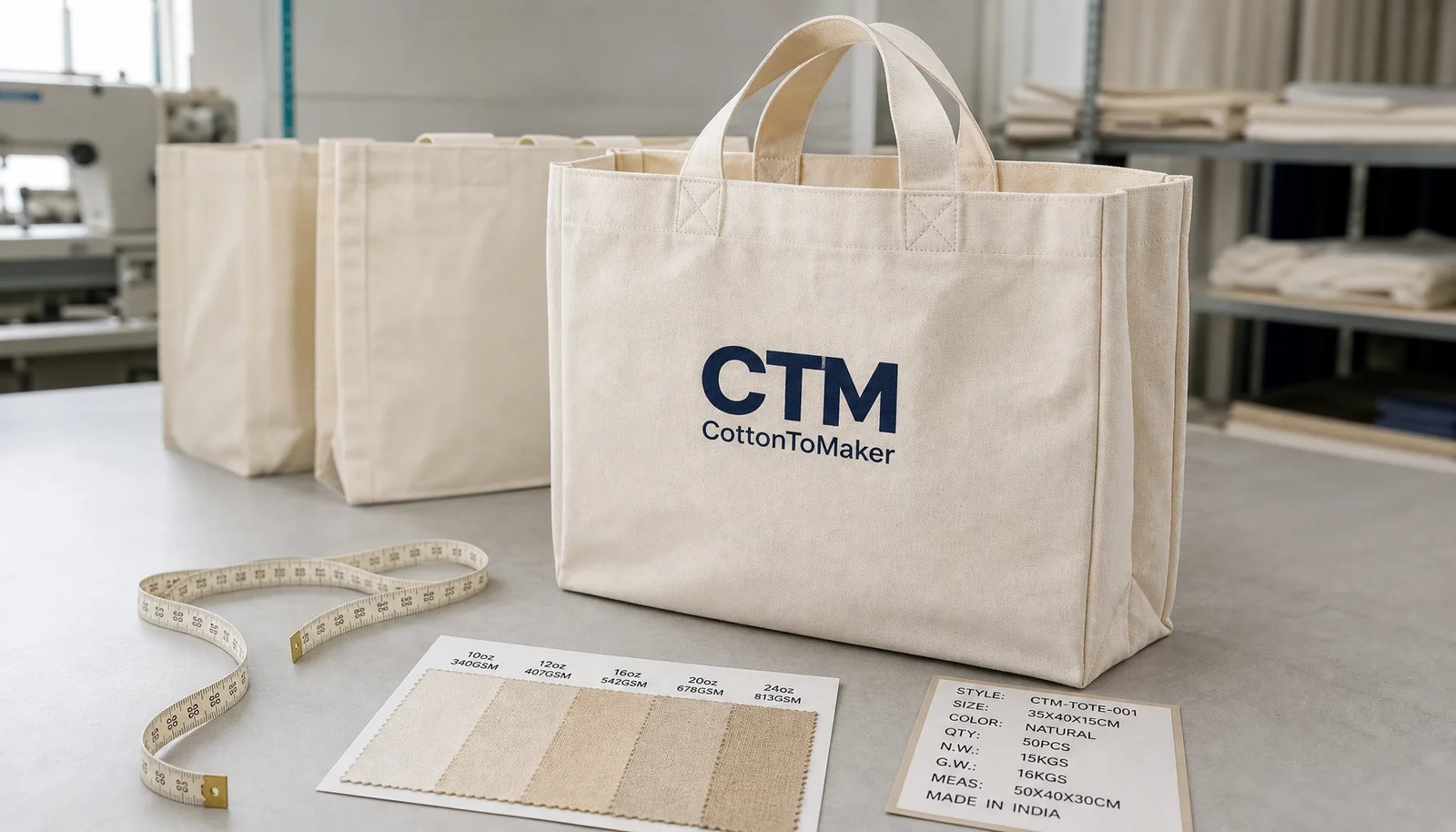
Start with the bookstore use case, not a generic tote name
A university bookstore grocery tote is not one standard product. The same bag may be sold as licensed merchandise, used at checkout, handed out at orientation, added to online orders, or packed with dorm supplies. Each use changes the right fabric weight, gusset, handle drop, print method, packing format, and inspection standard.
A vague request for a “canvas tote with logo” will produce quotes that look comparable but are not. One supplier may price a flat 6 oz giveaway bag, another an 8 oz event tote, and another a 12 oz gusseted retail bag with reinforced handles. All can be called canvas totes, but only one may fit a bookstore that expects students to carry books, apparel, bottles, snacks, and gifts across campus.
Before sending an RFQ, align purchasing, retail, licensing, warehouse, and marketing teams. Retail teams care about hand feel and saleability. Licensing teams care about approved marks and school colors. Warehouse teams care about cartons, labels, and receiving. Procurement needs landed cost, MOQ, lead time, and supplier reliability. A strong buying checklist turns these priorities into measurable requirements.
- For paid resale: prioritize 10-12 oz canvas, clean sewing, reinforced handles, approved artwork, and retail-ready presentation.
- For orientation kits: prioritize simple printing, budget control, bulk packing, and delivery before the campus event date.
- For checkout use: choose a gusseted body and practical load standard rather than the cheapest flat tote.
- For licensed spirit products: confirm logo rules, Pantone standards, trademark approval, and repeat color control.
- For online fulfillment: confirm folded size, barcode labels, hangtags, and whether the print tolerates folding.
Write an RFQ that factories can price without guessing
Good wholesale pricing starts with a complete specification. Soft sewn goods always have some variation, but words like large, durable, premium, and strong are not production standards. Replace them with finished dimensions, GSM, handle width, handle drop, stitch pattern, print size, print position, packing method, and tolerance.
Separate the tote specification from the SKU plan. The tote specification covers fabric, size, gusset, handles, stitching, labels, printing, and packing. The SKU plan covers quantities by fabric color, design, print colors, barcode, destination, and delivery window. This helps suppliers show setup charges, fabric allocation, screen costs, changeover time, packing labor, and inspection requirements instead of hiding them in a single unit price.
Also state what is not included. If there is no zipper, inner pocket, snap, individual polybag, care label, or hangtag, say so. If retail hangtags, UPC labels, or campus-specific carton marks are required, include them from the first quote request. Late packing changes can affect labor, carton counts, warehouse receiving, and ship date.
- Use finished dimensions after sewing, not cutting pattern dimensions.
- Define measurement points: top width, height, gusset depth, bottom width, handle length, and handle drop.
- Set a practical finished-size tolerance, often ±0.5 in for canvas totes.
- Specify print placement, such as front print centered, 9 in wide, 4 in below top seam.
- Create one SKU line for each fabric color, logo, size, packing format, barcode, and delivery date.
- Ask suppliers to list every deviation from the RFQ directly in the quote.
Choose canvas weight by GSM, not marketing language
Canvas weight drives cost, hand feel, durability, sewing difficulty, and freight. For most university bookstore grocery totes, 10 oz to 12 oz cotton canvas is the practical retail range. In metric terms, that is often about 270-340 GSM, depending on weave, finishing, dyeing, and supplier conversion. An 8 oz canvas, around 220-240 GSM, can work for orientation giveaways but may feel light for paid resale or heavy book loads.
Do not compare ounce descriptions alone. Some suppliers quote ounces per square yard. Some convert from GSM. Some refer to greige fabric before finishing, while others quote dyed or finished fabric. Ask for actual bulk GSM after finishing and a stated tolerance. If the tote will be washed or marketed as washable, add shrinkage and print durability requirements; otherwise, do not assume garment-level laundering performance.
Construction matters as much as weight. A tighter weave usually prints more cleanly and feels firmer. A looser weave may feel softer but distort more under load. Natural canvas often includes flecks and slubs, which may be acceptable if the standard is approved in advance. For retail resale, request a swatch or sample so the buying team can judge opacity, stiffness, surface texture, and perceived value.
- Budget event route: 8 oz canvas, about 220-240 GSM, for lighter short-term programs.
- Standard bookstore route: 10 oz canvas, about 270-300 GSM, for reusable campus retail totes.
- Premium route: 12 oz canvas, about 320-340 GSM, for stronger hand feel and heavier merchandise.
- Heavy specialty route: 14 oz or higher, often 380+ GSM, with higher sewing and freight impact.
- Quote requirement: state whether weight is measured before or after finishing, dyeing, or washing.
- QC requirement: test GSM on bulk fabric and compare it with the approved sample.
Size, gusset, and bottom construction determine usable capacity
A grocery-style bookstore tote should usually have a side gusset, bottom gusset, or boxed bottom. A flat tote is cheaper and packs tightly, but it does not handle boxed gifts, water bottles, sweatshirts, notebooks, and multiple books as neatly. A practical range for many bookstore totes is 15-17 in wide by 14-16 in high with a 4-6 in gusset.
Small size changes can affect cost more than expected. A deeper gusset adds fabric, sewing time, folding bulk, carton volume, and warehouse space. A taller body gives more print area but can feel awkward if handle drop is not adjusted. A wider body can require new print placement or revised screens. Lock dimensions before cutting markers and print screens are approved.
Bottom construction should be specified. A continuous side/bottom gusset often folds flatter. A boxed bottom may stand better when loaded, but it can add bulk and requires accurate sewing. If the tote must stand upright for display or checkout loading, request sample photos empty and filled, not just a flat front-view mockup.
- State finished width, height, gusset depth, and bottom style.
- Use a defined finished tolerance, commonly ±0.5 in unless tighter control is agreed.
- Check opening width and how easily the tote loads at checkout.
- Confirm whether the bag should stand when filled, fold flat, or balance both.
- Review carton cube before approving oversized gussets.
- Avoid late dimension changes after artwork and sampling are approved.
Specify handles as a performance feature
Handle failure is one of the easiest ways to turn a low unit price into a customer complaint. The bag body may be strong enough, but the handle joint can fail if the handle is narrow, seam allowance is short, stitch density is low, or reinforcement is missing. The quote should state handle material, width, total length, drop, stitch pattern, reinforcement method, thread color, and attachment style.
Comfort matters for campus use. A hand-carry tote may use shorter handles. A shoulder tote needs enough drop to fit over a sweatshirt or winter coat. Narrow handles can dig into the hand when the bag carries textbooks or bottles. Handles that are too long on a tall body may make the tote hit the leg while walking.
Define a load test before production. For a standard bookstore tote, buyers often use a practical test such as a filled load held for several minutes plus repeated lifts. The exact weight should match the intended program, but failure signs should be clear: fabric tearing, broken thread, seam slippage, skipped stitches, loose handle ends, or major distortion. Measure handle drop on finished samples because fabric shrinkage and top-hem sewing can change the result.
- Common handle width: about 1-1.5 in, with wider handles usually improving comfort.
- Shoulder-carry handles often need about 22-26 in total length, depending on bag height.
- Reinforcement options include box-X, bartack, double-row, or dense multi-row stitching.
- Specify whether handles are self-fabric canvas or cotton webbing.
- Check the handle seam allowance and whether ends are folded or hidden inside the hem.
- Inspect finished handle drop, not only the pattern measurement.
Match decoration to campus artwork, licensing, and fabric color
Screen printing is usually the practical decoration choice for wholesale canvas grocery totes for university bookstores. It works well for solid bookstore names, mascots, school marks, and one- to three-color graphics. Costs rise with additional colors, large ink coverage, tight registration, small reversed text, and strict Pantone matching. Large solid prints can also feel stiff, so approve a physical sample.
Heat transfer is useful for full-color art, gradients, and complex graphics, but buyers should check edge feel, adhesion, cracking risk, and rub behavior on canvas. Embroidery can look premium for small marks but may pucker lighter canvas or become costly on large front-panel art. Woven labels are useful for subtle branding, side tabs, or premium details, but they do not replace a visible bookstore logo when visibility is the goal.
University artwork needs a controlled approval path. Natural canvas has a warm base; bleached canvas brightens ink; dyed canvas can shift color and may require an underbase for light prints. If the licensing office requires specific school colors, approve a strike-off or pre-production sample printed on the actual fabric. Include logo usage restrictions, trademark rules, university seal limitations, and final approver names in the RFQ.
- Screen print: best for solid logos, mascots, bookstore names, and repeat wholesale runs.
- Heat transfer: useful for full-color art; test adhesion, cracking, and edge feel.
- Embroidery: premium for small marks; check puckering and backing on canvas.
- Woven label: good for subtle retail branding or side detail.
- Color approval: use Pantone reference, strike-off, or signed sample under consistent lighting.
- Artwork control: do not allow unapproved logo reuse, alteration, or production overruns.
Handle university-specific compliance before the PO
University bookstore buyers have compliance concerns that generic promotional tote buyers may not face. Licensed logos, mascots, seals, department names, and athletic marks may be controlled by the university or a licensing agent. The supplier should not begin bulk printing until artwork approval is documented. The purchase order should prohibit unauthorized reproduction, overruns, or use of artwork in supplier marketing unless separately approved.
Retail claims also need discipline. If a tote will be labeled organic, recycled, biodegradable, washable, or made with certified cotton, the claim should be supported before hangtags, product pages, or shelf signage are printed. Ask for certificates, transaction documents, composition declarations, or traceability records that match the actual order. Do not let a sustainability claim appear only because a supplier used the phrase casually in a quote.
Commercial terms should also reflect the risk of licensed goods. Review vendor insurance requirements, indemnity language, restricted substances expectations, country-of-origin marking, retail labeling, hangtag copy, barcode accuracy, and any campus vendor code of conduct. If the bookstore’s receiving system requires UPC, SKU, PO, or destination labels, make those part of the product specification, not a last-minute warehouse request.
- Confirm who approves licensed artwork and who signs the final pre-production sample.
- Require written limits on logo use, overruns, rejected goods, and supplier portfolio images.
- Verify documentation before using organic, recycled, certified, or washable claims.
- Check country-of-origin, fiber content, hangtag copy, and retail label requirements.
- Include vendor insurance, indemnity, and compliance obligations in purchasing documents.
- Require barcode and carton-label accuracy for retail and warehouse receiving.
Plan MOQ by SKU, not total quantity
MOQ issues appear when the buyer counts total units and the factory counts variations. A 5,000-piece order may look simple until it is divided across five logos, three fabric colors, two delivery windows, different barcodes, and separate destinations. Each variation can require separate screens, ink mixing, fabric allocation, cutting control, packing labels, carton marks, and inspection records.
Use a SKU table in the RFQ. Each line should show fabric color, finished size, print design, print color count, quantity, packing format, barcode or hangtag requirement, destination, and requested ship date. This lets suppliers price setup and production complexity clearly. It also helps the bookstore compare a wide assortment against a simpler program with higher units per design.
Reorder planning should be discussed early. Ask whether screens are stored, how long repeat artwork is kept, what the minimum reorder quantity is, whether the same canvas construction will remain available, and how repeat color will be controlled. For licensed bookstore assortments, a low first-order MOQ can be less useful if reorder quantities are too high or color consistency cannot be maintained.
- Request MOQ by fabric color, print design, bag size, print color count, packing method, and shipment lot.
- Expect dyed canvas to have higher MOQ than natural canvas because dye lots must be managed.
- Multiple logos usually require separate screens even on the same bag body.
- Below-MOQ orders may carry surcharges for fabric, screens, changeover, and packing labor.
- Compare many small SKUs against fewer higher-volume designs using landed cost, not unit cost alone.
- Ask about minimum reorder quantity, screen storage, fabric availability, and repeat color control.
Verify suppliers before relying on their quote
A low quote is not enough. Ask whether the supplier has produced similar canvas totes, not just non-woven promo bags or lightweight cotton shoppers. Request recent production photos showing canvas fabric, gusset construction, handle reinforcement, screen printing, packing, and carton marks. Photos do not replace an audit or sample, but they help confirm whether the supplier understands this product category.
Review production readiness. Useful questions include monthly tote capacity, sewing-line experience with 10-12 oz canvas, screen-printing capability, export experience, quality team structure, inspection process, and whether the factory or a subcontractor will print and sew the bags. If subcontracting is involved, ask who controls quality and who is responsible for defects.
Documentation matters when the bookstore needs reliable replenishment or retail claims. Ask for material traceability records, fabric mill information, dye lot tracking, certification documents if claims are made, and prior inspection report examples with confidential information removed. If the supplier has audit status, compliance documentation, or export records, review them before awarding a program tied to a campus deadline.
- Ask for recent canvas tote production photos with similar fabric weight and handle construction.
- Confirm whether printing, cutting, sewing, inspection, and packing are in-house or subcontracted.
- Review capacity for the required quantity and delivery window.
- Check export experience, packing standards, and ability to meet bookstore carton-label requirements.
- Request traceability documents for cotton, recycled content, organic claims, or dyed fabric lots.
- Ask how defects, rework, replacement, and late shipment risks are handled contractually.
Use sampling and QC to protect the campus deadline
A digital mockup cannot approve a canvas grocery tote. A pre-production sample should use actual fabric, actual handles, actual thread, actual print method, actual ink colors, and the planned packing fold. If substitute material is used, document the difference and require approval of the final fabric before bulk production.
Sample approval should be measurable. Record finished width, height, gusset depth, bottom style, handle length, handle drop, logo size, logo position, print color, and packing method. Keep a signed sample or marked photo set as the inspection standard. For university artwork, clarify whether the buyer, licensing office, bookstore manager, or brand team has final approval authority.
Final QC should cover fabric, sewing, print, labels, load performance, and packing. Use an agreed AQL approach where appropriate, such as General Inspection Level II with defect classes set by the buyer. Include barcode scan checks, carton-mark verification, SKU mix, carton count, gross weight, and moisture protection. A tote can pass visual inspection and still fail receiving if the barcode is wrong or cartons are mislabeled.
- Measure the approved sample and attach the measurements to the PO or approval sheet.
- Perform a practical load test using the agreed weight, hold time, and lift repetitions.
- Check print rub, curing, opacity, registration, and placement before full production is packed.
- Inspect handle reinforcement, open seams, skipped stitches, loose thread clusters, and raw edges.
- Verify barcode scans, hangtag copy, country-of-origin labels, and carton labels.
- Confirm carton quantity, SKU separation, PO number, destination, carton dimensions, and gross weight before shipment.
Specification comparison for buyers
| Option or decision | Typical cost impact | MOQ impact | Lead-time impact | Best use case |
|---|---|---|---|---|
| 8 oz canvas, about 220-240 GSM | Lower fabric cost and lighter freight; may require better reinforcement to feel acceptable | Usually easier to reach, especially in natural canvas | Often shorter if stock fabric is available | Orientation giveaways, move-in kits, budget checkout bags, event distribution |
| 10-12 oz canvas, about 270-340 GSM | Mid-range cost; stronger perceived value for retail | Standard wholesale MOQ by color and print design | Normal production timing; dyed colors may add time | University bookstore resale, grocery-style checkout totes, campus gift items |
| 12-14 oz premium canvas, about 320-380+ GSM | Higher material cost, slower sewing, heavier cartons, larger freight cube | May require higher MOQ if fabric is not stocked | Can be longer due to fabric sourcing and sewing complexity | Alumni gifts, premium school-spirit merchandise, higher-margin retail programs |
| Natural canvas body | Usually the most cost-efficient route | Often lowest MOQ compared with custom dyed fabric | Often fastest when fabric is in stock | General bookstore inventory, neutral retail programs, simple campus logos |
| Dyed school-color canvas | Higher cost for dyeing, shade control, and possible colorfastness testing | Often higher by dye lot and fabric color | Adds lab dip, shade approval, and possible re-dye time | Licensed school-spirit assortments, alumni collections, seasonal color programs |
| Screen print decoration | Cost-effective for 1-3 solid colors; screen/setup charges apply | MOQ usually tied to print design and color count | Efficient after artwork and strike-off approval | Bookstore logos, mascot art, school names, department marks |
| Heat transfer decoration | Higher unit cost for large or full-color graphics | Can be viable for smaller runs, depending on supplier setup | May add artwork proofing and application time | Full-color art, gradients, complex illustrations, short specialty runs |
| Bulk folded packing | Lower packing labor and less packaging material | Usually easier for large checkout or event orders | Faster than unit packing | Checkout inventory, orientation distribution, warehouse replenishment |
| Individual retail packing with barcode or hangtag | Higher labor, packaging, and label cost | Can increase MOQ or surcharge by SKU | Adds label proofing, scan checks, and packing time | Paid resale, online fulfillment, controlled inventory, gift programs |
Buyer checklist before sampling
- Define the use case first: paid resale, checkout grocery tote, orientation giveaway, alumni gift, online bookstore add-on, event kit, or licensed school-spirit merchandise.
- Specify fabric by both commercial ounce and GSM, and require the supplier to state whether GSM is measured on greige, finished, dyed, washed, or final bulk fabric.
- State the exact material route: natural cotton canvas, bleached cotton canvas, dyed canvas, recycled cotton blend, organic cotton canvas, cotton-poly blend, or another construction.
- Provide finished dimensions after sewing: top width, body height, gusset depth, bottom construction, handle total length, handle drop, handle width, and print placement.
- Set dimensional tolerances, commonly ±0.5 in for soft canvas totes unless tighter tolerances are justified and quoted.
- Define expected load use in plain terms: textbooks, notebooks, apparel, water bottles, packaged snacks, gifts, dorm supplies, or general bookstore merchandise.
- Specify handle material, width, reinforcement method, stitch pattern, seam allowance, thread color, and whether handles are inserted into the hem or attached externally.
- Provide vector artwork, Pantone references, logo usage rules, maximum print size, print position, licensing approval path, and any restrictions on mascot or university seal use.
- Separate quantities by SKU: fabric color, logo design, print color count, size, packing format, barcode, hangtag, destination, and delivery window.
- Require a pre-production sample using actual fabric, actual handle construction, actual print method, actual ink colors, and actual packing fold whenever possible.
Factory quote questions to send
- What is the actual bulk fabric GSM after finishing, and what production tolerance should we expect, for example ±5% or another stated range?
- Is the canvas natural, bleached, dyed, recycled blend, organic cotton, cotton-poly blend, or another construction, and what composition or certification documents can support any retail claim?
- Is the fabric weight quoted as ounces per square yard, converted from GSM, or based on a local fabric name, and is it measured before or after dyeing, finishing, washing, or shrinkage control?
- What finished bag size is included in the quote: top width, body height, gusset depth, bottom construction, handle total length, handle drop, and measurement tolerance?
- What handle material, width, stitch pattern, reinforcement method, thread type, seam allowance, and attachment method are included?
- What practical load test do you recommend for this construction, including weight, hold duration, lift repetitions, and failure signs such as torn fabric, broken thread, or seam slippage?
- Which decoration method is quoted, how many colors are included, what ink or transfer system is planned, and are screen charges, PMS matching, film, or artwork setup fees separate?
- Can Pantone colors be matched on the actual fabric color, and will approval be by lab dip, print strike-off, pre-production sample, signed swatch, or another physical standard?
- What registration tolerance and placement tolerance can you hold for the logo, measured from the top seam and side edges?
- What is the MOQ by fabric color, print design, print color count, bag size, packing format, and shipment lot, and what surcharge applies below the standard MOQ?
Quality-control points to confirm
- Verify fabric weight by GSM test on bulk fabric, not only by the commercial ounce description in the quotation.
- Record whether GSM is checked on finished fabric and set an allowed tolerance, commonly around ±5% unless a different standard is agreed.
- Use an agreed sampling plan such as ANSI/ASQ Z1.4 or ISO 2859-1 where appropriate; many buyers use General Inspection Level II with AQL limits set by defect class.
- Classify defects before inspection: critical defects may include wrong logo, unsafe contamination, or structural failure; major defects may include open seams, failed handles, severe stains, wrong size, or misplaced print; minor defects may include small loose threads within agreed limits.
- Check finished dimensions at the same measurement points on every inspected bag: top width, body height, gusset depth, bottom width, handle total length, and handle drop.
- Keep finished size within the agreed tolerance, commonly ±0.5 in for soft sewn totes unless the purchase order states otherwise.
- Inspect handle attachment for box-X, bartack, or specified reinforcement, with no skipped stitches, broken thread, loose stitch ends, seam slippage, raw edges, or fabric tearing.
- Run a practical load test based on bookstore use, for example 20-25 lb held for 2-5 minutes plus repeated lift cycles for standard retail totes, adjusted to the construction and approved in advance.
- Approve print color against a physical Pantone reference, strike-off, or signed pre-production sample under consistent lighting, not only from a monitor image.
- Check print curing, adhesion, rub resistance, edge sharpness, cracking risk, and opacity, especially for dark ink on natural canvas or white ink on dyed canvas.