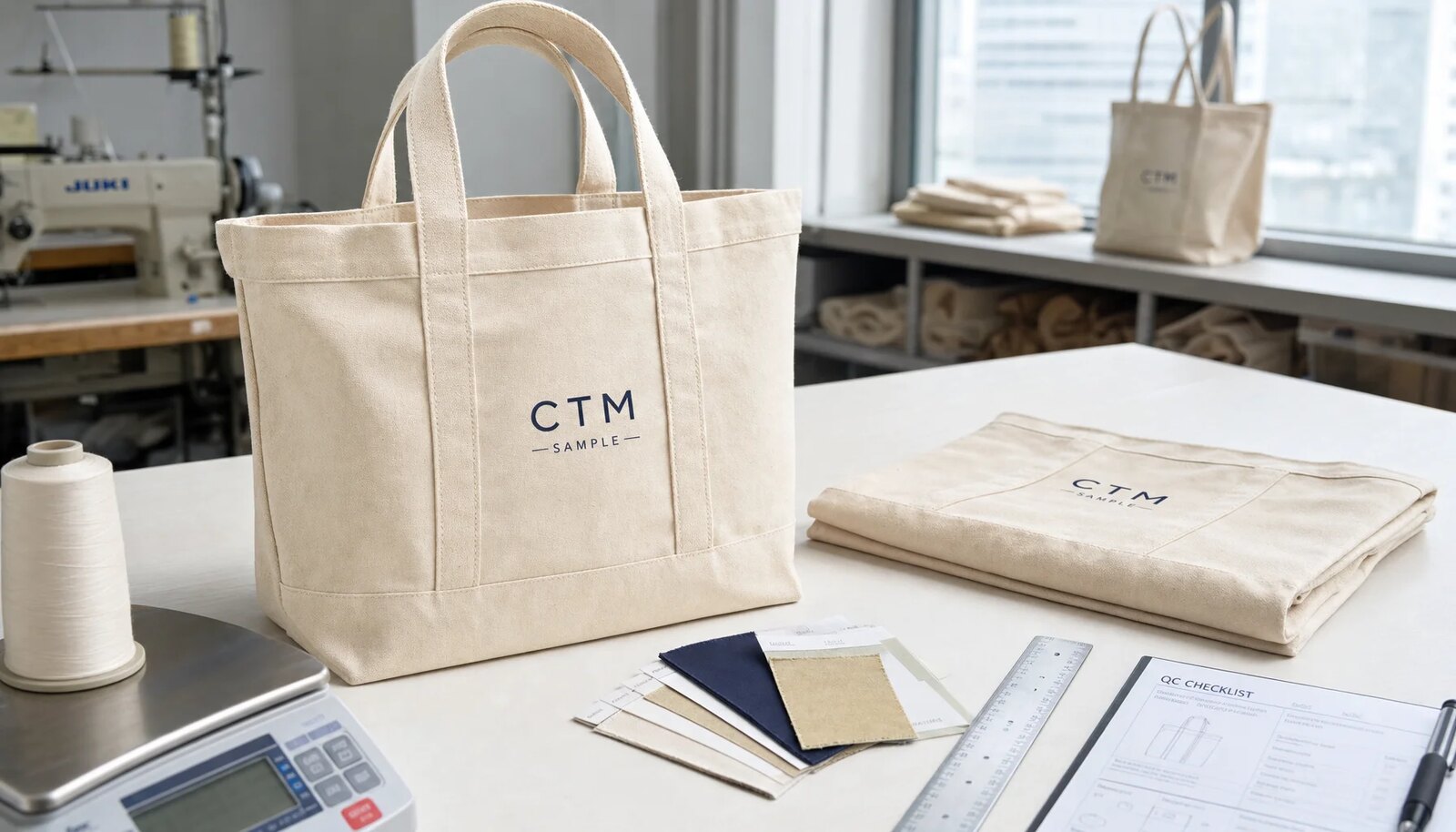
Start With The Bookstore Use Case
Canvas grocery totes for university bookstores are retail products, not just blank promotional bags. A bookstore tote may carry textbooks, notebooks, apparel, bottled drinks, snacks, gifts, and grocery items. It may also sit on a sales floor with hangtags, barcode labels, and official university artwork that must be received and scanned correctly.
The quality inspection checklist should begin before the supplier quote. If the RFQ only says canvas tote with logo, suppliers may quote different fabric weights, gussets, handle types, labels, and packing methods. The result is a low-confidence price comparison and a difficult final inspection.
A better RFQ translates the use case into measurable requirements: finished canvas GSM, finished dimensions, gusset depth, handle drop, load expectation, print method, label copy, barcode placement, carton marks, and inspection rules. These details help procurement compare true landed cost instead of only the first unit price.
- Use finished canvas weight, not only canvas weight.
- State whether the tote is for resale, events, grocery use, or premium gifting.
- Define capacity through size and gusset depth, not only front-panel dimensions.
- Include labels, barcodes, hangtags, and carton marks in the first quote.
- Make the inspection checklist part of the PO or supplier confirmation.
Select The Right Canvas Weight And Finish
For bookstore grocery totes, 10 oz to 12 oz finished cotton canvas is usually the practical starting range. That is roughly 340-410 GSM after finishing, although exact conversion depends on weave, yarn, moisture, dyeing, and finishing. An 8 oz tote can work for light events, but it may feel thin for grocery positioning. A 14 oz tote feels more premium, but it increases fabric cost, sewing bulk, carton weight, and freight.
The word finished matters. Greige fabric is unfinished mill fabric, and its weight can change after dyeing, washing, drying, pressing, or other finishing. One supplier quoting 12 oz greige canvas may deliver a lighter finished bag than another supplier quoting 12 oz finished canvas. Ask for finished ounces, finished GSM, and a tolerance such as plus or minus 5% if the factory can control it.
Composition also needs precision. Cotton, recycled cotton blends, organic cotton, and cotton-poly blends can all be valid, but they affect handfeel, shrinkage, shade consistency, labeling, and documentation. If the bookstore plans to advertise recycled or organic content, request certificates or test reports before approving retail copy. Country-of-origin, fiber content, care, and environmental claims should be handled according to the regulations and selling-market requirements that apply to the order.
- 8 oz finished canvas: better for light campaigns than heavy grocery use.
- 10 oz finished canvas: balanced option for many bookstore resale programs.
- 12 oz finished canvas: stronger handfeel and structure for repeat use.
- 14 oz finished canvas: premium feel, higher cost, heavier cartons, and more seam bulk.
- Natural canvas: inspect slubs, seed flecks, stains, odor, and print contrast.
- Dyed canvas: require lab dips, shade tolerance, and lot control.
Control Size, Gusset, Capacity, And Tolerances
A grocery tote should be specified for usable volume. Many bookstore programs fit well around 15-16 inches wide and 15-17 inches high, with a 4-6 inch gusset. This gives useful capacity for books, apparel, boxed gifts, and smaller grocery purchases without making the tote oversized, expensive to ship, or awkward to display.
Gusset construction affects both function and appearance. A side-and-bottom gusset helps the tote open and stand with boxier items. A bottom-only gusset can improve capacity while keeping a simpler front panel. Either option changes cutting, sewing, folding, carton cube, and logo placement. Artwork centered on a flat bag can look slightly different after the gusset opens.
Written tolerances reduce disputes. Canvas relaxes, shrinks, and shifts during cutting, sewing, and pressing. For many bulk tote orders, plus or minus 0.5 inch on main body dimensions is workable. Logo placement may need a tighter tolerance, such as plus or minus 0.25 inch, when official marks or retail display standards matter. Confirm tolerance capability before issuing the PO.
- Measure width across the relaxed body, and at the opening if shape matters.
- Measure height from top edge to bottom seam on a laid-flat bag.
- Measure gusset depth fully opened and review how it folds.
- Measure handle drop from bag top edge to the handle apex.
- Measure logo placement from top edge, side seam, bottom seam, and gusset fold.
- Approve the tote empty, filled, and folded before releasing production.
Engineer Handles For Real Loads
Handles are a common failure point for reusable totes. Strong fabric will not protect the product if the handle base tears out, the bartack is too short, or the top hem stitching fails. A bookstore customer may load one tote with books, bottled drinks, snacks, and apparel, then carry it across campus.
Both self-fabric handles and cotton webbing handles can work. Self-fabric gives a matched look. Webbing often provides consistent width and grip. The RFQ should state handle width, handle length, handle drop, reinforcement type, stitch density if required, and expected load performance. Box-X stitching, bartacks, double bartacks, or an approved equivalent should be visible on the sealed sample.
Make load testing operational. For example, the buyer may require selected production bags to hold 10-15 kg for 5 minutes, followed by 10 lift cycles, with no popped stitches, tearing, seam slippage over the agreed limit, or severe handle distortion. The exact weight should match the product position, but it must be written before inspection.
- Typical shoulder-carry handle drop: about 9-11 inches.
- Check handle base alignment and symmetry on both sides.
- Inspect skipped stitches, loose threads, broken needle marks, puckering, and short bartacks.
- Pull load-test samples from different cartons, not only the top carton.
- Record failures with carton number, photo, weight, duration, and defect classification.
Choose A Print Method And Test It On Bulk Canvas
Screen printing is often the most efficient choice for university marks, bookstore logos, and one-to-three-color graphics. It works well when ink deposit, registration, and curing are controlled. Buyers should provide vector artwork, final logo size, print position, color standard, and placement tolerance.
Canvas texture changes print appearance. Natural canvas may have seed flecks, slubs, and an uneven weave. Fine lines can fill in, small type can lose sharpness, and pale ink may appear weaker than it does in a digital proof. Large solid areas may need enough ink deposit to avoid a thin or patchy look. A digital mockup is useful for layout but not for final print approval.
Heat transfer and digital print can help with gradients, detailed artwork, short runs, or multiple department versions. They also need durability checks. Totes are folded, rubbed, stacked, handled at checkout, and carried repeatedly. Require dry rub, wet rub, tape pull, fold-across-print, and cleaning checks where the approved care instruction allows wiping or washing.
- Screen print: efficient for bold marks and solid colors.
- Heat transfer: check edge lift, cracking, handfeel, and tape-pull results.
- Digital print: review color saturation, banding, and adhesion on actual canvas.
- Embroidery: best for smaller premium marks, not large grocery graphics.
- Use Pantone or a physical color standard when school colors are important.
- Inspect opacity, registration, pinholes, bleeding, curing, peeling, and contamination.
Build An RFQ That Makes MOQ And Cost Comparable
MOQ is tied to fabric sourcing, cutting efficiency, print setup, sewing changeover, labels, and packing. A supplier may accept a low quantity, but the unit cost rises when screens, sampling, cutting, and line setup are spread across fewer pieces. One base size and one base fabric color usually creates cleaner economics than many small custom bodies.
Ask for quantity breaks at 500, 1,000, 3,000, and 5,000 pieces. Admissions, athletics, alumni relations, and department stores may use similar totes with different artwork. Consolidating the base bag can help, but each artwork may still need separate screens, setup, labels, or packing instructions. The quote should show these costs clearly.
Avoid comparing a complete quote with an incomplete one. A deeper gusset, heavier canvas, dyed fabric, multi-color print, hangtag, barcode label, individual bag, carton liner, and destination sorting all add cost. Ask what is included in the unit price and what is charged separately, including overage or shortage tolerance for custom lots.
- Quote 10 oz and 12 oz finished canvas side by side.
- Separate fabric color MOQ from artwork MOQ and print colorway MOQ.
- List screen charges, setup fees, lab dips, sample fees, and PMS matching.
- Include barcode labels, hangtags, care labels, origin labels, carton marks, and packing materials.
- Request carton dimensions, gross weight, net weight, and CBM for freight comparison.
Use Samples To Lock The Standard
A pre-production sample should represent the bulk order as closely as possible. It should use the correct finished canvas weight, fabric color, composition, handle material, reinforcement, seam construction, gusset, logo method, logo color, labels, hangtags, and fold. If substitute fabric is used because bulk fabric is not ready, mark the sample as reference only and require a bulk-fabric approval before full cutting.
University bookstore orders often involve multiple stakeholders. Procurement may approve price and terms. Retail operations may care about barcode scanning and carton receiving. Licensing or brand teams may approve official marks. Department buyers may approve artwork versions. A single approval record prevents conflicting instructions from reaching the factory.
Keep one sealed approved sample with the buyer and one with the factory. Attach an approval tag with date, artwork version, logo size, fabric weight, handle drop, label version, and any accepted deviations. For new suppliers, dyed canvas, official marks, large prints, or tight launch dates, request first-article review before the factory continues the full run.
- Approve the sample empty, filled, and folded.
- Photograph logo placement, label position, barcode location, hangtag, fold, and carton mark.
- Confirm the barcode scans before bulk label application.
- Use bulk fabric for the final approval whenever possible.
- Do not let a digital mockup replace a physical canvas print approval.
Run Final Inspection With AQL And Defect Classes
Final inspection should combine AQL sampling with tote-specific checks. A common consumer-goods starting point is General Inspection Level II with AQL examples such as 0 for critical, 2.5 for major, and 4.0 for minor defects, but the buyer should set the actual plan based on order risk, selling channel, and contract terms. Higher-risk bookstore orders may need tighter sampling or additional functional tests.
Defect classes must be clear. Critical defects may include unsafe contamination, mildew, severe odor, broken handles, wrong university logo, wrong legal label, or mixed customer artwork. Major defects may include open seams, large stains, unreadable barcodes, print cracking, dimensions outside tolerance, weak reinforcement, incorrect assortment, or cartons marked for the wrong destination. Minor defects may include small loose threads, light creasing, or natural slubs that remain within the approved standard.
Inspectors should pull samples from multiple cartons across the shipment. Tote defects often cluster by roll, print table, sewing operator, or packing team. A useful report connects each defect to a carton number, photos, measurements, defect class, and PO requirement. The sealed sample controls handfeel, shade, construction, and print appearance. The written spec controls tolerance, labels, packing, and pass-fail rules.
- Fabric: verify GSM, shade, slubs, stains, odor, panel mismatch, and surface cleanliness.
- Dimensions: measure width, height, gusset, handle length, handle drop, and logo placement.
- Sewing: check seam allowance, stitch density, skipped stitches, raw edges, open seams, and top hem strength.
- Handles: run the agreed load test and check seam slippage, bartacks, and distortion.
- Print: test dry rub, wet rub, tape pull, fold resistance, color, registration, and opacity.
- Labels: confirm country of origin, care or content details, barcode scan, price ticket, and hangtag.
- Packing: check assortment, quantity per carton, carton marks, liner, moisture condition, and crushed handles.
Treat Labeling, Packing, And Receiving As Quality
Packing problems create real cost for university bookstores. Receiving teams may need to scan SKUs, count cartons quickly, separate designs by department, route inventory to different campus locations, and replenish displays. Randomly mixed designs, unclear carton marks, crushed handles, and non-scannable barcodes can delay receiving even when the tote itself is well made.
Confirm label requirements early. Country-of-origin labels, fiber content or care information, price tickets, hangtags, and barcode labels may be needed depending on the selling market, product claim, and bookstore system. Avoid broad assumptions. If the tote will carry organic, recycled, or other sustainability claims, the supporting documentation and approved wording should be settled before printing labels or hangtags.
Folding also affects quality. Heavier canvas holds creases, and a fold line across the print may weaken presentation. Some bookstores want the logo visible in folded stacks; others prefer flat bulk packing for backroom efficiency. Define pieces per bundle, pieces per carton, carton dimensions, carton marks, and moisture protection before production is packed.
- Specify flat folded, half-folded, bundled, individually packed, or display folded.
- Avoid mixed cartons unless the assortment is clearly shown on carton marks and packing lists.
- Scan barcode samples before bulk packing and again during final inspection.
- Check carton marks for PO number, item number, design, color, quantity, and destination.
- Use liners or moisture barriers when humidity or long transit is a concern.
- Review carton gross weight so bookstore staff can handle cartons safely.
Specification comparison for buyers
| Option | Best use in bookstore programs | Tradeoff to price or QC | Inspection focus |
|---|---|---|---|
| 8 oz finished canvas, about 270 GSM | Light event totes, orientation giveaways, lower-price resale where expected load is modest | Lower material and freight cost, but less structure and weaker grocery positioning | Confirm finished GSM, handle reinforcement, seam strength, and whether the sample feels too thin when loaded |
| 10 oz finished canvas, about 340 GSM | Standard reusable bookstore tote for snacks, apparel, notebooks, gifts, and light groceries | Good balance of cost, handfeel, and sewability; still needs reinforced handles for books | Check GSM tolerance, gusset shape, handle load test, print opacity, and panel shade consistency |
| 12 oz finished canvas, about 410 GSM | Stronger grocery tote or retail merchandise tote where durability and handfeel matter | Higher fabric cost and carton weight; thicker seams require better sewing control | Inspect needle damage, bulky seam areas, handle base reinforcement, carton weight, and fold creasing |
| 14 oz finished canvas, about 475 GSM | Premium campus gift tote or higher-price alumni merchandise | Substantial feel but more expensive, heavier to ship, and harder to fold neatly | Review top hem bulk, stitch consistency, print coverage on coarse fabric, and carton compression |
| Screen print, 1-3 solid colors | University marks, bookstore logos, department names, and bold front-panel graphics | Efficient for repeatable artwork, but setup charges and registration matter | Check ink opacity, curing, registration, PMS match, pinholes, and rub resistance |
| Heat transfer | Detailed artwork, small runs, gradients, or designs with many colors | Can look sharp, but edge adhesion and cracking risk must be controlled | Run tape pull, fold-across-print, dry rub, wet rub, and edge-lift checks |
| Digital print | Short runs or artwork that changes often by department or event | Flexible, but color saturation may be muted on natural canvas and unit cost can be higher | Compare color to approved sample, inspect banding, wash or wipe durability, and print alignment |
| Embroidery | Small premium marks, crests, or alumni gift details | Durable look, but less practical for large grocery tote graphics and can pucker fabric | Check backing, stitch density, thread color, puckering, loose threads, and placement tolerance |
Buyer checklist before sampling
- Define finished tote width, height, gusset depth, handle length, and handle drop, with measurement method and tolerances in the RFQ.
- Specify finished canvas weight in ounces and GSM, and ask whether the quoted number is greige, dyed, washed, pressed, or fully finished fabric.
- State fabric composition clearly, such as cotton, recycled cotton blend, organic cotton, or cotton-poly blend, and request documentation before making retail claims.
- Classify the program as grocery tote, bookstore merchandise tote, event tote, or premium gift tote before choosing weight, gusset, labels, and packing.
- Quote the same construction in 10 oz and 12 oz finished canvas so procurement can compare unit cost, handfeel, carton weight, CBM, and freight impact.
- Require a pre-production sample using bulk or bulk-equivalent fabric, final handles, final reinforcement, final logo size, approved label copy, and intended fold.
- Approve logo placement on the tote empty, filled, and folded because gussets and folds can change the visual center of the artwork.
- Set handle load-test criteria, such as 10-15 kg held for 5 minutes plus 10 lift cycles, with no tearing, popped stitches, or severe distortion.
- Include print durability checks such as dry rub, wet rub, tape pull, fold-across-print, and wipe or wash evaluation if care instructions allow cleaning.
- Define critical, major, and minor defects before inspection, including wrong artwork, open seams, stains, odor, barcode errors, and carton mix errors.
Factory quote questions to send
- What is the finished fabric weight in ounces and GSM after dyeing, washing, pressing, or other finishing, and what production tolerance do you control?
- Is the quoted fabric cotton, recycled cotton blend, organic cotton, cotton-poly blend, or another composition, and what documentation can support any retail claim?
- What are your standard tolerances for finished width, height, gusset depth, handle length, handle drop, and logo placement?
- Which print method are you quoting, how many colors are included, what ink or transfer type will be used, and what is the maximum printable area?
- Can you quote the same tote at 10 oz and 12 oz finished canvas so we can compare price, handfeel, carton weight, CBM, and freight impact?
- What is the MOQ per fabric color, bag size, logo design, and print colorway, and how does pricing change at 500, 1,000, 3,000, and 5,000 pieces?
- Are screen charges, artwork setup, PMS matching, lab dips, sample fees, hangtags, barcode labels, country-of-origin labels, carton marks, and packing materials included?
- What handle reinforcement will be used, what stitch density is standard, and what handle load test can you perform on production pieces?
- Can you provide a pre-production sample from bulk fabric before full cutting, and how many calendar days are needed after final artwork approval?
- Can you split lead time into fabric sourcing, lab dip approval, sampling, screen or artwork preparation, cutting, printing, sewing, inspection, packing, and freight handover?
Quality-control points to confirm
- Finished canvas weight should match the approved specification within the agreed tolerance, verified by swatch weighing or lab measurement rather than mill labels alone.
- Finished dimensions should be measured on relaxed bags laid flat, with separate checks for width, height, gusset depth, handle length, and handle drop.
- Logo placement should be measured from fixed points such as top edge, side seam, bottom seam, and gusset fold, not judged only by visual centering.
- Handle attachment must show consistent reinforcement with no skipped stitches, loose threads, broken needle marks, weak bartacks, seam slippage, or misaligned bases.
- Load-tested handles should show no tearing, popped stitches, severe distortion, or top hem failure after the agreed weight, duration, and repetitions.
- Logo color, size, position, registration, opacity, and curing should match the sealed pre-production sample under consistent lighting.
- Print surface should be free of pinholes, heavy ink buildup, ghosting, off-registration, contamination, bleeding, peeling, and cracking after folding or rubbing.
- Side seams, bottom seams, top hem, and gusset corners should be straight, secure, and free from open seams, raw edges, puckering, or loose thread chains unless specified.
- Natural canvas should be checked for excessive seed marks, oil stains, water marks, weaving slubs, mildew odor, foreign fibers, panel shade mismatch, and surface contamination.
- Dyed canvas should be checked for color consistency between panels, handle material, body fabric, and production lots, especially when university colors are part of the retail appeal.