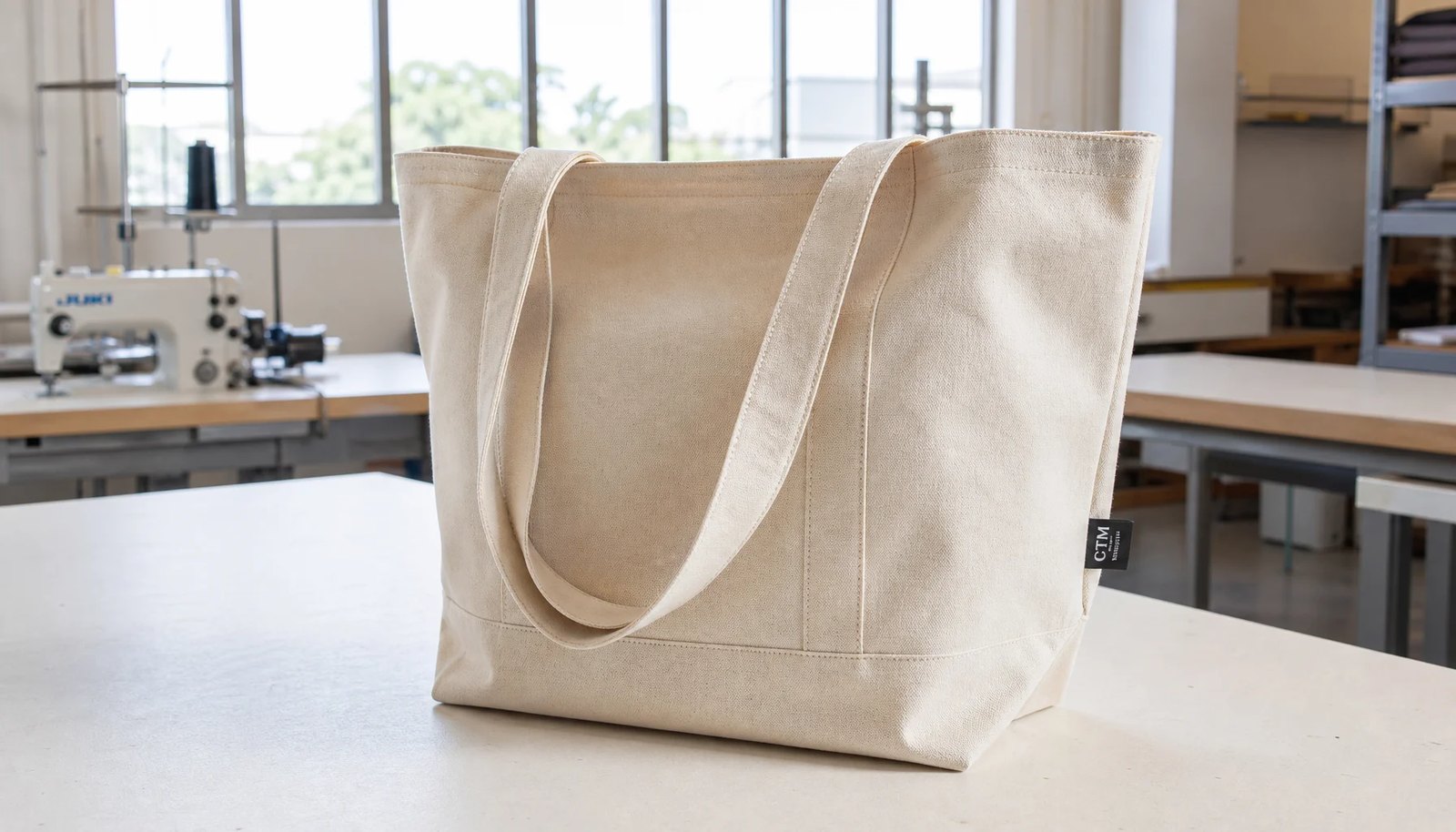
Why logo placement matters on a trade show grocery tote
A canvas grocery tote used at a trade show is not just a giveaway bag. It is a moving display panel, a sample carrier, a literature holder, and often the item attendees keep using after the event. For exhibitors, the tote may carry a company logo through crowded aisles for hours before it reaches an office, hotel room, retail counter, or warehouse desk. That makes logo placement a procurement decision, not only a design decision.
The question is not where the logo looks best on a flat mockup. The useful question is where the logo still reads when the bag is filled, carried by hand, held against clothing, stacked under brochures, or folded into a carton. A mark that looks balanced on a digital proof can disappear under a top fold, bend around a gusset, or sit too close to handle reinforcement after sewing. For a trade show exhibitor, that is wasted branding space and a preventable quality issue.
Procurement teams should treat placement as part of the product specification. The RFQ should include the finished bag dimensions, print size, print position, measurement points, and tolerance. Instead of asking for a large logo on the front, ask for the logo to be centered on the front panel with the top of the print a defined distance below the top hem and with minimum clearance from side seams and handle stitch points. That gives the factory something measurable.
- Specify the logo position for a filled bag, not only for a flat artwork proof.
- Keep the primary mark away from the top hem, side seams, bottom seam, gusset folds, and handle reinforcement.
- Use one main brand face for the exhibitor logo and reserve smaller areas for sponsor marks or campaign lines.
- Ask the supplier to show measurements from fixed construction points, not only a visual centered mockup.
Start with tote construction before artwork layout
Logo placement starts with the bag body. Before debating whether the mark should be five inches wide or seven inches wide, the buyer needs to know the finished panel size, gusset depth, handle drop, top hem depth, and where reinforcement stitching will land. These construction details define the actual printable area. If the print zone is calculated from the cut panel instead of the finished sewn bag, the final logo can end up too close to a seam or visibly off-center.
For canvas grocery totes, a practical trade show range is often 10 oz to 12 oz canvas, with 8 oz suitable for light literature and 14 oz better when the tote must feel rigid or support heavier contents. Roughly speaking, 10 oz canvas is around 340 GSM, 12 oz is around 407 GSM, and 14 oz is around 475 GSM, though mills vary. The right fabric weight depends on the expected load, event budget, and desired after-show use.
Gusset depth matters because it changes how the front panel behaves. A flat tote gives a simple print surface but carries less volume. A grocery-style tote with side and bottom gussets holds more, stands better when loaded, and feels more useful to attendees, but the front panel may curve toward the sides when full. The logo should remain inside the stable face of the panel, with enough margin so the artwork does not wrap into the gusset fold.
- Confirm finished dimensions, not only cut-panel dimensions.
- Match fabric weight to expected load: literature only, mixed samples, bottles, or retail purchases.
- Leave practical clearance around handle reinforcement and gusset folds before sizing the logo.
- Use a dimensioned layout as the bridge between procurement specifications and brand artwork.
Map the print-safe zone before you approve the artwork
The safest primary placement for canvas grocery totes for trade show exhibitors is usually the front panel, centered horizontally and positioned slightly above the visual center. On a typical 15 x 16 x 6 in tote, a centered logo often performs well when the top edge of the print sits about 2 to 2.5 in below the top hem. That still assumes the factory can preserve enough clearance from seams, folds, and handles. The point is not to force one exact number onto every tote, but to start from a measurable layout rather than an aesthetic guess.
The print should sit inside a usable safe zone. A practical safe zone removes the top hem, handle stitching, side seam allowance, gusset fold, and bottom seam area from consideration. The remaining panel is the real branding surface. On a smaller tote, that can mean the final print size needs to be more restrained than the marketing team first expects. For B2B procurement, a smaller logo placed cleanly is usually better than a large logo distorted by construction.
Back-panel printing can be useful when the exhibitor needs a secondary message. For example, the front can carry the company logo while the back carries a campaign line, product category, web address, or partner mark. The risk is that two-sided printing adds cost, setup time, and inspection points. Buyers should use the back panel when it serves a defined purpose, not simply because there is empty space.
- Use the front panel for the primary exhibitor logo.
- Place the logo slightly above visual center when the bag will be carried through crowded aisles.
- Use the back panel for a defined second message, not as a default decoration area.
- Use the gusset for small marks, icons, or side labels rather than detailed artwork.
- Avoid low logo placements unless the bag is intentionally designed for retail display rather than moving event visibility.
Match the print method to artwork, quantity, and canvas texture
Screen printing remains the practical default for many canvas tote programs. It works well for one-color and two-color logos, keeps unit cost manageable at commercial quantities, and can produce a durable, low-gloss finish that suits cotton canvas. A simple exhibitor wordmark, trade show campaign logo, or sponsor mark usually prints cleanly by screen print when the artwork is supplied as vector art and the print size is not too small.
Ink choice affects the final appearance. Water-based ink can give a softer hand on natural canvas, while other ink systems may provide stronger opacity on darker canvas or colored bag bodies. The supplier should explain what ink system is quoted, whether curing is handled in-house, and what durability checks are performed. Buyers do not need to become print technicians, but they do need to know whether the print has been tested on the actual fabric rather than assumed from a previous job.
Heat transfer or digital transfer can be the better choice when artwork has gradients, multiple colors, fine lines, or small type that would require too many screens. Transfers can also make sense for smaller runs where screen setup costs would be inefficient. The tradeoff is that transfers may feel stiffer, show more gloss, or behave differently on textured canvas. A transfer that looks sharp on a smooth proof material may not be acceptable on a coarse tote surface.
- Use screen print for simple solid-color logos and repeatable trade show programs.
- Use transfer methods for complex artwork, gradients, small runs, or high color counts, but approve them on the actual canvas.
- Use woven labels or sewn patches for premium detailing, small secondary branding, or artwork that needs sharper detail.
- Avoid relying on tiny text, very thin lines, or delicate reversed-out details unless the supplier confirms they can hold on canvas.
- Ask for print method, ink system, curing process, and durability checks in the quote.
Write the RFQ so suppliers can price accurately
A strong RFQ prevents vague quotes. For canvas grocery totes, the RFQ should read like a short production brief: finished size, gusset depth, canvas weight, fabric color, handle material, handle width, handle drop, reinforcement method, logo position, print size, print method, number of colors, packing method, delivery location, incoterm, and event deadline. When any of these details are missing, suppliers fill in assumptions, and those assumptions make quote comparison unreliable.
The most common procurement problem is comparing unlike quotes. One supplier may price 8 oz canvas with a smaller print area, while another prices 12 oz canvas with reinforced handles and tissue interleaving. Both quotes may say canvas grocery tote, but they are not the same product. To compare suppliers fairly, buyers should send the same spec sheet and require each supplier to list any deviations. A cheaper quote should be cheaper for a clear reason, not because key construction details were omitted.
Logo placement should be part of the RFQ, not a later artwork conversation. Include a requested placement such as centered front panel, print top edge a set distance below the top hem, with minimum clearance from side seams and handle stitching. If exact measurements are not yet known, ask the supplier to provide the recommended safe print zone on a dimensioned layout. This gives the brand team realistic boundaries before the sample is made.
- Send one controlled spec sheet to every supplier.
- Require suppliers to state deviations instead of silently substituting lower-cost materials.
- Ask for cost lines that separate bag, decoration, setup, sample, packing, and freight.
- Include a measured logo placement request or ask for the supplier's safe print zone.
- Ask for price breaks at several quantities so MOQ decisions are based on real cost behavior.
Use sampling to test more than the logo color
A pre-production sample should answer three questions: does the tote construction match the intended use, does the logo placement work on the sewn bag, and does the decoration perform acceptably on the actual canvas. A sample made from a different blank bag may be useful for a rough visual check, but it is not enough for production approval. Buyers should be clear when they are reviewing a reference sample versus approving a true pre-production sample.
The sample should be checked under realistic load. Put in the type of items the tote will carry at the show: catalogs, brochures, boxed samples, bottles, or bundled giveaways. Then view the bag from a few steps away, the way another attendee would see it in an aisle. This simple check often reveals whether the logo is too low, too close to the side fold, too small for visibility, or distorted by the contents.
Measurements matter at sample stage. Record finished width, height, gusset depth, handle drop, print width, print height, and placement from the top hem and side seams. If the buyer approves only a photo, production has too much room for interpretation. A signed or sealed sample, plus a written tolerance sheet, gives the factory and inspector a common reference.
- Load the sample with realistic trade show contents before approving placement.
- Measure the sample and record the approved logo position in writing.
- Approve color against a defined reference, not only a screen image.
- Test screen print, transfer, patch, or label behavior on the actual canvas.
- Keep a signed approval sample for final inspection and future reorders.
Define quality control before production starts
Quality control for canvas grocery totes should be defined before the purchase order is released. If the buyer waits until final inspection to decide what counts as acceptable, the supplier may have already produced thousands of units against a different standard. The QC plan should cover construction, logo placement, print quality, appearance, packing, and documentation.
Construction checks begin with measurements. Finished width, height, gusset depth, handle drop, and handle width should be measured against agreed tolerances. A common commercial starting point is plus or minus 0.25 in on small sewn items, but the buyer should set the actual tolerance for the program. Canvas products are sewn goods, so minor variation is normal. The issue is whether variation affects use, appearance, packing, or brand presentation.
Handle strength is especially important for trade show grocery totes because attendees may load them with heavier items than expected. Reinforcement at the handle base should be visually checked, and a reasonable loaded-bag check should be part of inspection. Buyers should specify if they expect bar tacks, X-box stitching, extra rows of stitching, or another reinforcement method. The term reinforced handles is too vague on its own.
- Set tolerances for finished dimensions, handle drop, print position, and acceptable cosmetic variation.
- Check construction strength at handle bases, seams, gussets, and bottom corners.
- Measure logo placement from fixed points instead of judging by eye only.
- Inspect print durability and appearance on actual production units, not only the sample.
- Verify carton count, carton marks, packing method, and PO references before shipment.
Plan packing and freight around the show date
Packing is part of the product specification because it affects how the tote looks when it reaches the booth. Canvas totes can arrive wrinkled, scuffed, damp, or miscounted if the carton plan is vague. The buyer should define whether bags are shipped flat, folded, nested, bundled, individually packed, or bulk packed. Each method has cost, labor, presentation, and freight implications.
Fold direction matters for printed totes. A hard crease through the logo can make a good print look poor at the booth. If the logo face is large, ask the factory how the tote will be folded and whether printed surfaces will rub against each other. Paper interleaving, tissue, or a different fold pattern may be justified for darker prints, transfers, or premium programs. For low-cost giveaways, bulk packing may be acceptable, but the buyer should make that decision knowingly.
Carton specifications should be confirmed before production is complete. Units per carton, carton size, gross weight, carton marks, PO number, item description, destination, and event reference should match the buyer's receiving plan. Trade show orders often move through warehouses, exhibit houses, hotels, event venues, or distributor networks. Clear carton marks reduce the risk of bags being delayed, split incorrectly, or received without identification.
- Specify folding method before mass packing begins.
- Protect printed faces from rubbing, hard creases, and moisture exposure.
- Confirm carton count, carton marks, gross weight, carton size, and estimated CBM.
- Plan backward from the show receiving deadline, not forward from the PO date.
- Treat late artwork approval as a freight-cost risk.
Compare supplier routes by accountability, not just FOB price
The supplier route shapes quality control. A direct factory that handles sewing and printing under one production plan can offer stronger accountability because construction, decoration, sampling, and packing are connected. If a logo drifts because the print jig was set incorrectly, the same supplier owns the correction. If the bag body changes and reduces print space, the issue can be caught before printing begins.
A trading company can still be useful, especially when a buyer needs multiple promotional items, consolidated communication, or supplier management across several categories. The key is transparency. Procurement should ask where the tote is sewn, where it is printed, who performs final inspection, and who is responsible for claims. If the trading company cannot identify the process owner, the buyer may struggle to resolve defects quickly.
Buying blank bags and decorating locally can be a smart rush option. It can shorten the decoration timeline when the event date is close, and it may give the buyer easier local proofing. However, this route creates a split responsibility. The blank bag supplier controls construction and fabric, while the decorator controls print. If the print area is smaller than expected or the fabric shade differs from the approved custom sample, neither party may fully own the result unless the buyer has specified the handoff carefully.
- Use a direct factory route when repeatability and one-party accountability matter most.
- Use a trading company when coordination across multiple items is worth the extra management layer.
- Use blank bags plus local decoration for rush timing or small local programs, with clear responsibility for construction and print.
- Compare total landed cost, defect risk, and timeline reliability, not only FOB unit price.
- Ask how the supplier will preserve artwork, samples, and specifications for reorders.
Control MOQ, variants, and landed cost
MOQ should be treated as a planning tool, not just a supplier rule. For a first trade show program, the lowest-risk approach is usually a controlled spec: one canvas color, one bag size, one handle option, one primary logo placement, and one decoration method. This keeps setup cost down, reduces approval complexity, and makes packing easier. It also gives the buyer a clean baseline for evaluating attendee response and reorder demand.
Variants create hidden cost. Adding a second logo position may mean another screen, another setup, another inspection point, and more production sorting. Adding multiple bag colors can change ink opacity and color matching. Adding several exhibitor logos for different regions may require separate packing lists and carton marks. These choices may be worthwhile, but they should be priced and managed as separate production requirements, not casual artwork changes.
Landed cost should include every practical cost needed to get saleable bags to the event or warehouse. That includes blank bag cost, decoration, setup, sampling, packing, export cartons, freight, insurance if applicable, duties, customs clearance, inland delivery, warehouse handling, and any rework or repacking. If the buyer only compares FOB unit prices, the quote with lower manufacturing cost may become more expensive after freight, damage, or schedule changes.
- Keep the first run simple unless variants have a clear business purpose.
- Price each added logo placement, bag color, or regional version as its own complexity.
- Use landed cost to compare suppliers and production routes.
- Ask for carton dimensions and gross weight before choosing heavier canvas or larger gussets.
- Document the final approved spec so reorder pricing is based on the same tote.
Specification comparison for buyers
| Spec decision | Recommended option | When it fits | Buyer risk to check |
|---|---|---|---|
| Primary logo position | Centered on the front panel, with the top of the print about 2 to 2.5 in below the top hem on a typical 15 x 16 x 6 in tote | Most trade show exhibitors that need the logo visible while attendees walk, queue, or carry the bag through the show floor | Confirm the print does not cross the top hem, side seam, bottom seam, gusset fold, or handle bar tack zone |
| Secondary branding position | Back panel, small gusset mark, or woven side label | Co-branding, sponsor marks, URL placement, or a premium retail-style detail | Do not let secondary branding compete with the main logo or create an extra setup charge without a clear purpose |
| Logo application source | Direct factory with in-house screen printing | One- or two-color artwork, repeat orders, and tighter control over registration and curing | Confirm who owns the screens, the ink system, curing process, and final inspection responsibility |
| Sampling route | Pre-production sample made from the same fabric weight, fabric shade, and decoration method as bulk production | First order, new logo size, a seam-adjacent placement, or any design with tight tolerances | Do not approve a sample made from a different blank bag, different fabric lot, or different ink batch |
| Production route | Bag sewing and decoration managed by the same supplier | Standard event programs where one party should own fit, print, packing, and export control | If printing is subcontracted, define who pays for rework if placement, curing, or color fails inspection |
| Rush route | Stock blank bags plus local decoration | Deadlines that are too tight for custom sewn production overseas | Blank quality, panel size, printable area, and color match may not align with the final custom spec |
| Complex artwork route | Heat transfer, digital transfer, woven patch, or sewn woven label | Fine type, gradients, multiple colors, or artwork that does not suit screen printing | Check for cracking, peeling, puckering, edge lift, stiffness, or gloss that looks out of place on canvas |
| MOQ strategy | One bag body color, one logo position, one print colorway | Pilot runs, distributor tests, and first-time event programs with unproven demand | Too many variants raise setup cost, slow approvals, and increase carton-label or packing errors |
| Fabric weight choice | 10 to 12 oz canvas for most trade show grocery totes | Handouts that may also carry catalogs, boxed samples, bottles, or retail purchases | 8 oz may feel soft and distort more; 14 oz improves body but increases material cost and freight weight |
Buyer checklist before sampling
- Freeze the finished bag size, gusset depth, handle length, handle width, seam allowance, and usable print area before sending artwork for final layout.
- State the canvas weight in oz or GSM, fabric color, weave expectation, and whether the tote must hold brochures, bottles, product samples, or retail purchases.
- Choose one primary logo position and one approved backup position in case the seam, gusset fold, or handle stitch line reduces the usable artwork zone.
- Send editable vector artwork, outlined fonts, logo clearance rules, and a Pantone reference or physical color target if brand color accuracy matters.
- Ask the supplier to return an artwork placement proof with measurements from the top hem, side seams, bottom seam, and handle attachment points.
- Request a pre-production sample from the same fabric weight, fabric shade, print method, and decoration position that will be used in bulk production.
- Specify reinforcement at handle bases, side seams, boxed corners, and any other load-bearing points instead of relying on the phrase heavy-duty.
- Define inspection tolerances for finished size, handle drop, logo position, color variation, visible stains, skipped stitches, and print defects.
- Confirm whether the printed surface needs tissue, paper interleaving, individual polybags, or a fold pattern that keeps ink faces from rubbing.
- Define packing format, units per carton, carton dimensions, carton gross weight, carton marks, PO references, and whether bags ship flat, folded, or nested.
Factory quote questions to send
- What finished bag size, gusset depth, handle drop, handle width, seam allowance, and usable print area are included in this quote?
- What canvas weight, GSM equivalent, fabric color, weave density, and shrinkage allowance are you quoting?
- Is the logo printed in-house or subcontracted, and who is responsible if print placement or curing fails final inspection?
- What is the setup fee for each color, each screen, each placement, each transfer, or each sewn label?
- What is the exact printable area after subtracting top hem, side seams, bottom seam, handle attachment, gusset fold, and practical press clearance?
- Can you provide a measured artwork placement proof before sampling and a pre-production sample before bulk production?
- Can the pre-production sample be made from the same fabric lot, ink system, curing process, and sewing construction used for production?
- What shrinkage allowance are you building in, and how will you control dimensional movement after pressing, steam, or other finishing steps?
- How does MOQ change if we add a gusset, longer handles, heavier canvas, an inner pocket, contrast handles, a woven label, or a second logo position?
- What are the unit price breaks at 500, 1,000, 3,000, 5,000, and 10,000 units, and what cost drivers change at each tier?
Quality-control points to confirm
- Finished size, gusset depth, handle drop, and handle width are measured against the approved tolerance and match the signed pre-production sample.
- Canvas weight, fabric shade, weave appearance, and handfeel are consistent across the bulk lot and do not visibly differ from carton to carton.
- Handle length is even, reinforcement stitching is secure, and handle bases do not pull away during a reasonable loaded-bag check.
- Side seams, top hem, bottom seam, boxed corners, and any inner pocket stitching are clean, straight, and free from skipped stitches or open seams.
- Logo placement stays within the agreed print zone and does not drift toward seams, hems, gusset folds, or handle attachment points.
- Printed color is compared against the approved reference under consistent light and does not smear, flake, or transfer during a dry rub check.
- Fine details, small type, negative spaces, and registration between colors are readable at the approved size and do not fill in during production printing.
- Heat transfers, patches, or woven labels lie flat without edge lift, puckering, loose corners, adhesive marks, or excess gloss that conflicts with the approved sample.
- No oil marks, glue spots, fabric stains, dirt, loose threads, needle holes, major slubs in the print area, or visible scorch marks appear on saleable units.
- Fold direction, tissue or interleaving, inner packing, carton counts, carton marks, and packing orientation match the purchase order and shipping documents.