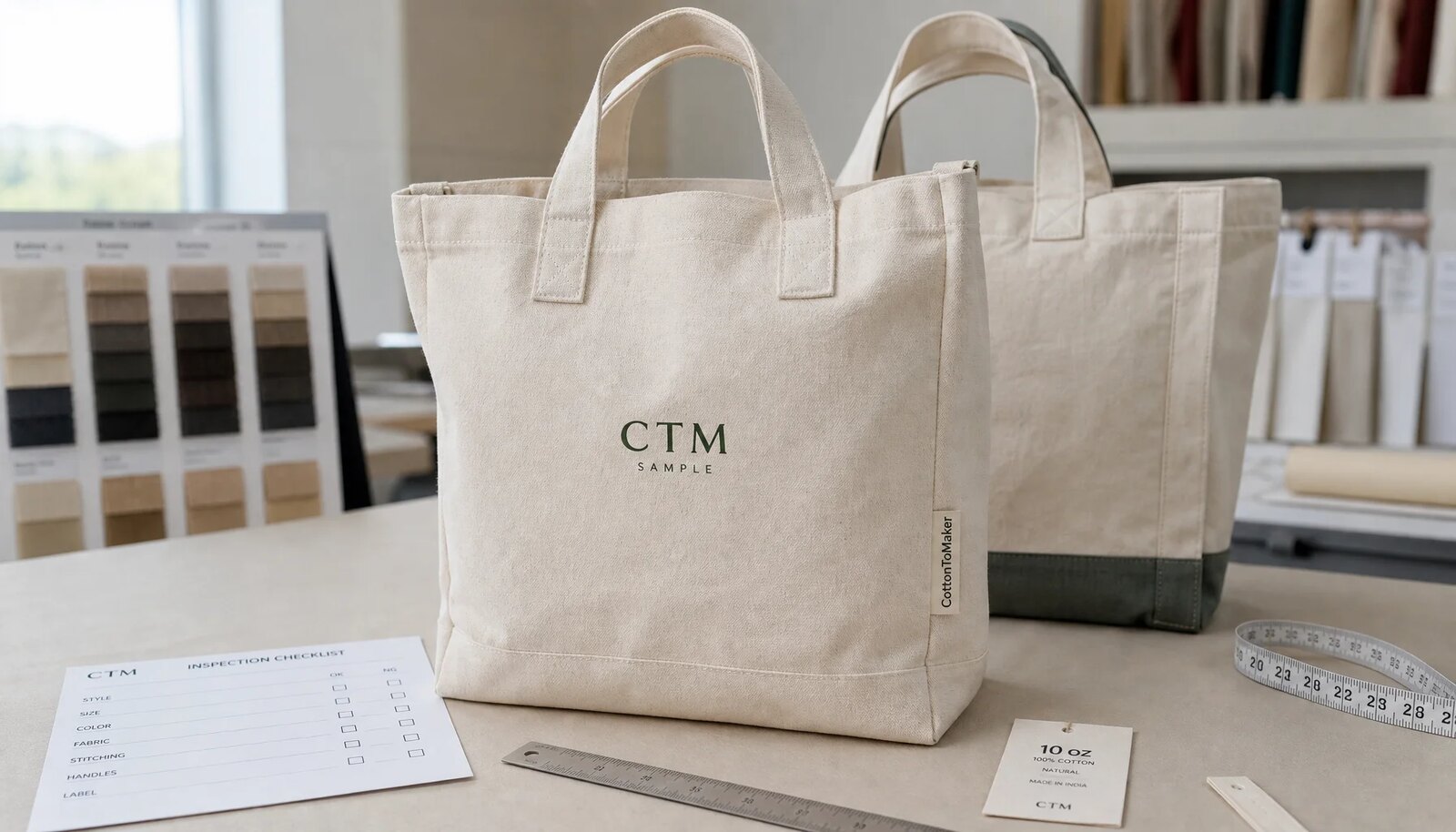
Start With the Event Use Case
Canvas grocery totes for craft fairs are simple products only when the specification is simple. In real event use, they carry public-facing branding and mixed weight: jars, books, candles, ceramics, produce, catalogs, boxed samples, and sponsor items. If a handle tears, a print sits off center, or the wrong logo mix reaches a venue, the defect is visible to customers and event teams immediately.
The first sourcing control is to state the tote function before asking for price. A brochure giveaway, paid retail tote, booth-kit bag, and grocery-weight reusable tote should not be quoted as the same item. Each needs different fabric weight, handle drop, reinforcement, print durability, fold method, and carton planning.
Use the checklist before price comparison. Otherwise, the lowest quote may simply reflect a lighter fabric, smaller body, weaker handle stitch, looser packing, or missing compliance work. The goal is not to over-engineer a tote. The goal is to make every supplier quote the same bag.
- State the use case in the RFQ: giveaway, resale item, vendor shopping bag, reusable grocery tote, sponsor bag, or booth-kit component.
- List example contents and expected filled weight so the supplier designs handles and seams around real event use.
- Decide whether the tote must stand upright, fold flat, fit over the shoulder, ship retail-ready, or match booth-kit carton counts.
- Classify broken handles, open seams, wrong logo, wrong SKU mix, severe stains, and incorrect packing as major defects before production.
Specify Fabric Without Guesswork
Do not ask for cotton canvas and stop there. Ask for fiber content, weave, ounce weight, GSM, color, finish, and tolerance. For buyer verification, the point is not to memorize universal fabric ranges; it is to make the quoted material measurable. If a supplier quotes 10 oz canvas, request the GSM equivalent and the acceptable variance. If a supplier quotes only GSM, ask what ounce-weight category and hand feel the sample represents.
Natural canvas can vary by lot. One batch may look cream, while another looks grey, yellow, or heavily speckled. Some slubs and flecks may be acceptable for a craft-market aesthetic, but stains, streaks, strong odor, or heavy black specks may not be. A signed physical swatch is stronger than a photo because lighting and screen color can mislead approvals.
Finish also matters. Greige, scoured, washed, bleached, dyed, brushed, and preshrunk canvas can behave differently in printing, shrinkage, hand feel, and shade stability. If the tote will be marketed as washable, approve a washed sample and define the maximum dimensional change and print appearance after washing.
- Specify cotton canvas, recycled cotton blend, organic cotton if required, or another stated fiber composition.
- Quote both ounce weight and GSM, with a measurable tolerance such as plus or minus 5 percent where verification is required.
- Approve natural, bleached, or dyed shade by physical swatch and retain the swatch in the order file.
- Ask whether finishing changes shrinkage, print absorption, hand feel, shade variation, or odor risk.
- Do not mix broad fabric categories in comparison tables; compare quoted fabric weights only after the same measurement basis is clear.
Control Finished Dimensions and Construction
Finished dimensions mean measurements after sewing and pressing, not cut-panel size. For a tote RFQ, list body width, body height, bottom gusset, side gusset if any, top hem depth, handle width, handle length, and handle drop. Not every dimension needs the same tolerance. Handle drop, logo placement, and barcode position may need tighter control than a non-critical side gusset.
The handle attachment is usually the highest-risk construction point. Self-fabric handles create a matched look, while cotton webbing can give more consistent width and strength. Reinforcement may use multiple stitch rows, box stitch, box-and-cross stitch, or bar tacks. The correct method depends on the load expectation and price target, but it must be stated.
Inside seam finish should be intentional. Natural canvas can fray around gusset corners, top hems, and seam allowances. Ask whether inside seams are overlocked, folded, bound, or left raw, and approve close-up photos before bulk production.
- Define width, height, gusset depth, top hem depth, handle width, handle length, handle drop, and measurement tolerance.
- Request close-up photos of top hem, handle insertion, reinforcement stitch, side seam, bottom seam, inside seam, and gusset corner.
- State stitch density target or workmanship standard for load-bearing seams and handle reinforcement.
- Check that left and right handles are balanced, untwisted, evenly placed, and aligned with the approved sample.
- Treat open seams, broken handle stitches, torn fabric at reinforcement, and severe measurement deviation as major defects.
Set Print and Artwork Acceptance Rules
At craft fairs, the logo often gets more attention than the fabric. Screen printing is common for solid logos and medium to larger runs. Heat transfer, digital transfer, and DTG can work for short runs, gradients, or many vendor-specific artworks. Each method needs different controls for hand feel, edge adhesion, rubbing, cracking, opacity, and color consistency.
Approve artwork on the actual production fabric. Fine lines, small type, reversed lettering, and halftones may fill in or lose clarity on textured canvas. A digital mockup confirms layout, but it does not prove ink absorption, curing, or print durability. The printed pre-production sample should become the reference for color, size, position, ink coverage, and acceptable canvas show-through.
Placement needs numbers. Instead of saying centered logo, define the print location from the top hem, side seam, or centerline and set the allowed deviation. Also confirm when printed totes can be folded and packed after curing, especially for large dark prints or transfers.
- Provide vector artwork where possible, plus Pantone, brand guide, or approved physical color reference.
- State print method, print size, color count, location, and placement tolerance from fixed reference points.
- Require a printed pre-production sample on the approved canvas, not only a digital proof.
- Check dry rub, wet rub where relevant, tape pull, scratch resistance, pinholes, edge bleeding, opacity, and cracking.
- Confirm curing and packing timing so prints are not folded tightly before the ink or transfer is stable.
Separate Compliance Into Five Buckets
Compliance should be more than a folder of generic certificates. For canvas grocery totes, buyers should separate supplier documentation, labeling and content claims, restricted substances, traceability, and buyer-required test reports. This keeps the compliance file practical and avoids confusing operational QC with legal or brand-risk documentation.
Supplier documentation confirms who is making and exporting the goods. Labeling and content claims confirm what the tote says about fiber, care, origin, organic cotton, recycled content, or washability. Restricted substance controls help manage chemicals in fabric, dye, ink, coatings, labels, and trims. Traceability links approved materials and production lots to the shipped order. Test reports, when required by the buyer or sales channel, should match the product, material, print, and order date as closely as possible.
Not every craft fair tote needs the same compliance package. A small local giveaway may have lighter requirements than a retail program sold through stores. The key is to state the required documents before the purchase order, because missing compliance paperwork is much harder to solve after cartons are packed.
- Supplier documents: legal name, production address, export entity if different, factory role, and subcontracted process list.
- Labeling and claims: fiber content, country of origin where required, care language if used, barcode, recycled or organic claim support, and approved hangtag wording.
- Restricted substances: buyer RSL requirements for fabric, dyes, inks, transfers, labels, coatings, and trims where applicable.
- Traceability: fabric lot, print batch, label lot, production dates, carton records, and inspection report tied to the PO.
- Test reports: buyer-required tests such as fiber content, colorfastness, print adhesion, restricted substances, or load performance when applicable.
Use Samples as Production Controls
A controlled sample path is one of the cheapest ways to reduce bulk risk. Buyers should normally approve a fabric swatch, blank construction sample, and printed pre-production sample. The blank sample verifies dimensions, gusset shape, handle drop, seam quality, load behavior, canvas hand feel, and fold method. The printed sample checks color, opacity, placement, curing, and how ink sits on the canvas texture.
Stock samples are useful for early supplier screening, but they should not become bulk approval unless every detail matches the order. A supplier may send a stock tote with heavier fabric, cleaner stitching, or better printing than the quoted production version. If a stock sample is only a workmanship reference, label it that way.
Sample approval should include written measurements and exception notes. If the buyer accepts a temporary label, substitute canvas, approximate print color, missing barcode, or unfinished packing at sample stage, record the correction required for bulk. Otherwise, the factory may repeat the shortcut.
- Measure and record finished width, height, gusset depth, top hem, handle width, handle drop, and print placement.
- Fill the sample with realistic event goods and check handle strain, seam stress, twisting, body sag, and user comfort.
- Rub the print with a white cloth and check ink transfer, pinholes, poor opacity, cracking, and edge adhesion.
- Sign and date the approved sample, then require first-piece photos before full cutting, printing, or packing proceeds.
- Keep photos of front, back, inside, gusset, handle reinforcement, print close-up, label, fold, inner pack, and carton mark.
Compare Quotes on the Same Basis
MOQ is shaped by fabric purchase minimums, cutting efficiency, print setup, label sourcing, packing labor, carton planning, and inspection time. If one tote body carries several printed designs, the order may be more efficient than separate runs with different fabrics, handles, labels, and packing. Ask whether body MOQ and print-design MOQ can be separated.
A useful quote shows what is included and what is not. Screen charges, sample fees, artwork setup, label setup, hangtag development, barcode stickers, individual polybags, special carton marks, and inspection support should not disappear inside an unclear unit price. Itemization helps buyers negotiate, reorder, and compare landed cost.
Cost drivers include fabric weight, tote size, gusset depth, handle material, reinforcement method, print method, number of print colors, print coverage, label type, hangtag, individual packaging, carton cube, inspection scope, and freight method. A low FOB price is not always the lowest landed cost if cartons are oversized, underfilled, or difficult to allocate.
- Ask if multiple designs can share one body MOQ when only the logo changes.
- Keep fabric, body size, handle construction, thread, and packing common across designs where possible.
- Separate sample fees, screen charges, label setup, barcode setup, and special packing from the tote unit price.
- Compare quotes using the same Incoterm, payment terms, lead time, inspection scope, carton data, and validity date.
- Request carton dimensions, pieces per carton, net weight, gross weight, and estimated CBM before supplier selection.
Plan Packing for Receiving and Allocation
Packing affects receiving, presentation, counting, allocation, and landed cost. Canvas totes can be flat packed, half folded, rolled, bundled, or individually polybagged. Flat bulk packing often works well for wholesale craft fair distribution because it reduces unnecessary plastic and simplifies counting. Individual polybags may be needed for retail presentation, hygiene rules, barcode control, or store receiving, but they add labor, cost, plastic, and carton volume.
Carton planning belongs in the RFQ. Ask for pieces per carton, carton dimensions, net weight, gross weight, carton mark format, and inner bundle quantity before the PO is released. If the order ships to several fairs, stores, sponsors, or vendor booths, carton quantities should match allocation rules.
Labels and hangtags need the same approval discipline as the tote. A wrong barcode, missing hangtag, incorrect content label where required, weak sticker adhesion, or unreadable carton mark can create receiving failures even when sewing quality is acceptable.
- Specify fold method, inner bundle quantity, individual polybag policy, hangtag position, barcode position, and carton quantity.
- Use carton counts that match booth kits, store allocations, distributor replenishment, or event team handling capacity.
- Require carton marks with item number, PO number, design name, color, quantity, gross weight, destination, and carton sequence when needed.
- Set a gross weight limit that warehouse and event teams can handle safely during receiving and booth setup.
- Verify SKU separation so mixed designs do not require sorting after arrival.
Inspect Before Shipment, Not After Arrival
Craft fair schedules rarely allow easy recovery. Build the sourcing calendar backward from event delivery through domestic distribution, customs clearance if applicable, shipment handover, final inspection, packing, print curing, sewing, cutting, fabric preparation, sample approval, and artwork freeze. Production days alone are not a lead-time plan.
Common schedule risks include late artwork, fabric shade changes, screen remake, supplier peak-season capacity, missing barcode files, carton mark revisions, and failed final inspection. If one tote body carries multiple vendor logos, freeze the body, fabric, handle, and packing early, then manage artwork cutoff dates by design.
Final inspection should happen before pickup. It should cover measurements, fabric appearance, handle load performance, stitch quality, print position, print curing, stains, odor, labels, packing, carton count, carton marks, and SKU separation. Corrective action terms should be agreed before production starts, not negotiated during an event deadline crisis.
- Set deadlines for swatch approval, pre-production sample approval, artwork freeze, bulk start, first-piece approval, final inspection, shipment handover, and event delivery.
- Schedule inspection early enough to allow sorting, rework, replacement, partial shipment, or routing changes if defects are found.
- Require first-piece photos for fabric, sewing, print, label, fold, inner pack, and carton mark before full production continues.
- Name the corrective action decision owner on both buyer and supplier sides before the purchase order is placed.
- Keep inspection photos and defect summaries for reorder comparison and supplier performance review.
Specification comparison for buyers
| Supplier option | What to verify | Commercial advantage | Buyer risk to control |
|---|---|---|---|
| Direct sewing factory | fabric swatch, approved sample, seam close-ups, logo test photos, packing pilot, and final inspection evidence | Better sample-to-bulk control and faster production feedback | May be weaker on export paperwork or branded packing unless checked early |
| Trading company | Factory name, production photos, trim-source proof, and who owns QC decisions | Can coordinate small mixed orders and extra services | Markup can hide real factory capability and slow defect decisions |
| Specialized bag workshop | bag size, gusset, handle drop, seam allowance, stitch density, reinforcement patch, and loading expectation | More practical for detailed construction, trims, and repeat programs | Capacity may be limited during peak seasons |
| Low-price general supplier | 8-12 oz cotton canvas, 120-220 gsm cotton, recycled cotton, or blended fabric selected by use case and target price | Useful for simple promotional runs with loose specs | Material downgrades, weak packing, and vague inspection scope can erase savings |
| Retail-ready supplier | fold method, inner bundle, carton count, carton mark, moisture protection, SKU separation, and warehouse receiving needs | Can handle labels, SKU separation, carton marks, and receiving rules | Higher unit cost must be compared against reduced warehouse work |
| Compliance-focused supplier | Fabric records, labeling review, test plan, and production traceability | Safer for retail programs and repeat brand orders | Documentation claims need evidence, not only sales language |
| Local sample room plus bulk factory | Signed sample, bulk factory handoff, first-piece photos, and deviation owner | Good for complex branding before large production | Sample room quality may not match bulk line unless handoff is controlled |
Buyer checklist before sampling
- Define the tote use case: light giveaway, vendor shopping bag, paid retail item, grocery-weight reusable tote, booth-kit component, sponsor welcome bag, or event merchandise.
- Specify fabric by fiber content, weave, ounce weight, GSM, natural or dyed shade, finish, and acceptable weight tolerance such as plus or minus 5 percent when verified by agreed sampling.
- Lock finished dimensions before pricing: body width, body height, bottom gusset, side gusset if any, top hem depth, handle width, handle length, handle drop, and dimension tolerances.
- State construction requirements: seam allowance, stitch density target, thread color, handle attachment style, box stitch or box-and-cross stitch, bar tack if used, and inside seam finish.
- Define print acceptance criteria: print method, color reference, print size, placement tolerance, opacity, curing, dry rub, wet rub where relevant, tape-pull or scratch check, pinholes, cracking, and acceptable canvas texture show-through.
- Separate compliance documents into supplier identity, production route, labeling and content claims, restricted substances, traceability records, and buyer-required test reports.
- Require physical approvals: fabric swatch, blank construction sample, printed pre-production sample, label and hangtag sample, barcode proof, folded packing sample, and carton mark proof.
- Confirm the production route: direct factory, nominated print shop, trader-managed factory, subcontracted print or packing unit, and who can approve first pieces and corrective action.
- Set a practical load-test requirement using intended contents, for example 8-12 kg for reusable grocery-style event bags unless the product is only a light giveaway.
- Compare supplier quotes only when fabric, dimensions, handle construction, print method, packing, inspection level, Incoterm, payment terms, carton data, lead time, and quote validity are all stated.
Factory quote questions to send
- Are cutting, sewing, printing, labeling, folding, and packing performed in your own facility, or are any steps subcontracted? Please identify each process owner.
- What fabric are you quoting by fiber content, weave, ounce weight, GSM, color, finish, and tolerance? Can you provide a swatch from the same planned bulk fabric source?
- What are the finished dimensions and tolerances for width, height, gusset depth, top hem, handle width, handle length, and handle drop after sewing and pressing?
- What stitch density, seam allowance, thread type, and handle reinforcement method will be used? Can you provide close-up photos of the handle attachment, side seam, bottom seam, and gusset corner?
- What load test do you recommend for this tote function, including weight, duration, lifting method, number of cycles if used, and pass/fail criteria?
- Which print method are you quoting, and what controls do you use for color matching, opacity, curing, dry rub, wet rub where applicable, tape pull, cracking, and print placement?
- Can you make a pre-production sample using the correct fabric, handle, thread, print ink, label, hangtag, barcode, fold method, inner pack, and carton packing before bulk production?
- What compliance documents can you provide for this order: business/export entity, fiber content declaration, restricted substance declaration, test reports if required, and lot traceability records?
- What is the MOQ if one tote body uses several printed designs? What changes if fabric color, handle color, label, barcode, hangtag, or packing rules differ by design?
- Please itemize unit price and one-time charges: sample fee, screen fee, artwork setup, label setup, hangtag, barcode sticker, individual polybag, special carton mark, and inspection support.
Quality-control points to confirm
- Fabric weight checked before cutting against approved ounce and GSM specification, with sampling taken from bulk fabric rolls and recorded against the agreed tolerance.
- Fabric shade, hand feel, weave, slubs, black specks, stains, streaks, and odor compared with the signed swatch under consistent lighting before production release.
- Finished dimensions measured after sewing and pressing: body width, height, gusset depth, top hem depth, handle width, handle length, and handle drop.
- Stitch quality checked for stitch density, skipped stitches, broken threads, loose threads, seam puckering, exposed raw edges, needle damage, and uneven seam allowance.
- Handle attachment inspected for reinforcement shape, stitch rows, balanced placement, no twisted handles, and no pulled stitches after load testing.
- Load test performed to the agreed weight and method, with failure criteria covering broken seams, torn fabric, pulled handle stitches, and severe distortion.
- Print position measured from fixed reference points such as top hem, side seam, or centerline, using the agreed placement tolerance and approved artwork layout.
- Print quality checked for color, opacity, registration, pinholes, smudges, ghosting, edge bleeding, cracking, poor adhesion, and unacceptable canvas texture show-through.
- Labels, hangtags, barcodes, content or care information if applicable, and event allocation stickers checked against buyer-approved artwork before cartons are sealed.
- Carton count, SKU separation, inner bundle quantity, carton marks, gross weight, moisture protection, and packing photos checked before shipment release.