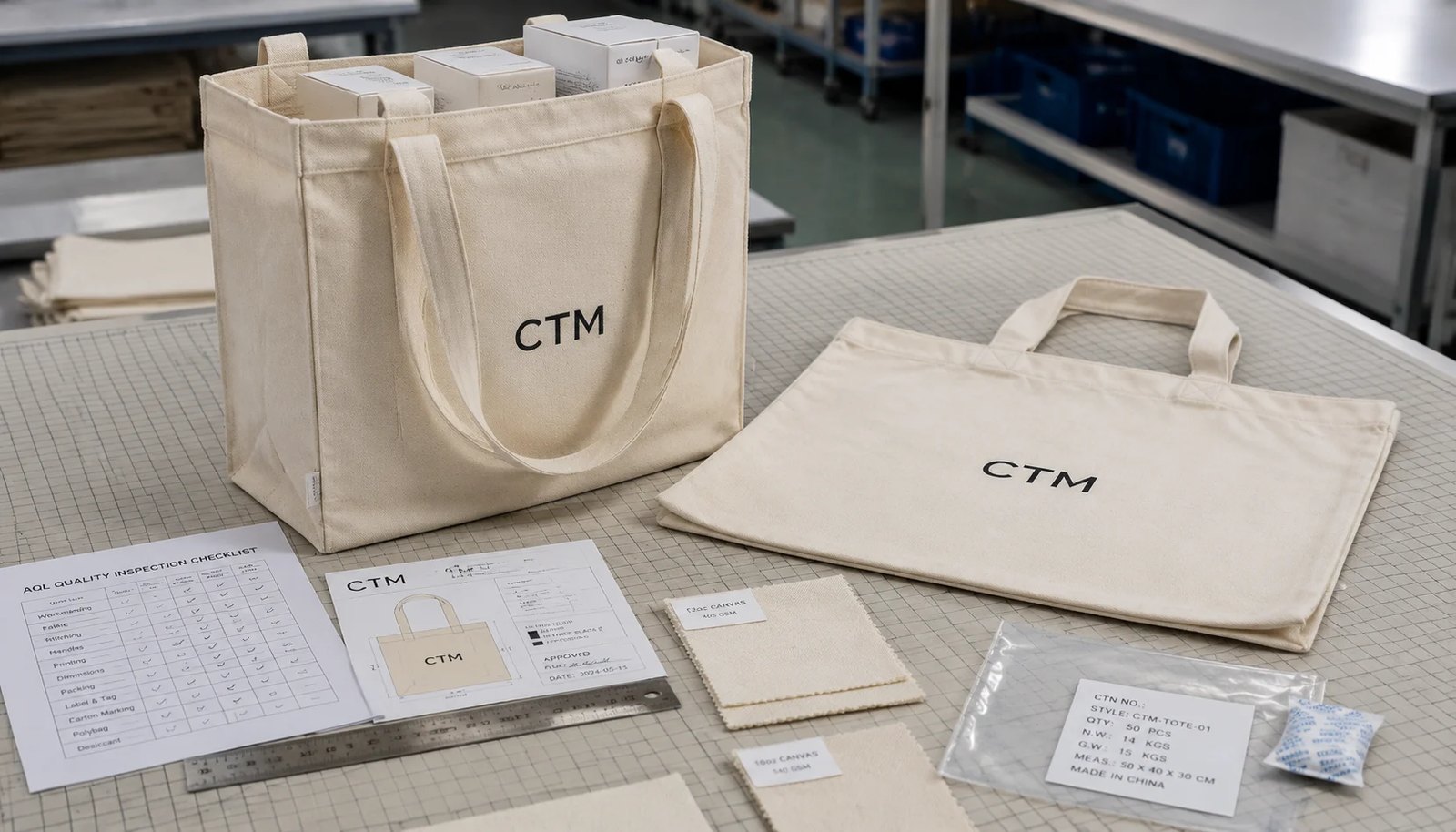
Why skincare brands need a stricter quality inspection checklist for canvas grocery totes
A canvas grocery tote used by a skincare brand is rarely just a low-cost shopping bag. In many programs it functions as part of the product presentation: a gift-with-purchase bag, a retail add-on, a PR kit carrier, an event tote, or outer packaging for boxed sets. That changes how the bag should be specified and inspected. A tote that is acceptable for leaflets or light promotional materials may fail quickly when filled with glass bottles, jars, pumps, and rigid cartons that create concentrated stress at the bottom corners and handle attachment points.
Skincare also raises the visual standard. Minimalist beauty branding makes small defects more visible. A slightly crooked logo, yellowish lot variation, rough print feel, fabric specking, or loose thread that might be ignored on a low-cost event bag can look out of place next to premium cartons and carefully designed primary packaging. The tote becomes part of the customer's perception of quality, not just a functional carrier.
For procurement teams, the key implication is simple: inspect the bag against actual use and actual brand presentation. Do not rely on a generic cotton tote checklist. The inspection standard should reflect fill weight, display use, distribution channel, and how the tote will sit alongside the skincare line in store, in e-commerce kits, or in influencer mailers.
A stronger checklist also helps commercially. When the specification is clear, supplier quotes become easier to compare, sample approval becomes faster, and final inspections become less subjective. Instead of arguing about whether a bag 'looks okay,' both buyer and factory can work against measurable criteria.
- Typical skincare tote use cases: gift-with-purchase, retail add-on bag, boxed set carrier, PR seeding bag, event distribution tote
- Common brand-sensitive defects: off-white shade shift, visible print pinholes, skewed logo, loose threads, uneven gusset shape, crushed packing folds
- Typical fill risk: cartons and bottles create point load and side pressure rather than evenly distributed soft weight
- Procurement goal: define a tote standard that protects appearance, carrying performance, packing efficiency, and repeatability across launches
Start with end use: define load, presentation, and channel before writing the spec
Before checking fabric or print details, define what the bag has to do. This is where many RFQs for canvas grocery totes become too vague. 'Canvas tote for skincare brand' does not tell a supplier whether the bag needs to carry two sample sachets, a six-piece holiday gift set, or several glass bottles sold at point of sale. Those are very different use conditions.
A useful procurement brief starts with fill profile. Note the approximate product mix, weight range, and the shape of the contents. Boxed skincare sets usually need a gusset that supports a cleaner rectangular fit. Loose bottles and jars create rolling movement and more stress when the bag swings during carrying. If the tote is mainly for checkout use, comfort and repeated carrying matter. If it is mainly for gift packaging, shape retention and print appearance may matter more than long-cycle durability.
Channel also affects quality priorities. A tote for a prestige retail counter may need tighter appearance standards, lighter odor tolerance, and cleaner packing than a bag intended for mass event distribution. A bag sold as branded merchandise may need stronger seam review and better reuse durability than a one-time promotional bag. A tote that enters an e-commerce fulfillment workflow may need barcode and carton labeling precision that is less critical for one-destination event delivery.
When the end use is clear, procurement can make better trade-offs. For example, a slightly heavier fabric may reduce bag collapse and improve the premium look for in-store sets. A webbing handle may be justified for higher carry frequency. Conversely, if the bag is a lightweight seasonal promotion, the team may intentionally choose a lower GSM spec while accepting a softer body shape. The important point is that the choice is deliberate and written down.
- Clarify intended fill weight range, for example under 1 kg, 1 to 3 kg, or 3 to 5 kg
- List contents by type: cartons, glass bottles, pumps, jars, tissue, inserts, or mixed gift items
- State primary channel: retail, PR, event, e-commerce kitting, subscription box support, or merchandise
- Decide what matters most: shape retention, carrying comfort, low cost, clean branding, reuse cycles, or compact packing
- Include one practical sentence in the RFQ such as: 'Bag must carry one boxed skincare set with four glass bottles without visible handle strain'
Fabric specification: choose canvas weight, composition, and shade standards with inspection in mind
For most skincare tote programs, 10 oz to 12 oz canvas, roughly 280 to 340 GSM, is the most practical starting range. It offers better structure than lightweight promotional canvas, supports cleaner screen printing, and resists the cheap slouch that appears when a softer bag is filled with boxes or bottles. That does not mean every project needs 12 oz. If the bag is only for samples or leaflets, lighter fabric may be commercially reasonable. But for retail-oriented skincare programs, a heavier base usually reduces quality complaints.
The critical step is to write the fabric in measurable language. Terms like 'cotton canvas' or 'thick canvas' are too loose for production control. State the finished GSM range, composition, weave, base color, and whether the project permits blends. If your team cares about sustainability positioning, clarify whether you need conventional cotton, recycled content, certified organic cotton, or simply natural unbleached cotton without a claim. Those choices affect quote logic, documentation, and in some cases MOQ.
Shade control is especially important for beauty brands because natural, cream, and off-white tones are common. These shades can vary visibly between lots. Buyers should define whether natural cotton specking is acceptable, what level of shade difference is commercially acceptable, and whether one shipment can contain mixed sub-lots if the variation is noticeable. Without this, suppliers may ship a technically acceptable range that still looks inconsistent in store.
Procurement teams should also remember that fabric weight alone is not the whole quality picture. Two fabrics with similar GSM can still differ in hand feel, compactness, print smoothness, and shape retention. That is why swatch approval and PP sample review remain important even when the GSM is defined.
A practical RFQ line should read more like a buying document than a design note. For example: 100% cotton plain weave canvas, finished weight 300 GSM plus or minus agreed tolerance, natural color to approved swatch, no unauthorized blend substitution. That gives both sourcing and QC something they can verify.
- Recommended default for many skincare programs: 100% cotton plain weave canvas, 280 to 340 GSM
- If dyed fabric is used, request visual shade approval against approved swatch or pantone-nearest target
- If organic or recycled claim matters, align document and labeling requirements before PO release
- Clarify whether natural cotton flecks are acceptable and to what degree
- Check whether supplier measures GSM on finished fabric and how they control lot-to-lot consistency
Construction details that most directly affect durability and shape
Many tote failures are caused less by the base fabric and more by how the bag is cut and sewn. This is why construction details should be part of the quality inspection checklist, not left to factory habit. For skincare totes carrying boxed products, the highest-stress areas are usually the handle joins, top hem, lower corners, and gusset seams. If these are inconsistent, even a good fabric can produce a weak bag.
Start by defining the body construction. A side-and-bottom gusset is usually the safer option for skincare because it holds a more stable rectangular shape, allows boxed sets to sit better, and reduces the tendency of the bag to twist under load. Flat totes can be suitable for light promotions, but they usually provide less structure and can make a premium gift set look awkward or unstable.
Handle specification deserves more detail than many buyers give it. State handle material, width, drop, insertion depth, and reinforcement type. Self-fabric handles often look cleaner and more premium, especially for natural canvas beauty programs, but they need neat folding and consistent sewing. Cotton webbing can improve carrying comfort and repeated-use performance, especially at higher loads. Neither is automatically better; the right choice depends on fill use and brand look.
Inspection should pay particular attention to reinforcement quality. Box stitch or X stitch is common for medium to heavier canvas totes. What matters is not just the nominal stitch pattern, but whether it is complete, centered, and sewn with enough seam allowance and back-tacking. Skipped stitches or narrow attachment areas can cause early failure even when the pattern looks correct at a glance.
Symmetry is another common issue. A bag can pass basic measurements but still hang crooked because one handle is set higher, one gusset is caught unevenly, or the top hem is pulled during sewing. For premium skincare presentation, visual balance matters nearly as much as pure seam strength.
- Preferred for many skincare retail bags: side and bottom gusset with reinforced handle attachment
- Typical handle width range: about 2.5 to 3.5 cm depending on expected load and design
- Common failure point: handle enters top hem with weak back-tack or uneven stitch capture
- Visual QC check: bag should hang evenly and stand more symmetrically when filled with representative contents
- Do not assume all factories use the same reinforcement standard for 'canvas tote'
Logo application and print quality: what buyers should inspect beyond color matching
For most bulk orders of canvas grocery totes for skincare brands, screen printing remains the most commercially reliable decoration method. It usually offers better opacity on cotton canvas, lower unit cost at scale, and a more natural hand feel than many transfer options. It also suits the simple one-color or two-color branding commonly used in skincare packaging. However, screen printing still requires control. Canvas is textured, natural shades can show through ink, and fine-line artwork can break up if the screen setup is not appropriate.
Heat transfer has a place, especially for photo graphics, gradients, or small test runs, but it creates different quality risks. The film edge may be visible, the surface can feel more plastic, and cracking or lifting may appear along fold lines if the application or storage conditions are poor. Embroidery can signal a premium look, yet it can also distort a lighter panel unless backing and stitch density are managed carefully.
The right inspection criteria depend on the print method, but several checks are universal. Buyers should define artwork size, orientation, logo centerline, placement tolerance, and color reference before sample approval. During inspection, assess edge definition, opacity, registration if multiple colors are used, and consistency across lots. On light natural canvas, white or pale inks often need special attention because weak laydown may let the fabric show through unevenly.
It is also worth reviewing the print as part of the filled and folded bag, not only laid flat. Some prints look fine on the inspection table but crack, wrinkle, or transfer when the bag is folded tightly after curing. If the bag will be bundled, stored, or repacked, print behavior under those conditions matters.
For small type or fine line logo work, a print strike-off before PP sample approval is one of the most practical risk controls. It is faster and cheaper than discovering legibility issues after the sewn sample or, worse, after bulk production starts.
- Best value method for many bulk skincare tote orders: 1 to 3 color screen print
- Define logo placement tolerance in measurable terms before production
- If white ink on natural canvas matters, confirm whether one pass or double pass is included in the quote
- Inspect print after folding and bundle simulation, not only on flat table view
- Request a strike-off for fine-line artwork, small text, or color-critical branding
RFQ and quote comparison: how to avoid false low prices on tote bag sourcing
Canvas tote pricing is easy to misread because the unit cost is heavily affected by specification details that are often missing from first-round inquiries. A factory quoting on stock natural canvas, single-color small print, and bulk bundle packing may appear much cheaper than a supplier quoting custom dyed fabric, wider handles, denser white ink, and individual bagging. Without normalization, those numbers are not directly comparable.
For skincare procurement teams, one of the most effective cost controls is simplification of the base spec. If one body size and one fabric color can be used across several campaigns, the brand can then vary artwork, insert cards, or destination labels without resetting every cost driver. This helps MOQs, reduces leftover stock risk, and can shorten replenishment cycles.
Quote comparison should separate the main cost blocks: fabric, print, labels and trims, packing, sampling, and any inspection or testing support. If the quote only shows a single ex-works price, ask the supplier to confirm what is included. The most common hidden differences are GSM level, print size, care label inclusion, individual polybagging, carton quality, and whether handle reinforcement is upgraded or basic.
MOQ logic also needs careful review. Low MOQ claims can be real when the factory is using shared stock natural fabric, but the MOQ may increase as soon as the buyer requests custom color, larger print, multiple destination labels, or unusual packing assortments. Procurement should ask which MOQ is driven by sewing, which by fabric, and which by print setup.
The best commercial result is usually not the lowest opening quote. It is the quote that accurately reflects the approved specification and can be repeated with fewer surprises after PO placement.
- Normalize all quotes to the same GSM, dimensions, print coverage, handle construction, and packing basis
- Ask suppliers to separate sample cost, print surcharge, labels, and packaging where possible
- Use one body size and one base color across campaigns if you want lower MOQ and easier replenishment
- Check if the quoted fabric is stock natural canvas or custom dyed canvas
- Confirm whether ex-works price assumes final inspection support and export packing
Sample approval sequence: the easiest place to prevent bulk defects
For B2B tote bag buying, sample approval is not just a branding step. It is the stage where the buyer defines the commercial standard for bulk. If the sample process is weak, final inspection becomes an argument about expectations rather than a check against an agreed benchmark.
A practical approval sequence starts with digital confirmation of dimensions and artwork placement, then moves to fabric swatch or shade reference approval if needed, then a print strike-off for logo review, and finally a pre-production sample made in the intended fabric and print method. For more demanding programs, a top-of-production photo or physical confirmation can be added before the full run continues.
The PP sample must be treated seriously. It should reflect bulk-equivalent fabric, actual stitching method, actual reinforcement, and intended packing style. Buyers should avoid approving a sample made from substitute cloth or temporary print methods simply because the shape looks correct. That almost always leads to differences later.
One of the most useful checks during sample review is a simple functional trial using real or equivalent skincare contents. Fill the bag with the heaviest planned set. Lift it repeatedly. Check corner stress, top opening shape, and handle comfort. Then fold and repack it according to the intended bulk packing method. If the print blocks, creases badly, or the gusset collapses in an unattractive way, the issue is cheaper to fix at sample stage than after production begins.
Equally important is recordkeeping. Approval comments should be consolidated into a spec sheet or PO annex rather than scattered across email chains. If the approved sample uses a thicker ink deposit, cleaner seam trimming, or wider handle than the first quote, those details need to become the production standard in writing.
- Useful approval flow: layout approval, swatch approval, strike-off, PP sample, top-of-production check
- Test the PP sample with realistic skincare contents, not only empty visual review
- Turn sample comments into a formal approved standard attached to the PO
- Do not approve substitute materials if the project is sensitive to structure or shade
- Use photos with measurement references to reduce later disputes
Quality inspection checklist by stage: incoming, inline, top-of-production, and final random inspection
The most reliable way to control tote bag quality is to divide inspection by production stage. Waiting until final random inspection is risky because many recurring defects begin much earlier and become expensive to correct once the order is packed. A stage-based checklist helps procurement teams and suppliers catch issues while correction is still practical.
Incoming material control should focus on fabric verification and readiness of all key inputs. Check fabric weight, shade consistency, visible surface issues, and whether print materials, labels, and packaging components match the approved spec. If the fabric for one order already contains mixed visible lots, the factory should not proceed into cutting without buyer guidance.
Inline control should monitor repeatability. This includes cut panel size, grain alignment, gusset consistency, handle placement, stitch quality, and print curing. A recurring issue such as a low logo position or uneven handle drop often appears early if jigs are not set correctly. Inline checks allow correction before thousands of units are completed.
Top-of-production review is especially valuable for skincare-branded bags because it catches visual defects at the moment real production conditions are established. The first packed output often reveals differences that a single PP sample does not show, such as slightly lighter print density, different fold marks, or faster stitching that affects seam neatness.
Final random inspection remains essential because it verifies whether the shipment as packed still meets standard. But final inspection should be objective. Instead of broad phrases like 'good workmanship,' define what is acceptable for stains, print pinholes, skew, dimension tolerance, handle attachment, label correctness, odor, and packing count. If your team uses AQL, classify likely critical, major, and minor defects in advance so release decisions are faster and less subjective.
For skincare launches tied to promotion dates, this staged model also protects timing. Catching a defect at incoming or inline stage is not only a quality improvement; it is often a lead-time improvement because rework is smaller and more targeted.
- Incoming checks: GSM, shade consistency, fabric cleanliness, trim and packaging readiness
- Inline checks: cut accuracy, handle alignment, seam quality, reinforcement completion, print cure
- Top-of-production checks: first-run consistency against approved PP standard
- Final checks: appearance, dimensions, load spot check, labeling, carton count, carton condition
- Use measurable tolerances and defect definitions to reduce subjective disputes
Packing, labeling, and carton control: where many tote orders lose value after production
Packing deserves more attention than it usually receives in tote bag sourcing. A well-made bag can still arrive in poor saleable condition if prints are over-compressed, gussets are crushed, or carton labeling is inconsistent. For skincare brands, this matters because the tote may go directly into retail, gift assembly, or influencer mailers where presentation and receiving accuracy both matter.
The first decision is whether the bag truly needs individual polybagging. Some buyers request polybags out of habit even when the bags are simply removed and repacked at destination. If the bags are clean-packed in controlled cartons, bundle packing may be enough and can reduce unnecessary material. On the other hand, if channel sorting, barcode scanning, or surface protection is important, individual bagging may save labor downstream.
Bundle count also matters. Over-compression can create permanent fold memory, transfer print impression, or flatten a gusset so badly that the bag needs steaming or hand reshaping. This is particularly relevant when dense screen print areas are packed before they are fully stable. Procurement should define not only units per carton, but how the units are bundled and what degree of compression is acceptable.
Carton control affects warehouse efficiency and freight economics. Cartons that are too large may collapse or allow product shifting. Cartons that are too heavy may create handling issues at destination. Clear carton marks, destination labels, and count accuracy reduce receiving delays and relabeling costs. If several artworks or channels are packed together, packing instructions need to be even more explicit.
For sea shipments or long storage periods, moisture protection may also be worth specifying. Canvas is a natural-fiber product and should arrive dry and odor-free. Desiccant or moisture liner is not always necessary, but the route and storage conditions should guide that choice rather than routine habit.
- Define whether individual polybags are necessary or whether clean bundle packing is enough
- Set bundle count and carton quantity based on warehouse handling, not only factory convenience
- Control compression to avoid print offset, crushed gussets, and heavy fold marks
- Require exact carton marks, barcode placement, and destination identification if multiple channels are involved
- Consider desiccant or moisture protection when transit or storage conditions justify it
Lead time, testing, and risk planning before PO release
Canvas tote production often appears simple, but the timeline becomes unreliable when approvals and dependencies are not mapped early. The biggest delays are usually not sewing delays alone. They come from late artwork release, unclear shade expectations, rework after strike-off rejection, packaging changes, or delayed PP sample comments. Procurement teams should ask what conditions must be satisfied before bulk fabric is booked and before cutting begins.
Custom dyed fabric adds another approval gate and should be treated accordingly. If your skincare brand uses a specific cream, sage, or muted brand tone, dyeing and shade approval may take longer than a buyer expects. Likewise, larger or denser prints may affect drying and curing throughput. The practical question is not simply whether the supplier can finish quickly, but what sequence controls the critical path.
Testing should be considered based on channel risk, not automatically added or ignored. A simple load trial and seam review may be enough for many promotional programs. Retailer-facing programs or marketplace listings may justify additional checks such as colorfastness, dimensional tolerance, or print adhesion. If the bag is likely to be reused and the brand messaging implies durability, some level of performance verification can be commercially wise even if it is not legally required.
Another useful planning tool is the top-of-production checkpoint. This relatively small step can prevent large delays because it catches process drift before the entire order is finished. If a logo is 10 mm too low or the natural canvas shade is warmer than the approved swatch, correcting early is far easier than after full packing.
Finally, inspection booking should be tied to realistic completion timing. Over-optimistic finish dates create avoidable missed inspections, air-freight pressure, or rushed packing. A disciplined production calendar protects both launch timing and quality.
- Map lead time from artwork approval to inspection readiness, not only sewing days
- Add time for custom dye, strike-off approval, and PP sample feedback if applicable
- Choose testing level based on retail risk, reuse expectation, and customer promise
- Use top-of-production review to catch repeat issues before full run completion
- Book final inspection against realistic packed-goods readiness
Specification comparison for buyers
| Spec decision | Recommended option | When it fits | Buyer risk to check |
|---|---|---|---|
| Fabric weight | 10 oz to 12 oz canvas, about 280 to 340 GSM | Best for skincare retail sets, gifting, PR kits, and repeat in-store use where bottles and cartons add point load | Below about 250 GSM, the bag can feel underbuilt, sag when filled, and show more print wrinkling or panel distortion |
| Cotton type | Conventional cotton canvas for value-driven projects; certified organic cotton only when claim language and document scope are planned in advance | Use conventional when commercial target matters more than claim messaging; use certified organic only when hangtags, packaging, or retailer compliance require it | Do not market the bag as organic unless chain-of-custody paperwork, labeling, and claim wording are aligned across PO, packaging, and shipping documents |
| Construction | Side and bottom gusset with reinforced handle box stitch or X stitch | Better for boxed skincare kits, bottle assortments, launch gifts, and retail add-on bags that need to stand or carry stable loads | Flat totes may quote lower but often fit kits poorly, tip over more easily, and stress handle seams sooner |
| Handle material | Self-fabric handles in matching canvas for cleaner retail appearance; cotton webbing for higher cycle carrying | Self-fabric suits premium brand look; webbing suits event use, heavier fills, and longer carry duration | Factories may narrow handle width or reduce insertion depth versus sample, which changes comfort and durability |
| Print method | Screen print for bold one to three color branding; heat transfer only for photo graphics, gradients, or short runs | Screen print usually offers better opacity, lower bulk cost, and more natural hand feel on canvas | Heat transfer can feel plastic and crack at fold lines; screen print needs pantone reference, strike-off approval, and placement tolerance defined |
| Inner finish | No lamination unless spill resistance is essential; add care label and optional recycled PE inner bag for set packing if needed | Good for dry skincare sets, standard retail, gifting, and reusable shopping use | Lamination changes hand feel, can raise MOQ, may affect sustainability messaging, and can complicate folding and sewing |
| MOQ logic | Use one body size and one fabric color across multiple SKUs, then vary print, insert card, or channel label | Useful when a brand wants to split quantities across stores, campaigns, gift-with-purchase programs, or regional launches | Custom dyed low-volume colors often trigger dye minimums, surcharge, and slower lead time that erase the apparent price advantage |
| Carton packing | Flat packed by bundle count with moisture control and carton weight below buyer handling limit | Best for importer warehousing, repacking, and retail redistribution | Over-compressed bundles can crease prints, flatten gussets, and create receiving issues if carton counts or labels are inconsistent |
| Inspection level | AQL-based final random inspection plus pre-production sample and top-of-production review | Suitable for importers needing repeatable release criteria, objective defect grading, and lower claim risk | If QC happens only at final stage, recurring issues such as skewed panels, weak handle sewing, or low logo placement are often discovered too late |
Buyer checklist before sampling
- Define the real fill use in the RFQ: empty giveaway bag, boxed skincare set, bottle-bearing retail tote, PR mailer support bag, or event distribution bag, because GSM, gusset depth, and handle reinforcement depend on actual load.
- State finished size with tolerance in measurable terms: width, height, bottom gusset, side gusset if separate, handle width, handle drop, and seam allowance expectation, not only a reference image.
- Specify fabric as finished GSM range, weave type, color standard, composition, and whether the quoted weight refers to finished fabric; if washed finish is requested, note whether tolerance is checked before or after washing.
- State whether the bag must stand better when filled, fold flatter for kitting, or optimize carton density, because these practical goals affect fabric choice and gusset construction.
- Lock branding method early: screen print, heat transfer, embroidery, woven label, or combined decoration, with artwork size, pantone reference, placement tolerance, and print side count.
- Approve a pre-production sample made from bulk-equivalent fabric, actual print method, actual handle construction, and intended packing method; do not approve a mixed-reference sample built from substitute materials.
- Write seam and handle reinforcement requirements into the PO: stitch type, stitch density range if used internally, insertion depth, back-tacking expectation, and whether box stitch, X stitch, bartack, or another reinforcement is mandatory.
- Define acceptable appearance limits for slub, shade variation, panel skew, fabric specks, loose threads, seam waviness, print edge sharpness, and odor, especially for light natural canvas used by skincare brands.
- Include complete packing instructions: units per polybag if used, bundle count, carton quantity, carton gross weight limit, carton dimensions target, barcode placement, carton marks, and whether desiccant or moisture liner is needed.
- Plan QC timing at pre-production, top-of-production, inline, and final random inspection for any order where branding, retailer presentation, or campaign timing matter.
Factory quote questions to send
- What finished fabric GSM are you quoting, what tolerance do you allow by batch, and how do you verify it internally before cutting?
- Is the quoted canvas plain weave cotton, recycled blend, or another composition, and can the exact ratio appear on the proforma invoice and packing list if needed for compliance or customs?
- What tote dimensions are included in the quote, including body width, body height, bottom or side gusset, handle width, handle drop, and production tolerance in millimeters?
- What handle construction is included: self-fabric or webbing, folded or single layer, insertion depth, and attachment method such as box stitch, X stitch, bartack, or straight stitch only?
- What print method is included, how many colors, what print area, what artwork preparation is needed, and what surcharge applies for larger logos, double-sided print, or denser white ink coverage?
- Can you provide a pre-production sample made from bulk-equivalent fabric and print, and is the sample cost refundable after bulk order confirmation?
- What is your MOQ by fabric color, bag size, and print setup, and can multiple artworks or destinations share one base production run?
- What packaging is included in the price: individual polybag, bundle count, carton quantity, barcode sticker, carton marks, desiccant, and carton dimensions or weight estimate?
- What lead time applies for fabric booking, lab dip or shade approval if dyed, strike-off, pre-production sample, bulk production, and final inspection readiness after deposit and artwork approval?
- What in-house or third-party tests can you support for colorfastness, seam strength, dimensional tolerance, print adhesion, odor, and load performance if our retailer or compliance team requests evidence?
Quality-control points to confirm
- Fabric weight should remain within the agreed GSM tolerance and match the approved hand feel; random rolls should not vary enough to create visibly mixed bag stiffness in one shipment.
- Fabric surface should be commercially clean for the agreed standard, with no major stains, oil marks, mildew odor, severe dark fiber contamination, or needle damage that would be obvious beside premium skincare packaging.
- Body panels should be square and balanced; logo alignment must not appear tilted because of off-grain cutting, skewed sewing, or uneven top hem.
- Finished dimensions must stay within the agreed tolerance for width, height, gusset, handle width, and handle drop; the buyer and factory should use the same measurement method on flattened goods.
- Handle attachment must follow the approved reinforcement pattern with no skipped stitches, broken threads, weak back-tacking, narrow seam allowance, or incomplete box or X stitch formation.
- Stitch density and seam appearance should be consistent across side seams, bottom join, top hem, and handle joins; loose thread ends should be trimmed before packing.
- Print placement should be centered to the agreed tolerance, with solid opacity, clean edges, no ghosting, no smudging, no obvious pinholes beyond standard, and no color drift versus approved sample under normal viewing conditions.
- If white or pale ink is printed on natural canvas, inspect coverage carefully for fabric show-through, under-cured tackiness, and inconsistent opacity across production lots.
- Color shade should be commercially consistent within one shipment; visibly mixed white, natural, cream, or dyed lots should be segregated and approved before packing.
- Odor should be commercially acceptable, especially if bags will be packed together with skincare cartons or used in PR kits where unboxing experience matters.