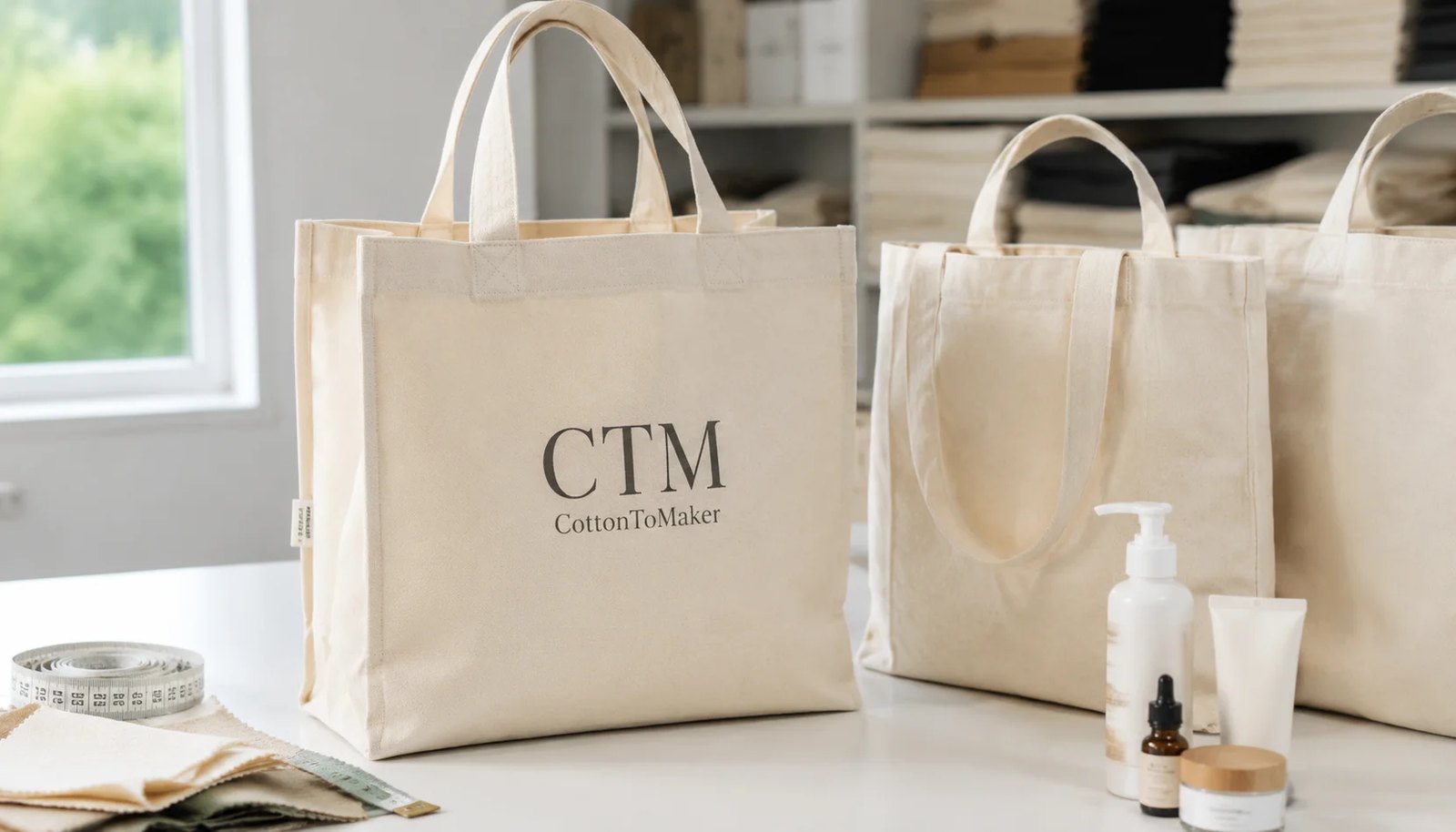
Start with the skincare load, not the tote photo
Canvas grocery totes for skincare brands are often sourced from a beautiful reference image, but the correct material choice starts with the product load. A tote carrying two lightweight lotion tubes does not need the same fabric and handle construction as a tote carrying glass cleanser bottles, refill pouches, candles, and a boxed gift set. The first RFQ step is to list what the customer will actually put inside the bag and the approximate packed weight.
For procurement teams, this prevents two common mistakes: overbuying a very heavy canvas that raises freight cost, or buying a thin fabric that looks acceptable in a sample but fails in store. Skincare products also create special handling concerns. Glass jars have concentrated weight, pump bottles can press against the panel, and printed retail cartons can mark light canvas if the bag is tightly packed for a long time.
- Light campaign bag: sheet masks, sachets, small tubes, or paper inserts, usually below 2 kg loaded weight.
- Standard skincare grocery tote: mixed bottles, cartons, and refill packs, commonly 3-5 kg loaded weight.
- Premium retail or spa tote: glass jars, full-size gift sets, and repeated reuse, often requiring stronger canvas and reinforced handles.
- RFQ note: provide product dimensions or a packing sketch if the tote must hold a specific gift set arrangement.
Choose canvas weight by use case, not by lowest unit price
The most practical specification for a skincare grocery tote is usually 10 oz cotton canvas, around 340 GSM. It has enough body to support retail products without looking cheap, but it is still efficient to cut, sew, pack, and ship. For natural or minimalist skincare brands, 10 oz canvas gives a visible woven texture that supports a clean brand image while still taking screen print well.
An 8 oz canvas, around 270 GSM, can work for light promotions, but it will not provide the same premium handfeel. A 12 oz canvas, around 400 GSM, feels more durable and holds structure better, but the buyer should expect higher fabric cost, higher carton gross weight, and sometimes a stiffer bag. If the tote is part of a paid retail product or premium gift-with-purchase, 12 oz can be justified. If it is only a temporary event giveaway, it may be unnecessary.
- 8 oz / about 270 GSM: economical, softer, less structured, suitable for light skincare samples.
- 10 oz / about 340 GSM: strong default for grocery-style skincare totes and retail promotions.
- 12 oz / about 400 GSM: premium feel, better structure, higher cost and freight impact.
- Important tolerance: state acceptable GSM range, such as plus or minus 5%, because canvas is not always exact lot to lot.
Conventional, organic, recycled, and dyed canvas all change the sourcing plan
Material selection is not only about thickness. Skincare brands often want a responsible material story, but every fabric route has different commercial consequences. Conventional cotton canvas is the most flexible for MOQ and timing. Organic cotton may require available certified fabric or a longer fabric booking window. Recycled cotton canvas can have a different handfeel, more visible fiber variation, and possible color limits depending on the source yarn.
Dyed canvas gives strong brand alignment when a tote must match a brand color, but it adds lab dip approval, colorfastness risk, and higher MOQ. Natural unbleached canvas is usually the safest route for speed and cost, but it will show cotton seed specks and shade variation. That is not automatically a defect, but it must be accepted before bulk production. If the brand wants a very clean white skincare look, bleached or dyed canvas may be needed.
- Natural canvas: faster, lower MOQ, visible cotton specks, good for clean beauty and refill programs.
- Bleached canvas: cleaner background for delicate artwork, but may show dirt more easily during handling.
- Dyed canvas: strong brand color, needs lab dip, color tolerance, and colorfastness agreement.
- Organic or recycled canvas: useful for brand positioning, but documentation and traceability should be defined before purchase order.
Gusset and handle construction decide whether the tote works as a grocery bag
A flat tote is cheaper and packs very efficiently, but it is not always suitable for grocery-style skincare use. Bottles and boxed sets stand better in a tote with a bottom gusset, usually 10-12 cm for a medium retail bag. A boxed bottom also improves shelf and counter presentation because the tote can hold product volume without bulging awkwardly.
Handles deserve the same attention as fabric GSM. A heavy canvas body with weak handles is a false economy. For skincare grocery totes, self-fabric handles around 3 cm wide are a clean option, especially when reinforced with cross-stitching or box stitching. If the tote must be carried on the shoulder, the handle drop should be specified, not guessed from a photo. A short hand-carry handle may frustrate customers using the tote for repeat shopping.
- Common medium tote size: around 38 W x 40 H cm with 10 cm gusset, adjusted to product cartons.
- Shoulder carry handle drop: often around 25-30 cm, depending on market preference.
- Handle width: around 2.5-3.5 cm for comfort and strength.
- Reinforcement: box stitch, cross stitch, or bartack at stress points, with thread density suitable for heavy fabric.
Printing on canvas needs artwork rules before sampling
Most skincare brands prefer understated graphics: one-color logo, ingredient-style copy, or a simple line illustration. Water-based screen printing is usually the best starting point for natural canvas totes because it gives a soft handfeel and works well for solid brand marks. Plastisol or heavy ink can look too thick for a natural skincare brand, although it may be acceptable for bold graphics.
The artwork should be prepared for fabric texture. Very fine text, thin lines, small QR codes, and large solid ink blocks can create production problems. Canvas is not smooth paper; ink sits across yarns and slubs. A good RFQ includes print size, exact placement from top edge or side seam, Pantone color, acceptable position tolerance, and whether the print must pass a rub test or wash test.
- Best for 1-3 solid colors: screen print with approved strike-off.
- Best for detailed artwork or gradients: heat transfer, but evaluate handfeel and edge durability.
- Best for premium subtle branding: woven label, cotton label, or small side seam label.
- Avoid without testing: tiny serif copy, very low-contrast ink on natural canvas, large prints crossing seams or gussets.
How MOQ works for canvas grocery tote material choices
MOQ is not only a factory policy; it comes from fabric availability, dyeing minimums, cutting efficiency, print setup, and packing labor. A standard natural canvas tote with one-color print may be practical at 300-500 pieces depending on workshop scheduling and stock fabric. A custom dyed 12 oz canvas tote may need 1000 pieces or more because the fabric mill and dye house have their own minimums.
Buyers comparing quotes should identify which supplier is quoting from stock fabric and which supplier is reserving new fabric production. Stock fabric can reduce lead time but may have limited shade control for repeat orders. Made-to-order fabric provides better control but requires higher commitment. For distributors and importers planning multiple brand programs, it can be efficient to standardize one body size and fabric weight, then customize print and labels by customer.
- Lower MOQ is easier with natural stock canvas, standard dimensions, and simple one-color print.
- Higher MOQ is likely with custom dyeing, special GSM, organic certification paperwork, or recycled cotton blend.
- Print setup cost is spread across the order; small runs can have a high effective unit cost.
- Repeat orders should reference the previous fabric lot, sample approval, and any accepted shade tolerance.
Sample approval should test material behavior, not just appearance
A good approval sample is made with actual or clearly identified equivalent bulk fabric. If the sample uses a different canvas weight, different handle webbing, or digital sample print instead of the intended screen print, it is only a style sample. That may be useful early, but it should not release bulk production. For skincare brands, the material must be checked with real product weight and packaging shape.
During sample review, load the tote with the actual skincare items or a weight equivalent. Hang it for a short period, carry it by the handle, and look for handle distortion, seam opening, or panel stretching. Place the printed side against retail cartons to see whether ink scuffs or transfers. If the bag is natural canvas, review shade, slubs, and logo-area cleanliness under normal retail lighting, not only under factory lights.
- Measure finished width, height, gusset, handle width, and handle drop against the specification sheet.
- Weigh the sample or fabric cutting to estimate whether GSM matches the quoted material.
- Rub the print with a dry white cloth and, if relevant, a slightly damp cloth after curing.
- Test packing with the actual skincare gift set or equivalent dummy cartons before approving bulk.
Packing choices affect creasing, shelf presentation, and landed cost
Canvas totes are often treated as simple soft goods, but packing can change the final presentation. Flat packing is efficient and usually best for export cartons. However, heavy canvas can keep fold lines, especially after long sea freight. If the tote is going directly into retail gift sets, the folding method and carton compression should be approved during sampling.
Individual polybags protect the tote from dust and moisture, but they add labor, material cost, and sustainability concerns. Paper bands, tissue wrapping, or bulk pack with a master poly liner may be more suitable for natural skincare brands. For importers, carton data is not a detail to collect later. Pieces per carton, carton size, gross weight, and CBM directly affect freight quotes and warehouse handling.
- Bulk pack: lowest packing cost, good for store operations or repacking at destination.
- Individual polybag: better protection, easier distribution, more plastic and labor.
- Paper band or hangtag: stronger retail presentation, must be tested for rubbing on print.
- Carton marks: include SKU, PO number, quantity, country of origin if required, and any retailer routing data.
Lead time risks come from fabric, print approval, and retail labeling
A standard natural canvas tote with simple screen print can move quickly once artwork, sample, deposit, and fabric are approved. The schedule becomes less predictable when the order includes custom dyeing, special labels, retail barcodes, mixed carton assortments, or multiple artwork versions. Buyers should separate sample lead time from bulk lead time in the RFQ to avoid misunderstanding.
The most common delay is not sewing capacity; it is incomplete approval data. Missing Pantone references, late barcode files, unclear carton marks, or changing the handle length after sample approval can stop production. For seasonal skincare promotions, set a backward calendar from the required warehouse delivery date and include time for final inspection, export booking, customs documents, and inland transport.
- Artwork approval: vector logo, print size, Pantone color, placement, and print method.
- Material approval: GSM, color, composition, and sample fabric reference.
- Packing approval: folding method, label position, carton quantity, and carton marks.
- Shipment planning: collect carton CBM early so freight forwarders can estimate space and cost.
Quote comparison: what a complete supplier offer should show
A low unit price is not useful if the quote hides fabric changes, packing differences, or missing print setup charges. A complete canvas tote quote should identify fabric weight, composition, size, gusset, handles, print method, number of colors, packing, MOQ, sample terms, bulk lead time, and carton data. Without those details, procurement teams cannot compare suppliers fairly.
For landed-cost comparison, the carton information is especially important. A cheaper 12 oz tote may become more expensive after freight because of higher gross weight and larger carton volume. A supplier that provides clear CBM, gross weight, and pieces per carton is easier to evaluate than one that only sends a unit price. The best RFQ result is not always the lowest FOB number; it is the offer with a stable specification and fewer surprises before shipment.
- Separate cost lines: bag, print setup, label, hangtag, individual packing, sample, courier, and inland delivery if applicable.
- Commercial terms: MOQ, payment terms, trade term, port, sample time, bulk time, quote validity.
- Technical data: GSM, tolerance, size tolerance, load test target, print tolerance, and packing method.
- Logistics data: carton size, gross weight, net weight, pieces per carton, total CBM, and pallet option if needed.
Specification comparison for buyers
| Spec decision | Recommended option | When it fits | Buyer risk to check |
|---|---|---|---|
| Main body fabric | 10 oz / 340 GSM cotton canvas for most skincare retail totes | Good balance for cleanser bottles, gift sets, refill packs, and in-store promotions where the tote must feel substantial but not stiff | Quotes using 8 oz may look cheaper but can feel thin after washing or when carrying glass bottles |
| Premium fabric upgrade | 12 oz / 400 GSM canvas or recycled cotton canvas with lab-tested composition | Higher-end skincare gift-with-purchase, boutique retail, spa merchandise, or reusable grocery-style programs | Heavier fabric increases unit cost, carton weight, freight cost, and may need stronger needle and slower sewing speed |
| Budget fabric option | 8 oz / 270 GSM canvas with reinforced stress points | Short campaign runs, light cartons, sheet masks, sachets, or low retail price point bundles | Not ideal for multiple full-size bottles; print may show more fabric texture and panels can collapse more easily |
| Handle material | Self-fabric canvas handles, 3 cm width, cross-stitched at attachment | Clean brand look, better perceived value, suitable for carrying 5-8 kg when stitched correctly | Narrow webbing or single bartack only can fail during loaded use; handle drop must suit shoulder carry if used as a grocery tote |
| Bottom construction | Flat tote for low-cost events; boxed gusset 10-12 cm for retail grocery use | Boxed bottom holds skincare kits and refill cartons upright, improving shop-floor presentation and packing efficiency | Gusset size affects fabric consumption and carton volume; inconsistent gussets make the tote look twisted when filled |
| Print method | Water-based screen print for 1-3 solid colors; heat transfer only for complex artwork | Skincare brands usually need clean logo, ingredient-style text, or minimalist graphics on natural canvas | Fine serif text below 1 mm line width can fill in on canvas; large ink coverage may stiffen the panel |
| Dye and color | Natural, unbleached, or solid dyed canvas with colorfastness target agreed before bulk | Natural canvas suits clean beauty and refill programs; dyed canvas suits seasonal retail or brand color matching | Natural cotton has shade variation; dyed fabric requires lab dip approval and extra time |
| MOQ logic | 300-500 pcs for standard natural canvas; 1000+ pcs for custom dyed fabric or special recycled blend | Standard fabric allows faster sampling and more flexible replenishment orders | Very low MOQ may use stock fabric with limited shade control; custom fabric MOQ can drive overproduction |
| Packing method | Flat packed 50-100 pcs per export carton with inner polybag or paper band as required | Keeps freight efficient and protects print from abrasion during ocean or air shipment | Individual polybags add labor, material cost, and sustainability concerns; vacuum packing can crease heavy canvas |
Buyer checklist before sampling
- Define the expected load: number of skincare bottles, glass jars, refill pouches, or gift cartons the tote must carry.
- Select fabric weight by use case: 8 oz for light campaigns, 10 oz for standard retail grocery tote, 12 oz for premium reusable programs.
- State the finished bag size, gusset depth, handle width, and handle drop in the RFQ instead of only sending a reference photo.
- Specify whether the fabric should be natural, bleached, dyed, organic cotton, recycled cotton, or conventional cotton canvas.
- Provide logo artwork in vector format and mark exact print size, print position, Pantone colors, and tolerance.
- Request a pre-production sample using actual bulk fabric, actual handle construction, and actual print method.
- Include acceptance criteria for fabric GSM tolerance, seam strength, print alignment, stains, broken stitches, and carton labeling.
- Clarify packing preference: bulk pack, individual polybag, paper band, hangtag, barcode sticker, master carton marks, and pallet requirement.
- Require quote separation for bag cost, print setup, sample cost, packing upgrade, inland delivery, and export carton details.
- Compare suppliers using finished specification and carton data, not only unit price.
Factory quote questions to send
- What fabric composition, weave, ounce weight, and GSM will be used for the quoted canvas tote?
- Is the fabric stock material, made-to-order fabric, organic cotton, recycled cotton, or conventional cotton?
- What is the GSM tolerance and shrinkage range after normal washing or steam finishing?
- What finished dimensions, gusset depth, handle width, handle drop, and seam allowance are included in the quote?
- What load test method can be used for this tote, and what loaded weight is realistic for the proposed construction?
- Which print method is quoted, and how many colors, screens, or transfer sheets are included?
- Are print setup charges, artwork adjustment, strike-off, sample fee, and courier fee included or separate?
- What MOQ applies for natural canvas, dyed canvas, custom fabric, and repeat orders?
- What is the sample lead time and bulk lead time after sample approval and deposit?
- How many pieces per export carton, what carton size, what gross weight, and what CBM are expected?
Quality-control points to confirm
- Fabric GSM should be checked from bulk fabric cutting pieces, not only from supplier swatches.
- Finished bag dimensions should stay within agreed tolerance, usually plus or minus 0.5 cm for panel width and height and plus or minus 1 cm for handle drop.
- Handle attachment should use cross-stitching, box stitching, or dense bartack with no skipped stitches or loose thread ends.
- A practical load test should hold the agreed weight for a defined time without handle tearing, seam opening, or fabric distortion.
- Screen print should match approved strike-off for color, position, edge sharpness, curing, and rub resistance.
- Natural canvas should be free from large oil stains, dark contamination, mildew smell, and excessive slubs on the logo area.
- All totes should be trimmed of loose threads and checked for broken needles, uneven seams, twisted handles, and puckered gussets.
- Cartons should be dry, correctly labeled, strong enough for export handling, and packed to avoid crushing or deep creasing.
- If barcodes or retail labels are required, scanning and placement should be checked before final carton sealing.
- Final inspection should use an agreed AQL level or a clearly defined internal inspection standard before shipment.