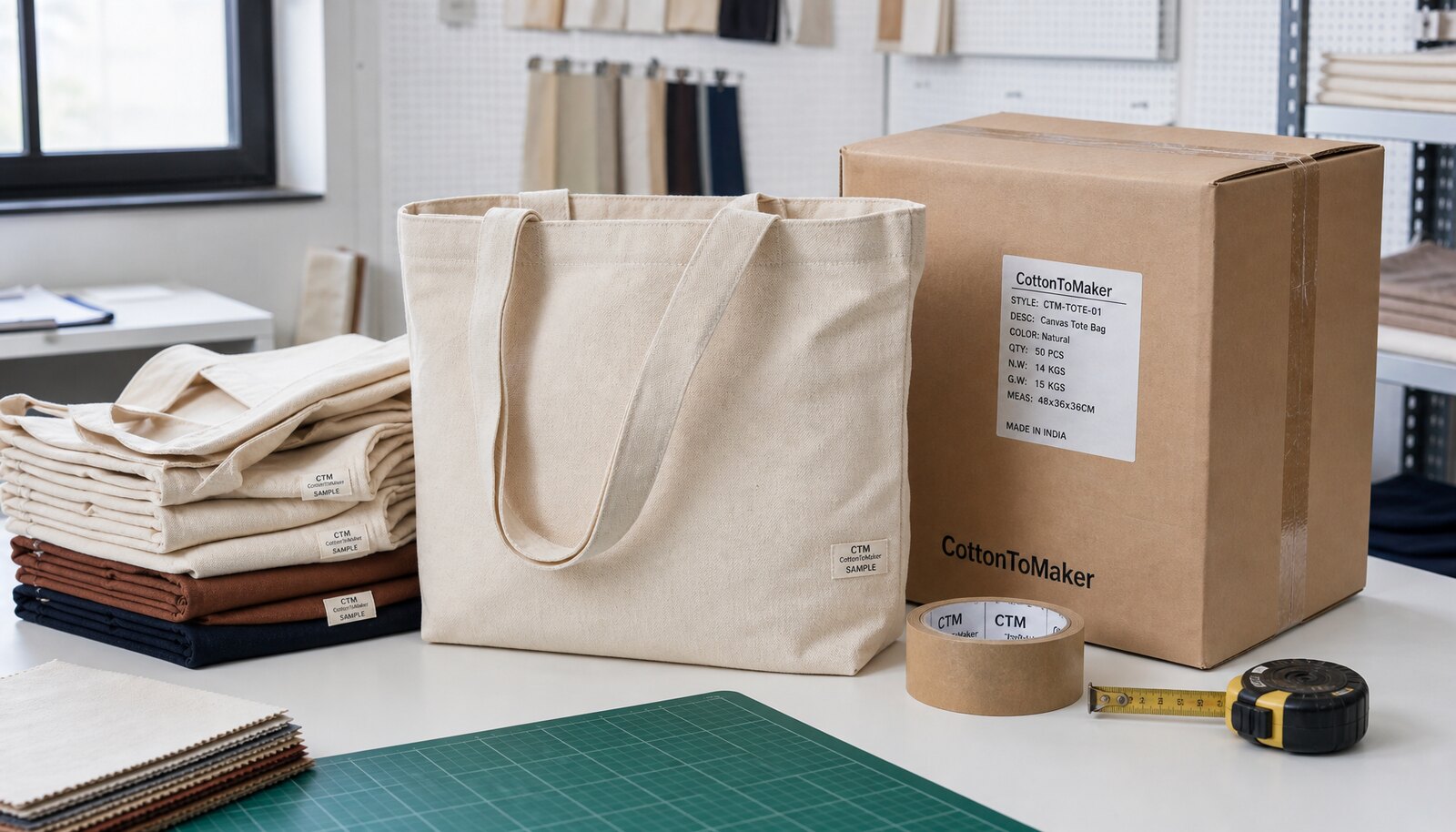
Why carton planning belongs in the tote specification
A canvas grocery tote can look simple on a product sheet. Pick the fabric, add the logo, approve the sample, ship the order. In corporate gifting, that shortcut is where problems start. The item your warehouse receives is not just a sewn cotton bag. It is a folded, counted, protected, labeled, and transported unit inside a master carton. If that carton plan is vague, the buyer may inherit rubbed prints, crushed handles, bowed cartons, remeasurement charges, receiving delays, repacking labor, or missed event dates.
The risk is higher when the tote is part of a client gift, employee welcome kit, conference handout, or sales campaign. The bag may be the first branded item the recipient touches. If it arrives wrinkled, dusty, damp, or inconsistently folded, the whole gift program can feel rushed even when the sewing itself is acceptable. Procurement teams should therefore treat carton planning as part of the product specification, not as a warehouse detail to solve later.
The practical purpose of canvas grocery totes shipping carton planning for corporate gifting is to connect the product and the logistics. Tote construction affects folded size. Folded size affects pack count. Pack count affects carton strength, gross weight, CBM, pallet pattern, and handling method. When those relationships are locked before the purchase order, suppliers quote against the same assumptions, forwarders receive cleaner freight data, and the buyer can compare true landed cost rather than only unit price.
- Treat carton dimensions, pack count, gross weight, and carton marks as purchase-order specifications, not afterthoughts.
- Ask marketing, logistics, and the 3PL to review the packing plan before mass production if the order is event-critical.
- Reject vague packing descriptions such as 'standard export packing' when comparing suppliers; require measurable carton data.
- Do not approve bulk packing until the folded tote and packed carton format are proven by sample, photos, or inspection.
Start with a measurable tote construction spec
Carton planning starts with the finished tote, not the cardboard box. The RFQ should state finished width, height, gusset depth, handle drop, handle width, fabric weight, seam type, top hem depth, and reinforcement method. Each detail changes folded thickness and carton density. A wide gusset does not fold like a flat tote. Long self-fabric handles can create bulky layers if they are not aligned. Webbing handles, inner pockets, hangtags, snaps, labels, and base inserts can all reduce the safe number of pieces in a carton.
Fabric weight needs particular care. Cotton canvas is often described as 10 oz, 12 oz, 14 oz, or 16 oz, usually meaning ounces per square yard. Some mills and factories work in GSM instead. Buyers should not let these terms float loosely between suppliers. A stronger RFQ asks the factory to declare the basis of the quoted fabric, provide the conversion if needed, and commit to a production tolerance. If no tighter standard is agreed, many buyers use about +/-5% as a working tolerance, but the approved requirement should be written clearly.
Heavier canvas often gives a better hand feel and a more structured grocery tote. It also increases folded height, carton weight, freight cube, and sometimes sewing bulk. A 14 oz or 16 oz canvas can make sense for a premium reusable grocery tote. A 10 oz or 12 oz fabric may be enough for a lighter event giveaway if the expected load is modest. The point is to choose the fabric in context: intended contents, brand positioning, logo process, carton count, warehouse handling, and landed cost all matter.
- Specify finished dimensions and tolerance, not only an approximate catalog size.
- Confirm whether the tote is flat bottom, boxed bottom, side gusset, bottom gusset, or no gusset because each format folds differently.
- Ask the factory to declare fabric weight basis: oz/sq yd, GSM, or another local standard.
- If the tote will hold other gift items, share the approximate contents and total weight before the supplier recommends construction.
Use realistic tolerances for product and packing
Many purchase orders say 'as approved sample' and stop there. That sounds clear until final inspection begins. Inspectors need objective limits, and suppliers need to know what they are expected to control. For sewn cotton bags, tolerances cannot be as tight as machined parts, but they should still be measurable. A workable starting point might be +/-5 mm on body width and height, +/-5 mm on gusset, +/-10 mm on handle drop, and +/-3 mm to +/-5 mm on logo placement depending on the decoration method and fixture.
Packing needs tolerances too. Carton dimensions should stay close enough to the approved plan for freight booking, pallet planning, and warehouse slotting. Minor variance can happen because of carton manufacturing and product compression, but a changed carton size, pack count, or fold method is not a minor change. It can alter CBM, gross weight, pallet height, carton labels, and receiving workflow. If freight has already been booked on declared cube, late packing changes can also create avoidable charges or delays.
Clear tolerances reduce arguments. Is a tote 6 mm narrower than the sample acceptable? Is a logo 4 mm low a defect? If the carton is 3 cm taller than quoted, who absorbs the freight impact? Written tolerances turn subjective reactions into inspection decisions. They also help the sewing, printing, and packing teams keep the order consistent across shifts and production days.
- Add measurable tolerances for tote body, gusset, handle drop, logo placement, folded size, and carton data.
- State inspection method: measure flat, without stretching, from consistent reference points such as top hem and side seam.
- Require written approval before the supplier changes pack count, carton size, carton grade, inner packing, or carton marks.
- Align tolerances with the actual production method; embroidery and screen print may behave differently on sewn goods.
Build the master carton spec instead of accepting standard export packing
The master carton specification should be as concrete as the tote specification. At minimum, it should include outside carton dimensions, pieces per carton, net weight, gross weight, carton construction, sealing method, carton marks, and whether cartons will be palletized or loaded loose. The phrase 'export carton' means different things in different factories. For dense canvas loads, a weak or oversized carton can fail long before the shipment reaches the buyer. Corners crush. Sidewalls bow. Tape splits. Stacks become unsafe.
For canvas grocery tote orders, practical carton counts often land between 20 and 50 pieces per master carton. Common planning counts include 25, 30, 40, and 50 pieces, but the right answer depends on fabric weight, folded size, handle bulk, decoration method, inner protection, and maximum carton weight. A 16 oz gusseted tote with embroidery and tissue will not pack like a 12 oz flat tote with a small screen print. Ask suppliers to trial pack at least two options rather than guessing from open dimensions.
Carton strength should match the route. Sea freight, long warehouse dwell time, pallet stacking, mixed-container handling, and heavy pack counts usually call for stronger corrugated board. For dense canvas cartons, buyers commonly request 5-ply double-wall construction when the load justifies it. If your company or 3PL has a formal standard, ask for ECT, burst strength, or a carton supplier specification. If formal testing is not required, still ask the factory to declare and photograph the carton grade. Saving a small amount on weak cartons can become expensive when a gifting shipment arrives damaged or hard to receive.
- Request carton L x W x H in centimeters or inches, plus CBM per carton and total CBM for the order.
- Set a maximum carton gross weight, often 15-20 kg for manual handling unless your warehouse approves otherwise.
- Specify carton sealing: tape width, H-taping if required, straps if required, and whether inner liners are used.
- For palletized orders, confirm pallet size, cartons per layer, layers per pallet, maximum pallet height, and pallet gross weight.
Choose fold style and pack count from a packed trial
Fold style is not cosmetic. It is a packing control. A flat fold can protect the front panel and create a clean presentation, but it may use more carton footprint. A half fold or tri-fold may improve cube efficiency, yet the fold line can crease a logo or concentrate pressure on handle stitching. A gusseted grocery tote often needs a defined side-gusset tuck so the carton closes squarely. Without a reference, different packing workers can create different carton heights from identical totes.
A proper packed trial shows the actual folded dimensions, bundle arrangement, carton fill level, and pressure points. If workers must force the flaps closed, the carton is probably overpacked. If there is too much empty space, totes can shift and rub during transit. The best carton is usually firm, not compressed. Handle alignment also matters. Handles should face the same direction and should not form one thick lump in the center of the carton. If the logo surface touches rough seams, heavy reinforcement, or embroidery backing, use tissue or change the fold.
Pack count should also support receiving accuracy. Bundles of 5 or 10 can help a 3PL count quickly, but tight bands may mark the canvas during long storage. Paper bands, removable straps, or loose counted bundles may work better depending on the distribution plan. Individual polybags add thickness and trapped air, so they can reduce carton count. Any change to folding or inner packing should trigger a new carton calculation instead of being treated as a small packing adjustment.
- Approve a photo standard showing open tote, folded tote, handle direction, logo orientation, bundle count, and carton fill.
- Compare at least two trial pack counts, such as 25 pcs/carton and 40 pcs/carton, before finalizing the PO.
- Keep artwork away from fold lines where possible, especially for large, thick, metallic, puff, or transfer prints.
- Open trial cartons after compression or short storage to check whether handles, bands, or neighboring totes leave marks.
Match inner protection to route, decoration, and presentation
Inner protection should solve a known risk. It should not be added automatically, and it should not be removed just to lower a quote. For a durable screen-printed natural canvas tote moving a short distance, a clean carton liner may be enough. For a premium executive gift, a light-colored tote, a large print, sea freight, humid-season transit, or long storage, tissue separation or individual polybags may be justified. The right choice balances protection, labor, waste, carton cube, unpacking speed, and destination rules.
Decoration changes the decision. A well-cured screen print may tolerate bulk packing, but heavy ink coverage can rub if the tote is compressed. Heat transfers can show pressure marks if packed too soon or folded in the wrong place. Embroidery adds thread and backing, which can press into adjacent fabric. Digital print should be checked for abrasion and colorfastness on the actual canvas. Ask the supplier to confirm curing, cooling, and resting time before packing. Printed totes packed too early can block, smudge, or carry odor into the carton.
Cotton canvas also needs moisture discipline. Goods should be dry before sealing. Cartons should be stored off the floor. Packed cartons should be protected from rain, wet docks, and container condensation during loading. Desiccants may help manage normal humidity in a closed carton, but they cannot rescue wet goods or damp cardboard. For sea freight or humid routes, ask about dry storage, carton liner options, container condition, and whether desiccants or moisture indicators are appropriate.
- Use carton liners to reduce dust and carton-fiber transfer when bulk packing is acceptable.
- Use tissue sheets or separators when print surfaces, embroidery, or light canvas colors may rub or mark.
- Use individual polybags when required by presentation, 3PL handling, moisture exposure, or direct handout standards.
- Confirm printed goods are cured and canvas is dry before packing; do not use desiccants as a substitute for proper drying.
Connect logo placement, decoration process, and carton pressure
The logo is often the part of the tote that receives the most scrutiny. It should therefore be reviewed together with the carton plan. A logo may look perfect on an open sample, then crease because the approved fold crosses the artwork. A thick ink deposit may crack at a fold. A transfer may show pressure marks after weeks in a tight carton. Embroidery can look premium but also create a raised area that affects stacking, fold thickness, and carton count.
Measure logo placement from fixed points, such as the top hem and side seam, not by eye. If the tote is sewn before printing, platen access and seam bulk may limit the safe print area. If panels are printed before sewing, sewing tolerance can affect final logo alignment. Ask the factory how the decoration will be applied and whether the proposed location is realistic in bulk. On coarse canvas, very fine lines, small reversed text, and tight registration can be less reliable than on a smooth fabric.
Print QC should happen on finished totes, not only on a flat strike-off. Inspectors should check opacity, registration, edge sharpness, smudging, pinholes, curing, adhesion, hand feel, and rub risk. A simple dry rub check on packed product can reveal issues a loose swatch misses. For corporate colors, Pantone references are useful, but buyers should be realistic: cotton canvas base color and texture affect perceived color. Approve a production strike-off on the actual fabric rather than expecting coated-paper color to translate perfectly.
- Ask for a print strike-off on actual bulk canvas, then review the same tote folded in the approved carton format.
- Measure logo placement with a ruler from top hem and side seam; define acceptable variance before inspection.
- Avoid placing critical artwork over seams, gusset folds, deep texture, or planned fold lines whenever possible.
- For embroidery, check backing, puckering, trimming, needle holes, and whether raised stitching presses into adjacent totes.
Compare quotes by landed cost and carton efficiency
A lower tote unit price can hide a poor packing plan. One supplier may quote aggressively while using thin cartons, vague labeling, a risky pack count, and no inner liner. Another supplier may include stronger cartons, controlled folding, readable carton marks, and a slightly lower pack count that protects the logo. The second quote may look higher at unit level but perform better after freight, receiving, storage, damage risk, and repacking labor are included.
Ask every supplier to quote the same tote construction, decoration method, fold style, pack count, carton grade, inner packing, carton marks, and Incoterms. Incoterms matter because EXW, FOB, CIF, DAP, and DDP shift cost and responsibility. Even when the supplier quotes delivered pricing, require carton dimensions, gross weight, and total CBM. Without that data, the buyer cannot judge freight efficiency or warehouse impact.
A useful comparison metric is CBM per 1,000 pieces, reviewed alongside gross weight per carton and total carton count. This quickly shows whether a pack plan saves cube or simply creates a heavy handling problem. Ask whether folding labor, carton liners, individual polybags, labels, barcodes, pallets, corner boards, and special marks are included. When those details are buried inside a single price, quote comparison becomes guesswork.
- Compare quotes using the same Incoterms and the same approved carton assumptions.
- Ask for unit product cost, decoration cost, packing cost, palletization cost, and freight cost as separate lines when possible.
- Calculate CBM per 1,000 pcs and carton gross weight to compare freight and handling efficiency.
- Include a PO clause requiring written approval before carton substitution, pack-count change, or label change.
Approve samples that prove both product and packing
A loose pre-production sample is necessary, but it does not prove the shipment will pack well. It can confirm fabric, sewing, dimensions, and logo appearance. It cannot prove that 40 pieces will travel safely in a carton for weeks without crushing handles or rubbing ink. For corporate gifting, approval should cover the material, print strike-off, pre-production tote, folded sample, and packed-carton format. For higher-value or event-critical programs, a physical packed carton may be worth approving. For lower-risk orders, a detailed photo set may be enough if it is specific.
The packed sample should answer practical questions. Does the tote fold neatly without stressing the logo? Do the handles align, or do they form a pressure lump? Does the carton close naturally? Is the fill firm without over-compression? Are tissue sheets, liners, bands, or polybags placed correctly? Are carton marks readable and printed on the correct side? Can the receiving warehouse identify item, PO, color, quantity, and destination without opening every carton?
Keep a reference until the order is received. That reference may include a sealed approved sample, signed sample tag, and photos showing the open tote, logo close-up, seam details, folded unit, bundle arrangement, open carton, sealed carton, and carton label. It is useful for final inspection and repeat orders. Without a retained reference, factories may unintentionally drift in fold style, label format, carton size, or construction details.
- Approve product sample and packed format as separate checkpoints.
- Request packed-carton photos before bulk packing: folded units, carton fill, liner/tissue if used, sealed carton, and carton marks.
- Keep the approved sample and packing reference until the final warehouse accepts the shipment.
- Do not approve mass packing if the trial carton bulges, compresses handles, transfers print, or differs from quoted dimensions.
Final QC, shipment release, and schedule control
Final QC should inspect the tote and the carton as one commercial product. Product checks include fabric weight, shade, dimensions, handle construction, stitching, seam strength, logo placement, print quality, cleanliness, odor, and moisture concerns. Packing checks include folded size, bundle count, pieces per carton, carton dimensions, gross weight, carton strength, inner protection, carton marks, sealing, pallet pattern, and loading condition. A shipment can be sewn correctly and still fail the program if the cartons are mislabeled or the count is wrong.
Inspection should be random across the packed lot, not limited to cartons prepared for presentation. Open cartons from different production times, colors, logo versions, and pallet positions. Check whether bottom cartons show compression. Look for print rub. Compare carton weights for consistency. For multi-destination programs, confirm that the packing list separates each destination and that carton numbers match the physical labels. If barcodes are required, scan samples before release instead of discovering label errors at the receiving dock.
Lead time must include more than sewing. Corporate gifting schedules may involve artwork approval, fabric sourcing, dyeing, cutting, sewing, printing, curing, trimming, pressing, folding, carton procurement, packing, inspection, export documents, freight pickup, customs clearance, 3PL receiving, and final distribution. Late carton decisions can disturb the entire timeline. Individual polybags, special labels, palletization, barcode compliance, or split shipments should be known before production starts. If the event date is fixed, ask for a critical path with approval deadlines and shipment milestones.
- Inspect cartons for count, fold, label accuracy, carton condition, carton weight, and actual dimensions before shipment release.
- Match final packing list data to physical cartons: total cartons, pieces per carton, gross weight, net weight, CBM, and destination.
- For palletized orders, request photos before wrapping and after wrapping; verify carton orientation and pallet height.
- Freeze artwork, carton plan, carton marks, and Incoterms early enough to protect the gifting schedule.
Specification comparison for buyers
| Spec decision | Recommended option | When it fits | Buyer risk to check |
|---|---|---|---|
| Fabric weight | 12 oz, 14 oz, or 16 oz cotton canvas, confirmed as oz/sq yd or GSM with an agreed tolerance, commonly +/-5% if not otherwise specified | Corporate grocery totes where the buyer needs a balance of hand feel, load capacity, print appearance, and freight cube | A supplier may quote a nominal ounce weight but ship lighter fabric; verify by GSM test or cut-weight method before bulk approval |
| Finished tote dimensions | Define width x height x gusset, handle drop, handle width, top hem depth, and finished tolerance such as +/-5 mm for main dimensions and +/-10 mm for handle drop | Programs where thousands of units must fold consistently, fit kits, or display the logo in the same position | Loose sizing changes folded height, carton count, logo alignment, pallet pattern, and receiving expectations |
| Handle reinforcement | Cross-stitch, box stitch, or bartack reinforcement with specified stitch density and thread color matching the approved sample | Reusable grocery totes carrying groceries, welcome-kit contents, catalogs, samples, or event materials | Weak reinforcement may not fail during inspection but can fail in end use; bulky reinforcement can also create carton pressure points |
| Logo method | Screen print for solid spot-color artwork; embroidery for smaller premium marks; transfer or digital print only when artwork complexity, quantity, and fabric texture justify it | Corporate gifting where brand color, repeatability, and clean presentation matter more than novelty | Coarse canvas can reduce fine-line clarity; thick ink can crack on fold lines; embroidery backing increases fold thickness |
| Folded size | Approve the actual folded length x width x height after print curing, pressing, and final folding | Orders moving through 3PLs, kitting centers, event teams, or multi-destination distribution | Open tote dimensions alone do not predict carton cube; inconsistent folding causes bulging cartons and unstable pallets |
| Carton pack count | Validate 20-50 pcs/master carton by trial packing; common practical targets are 25, 30, 40, or 50 pcs depending on tote thickness and weight | Bulk corporate gifting shipments where freight efficiency must be balanced against product presentation and manual handling | Maximum pack count may crush handles, create print rub, exceed warehouse weight limits, or make cartons difficult to count |
| Maximum carton weight | Set a buyer-approved gross-weight limit, often 15-20 kg for manually handled cartons unless the receiving warehouse allows more | Warehouses, event venues, and 3PLs that unload by hand or move cartons without pallet jacks at every point | A cube-efficient carton can still be operationally poor if it is too heavy or fails local manual-handling rules |
| Carton strength | Export-grade corrugated carton, often 5-ply double-wall for dense canvas loads, with ECT or burst specification requested when available | Sea freight, pallet stacking, long storage, mixed-container handling, or heavy pack counts | Vague 'standard carton' language can lead to crushed corners, bowed sidewalls, broken seams, and weak freight-claim documentation |
| Inner protection | Carton liner as a baseline; tissue, bands, or individual polybags only when required by presentation, print finish, humidity, or receiving rules | Light canvas colors, large prints, premium events, sea freight, long storage, or direct handout from cartons | Too little protection creates dust, rub, moisture, or odor risk; unnecessary polybags add cost, labor, waste, and slower unpacking |
Buyer checklist before sampling
- Define finished tote width, height, gusset, handle drop, handle width, fabric weight, top hem, seam construction, and reinforcement before requesting final pricing.
- State whether fabric weight is required in oz per square yard or GSM, and ask the supplier to declare the conversion and acceptable production tolerance.
- Confirm the intended contents and approximate load expectation so the supplier does not quote a light promotional tote for a reusable grocery or welcome-kit application.
- Provide logo size, placement from fixed reference points, color count, Pantone references where required, print method preference, and whether artwork may cross seams, gussets, or fold lines.
- Ask for the expected folded dimensions after decoration, curing, trimming, pressing, and final packing, not only the open tote size.
- Request two carton plans, such as 25 pcs/carton and 40 pcs/carton, showing carton L x W x H, gross weight, net weight, CBM, carton grade, and total carton count.
- Set a maximum carton gross weight based on the receiving warehouse or event venue, commonly 15-20 kg for manually handled export cartons unless otherwise approved.
- Specify folding method with photos or drawings: flat fold, half fold, tri-fold, handle direction, logo orientation, bundle size, and whether the logo faces inward or outward.
- Decide whether the order requires carton liner, tissue separation, paper banding, individual polybagging, hangtags, barcode stickers, or no extra inner packing.
- Confirm carton strength, flute/double-wall construction if available, sealing method, strapping requirement, and whether cartons will be palletized, floor loaded, or delivered loose.
Factory quote questions to send
- What finished tote width, height, gusset, handle drop, handle width, top hem depth, fabric weight, and seam construction are included in your quote?
- Are you quoting fabric weight in oz per square yard or GSM, and what bulk tolerance will you hold for fabric weight and shrinkage?
- What dimensional tolerances will you hold in bulk for tote width, height, gusset, handle drop, and logo placement? Please state measurable tolerances, not only 'normal tolerance'.
- Which canvas weight do you recommend for the intended corporate gifting use and expected contents, and what trade-off should we expect in carton cube and carton weight?
- What print method are you quoting, what maximum print area is safe on this tote, and do you see risks with canvas texture, ink opacity, curing, wash/rub resistance, or fold-line placement?
- Can you provide a print strike-off on the same bulk canvas and a folded sample showing whether the logo creases or touches handle reinforcement?
- What folded dimensions do you expect after final pressing and packing, and how many pieces can fit without crushing handles or rubbing the print surface?
- Please quote two packing options, for example 25 pcs/carton and 40 pcs/carton, with carton dimensions, net weight, gross weight, CBM/carton, total carton count, and CBM per 1,000 pcs.
- What master carton grade will you use? Is it single-wall or double-wall, 3-ply or 5-ply, and can you provide ECT, burst, or supplier carton specification if required?
- Does your unit price include folding labor, tissue or liner if specified, inner bundles, individual polybags if required, carton labels, master carton marks, and final packing list preparation?
Quality-control points to confirm
- Verify fabric weight against the quoted oz or GSM range using a documented method; nominal canvas weight should not be accepted by visual feel alone.
- Measure finished tote width, height, gusset, handle drop, and handle width against written tolerances, such as +/-5 mm for body dimensions and +/-10 mm for handle drop unless the buyer approves otherwise.
- Check fabric shade under consistent lighting, especially for natural, black, navy, or dyed canvas where lot-to-lot variation can be visible in corporate gifting.
- Inspect canvas cleanliness for oil spots, dirt, weaving slubs beyond the approved standard, odor, mildew marks, and excessive loose fibers before packing.
- Review top hem, side seams, bottom seams, gusset seams, and seam allowance against the approved sample so the tote folds and hangs consistently.
- Check handle reinforcement type, bartack or box-stitch position, stitch density, thread trimming, and thread color; reinforcement should be secure and symmetrical.
- Measure logo placement from fixed points, such as top hem and side seam, using an agreed tolerance, commonly +/-3 mm to +/-5 mm for print placement depending on method and tote construction.
- Check print quality on finished totes for opacity, registration, edge sharpness, pinholes, smudges, curing, adhesion, rub risk, and whether ink sits cleanly on the canvas texture.
- For embroidery, inspect backing, thread tension, trimming, puckering, needle damage, and added thickness at fold points before approving the carton count.
- Audit folding during packing so handle direction, logo orientation, fold line, bundle count, and presentation match the approved packing reference.