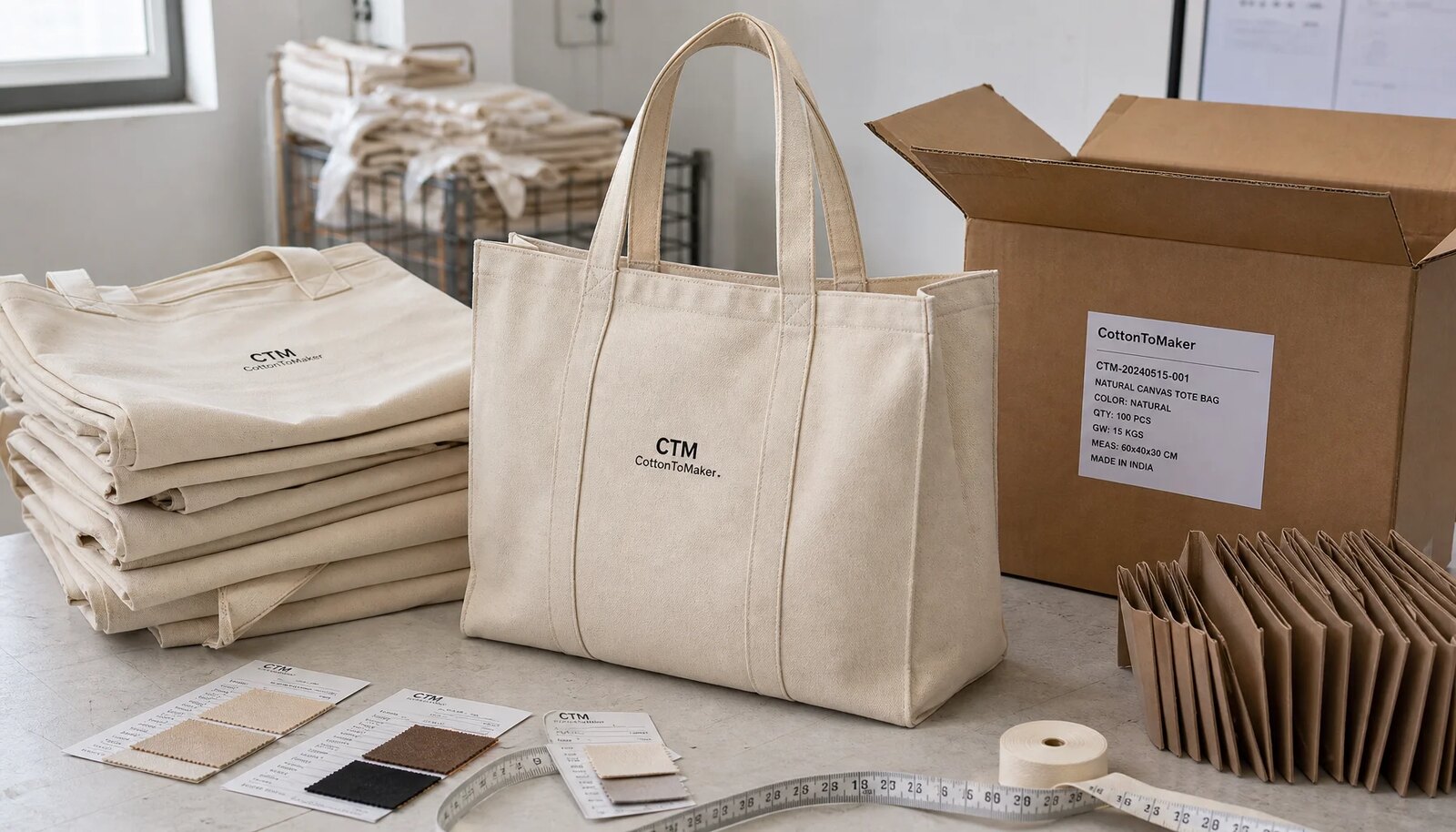
Treat Packing as Part of the Tote Spec
Craft fair tote orders are usually tied to fixed dates, short receiving windows, and temporary storage areas. A tote can pass fabric and print approval but still create problems if cartons are too heavy, labels are unclear, or mixed versions arrive without allocation details. For this reason, carton planning should be handled during product specification, not after bulk production is finished.
The buyer’s RFQ should request packed data by SKU, print version, and destination. At minimum, ask for pieces per carton, inner bundle count, carton outer dimensions, gross weight, net weight, total carton count, and total CBM. If a supplier gives one average packing estimate for several fabric weights or logo versions, the quote is not ready for landed-cost comparison.
This is also where the awkward search phrase canvas grocery totes shipping carton planning for craft fairs becomes a practical buyer task: deciding how real bags will be folded, counted, labeled, moved, and received before the event opens. The best carton plan reflects how inventory will be unloaded, split by booth, stored, and carried inside the venue.
- Confirm carton data before issuing the final PO, not only before shipment.
- Require packed data by SKU, print version, and destination split.
- Set a maximum carton gross weight that works for the venue and receiving team.
- Avoid supplier default packing when the order has gussets, heavy canvas, large prints, or multiple allocations.
- Keep packing approval records with the signed product sample and artwork sheet.
Start With Bag Size, Gusset, and Fabric Weight
The physical tote drives carton planning more than artwork alone. A flat 38 x 42 cm cotton tote stacks differently from a 40 x 35 x 12 cm grocery tote with a boxed bottom. The gusseted version may be better for craft fair shoppers carrying jars, candles, ceramics, packaged food, apparel, books, or kits, but it also increases fold thickness and reduces pieces per carton.
Fabric weight needs careful confirmation. Canvas ounce labels are not always converted consistently; some suppliers quote ounces per square yard, others use local mill categories, and some repeat a market name without measured GSM. For procurement control, request the canvas oz reference, measured GSM, and finished printed sample weight.
Finished dimensions matter more than cut dimensions. Cotton canvas can shift through dyeing, printing, pressing, and sewing. If the tote must hold a specific boxed item, folded apparel pack, sponsor brochure, or grocery-style load, confirm usable internal width and gusset depth on a sample before approving carton quantity.
- 8 oz canvas folds easily but may feel too light for grocery-style resale.
- 10 oz canvas is a common balanced option for event and sponsor totes.
- 12 oz canvas gives more structure but increases gross weight and carton cube.
- 14 oz and heavier canvas needs extra control for seam bulk, needle wear, and carton compression.
- An 8 to 12 cm gusset is practical for many grocery-style totes, but it must be tested in the final fold.
- Finished printed piece weight is the key input for carton gross weight.
Write Tolerances Before Bulk Approval
Canvas totes are sewn textile products, so perfect uniformity is not realistic. However, vague terms such as standard size, neat stitching, or centered print do not give the supplier, inspector, and buyer a shared standard. The PO and inspection checklist should define measurement points and acceptance limits.
Useful commercial starting points include width and height +/-1 cm, gusset depth +/-0.5 to 1 cm, handle length +/-1 cm, handle drop +/-0.5 to 1 cm, and print placement +/-0.5 to 1 cm depending on artwork size. Fabric GSM is often managed around +/-5 percent when the mill and factory confirm feasibility. These numbers should be agreed, not assumed.
Tolerances also affect packing. A slightly thicker fabric lot, wider seam allowance, or bulky handle fold can reduce pieces per carton. A print placed too close to the fold line can create cracking or pressure marks. Approve the tote, fold, and carton loading pattern as one connected standard.
- Measure width and height with the finished tote laid flat without stretching.
- Measure gusset depth at the point defined on the approved spec sheet.
- Measure handle drop from the top opening edge to the natural handle apex.
- Measure print placement from top edge, side edge, and center line.
- Record fabric GSM, piece weight, carton dimensions, and carton gross weight during inspection.
- Classify tolerance failures as minor, major, or critical before inspection begins.
Convert Product Specs Into Carton Data
Once the tote is defined, turn the product into freight data. One supplier may quote a lower unit price but use loose folding, oversized cartons, or individual polybags that increase CBM. Another may quote slightly higher but provide controlled bundles, stronger cartons, and faster receiving. For B2B buyers, carton dimensions are part of the cost structure.
Weight is the first calculation. If a printed tote weighs 280 g and the carton holds 50 pieces, product weight is already 14 kg before carton board, bands, labels, tape, and moisture variation. If a heavier gusseted tote weighs 420 g and the carton still holds 50 pieces, product weight reaches 21 kg before packing materials. That may be too heavy for event handling.
Cube is the second calculation. Fold method, handle position, gusset shape, inner packing, and compression all affect outer carton size. Over-compressing saves space at the factory but may leave deep creases, distorted corners, and print pressure marks. Under-packing wastes freight and lets totes shift and soil during transit.
- Request carton outer dimensions, not only inner dimensions.
- Ask for gross weight, net weight, total cartons, and total CBM on every quote.
- Set maximum carton gross weight in the PO so cartons cannot be overfilled later.
- Recalculate freight after sample weight and packing method are confirmed.
- Share final carton data with the forwarder before booking ocean, air, courier, or truck freight.
- Request revised carton data when GSM, print area, fold, bundle count, or polybag use changes.
Approve Fold, Bundles, and Inner Packing
Fold method is easy to overlook because the tote looks simple when laid flat. In production, however, the fold controls carton stability, print protection, handle bulk, and counting speed. The approved fold should show whether handles are tucked inside, whether the gusset is flattened or boxed, and whether the print crosses a crease.
For craft fair distribution, bundle packing is often more practical than individual polybags. Bundles of 10 or 25 pieces secured with a kraft paper band, cotton tie, paper belly band, or recycled bundle bag let teams count quickly. If a booth needs 100 totes, receiving can verify four bundles of 25 without touching every item.
Individual polybags still have a place. They may be needed for retail resale, barcode scanning, dust protection, long storage, or direct-to-consumer fulfillment. The tradeoff is added cost, cube, plastic, and unpacking time. Polybags can also trap odor when printed goods are packed before ink has fully cured or cooled.
- Flat fold gives low cube for simple totes when heavy ink does not cross the fold.
- Half fold with handles tucked inside gives cleaner presentation and stable bundles.
- Bundles of 10 suit booth kits, sponsor packs, and smaller vendor allocations.
- Bundles of 25 suit larger replenishment needs but are less flexible for small splits.
- Individual polybags suit retail resale, barcode receiving, or extended storage.
- Do not approve final carton quantity until fold and inner packing are confirmed.
Control Print Curing Before Carton Packing
Print method affects carton risk as much as appearance. Screen printing is common for canvas grocery totes because it handles solid logos, sponsor marks, and simple spot-color artwork efficiently. Heat transfer may suit gradients or detailed graphics, while embroidery can work for small premium logos. Each method changes fold behavior, surface feel, and packing risk.
The production calendar must allow curing, drying, or cooling before folding and stacking. If printed totes go into cartons too soon, ink may transfer, stick to adjacent fabric, create odor, or crack along a tight fold. Risk increases with large ink coverage, dark ink on natural canvas, white ink on dyed canvas, high-density effects, and heavy ink deposits on textured fabric.
Buyers should approve print placement together with the fold. A logo that looks good flat may be damaged if the fold crosses the thickest ink area. Ask the supplier to perform a basic dry rub check, odor check, and short stack test when print coverage is large or the event date leaves little time for rework.
- Use screen print for bold logos, sponsor names, icons, and one to three spot colors.
- Approve heat transfer only after checking edge feel, film outline, fold behavior, and heat mark risk.
- Avoid sharp folds through large or thick ink deposits.
- Build curing and cooling time into the lead time rather than assuming same-day packing.
- Request first-carton photos after production packing starts.
- Open packed samples to check sticking, transfer, cracking, odor, and pressure marks.
Specify Carton Strength and Handling Limits
Canvas is dense, so master carton strength should be specified. A carton that looks efficient in a quote may bow or split when filled with 12 oz gusseted totes. Goods may pass through factory loading, export trucking, port or airport handling, forwarder warehouses, domestic carriers, temporary storage, and venue setup. Each transfer adds damage risk.
Many event programs target 12 to 18 kg gross weight per carton, but the correct limit depends on warehouse rules, parcel carrier requirements, labor policy, and whether cartons will be hand-carried inside a venue. The lowest carton count is not always the best option if it creates unsafe lifting, crushed bottom cartons, or carrier surcharges.
Double-wall corrugated cartons are usually preferred for heavy canvas, LCL ocean freight, long storage, stacking, and mixed-cargo handling. Single-wall cartons may be acceptable for lighter flat totes moving short domestic distances, but they should be checked against actual packed weight. Tape quality, humidity exposure, pallet pattern, and stretch wrap also affect arrival condition.
- Require actual printed sample weight before approving pieces per carton.
- Use double-wall cartons for heavy canvas, long transit, LCL movement, storage, or courier handling.
- Specify maximum gross weight, not only target pieces per carton.
- Avoid over-compression that creates permanent creases or distorted gussets.
- Confirm pallet height, carton orientation, stretch wrap, and pallet labels when palletized.
- Ask for photos of a sealed carton on a scale and a carton being measured.
Build SKU Allocation Around the Event
MOQ is not a single number for canvas tote orders. A supplier may have separate minimums for fabric purchasing, dyeing, cutting, handle color, screen setup, carton label versions, and destination splits. Natural canvas with one standard body is usually simpler than custom-dyed fabric, multiple handle colors, or several bag sizes.
Craft fair buyers often need sponsor versions, city versions, retailer versions, artist collaborations, or booth allocation codes. If the same tote body is printed with several logos, the supplier may support lower quantities per logo with separate setup charges. If each logo also needs separate carton marks or destination splits, packing labor and inspection time increase.
Separated cartons by SKU or allocation code are usually cleaner for event receiving. Mixed cartons can reduce carton count, but they require exact outer labels and a detailed packing list. If mixed cartons are unavoidable, contents should be organized by marked bundles or dividers so teams do not have to repack inventory on arrival.
- Simplest order: one natural canvas body, one print, one carton mark, one destination.
- Moderate order: same tote body with several print versions in separated cartons.
- Complex order: multiple body colors, handle colors, sizes, logos, destinations, or booth allocations.
- RFQs should state total quantity, quantity per logo, quantity per carton mark, and whether mixed cartons are allowed.
- Carton labels should match the buyer’s allocation spreadsheet.
- Packing lists should show carton number, SKU, print version, destination, and quantity.
Use Packed-Carton Approval Before Shipment
A standard pre-production sample checks fabric, size, stitching, handle reinforcement, and print placement. For event orders, the buyer should also approve fold direction, handle position, bundle count, inner packing material, master carton loading pattern, and carton label format. This does not always require shipping a full carton sample, but the supplier should provide enough photo or video evidence to prove the method works.
This checkpoint prevents late surprises. A good-looking tote may become unacceptable if the logo is creased through the center, handles create a bulky hump, or gusset corners are crushed. A carton may be too tall for pallet stacking, too heavy for venue staff, or too loose for transit.
Keep one signed sample, one approved artwork placement sheet, one approved carton label, and one approved packing photo set as inspection references. When mass packing starts, request first-carton photos before the entire shipment is sealed. This simple step can catch wrong labels, wrong bundle counts, incorrect fold direction, and overfilled cartons.
- Approve fabric swatch with GSM, color, surface texture, and dye lot if relevant.
- Approve printed sample using the bulk print method, ink system, artwork size, and placement.
- Approve fold line, print protection, gusset position, and handle placement.
- Approve bundle count, bundle label, inner packing material, and carton loading pattern.
- Approve master carton label before bulk carton marking begins.
- Use signed samples and packing photos as the pre-shipment inspection standard.
Compare Landed Cost, Not Unit Price Only
A unit-price comparison is too narrow for canvas grocery totes. Two suppliers can quote the same bag size and fabric weight while landing at different total costs because of carton cube, carton strength, inner packing, sample charges, screen charges, SKU separation, and lead time. Procurement should compare the full order structure.
The quote should include product price, sample cost, setup cost, MOQ by version, pieces per bundle, pieces per carton, carton dimensions, gross weight, net weight, total cartons, total CBM, carton board type, label requirements, and packing materials. If a forwarder is involved, this data supports freight estimates. If goods ship directly to an event warehouse, it supports receiving space and labor planning.
Ask what is excluded. Some quotes include only the tote and a basic export carton. Barcode labels, palletization, destination labels, special carton marks, export documents, fumigation if required, origin trucking, or destination split packing may be additional. Clear exclusions are easier to manage than surprise charges close to the craft fair date.
- A lower unit price can lose value if loose folding increases CBM.
- Individual polybags may improve retail presentation but add cost, cube, and unpacking time.
- Double-wall cartons add packing cost but can reduce transit and storage risk.
- Controlled bundle packing can reduce counting and allocation labor.
- Recalculate landed cost after actual sample weight and carton dimensions are confirmed.
- Ask the forwarder to review final carton data before choosing the shipping method.
Specification comparison for buyers
| Planning decision | Recommended buyer position | Best fit | Risk to control |
|---|---|---|---|
| Fabric weight | Specify both canvas oz reference and measured GSM; request finished sample piece weight before carton approval | Craft fair retail, sponsor merchandise, reusable grocery bags, gift-with-purchase programs | Oz labels are not always comparable. Heavier fabric changes sewing cost, carton gross weight, CBM, and manual handling |
| Bag structure | Use flat totes for simple giveaways; use boxed-bottom or side-gusset totes with 8 to 12 cm gusset for grocery-style utility | Vendors selling jars, candles, ceramics, books, packaged food, apparel, or kits | Gussets improve function but add fold bulk. Confirm carton data on the final pattern, not a similar tote |
| Finished tolerances | Write tolerances for width, height, gusset, handle length, handle drop, fabric GSM, print placement, and carton gross weight | Any B2B order where inspection, rework, or claims must be objective | Without written tolerances, size and packing disputes become visual judgment calls |
| Handle reinforcement | Use shoulder handles around 55 to 65 cm with box-X, bar tack, or dense back-tack reinforcement | Reusable grocery totes expected to carry multiple purchases | Weak handles create seam tearing and brand risk. Include stitch and pull checks in QC |
| Print and curing | Screen print for solid logos and spot colors; approve curing, rub resistance, odor, and fold behavior | Fair branding, sponsor logos, retailer marks, event merchandise | Packing too soon can cause ink transfer, sticking, odor, cracking, or pressure marks inside cartons |
| Fold and bundles | Approve flat fold or half fold, then bundle in 10s or 25s with paper band, cotton tie, or bundle bag | Fast receiving, booth allocation, and lower plastic use | Random folding causes uneven cartons, hard counting, crushed corners, and unreliable carton quantity |
| Master carton | Use double-wall corrugated cartons for heavy canvas, LCL ocean freight, stacking, storage, or courier handling | Imported goods, mixed cargo, temporary event warehousing | Weak cartons bow, split, and soil bags. Overfilled cartons may exceed safe lifting limits |
| Pieces per carton | Common range: 50 pcs for light flat totes; 25 to 40 pcs for heavier gusseted totes | Balancing freight efficiency with venue handling | Too many pieces may exceed 18 kg, compress prints, distort gussets, and trigger receiving problems |
| Carton labels | Require SKU, print version, PO, carton number, quantity, GW, NW, destination, allocation code, and barcode if used | Multi-logo, multi-city, sponsor, retailer, or booth-kit programs | Poor labels force carton opening, relabeling, manual sorting, and event-date delays |
Buyer checklist before sampling
- Define finished tote width, height, gusset depth, handle length, handle drop, fabric GSM, canvas oz reference, expected load, print size, and intended use before requesting carton data.
- Ask each supplier to quote pieces per inner bundle, pieces per master carton, outer carton dimensions, gross weight, net weight, total carton count, and total CBM by SKU and print version.
- Require a finished printed sample weight before approving final carton quantity; do not rely only on estimated fabric weight or a reference tote.
- Set written tolerances for fabric GSM, finished dimensions, handle placement, print placement, stitch density, and maximum carton gross weight.
- Approve the fold method and packing photo set, including handle position, gusset placement, bundle count, inner packing material, and carton loading pattern.
- Choose a maximum carton gross weight that works for the receiving team, carrier, and venue; many event programs target 12 to 18 kg, but local rules should decide.
- Separate cartons by SKU, logo, color, destination, or fair allocation code unless mixed cartons are clearly listed on labels and packing documents.
- Confirm print curing, rub resistance, odor control, and drying or cooling time before printed totes are folded and packed.
- Use double-wall cartons when canvas is heavy, cartons are stacked, goods move by LCL ocean freight, or inventory will be stored before the fair.
- Decide whether individual polybags are truly needed; controlled bundle packing is often faster for booth distribution and usually reduces plastic, cube, and unpacking labor.
Factory quote questions to send
- What are the final finished bag dimensions, gusset construction, handle length, handle drop, fabric GSM, canvas oz reference, and estimated finished piece weight for each option?
- What tolerances do you apply for fabric GSM, finished width, height, gusset depth, handle length, handle drop, print placement, stitch density, and carton gross weight?
- How many pieces are packed per inner bundle and per master carton for the final folded tote, not for a similar bag?
- What are the outer master carton dimensions, gross weight, net weight, total carton count, and total CBM for the full order and for each SKU or logo version?
- Is the export carton single-wall or double-wall, what board grade or flute is used, and is it suitable for the proposed gross weight and shipping method?
- How long will printed totes cure, dry, or cool before folding and packing, and what rub, blocking, or odor checks are performed?
- Can you provide a pre-production packing photo or short video showing fold direction, handle placement, print protection, bundle count, and carton loading pattern?
- How will mixed SKUs, colors, logos, sponsor versions, destinations, or event allocation codes be separated, counted, packed, and marked at carton level?
- What is the MOQ by fabric color, fabric weight, bag size, handle color, print version, packing method, carton label version, and destination split?
- Which quote items are included or excluded: screen setup, print test, carton cost, bundle materials, barcode labels, palletizing, fumigation if required, export documents, and local trucking?
Quality-control points to confirm
- Fabric GSM tolerance should be written into the inspection standard; +/-5 percent is a common commercial starting point when the supplier confirms feasibility.
- Finished dimensions should be measured after sewing and pressing, with separate checks for width, height, gusset depth, handle length, and handle drop.
- Fabric inspection should cover stains, oil marks, holes, broken yarns, excessive slubs, shade variation, and visible contamination, especially on natural or dyed canvas.
- Handle reinforcement should be checked for stitch pattern, stitch density, thread trimming, back-tack security, and load resistance appropriate to the expected grocery use.
- Bottom seams, gusset corners, and side panels should be inspected for skipped stitches, loose threads, uneven seam allowance, puckering, and stress points.
- Print position should be checked against an approved artwork placement sheet using measurements from the top edge, side edge, and center line.
- Printed panels must be dry, odor-controlled, and resistant to normal rub before folding, bundling, or carton packing.
- Fold lines should avoid heavy ink deposits when possible, and packed samples should be checked for cracking, sticking, transfer, and permanent creasing.
- Carton quantity should match the packing list, with random open-carton count checks before final shipment release.
- Carton gross weight and outer dimensions should be measured during pre-shipment inspection because freight cost and handling risk depend on actual packed data.