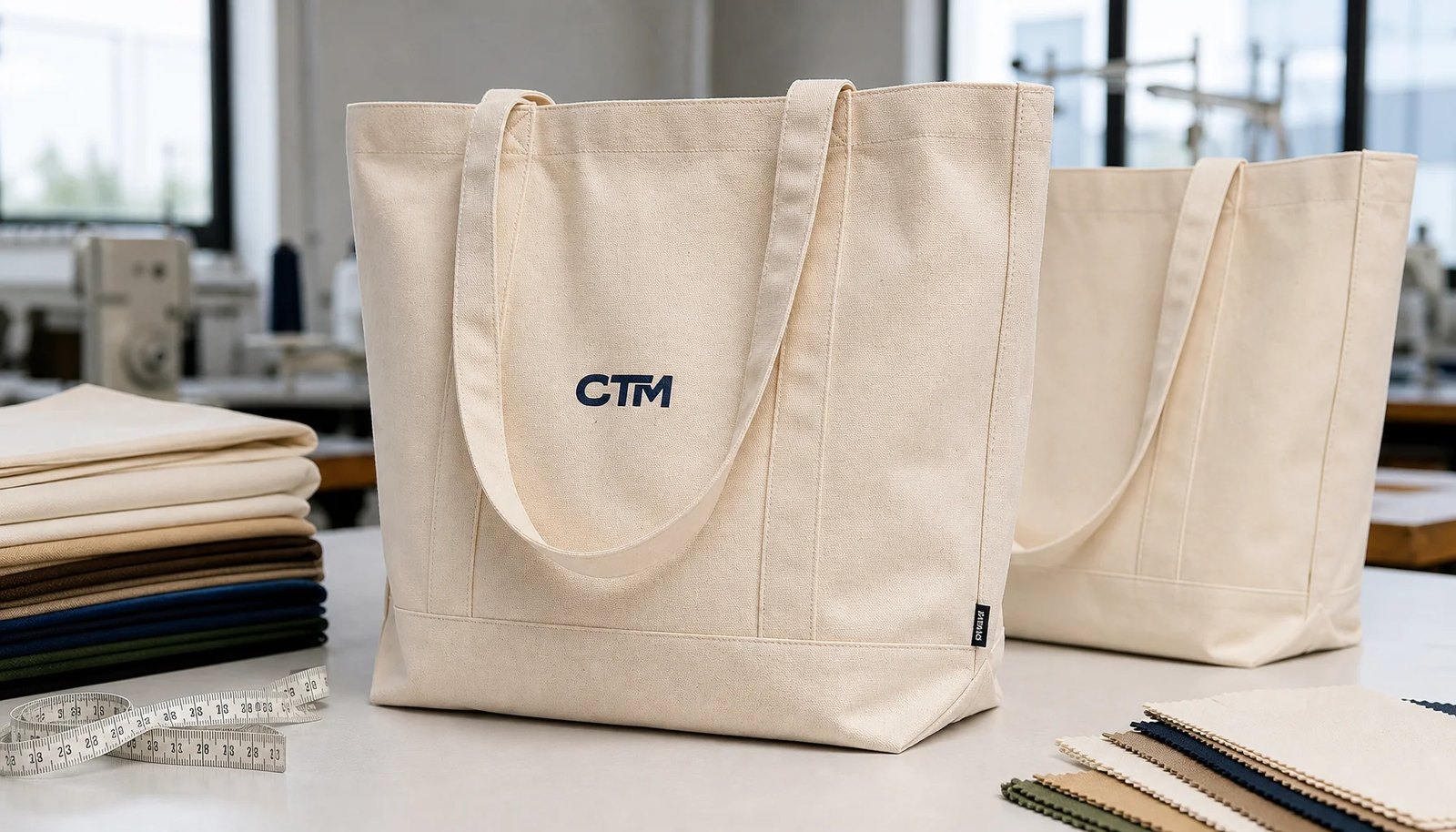
Start With the Bookstore Use Case
A canvas grocery tote for a university bookstore is not one fixed product. The same general bag can be a retail resale item, a checkout alternative, a food pantry carrier, an orientation kit tote, a donor gift, or a replenishment SKU for a distributor. Each use changes the RFQ. A resale tote needs clean stitching, consistent artwork, barcode or hangtag options, and presentation that works on a bookstore shelf. A food pantry tote needs capacity, comfortable handles, and reliable load performance. An orientation tote often needs department sorting, carton routing, and delivery by a fixed move-in date.
The most common sourcing problem starts with a photo. A buyer asks for a “natural canvas grocery tote with school logo,” and three suppliers quote three different products. One may price 8 oz canvas, another 10 oz, and another 12 oz. One may assume a flat body, another a side gusset. Handle drop, stitch reinforcement, print area, and packing can all change quietly. The lowest quote may simply be the lightest bag with the least documentation.
A better RFQ begins with the operational job the tote must do. If the bag replaces checkout bags, include target working load, handle drop, and how cartons flow into the bookstore. If the bag will be sold, include retail label needs, artwork approval, and cosmetic defect standards. If it supports a campus grocery or food pantry program, describe the expected contents and whether the tote must hold boxed goods, bottles, or mixed items. These details affect fabric weight, gusset depth, handle reinforcement, print durability, packing, and final landed cost.
- Primary use: retail resale, checkout bag, food pantry tote, orientation kit, alumni event gift, or distributor replenishment item.
- Expected contents: apparel, books, groceries, drink bottles, event folders, snack packs, or mixed campus merchandise.
- Brand control: licensed university mark, mascot, bookstore logo, department version, sponsor logo, or seasonal message.
- Receiving route: bookstore dock, campus warehouse, event staging area, distributor DC, or multiple department destinations.
- Commercial goal: lowest event cost, durable daily-use tote, premium retail item, sustainability-positioned product, or reorderable stock SKU.
Build the RFQ Like a Purchasing Document
A strong RFQ should read like a controlled purchasing document, not a mood board. It needs a specification block, artwork instructions, quote lines, sample requirements, quality expectations, packing rules, lead time milestones, and commercial terms. That structure helps suppliers quote the same product and gives procurement a fair basis for comparison. It also reduces late-stage surprises, such as extra barcode fees, carton changes, larger print charges, or a lead time that did not include sample approval.
University bookstore orders often pass through several hands. Procurement may manage price and supplier selection. Marketing may review presentation. Licensing may approve university marks. Bookstore operations may care most about carton labels, shelf-readiness, and receiving labor. If the RFQ does not show this approval path, the timeline can become unrealistic. Tell the supplier whether production can begin after digital proof approval, after printed strike-off approval, or only after a full pre-production sample is signed off.
Ask each supplier to quote the requested specification first and list exceptions separately. A factory suggestion can be useful. Stock 10 oz canvas may shorten lead time. A different carton count may make receiving easier. Cotton webbing handles may be more consistent than self-fabric handles for some programs. The issue is not the recommendation; the issue is hidden substitution. A line-by-line confirmation table keeps alternate fabric, changed packing, and different print methods from disappearing inside a unit price.
- Specification block: finished size, gusset type, fabric weight, fabric color, handle construction, print method, and packing style.
- Artwork block: vector file requirement, Pantone colors, print side, print size, print location, and trademark approval sequence.
- Quote block: quantity ladder, unit price, setup charges, sample cost, packing cost, testing cost, inspection cost, currency, and quote validity.
- Commercial block: Incoterm, loading port or delivery point, payment terms, production lead time, transit assumption, and exclusions.
- Sample block: fabric swatch, strike-off, construction sample, pre-production sample, approval deadline, and courier cost responsibility.
- Deviation block: supplier must list every change from the requested spec, including alternate fabric, carton count, labels, or print process.
Specify Canvas With Weight, Finish, and Tolerance
Fabric is where many tote quotes drift apart. Canvas can be described by ounce weight, GSM, yarn count, weave density, or vague phrases such as “heavy cotton.” For RFQ comparison, use both ounce weight and approximate GSM. Common reference points are 8 oz at roughly 270 GSM, 10 oz at roughly 340 GSM, and 12 oz at roughly 400 GSM, depending on construction and finishing. These numbers are useful anchors, but the supplier still needs to confirm the exact fabric being quoted and the normal tolerance.
For many university bookstore grocery totes, 10 oz to 12 oz cotton canvas is a practical range. A 10 oz canvas can work well for reusable checkout and retail totes when handles and seams are reinforced. A 12 oz canvas gives more body and a sturdier hand feel for groceries and books, but it raises material cost, sewing bulk, carton weight, and freight cube. Lighter 6 oz to 8 oz cotton can be useful for budget events, but it should be described as a light shopper unless the load expectation is modest.
Do not leave the color state open. Natural unbleached canvas is popular because it feels familiar, casual, and bookstore-friendly, but seed flecks, small slubs, and shade variation are normal unless a stricter visual standard is agreed. Bleached canvas looks cleaner but can show dirt and handling marks more easily. Dyed canvas can support school-color programs, yet dye lots may require higher MOQ and shade approval. If organic cotton or recycled-content fabric is requested, ask what the certificate covers: raw fiber, yarn, fabric, finished bag, or transaction certificate where applicable.
- Budget option: 8 oz cotton canvas, about 270 GSM, suitable for light merchandise, events, and lower-cost promotions.
- Core option: 10 oz cotton canvas, about 340 GSM, suitable for reusable checkout totes and many bookstore resale programs.
- Heavy option: 12 oz cotton canvas, about 400 GSM, better body for groceries and books, with higher material and freight cost.
- Premium option: 14-16 oz canvas, strong retail hand feel, but more seam bulk, needle stress, and carton weight.
- Tolerance wording: ask the supplier to state normal GSM tolerance, shrinkage expectation, and whether fabric weight is measured before cutting.
- RFQ wording: “Quote natural unbleached 10 oz cotton canvas, approximately 340 GSM, with fabric tolerance, shade range, and seed-fleck standard confirmed.”
Control Size, Gusset, Handles, and Load
A grocery tote is bought for capacity, not just for a logo panel. A flat tote can look acceptable in a mockup but carry far less once students load it with books, snacks, boxed items, water bottles, or sweatshirts. A practical starting point for a bookstore grocery tote is about 38 cm wide x 40 cm high x 12 cm deep, although the best size depends on use. Food pantry programs may need more depth. Retail programs may prefer a cleaner silhouette. Textbook-heavy use may require stronger handles more than extra height.
Define the gusset in plain terms. A side gusset expands the body and is common for shopping-style totes. A bottom gusset improves base capacity but may collapse if the pattern and seams are too light. A boxed bottom gives more structure but adds sewing time. If the RFQ says only “gusseted,” suppliers may quote different patterns. State whether dimensions are finished measurements, whether width is measured seam to seam, and whether depth refers to side gusset, bottom gusset, or opened base depth.
Handles deserve the same precision as fabric. For shoulder carry, a 25-30 cm drop is a useful range. Shorter handles may be fine for hand-carry bags, but they should be intentional. A 2.5-3.0 cm handle width is generally more comfortable than narrow tape when the tote carries groceries or books. Reinforcement should be visible and inspectable: box-cross stitching, bartacks, or an equivalent method at each handle attachment point. If the bag is expected to carry 8-12 kg in normal campus use, write that into the RFQ and sample test.
- Core size: 38 W x 40 H x 12 D cm is a practical starting point for bookstore checkout and campus grocery use.
- Large-use adjustment: increase gusset depth for food pantry goods, boxed merchandise, bulky apparel, or drink bottles.
- Handle drop: 25-30 cm supports shoulder carry; specify shorter drops only when hand carry is intentional.
- Handle width: 2.5-3.0 cm improves comfort versus narrow handles, especially for books and groceries.
- Reinforcement: require box-cross stitch, bartack reinforcement, or approved equivalent at every handle attachment point.
- Load language: state a target working load, such as 8-12 kg, and require no handle tearing, seam opening, or severe distortion after test carry.
Match Print Method to Licensed Artwork
Most canvas grocery totes for university bookstores are best quoted with screen printing when the artwork is solid, vector-based, and one to three colors. Screen print is efficient at volume and works well for bookstore logos, short slogans, simple mascot graphics, and event marks. Still, canvas is not paper. Texture affects edge sharpness and opacity. Natural canvas may absorb ink differently from bleached or dyed fabric, and a large solid logo may require more ink deposit and tighter curing control than a small chest-style mark.
Artwork risk should be visible before suppliers price the order. A one-color navy bookstore logo on natural canvas is straightforward. A full-color mascot with gradients, small licensing text, and sponsor names is not. Provide vector artwork, Pantone references, print size, print side, and placement measured from a seam or bag edge. If a trademark symbol, mascot outline, legal line, or sponsor name must be exact, include it in the approval criteria instead of leaving it as a subjective comment after production.
Heat transfer, DTG, woven labels, patches, and embroidery can all work in the right context. They should not be chosen by default. Heat transfer may help with lower-volume multicolor artwork, but it must be checked for edge lift, cracking after folding, scorching, adhesive outline, and hand feel on textured canvas. DTG can support complex graphics, but results vary with pretreatment and fabric surface. Embroidery can look premium for a small mark, while large embroidery on a tote panel may pucker fabric and increase cost.
- Screen print: best for solid university logos, bookstore marks, simple slogans, and repeatable volume orders.
- Heat transfer: useful for low-volume multicolor artwork, with mandatory fold, rub, edge-lift, and hand-feel checks.
- DTG: possible for complex graphics, but require a production-fabric sample because texture affects clarity and color.
- Woven label or side tab: useful for premium branding without a large ink area on the bag panel.
- Embroidery or patch: suitable for small badges, not large grocery tote graphics unless puckering and cost are accepted.
- Approval rule: require a printed strike-off or pre-production print on production fabric before bulk printing begins.
Use MOQ and Price Breaks Correctly
MOQ is driven by more than a factory's preference. It may depend on fabric availability, dye lot size, cutting efficiency, print setup, screen count, labor scheduling, packing materials, and administrative cost. A natural canvas tote with a one-color print may be practical at a lower quantity than a custom-dyed tote with three artwork versions, hangtags, individual barcode labels, and department-specific cartons. Ask what drives the MOQ rather than treating the number as arbitrary.
For procurement comparison, request a price ladder at 500, 1,000, 3,000, and 5,000 pieces using the identical specification. This shows how fixed costs such as screens, sampling, and setup are spread across the order. It also helps the bookstore decide whether to buy for a single semester, an academic year, or a replenishment program. A lower unit price at a higher quantity is not automatically better if storage is tight or event-specific branding may expire.
Multiple artwork versions need clear costing. If the same bag body carries four department logos, the cutting and sewing may be shared, but printing, screen setup, sorting, and carton labeling are separate. Ask whether the supplier can print shared blanks after sewing, whether each design has its own minimum quantity, and whether mixed cartons are allowed. For bookstores, wrong artwork in the wrong carton can create more trouble than a small unit-price increase.
- Quote ladder: request 500, 1,000, 3,000, and 5,000 pieces with the same fabric, size, handle, print, packing, and Incoterm.
- MOQ driver: ask whether minimum quantity is based on fabric, dyeing, cutting, sewing, printing, labels, packing, or administration.
- Version control: list each artwork version by SKU, quantity, print colors, carton label, and destination.
- Reorder control: ask whether fabric continuity, screens, labels, and pricing can be maintained for future bookstore replenishment.
- Savings options: request alternatives separately, such as stock fabric, fewer print colors, bulk packing, or simplified hangtags.
- Budget comparison: compare total landed cost, storage impact, inspection, duty, freight cube, and receiving labor, not only unit price.
Request Comparable Quote Data
A usable supplier quote separates technical assumptions from commercial costs. The unit price alone is not enough. It should not hide screen setup, sample charges, strike-offs, hangtags, barcode labels, individual polybags, cartons, inspection, testing, or freight. If one supplier quotes only a clean unit price and another includes accessories and logistics, procurement cannot see which option is actually more competitive.
Ask suppliers to identify the product as priced. The quote should include fabric weight, composition, color state, finished size, gusset style, handle width, handle drop, reinforcement method, print method, number of print colors, maximum print area, quantity, carton quantity, carton size, gross weight, net weight, estimated CBM, Incoterm, port or delivery point, payment term, sample lead time, production lead time, and quote validity. These details make factory-direct, distributor, domestic decoration, and imported options easier to compare.
Logistics assumptions should be reviewed early, not after the PO. A FOB quote is not the same as a delivered-to-campus quote. A carton of 100 heavy canvas totes may reduce carton count but become awkward or unsafe to handle. A carton of 25 may protect appearance but increase freight cube and receiving labor. Ask for carton data during RFQ evaluation so landed cost and campus receiving feasibility can be checked before award.
- Cost lines: bag sewing, fabric upgrade, printing, screen setup, strike-off, sample, labels, hangtags, polybags, cartons, testing, inspection, rework, and freight.
- Technical lines: fabric GSM, fabric finish, size tolerance, gusset, handle construction, stitch reinforcement, print method, colors, and print area.
- Logistics lines: pieces per carton, carton dimensions, gross weight, net weight, estimated CBM, carton marks, barcode label format, and pallet request if any.
- Commercial lines: Incoterm, port or delivery point, currency, payment term, deposit, balance timing, quote validity, sample timing, and production timing.
- Exclusions: licensing fees, trademark approval, artwork redraw, testing, inspection, duties, destination delivery, storage, and retailer compliance labels.
- Decision rule: require suppliers to show cost-saving alternatives separately instead of silently changing the requested specification.
Approve Samples With Measurable Records
Sample approval should lock a measurable production standard. For a canvas grocery tote, the pre-production sample should use production fabric, final handle length, final reinforcement, final print method, final logo size, final print location, final labels, and intended packing fold. A sample made with substitute fabric can still help with size or construction review, but it should be labeled construction-only. It should not authorize bulk fabric cutting or printing.
Measure and record the approved sample before production starts. Document width, height, gusset depth, handle drop, handle width, seam type, reinforcement type, stitch density if specified, print width, print height, print distance from the top edge or side seam, label placement, fold direction, and packing method. Photos help, but measurements and written tolerances are what inspectors and receiving teams can apply consistently.
Tie university approvals to production gates. The supplier should know whether the order requires fabric swatch approval, printed strike-off approval, licensing approval, full pre-production sample approval, or all of these. State whether the factory may reserve fabric, cut fabric, sew blanks, or print logos before final approval. For licensed marks, avoid bulk printing from a PDF mockup alone unless the university has already cleared the exact artwork and color references.
- Sample types: fabric swatch, print strike-off, construction sample, pre-production sample, and sealed production reference sample.
- Measurement record: width, height, depth, handle drop, handle width, print dimensions, print placement, label location, seam type, and fold method.
- Print review: check Pantone target, opacity, curing, registration, logo shape, mascot detail, legal marks, and department or sponsor names.
- Use test: load the sample to the agreed working load, carry it, fold it as packed, and inspect handle stress and print cracking.
- Approval control: keep one signed sample with the buyer, one sealed sample at the factory, and one photo set for the inspection file.
- Change rule: any change to fabric, size, handle, print, label, carton, or packing after approval requires written buyer confirmation.
Define QC Defects Before Inspection
Quality control should focus on defects that affect brand acceptance, saleability, durability, and receiving accuracy. Natural cotton flecks may be acceptable on unbleached canvas. Oil stains, mildew odor, holes, mixed shade lots, open seams, wrong logo color, and weak handles should not pass. Define critical, major, and minor defects in the PO or inspection protocol before production, especially when a third-party inspection will decide shipment release.
Dimensional tolerance must be realistic for sewn cotton goods. For a grocery tote around 38 x 40 x 12 cm, main dimensions are often controlled around +/-1 cm unless a tighter tolerance is agreed and sampled. Handle drop, gusset depth, print size, and print placement need their own tolerance because they affect usability and display appearance. A logo printed 2 cm too low may be readable, yet still look wrong on a retail wall.
Performance checks should match the intended use. If the tote will carry groceries or textbooks, require a practical load check at the agreed working load, such as 8-12 kg, using the finished handle and seam construction. The check should look for tearing, open seams, skipped stitches, handle twist, and severe distortion. Print should also be checked after folding because many totes are packed folded or stacked flat. Uncured ink, cracking, or transfer marks can appear before the product ever reaches the shelf.
- Critical defects: wrong artwork, wrong material, unsafe needle fragments, severe mildew, broken handles, or goods that cannot be sold or used.
- Major defects: visible stains, open seams, wrong size outside tolerance, unacceptable shade mixing, weak handle attachment, or large print misregistration.
- Minor defects: small loose threads, slight natural flecks, minor shade variation within approved range, or cosmetic issues not obvious in normal use.
- Measurement checks: finished width, height, depth, handle drop, handle width, print size, and logo position from agreed reference points.
- Performance checks: load carry, seam security, print rub, print fold resistance, odor, moisture, and carton quantity verification.
- Inspection rule: AQL is useful only when defect definitions, tolerances, and approved sample references are written clearly.
Control Packing, Cartons, and Receiving Labels
Packing affects appearance, freight cost, receiving labor, and damage risk. Canvas grocery totes can be flat packed, folded, bundled, individually polybagged, fitted with hangtags, wrapped with belly bands, or packed by SKU. A bookstore resale item may need clean folding, barcode labels, and hangtags. An orientation event may need fast counting and cartons routed by department. A food pantry program may accept bulk packing as long as the totes stay clean and dry.
Carton quantity should be based on handling weight and product protection, not only factory convenience. Fifty pieces per export carton can be a practical starting point for many canvas totes, but a heavy 12 oz gusseted tote with labels may make cartons too heavy if packed at high quantity. Overpacked cartons can crease prints, crush folds, and frustrate campus receiving. Underfilled cartons increase freight cube and may allow goods to shift. Require carton dimensions, gross weight, net weight, estimated CBM, carton strength, and maximum carton weight in the quote.
University receiving requirements belong in the RFQ and PO. A campus bookstore may require PO number, SKU, artwork version, carton number, quantity, destination department, barcode label, delivery appointment notes, or distributor routing information. If multiple departments receive the same base tote with different logos, carton labels should prevent mixing. Waiting until delivery to solve labels creates count disputes, dock delays, and event risk.
- Bulk packing: lowest cost for event distribution, pantry use, or backroom storage when retail presentation is not required.
- Individual polybag: protects goods during handling and resale, but adds plastic, labor, cost, and waste considerations.
- Hangtag or belly band: useful for retail sale, price display, sustainability message, barcode, and gift presentation, but must be sampled and quoted.
- Carton data: pieces per carton, carton size, gross weight, net weight, CBM, carton strength, and maximum handling weight.
- Label data: PO number, SKU, artwork version, quantity, carton number, destination, barcode, and campus receiving instructions.
- Packing approval: retain a photo of approved fold, bundle method, inner packing, carton label, and carton marks for inspection.
Specification comparison for buyers
| RFQ decision | Quote-ready recommendation | Best fit for university bookstores | Procurement risk to control |
|---|---|---|---|
| Fabric weight | Quote cotton canvas by ounce weight and GSM, such as 10 oz / about 340 GSM or 12 oz / about 400 GSM, with the supplier's stated tolerance. | Reusable checkout totes, bookstore retail resale, food pantry programs, orientation kits, and campus grocery promotions. | Quotes are not comparable unless the supplier confirms GSM basis, fabric color state, finished bag weight, and allowable tolerance. |
| Fabric type and finish | Ask for natural unbleached, bleached, dyed, organic cotton, recycled cotton blend, or certified material as separate quote options. | Natural canvas for a classic campus retail look; dyed canvas for school colors; certified cotton for defined sustainability programs. | Natural flecks, slubs, shade variation, dye lot MOQ, and certificate scope can affect acceptance, cost, and reorder consistency. |
| Finished size and capacity | Use finished measurements such as 38 W x 40 H x 12 D cm, and define side gusset, bottom gusset, or boxed bottom. | Textbooks, snacks, apparel, water bottles, grocery items, event packets, and bookstore merchandise bundles. | Flat shopper bags are cheaper but carry less volume and may disappoint users when described as grocery totes. |
| Handle construction | Specify 2.5-3.0 cm handle width, 25-30 cm drop for shoulder carry, and box-cross stitch or bartack reinforcement. | Daily campus use where students carry books, groceries, apparel, drink bottles, and event materials. | Thin tape, short drop, or single-line stitching can reduce cost but increase complaints about comfort and durability. |
| Print method | Quote screen print for solid one- to three-color logos; quote heat transfer, DTG, label, patch, or embroidery only when artwork requires it. | Licensed university marks, bookstore logos, mascot graphics, department versions, donor programs, and event slogans. | Pantone accuracy, opacity on natural canvas, registration, curing, and trademark details must be approved on physical material. |
| MOQ and quantity breaks | Request identical specs at 500, 1,000, 3,000, and 5,000 pieces, with setup, sample, and version charges shown separately. | Semester buying, annual bookstore programs, distributor replenishment, and multiple department orders. | A low MOQ may rely on stock fabric, simplified packing, higher setup cost, or changed construction not visible in the unit price. |
| Sample approval | Require a pre-production sample using production fabric, final handle, final print method, final labels, and intended packing fold. | Fixed campus dates, licensed artwork approvals, retail shelf presentation, and repeat reorder programs. | Approving a substitute swatch or digital mockup can lead to bulk differences in shade, stiffness, print coverage, and dimensions. |
| QC acceptance | Define critical, major, and minor defects plus measurement tolerance, print checks, load check, odor, moisture, and carton count controls. | Third-party inspection, importer QC, factory final inspection, or bookstore receiving checks before shipment release. | AQL without written defect definitions and approved sample references gives inspectors too much room for interpretation. |
| Packing and labeling | Specify flat pack, folded, bundled, individual polybag, belly band, hangtag, carton quantity, carton marks, and barcode labels. | Campus receiving docks, bookstore stockrooms, event staging, distributor DCs, and multi-department routing. | Overweight cartons, dirty loose packing, wrong SKU labels, and mixed artwork versions create receiving disputes and event delays. |
Buyer checklist before sampling
- Define the buying use before requesting price: resale tote, checkout alternative, orientation kit, food pantry tote, alumni item, bookstore promotion, or distributor stock item.
- State finished bag dimensions in width x height x depth, identify gusset style, and confirm whether dimensions are measured flat, opened, or after finishing.
- Specify cotton canvas in both ounce weight and approximate GSM, such as 10 oz / about 340 GSM, and ask for the supplier's normal tolerance.
- Define fabric color state: natural unbleached, bleached, dyed, organic cotton, recycled-content blend, greige, or custom dyed to a campus color.
- Ask whether fabric is in stock, reserved, custom woven, or dyed to order, and whether the same fabric can be reordered for future bookstore programs.
- Specify handle width, handle drop, handle material, reinforcement method, stitch type, and target working load, such as 8-12 kg for groceries or books.
- Provide vector artwork, Pantone references, print size, print position, print side, trademark symbol requirements, and university licensing approval sequence.
- Request price breaks at 500, 1,000, 3,000, and 5,000 pieces using the same fabric, size, handle, print, packing, and Incoterm.
- Separate cost lines for sewing, fabric upgrades, printing, screen setup, samples, strike-offs, hangtags, labels, polybags, cartons, testing, inspection, and freight.
- Require a pre-production sample using production fabric; if substitute material is used, mark the sample as construction-only and not bulk approval.
Factory quote questions to send
- What exact canvas weight are you quoting in ounces and GSM, what tolerance applies, and is GSM measured on finished fabric before cutting?
- Is the quoted canvas natural unbleached, bleached, dyed, greige, organic cotton, recycled cotton blend, or another composition, and what certificate scope is available?
- Is the fabric in stock now, reserved for this order, custom woven, or dyed to order, and how many days of material lead time are included?
- What yarn count, weave density, shrinkage expectation, and estimated finished bag weight are assumed for this quote?
- What finished dimensions, gusset type, handle drop, handle width, seam allowance, stitch density, and reinforcement method are included in the unit price?
- What working load do you recommend for this construction, and what practical load check do you perform on handle attachment and side seams?
- Which print method is included, how many colors are priced, what ink type or transfer material is used, and what maximum print area is included?
- Can you provide a printed strike-off or pre-production sample on the same canvas lot intended for bulk production before screen approval?
- What price breaks apply at 500, 1,000, 3,000, and 5,000 pieces using the same fabric, size, handle, print, packing, and Incoterm?
- If we split the order into multiple department logos or artwork versions, how does that affect MOQ, screen charges, production days, sorting, and carton labels?
Quality-control points to confirm
- Finished width, height, gusset depth, handle drop, handle width, print size, and print placement should be measured against the approved sample and PO; main dimensions are commonly controlled around +/-1 cm unless a tighter tolerance is agreed.
- Fabric weight should be checked against the written ounce and GSM specification because a material downgrade changes hand feel, load performance, retail value, carton weight, and landed cost assumptions.
- Natural canvas should be inspected against an approved visual standard for seed flecks and shade variation; oil stains, mildew odor, water marks, holes, severe slubs, and mixed shade lots should be treated as major defects unless pre-approved.
- Handle attachment should be checked using the agreed working load, such as 8-12 kg for campus groceries or books, with no seam tearing, fabric ripping, skipped stitches, handle twisting, or visible distortion after carrying.
- Stitching should be straight and secure, lockstitch tension should be balanced, bartacks or box-cross reinforcement should be complete, seams should not be open, and loose threads should be trimmed before packing.
- Screen print should be checked for Pantone match within the agreed tolerance, ink opacity, registration, curing, smudges, pinholes, ink bleeding, cracking after folding, and correct front or back panel position.
- Heat transfer prints, if used, should be checked for edge lift, cracking, scorching, adhesive outline, transfer skew, excessive hand feel, and performance after folding and light rubbing.
- Artwork should be compared with the approved vector file, including mascot details, logo orientation, trademark symbol position, line thickness, legal text, sponsor names, and maximum print area.
- Cartons should match the approved packing plan, including piece count, fold direction, inner packing, carton strength, carton marks, SKU labels, barcode labels, PO number, artwork version, and destination details.
- Random packed cartons should be opened before shipment release to confirm dimensions, fabric shade, print quality, odor, moisture, packing fold, label accuracy, carton quantity, and mixed-version separation.