Start With The Hotel Retail Use Case, Not A Generic Tote
A canvas grocery tote for hotel retail has a very specific job. It may sit folded in a resort market, hang in a lobby shop, carry snacks and bottled drinks back to a guest room, or sell as a destination souvenir. Procurement is not buying only a fabric container. The order has to deliver handfeel, shelf presence, brand accuracy, load performance, and a SKU that can be reordered without drifting from the original standard.
That is why a weak RFQ creates trouble. If the brief only says canvas grocery tote, suppliers can quote completely different products and still look comparable in a spreadsheet. One may assume a light promotional bag. Another may quote a heavier retail tote with reinforced webbing handles. A third may include hangtags and carton marks while the others exclude them. The price gap may look like supplier competitiveness, but often it is simply a spec gap.
Before unit price enters the conversation, define the use case. A hotel convenience market may need a gusseted bag that holds boxed food and beverages. A spa boutique may care more about clean fabric, a refined label, and a tidy folded presentation. A conference retail pop-up may prioritize fast replenishment and a simple one-color mark. These are different sourcing briefs, and the RFQ should say so clearly.
This opening context also keeps internal teams aligned. Merchandising may care about retail price and brand story. Operations may care about carton marks, backroom storage, and how quickly staff can restock. Procurement may focus on MOQ, payment terms, lead time, and landed cost. Put the channel, target use, and performance expectation in writing so the factory does not optimize for the wrong thing.
- State the sales channel: gift shop, resort market, lobby convenience store, spa boutique, event retail, or amenity program.
- Define the expected contents: light souvenirs, groceries, bottled drinks, folded apparel, beach items, or mixed retail purchases.
- Tell suppliers whether the priority is lowest price, premium handfeel, shelf presentation, repeat durability, or balanced retail margin.
- Confirm the display method: flat stack, peg hang, shelf cubby, checkout basket, folded bundle, or backroom replenishment only.
- List brand restrictions such as natural cotton look, plastic-free presentation, low odor, no glossy packaging, or specific label requirements.
Write The Core Product Specification In Measurable Terms
The strongest canvas grocery totes RFQ template is built on measurable details, not adjectives. Canvas weight, finished size, gusset, handle construction, seam finish, and reinforcement all change both cost and performance. A supplier quoting 10 oz canvas with narrow self-fabric handles is not quoting the same product as a supplier quoting 12 oz canvas with 3 cm cotton webbing handles and reinforced attachments.
For many hotel retail grocery totes, 12 oz canvas, approximately 400 gsm, is a practical starting point. It usually feels more substantial than a promotional tote while remaining manageable for sewing, folding, and freight. A 10 oz canvas, around 340 gsm, can work for value programs where the expected load is modest. A 14 oz canvas, around 475 gsm, can create a more premium handfeel, but it adds fabric cost, seam bulk, folding thickness, and carton cube.
Ask for GSM as well as ounces. Ounce terminology can be interpreted differently depending on fabric basis and market convention, while GSM gives procurement a clearer basis for comparison. Do not allow phrases such as heavy cotton, thick canvas, or premium canvas to stand on their own. Pair them with fabric weight, approved swatch, and tolerance.
Finished dimensions matter just as much. A common grocery tote format is about 38 x 42 cm with an 8-12 cm gusset, but the right size depends on what the property sells. Quote finished size, not only cutting size. Include tolerance: for many sewn totes, +/-1 cm on body width and height is realistic, while handle drop may need closer control such as +/-0.5 cm. If the tote must fit a retail fixture, shelf cubby, belly band, or mailer, confirm those constraints before PO release.
- Specify finished width, height, gusset depth, top hem width, handle drop, and handle webbing width.
- Name the target fabric weight in both ounces and GSM, with a numerical tolerance such as +/-5% GSM if acceptable.
- Define the gusset type: side gusset, bottom gusset, boxed bottom, or flat tote if grocery capacity is not required.
- State handle material, such as cotton webbing, self-fabric, or another approved webbing, and define width and drop.
- Require reinforcement at handle attachment: box-and-cross stitch, bar-tack, or another approved pattern.
- Define seam finish, thread color, stitch appearance, and whether internal seams should be overlocked, bound, or folded and stitched.
Control Fabric, Color, And Natural Canvas Variability
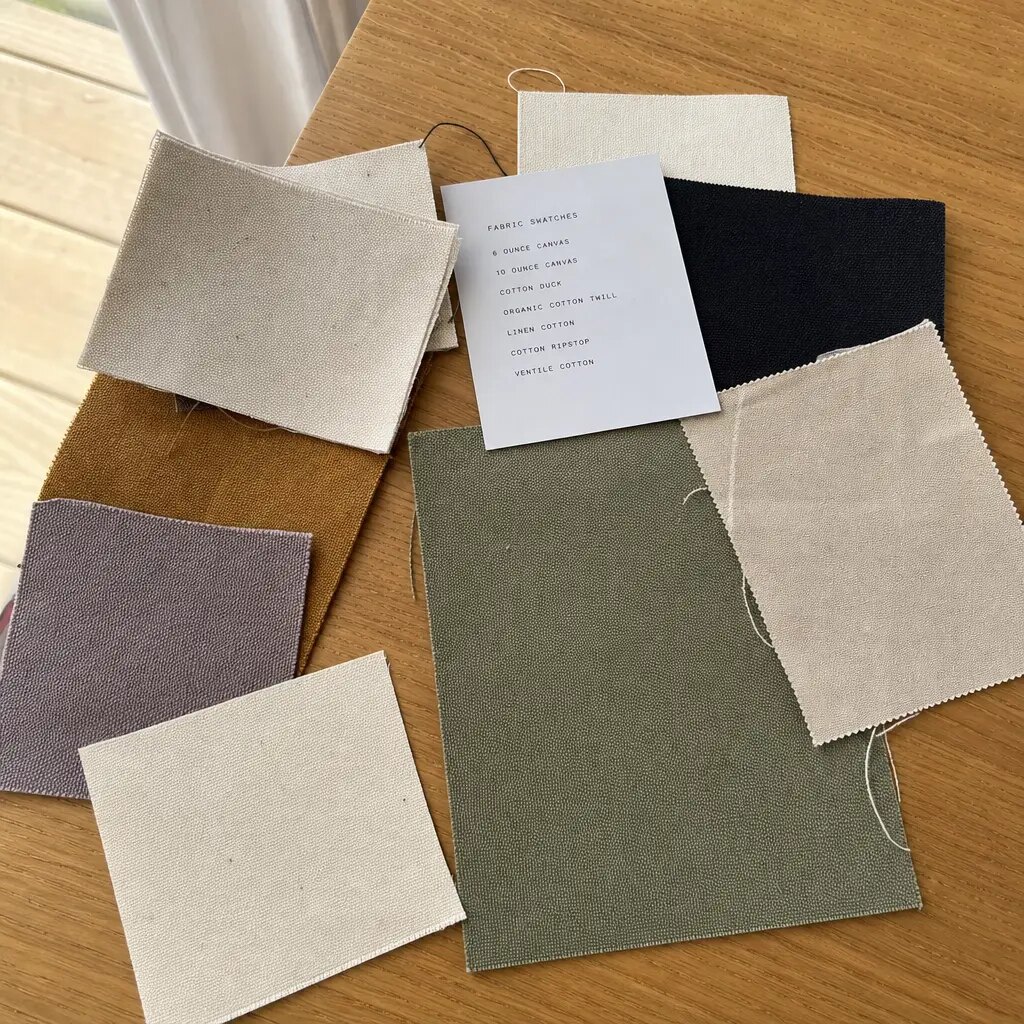
Canvas is not a perfectly uniform synthetic sheet. Natural cotton canvas may show small flecks, minor slubs, and some shade variation. For one hotel brand, that texture may support a relaxed natural look. For another, dark flecks or uneven panels may look dirty on a retail shelf. The RFQ should say what is acceptable before samples are cut.
Ask whether the fabric is greige, natural, bleached, dyed, washed, or otherwise treated. Natural canvas is common for hotel retail because it has a warm, low-gloss appearance and works well with simple screen print. Bleached or dyed canvas can support a cleaner or more brand-specific color, but it adds shade-control questions. If the fabric is dyed, request a color standard and an approval process, such as swatch or lab dip approval. If the tote will be washed, confirm shrinkage and final-size tolerance after processing.
The RFQ should also name what must not appear in finished goods. Oil marks, mildew, water stains, strong odor, insect contamination, and large dirty slubs are not retail-acceptable. These details may sound obvious, but writing them down helps the supplier sort fabric panels before sewing rather than discovering problems after finished bags are packed.
For multi-property or repeat programs, fabric lot control becomes more important. Reorders can shift in shade or handfeel if the supplier changes canvas source without notice. Ask whether bulk production will be cut from one fabric lot and whether reorders will be matched to a retained standard swatch. Exact replication may not always be possible with natural cotton, but the process should be controlled.
- Request a fabric swatch from actual available production canvas, not only a catalog reference.
- State whether small natural cotton flecks are acceptable and what level of dark slub or panel variation is not acceptable.
- Confirm fabric color standard: natural, bleached, dyed Pantone approximation, or buyer-approved swatch.
- Ask for GSM test results or the supplier’s measurement method if fabric weight is a critical approval point.
- Define unacceptable material defects: holes, thin spots, mold, oil, water marks, heavy dirt, strong odor, and obvious shade mismatch.
- For dyed or washed canvas, ask about shrinkage, colorfastness, shade lot control, and whether all bags will be cut from one fabric lot.
Turn Artwork Into Factory-Ready Print Instructions
Hotel logo files are often built for presentations, not production. A factory-ready RFQ needs vector artwork, outlined fonts, spot-color separations, Pantone references, print size, print side, and measured placement. A logo that is 2 cm too low or slightly off-center can make a tote look wrong on the shelf, even if the sewing is otherwise acceptable.
For most canvas grocery totes with simple property logos or destination graphics, one- or two-color screen printing is usually the most practical route. It supports clean edges, repeatable placement, and predictable setup costs. Still, the quote should explain how setup is charged: per color, per side, per design, and whether repeat orders pay again. If the artwork includes gradients, photographs, distressed effects, or many colors, ask the supplier to recommend the right process and explain the cost, handfeel, color, and durability tradeoffs.
Print on canvas behaves differently from print on paper. The weave texture, fabric shade, and ink absorption all affect the final look. A Pantone color on natural cotton may not look identical to the same Pantone on coated paper. The RFQ should allow the supplier to flag limitations and should require a strike-off or pre-production sample for fine lines, tight registration, light ink on dark fabric, or large ink coverage.
Placement instructions should be measured from fixed references. Use top hem, side seam, center line, or gusset edge. Avoid instructions such as logo centered nicely or standard position. Those phrases are hard to inspect and easy to dispute. A simple placement diagram with dimensions is often more useful than a long email thread.
- Provide AI, EPS, SVG, or print-ready PDF files; do not rely on low-resolution JPG or PNG files for final production.
- Include Pantone references, but require the supplier to note expected variation caused by natural canvas and ink absorption.
- State print width, print height, print side, orientation, and distance from top hem, side seam, and gusset.
- Define print placement tolerance, such as +/-0.5 cm or another agreed range based on supplier capability.
- Ask the supplier to state maximum print area, minimum line thickness guidance, and registration tolerance for multi-color prints.
- Require approval of an artwork proof before screen making and a strike-off when the design is technically sensitive.
Make The Quote Expose All Cost Drivers
A procurement-useful quote is more than a unit price. It should show what is included, what is excluded, and what assumptions sit behind the number. Small hotel retail details can change the final cost: hangtags, barcode stickers, woven labels, printed carton marks, inner packing, sample charges, screen setup, export cartons, and inspection support. If one supplier includes them and another leaves them out, the lowest headline price may not be the best commercial offer.
Request quantity breaks at 500, 1000, and 3000 pieces per design or color using the same specification. This helps hotel buyers see whether a small launch order is viable and whether a consolidated multi-property purchase creates a real advantage. If different properties use the same bag size and fabric but different logos, ask whether fabric purchasing can be combined while print setup is charged separately by logo.
Keep the incoterm and currency consistent. EXW, FOB, CIF, and DDP quotes answer different questions. If one supplier quotes FOB and another quotes DDP, procurement may be comparing logistics scope rather than product value. The RFQ should state required incoterm, named port or destination address when relevant, quote validity, payment terms, and the assumptions behind production lead time.
Ask suppliers to call out cost options instead of quietly changing the product. If the target price is too high, a good supplier may suggest a lighter GSM, simpler label, smaller print area, reduced print colors, or standard packing. Those alternatives can be useful, but they should be shown as options, not blended into the base quote without notice.
- Ask for line items: tote, screen setup, per-unit print, label, hangtag, barcode, inner packing, master carton, sample, and documentation.
- Require quote assumptions for fabric color, GSM, size, print colors, print sides, carton case pack, and MOQ.
- Request 500, 1000, and 3000 pc price breaks without changing the product spec.
- Clarify whether screen charges are one-time, charged again for reorders, or charged again when artwork changes.
- Ask suppliers to identify exclusions clearly, including freight, duty, inspection, barcode setup, carton printing, and custom labels.
- Keep sample cost separate from bulk cost so approval can proceed without distorting unit-price comparison.
Select A Supplier Route Based On Control, Not Photos
A polished product photo does not prove production control. For hotel retail programs, the supplier must be able to manage fabric consistency, cutting accuracy, handle reinforcement, print placement, final inspection, and packing. A direct factory can be a strong route for repeat orders because it often provides better access to technical details and faster correction when a sample reveals issues. The buyer still needs a disciplined specification and approval process.
Trading companies and sourcing agents can also be useful, especially when a hotel group is buying multiple categories or needs broader coordination. The key question is visibility. Who selects the factory? Who approves the swatch? Who inspects printing? Who is responsible if bulk goods fail inspection? A local decorator can help with rush or small top-up orders, but stock blanks may not match the original tote’s GSM, handle drop, gusset, or label position.
Evaluate suppliers by what they can document. Ask for fabric swatches, seam close-ups, handle reinforcement photos, print close-ups, packing examples, and a plain-language description of the production flow. If printing is outsourced, ask how print panels or finished bags are inspected before final packing. The best answer is specific: who checks what, when, and against which standard.
Be careful with suppliers who answer every technical question with no problem. Every sewn product has tolerances. Every print method has limits. A supplier that can explain acceptable variation, risk points, and corrective action is usually more useful than one that offers only broad reassurance.
- Direct factory: best for repeatability, technical control, and defined QC on recurring hotel retail programs.
- Trading partner: useful for broad sourcing, but require clear responsibility for sampling, production monitoring, and corrective action.
- Local decorator: useful for urgent small orders, but confirm blank tote specifications match the approved program.
- Stock blank route: fastest launch, but limited control over GSM, dimensions, handle construction, fabric shade, and labels.
- Ask for production photos and construction details, not only catalog images or digital mockups.
- Confirm where cutting, sewing, printing, trimming, inspection, and packing physically occur.
Use Sampling To Freeze The Standard For Bulk Production
The pre-production sample is not just a logo preview. It is the buyer’s control standard for bulk production. It should use final fabric GSM, final fabric color, final handle webbing, final thread, approved label, approved print method, and the proposed fold method. If the factory uses substitute canvas or temporary handles, the sample cannot reliably predict handfeel, print absorption, folding thickness, or load performance.
Measure the sample and record the results. Check finished width, height, gusset, handle drop, webbing width, top hem, print size, and print placement against the RFQ. Look at the tote loaded as it would be used in the hotel market. Does the bottom sit properly? Are the handles comfortable? Does the print distort when the bag is filled? Small observations at sample stage can prevent expensive arguments later.
If a sample is approved with corrections, document each correction clearly. For example: construction approved, but move print 1 cm higher in bulk; fabric approved, but revise barcode artwork; handle length approved, but trim loose thread ends more carefully. Avoid vague conditional approvals. A verbal note can disappear before production; a written approval sheet travels with the order.
Use a signed golden sample process. One approved sample should stay with the supplier’s production or QC team, and one should stay with the buyer or third-party inspector when possible. Photograph the front, back, inside seam, handle attachment, label, print close-up, fold, and carton arrangement. Those images become practical references for inspection and future reorders.
- Require the pre-production sample to use actual bulk materials wherever available.
- Measure and record finished size, gusset, handle drop, handle width, print size, and print placement.
- Sign and date the golden sample with PO number, SKU, artwork version, and approval conditions.
- Request a revised sample if fabric weight, handle reinforcement, print method, or size is materially wrong.
- Use realistic contents to check handle comfort, seam stress, and bottom shape when the tote is intended for grocery use.
- Confirm the fold and packing method do not create unacceptable creases, print transfer, or distorted handles.
Specify QC Tolerances And Defect Categories Before Production
Quality control for canvas grocery totes should be measurable. A useful RFQ defines checks, tolerances, and defect categories before goods are sewn. For many tote programs, body dimensions within +/-1 cm may be acceptable, while handle drop and print placement may need closer control. GSM may be controlled within about +/-5% if the supplier confirms that range. The final tolerances belong in the PO or approved specification sheet.
Defect categories make inspection less subjective. Critical defects are safety, legality, or severe contamination issues, such as sharp foreign objects, mold, incorrect country-of-origin marking where required, or severe odor. Major defects affect saleability or use: weak handle attachment, open seams, wrong logo, incorrect print color, heavy stains, size outside tolerance, or barcode errors. Minor defects are small cosmetic issues that do not materially affect use or retail appearance, such as a short loose thread that can be trimmed.
Many buyers use AQL-based final inspection, but the RFQ should not simply say standard AQL without detail. State the inspection level and acceptance limits if your organization has them. If not, require the supplier to propose an inspection plan for approval. The checklist should include fabric, dimensions, stitching, handle strength, print, odor, cleanliness, labels, packing, carton count, and SKU separation.
Do not leave QC until the final carton is sealed. In-process checks are especially useful for fabric defects, print placement, and handle attachment because these problems become harder to correct after sewing and packing. Ask the supplier which checks happen before cutting, after printing, during sewing, and before final packing.
- Write numerical tolerances for GSM, body size, gusset, handle drop, handle width, print size, and print placement.
- Define critical defects: mold, strong chemical odor, sharp contamination, illegal labeling, severe dirt, or unsafe construction.
- Define major defects: open seams, weak handles, wrong logo, wrong size, poor print adhesion, heavy stains, barcode errors, or wrong SKU packing.
- Define minor defects: trimable threads, very small cosmetic marks within the approved standard, or slight fold inconsistency.
- Require the supplier to document corrective action if defects exceed the agreed limit.
- Check carton count, case pack, carton marks, and SKU separation before shipment, not only after warehouse receipt.
Build Packing Around Retail Presentation And Receiving
Packing can protect the sale or damage it. A well-sewn tote may still disappoint if it arrives crushed, dirty, over-compressed, or folded through the logo in an unattractive way. The RFQ should define whether bags are flat-folded, half-folded, nested, packed with a hangtag, tied with a belly band, or individually packed. If the brand wants reduced plastic, state whether individual polybags are prohibited, optional, or allowed only for moisture protection.
Case pack should reflect real handling. A 25-piece carton may be easier for property-level replenishment. A 50- or 100-piece carton may reduce carton handling but can become heavy and may compress the bags. The right answer depends on fabric weight, tote size, destination warehouse rules, and how individual hotels receive goods. Ask for carton dimensions, gross weight, net weight, and packing photos before final approval.
Retail compliance details belong in the product spec, not in a late email. Hangtag material, barcode placement, country-of-origin marking, care or material wording, price-ticket area, and SKU labels should be included in the quote. For multi-property programs, standardize carton marks and SKU structure where possible so receiving teams can identify property logos, quantities, and carton numbers without opening every case.
Mixed cartons are another common source of confusion. They may help with distribution, but they can create receiving errors if property logos or SKUs are similar. If mixed cartons are allowed, require a clear packing list and internal separation. If not, specify one SKU or one property logo per carton.
- Define fold method: flat-fold, half-fold, nested stack, retail belly band, or peg-ready hangtag presentation.
- State whether individual polybags are required, prohibited, or replaced by bulk moisture protection.
- Specify hangtag size, paper type, string, barcode location, country-of-origin wording, and price-ticket area.
- Require carton case pack, carton dimensions, gross weight, net weight, and carton mark layout.
- Avoid over-compression that causes deep creasing, handle distortion, or print transfer.
- Require carton marks showing PO number, SKU, logo/property code, quantity, carton number, and destination.
- State whether mixed cartons are allowed; if not, require one SKU or one property logo per carton.
Plan Lead Time Around Approvals, Materials, And Freight
Canvas tote schedules often slip because approvals are late, not because sewing is unusually complex. Artwork proofing, Pantone review, sample revision, hangtag approval, barcode setup, carton mark confirmation, and fabric booking can all slow the order. A quote that says 35 days production is not meaningful unless the start point is defined. Ask whether the clock begins after deposit, artwork approval, fabric approval, signed sample approval, or receipt of all packing files.
Separate sampling from bulk production in the timeline. When production fabric and trims are available, a pre-production sample may take about 5-10 working days, plus transit and buyer review time. Bulk production for straightforward canvas grocery tote programs is often quoted around 30-45 days after all approvals, but the real schedule depends on order quantity, printing capacity, factory loading, fabric availability, and packing material readiness. Custom dyed fabric, complex labels, or multiple property logos may extend the timeline.
Hotel retail deadlines are usually tied to season launches, holiday resets, conferences, and property openings. Work backward from the required arrival date and include time for inspection, freight, customs, warehouse receiving, and distribution to properties. Air freight can be costly for bulky canvas totes, so it should not be the default rescue plan for delayed approvals.
The RFQ should also ask suppliers to identify the bottleneck. Sometimes fabric is the constraint. Sometimes it is screen printing, labels, cartons, or export booking. Knowing the risk early lets procurement decide whether to simplify the spec, split shipment, approve a standard material, or move the launch date before costs escalate.
- Ask suppliers to separate sample lead time, sample transit, approval time, bulk production, inspection, and shipment.
- Define the production start trigger: deposit, artwork approval, fabric approval, signed sample approval, or all packing files approved.
- Freeze artwork before sample approval whenever possible to avoid repeated screen setup.
- Add buffer for sample revision when print placement, handle length, or packing is new.
- Ask which step is the likely bottleneck: fabric, printing, sewing, labels, cartons, inspection, or export booking.
- Avoid changing hangtags, barcodes, or carton marks after production starts without written schedule impact.
Specification comparison for buyers
| Spec decision | Recommended option | When it fits | Buyer risk to check |
|---|---|---|---|
| Supplier route | Direct factory or managed factory partner with documented control over cutting, sewing, printing coordination, final QC, and packing | Best for repeat hotel retail programs where GSM, dimensions, logo placement, carton specs, and reorder consistency matter | Verify which steps are in-house and which are subcontracted. If printing or sewing is outsourced, require the supplier to remain responsible for inspection, corrective action, and replacement plans. |
| Fabric weight | 12 oz canvas, approximately 400 gsm, as the default retail grocery tote starting point | Works for resort markets, hotel gift shops, lobby convenience stores, and reusable guest shopping bags where the tote must feel substantial | Do not accept vague terms such as thick canvas or heavy cotton. Require measured GSM, swatch approval, and a written GSM tolerance, commonly about +/-5% unless otherwise agreed. |
| Alternative fabric weights | 10 oz / about 340 gsm for value programs; 14 oz / about 475 gsm for premium handfeel | Useful when the buyer needs either a lower opening price or a heavier shelf presentation | Changing GSM affects fabric cost, seam bulk, folding thickness, carton cube, print absorption, and load performance. Re-sample before approving the change. |
| Finished bag size | Approx. 38 x 42 cm with 8-12 cm gusset, or a comparable 15 x 16.5 in format with 3-5 in gusset | Fits groceries, snacks, bottled beverages, folded apparel, beach items, and hotel market purchases | Quote finished size, not cutting size. Confirm tolerance, often +/-1 cm for body dimensions and +/-0.5 cm for handle drop unless another tolerance is agreed. |
| Handle construction | Cotton webbing handles, 2.5-3.8 cm wide, with box-and-cross stitch or bar-tack reinforcement | Best for heavier guest purchases and retail programs that need a durable, comfortable feel | Check webbing width, handle drop, stitch density, reinforcement shape, needle holes, puckering, and comfort when the tote is loaded. |
| Load expectation | Define a practical intended load, such as 5-8 kg for routine grocery-style use, and test the approved sample accordingly | Useful when the tote may carry bottles, boxed food, beach items, or several retail purchases at once | Avoid broad strength claims. Ask how handle attachment and seams are checked rather than accepting unsupported capacity statements. |
| Print method | One- or two-color screen print for most hotel logos and destination graphics | Good for clean brand marks, repeat orders, controlled placement, and predictable setup cost | Confirm setup cost per color and side, maximum print area, registration tolerance, ink type, curing method, and whether colors are matched to Pantone or standard ink. |
| Artwork route | Vector artwork with outlined fonts, separated spot colors, print dimensions, and measured placement from top edge and side seams | Fits hotel logos, property marks, destination artwork, and multi-property programs | Low-resolution raster files, missing Pantone references, and unclear placement cause sample delays and disputes. Require an approved artwork proof before screens are made. |
| MOQ strategy | Request price breaks at 500, 1000, and 3000 pcs per design/color, plus any combined-volume option for multi-property buys | Useful for first launches, seasonal replenishment, and centralized hotel procurement | Mixing fabric colors, sizes, print colors, or property logos may create separate setups and reduce price-break benefit. The quote should state assumptions clearly. |
Buyer checklist before sampling
- Define the use case: paid hotel gift shop item, resort market grocery tote, lobby convenience store bag, amenity store product, event retail, or guest welcome merchandise.
- State the target customer expectation: value reusable bag, mid-range retail tote, or premium destination souvenir.
- Set the target fabric weight in GSM and ounces, plus an acceptable tolerance such as +/-5% GSM after normal fabric conditioning.
- Lock finished width, height, gusset depth, top hem width, handle drop, handle webbing width, seam finish, and reinforcement method before requesting price.
- Specify fabric color, thread color, handle color, label color, and whether natural cotton flecks, slubs, or shade variation are acceptable.
- Provide vector artwork with outlined fonts, Pantone references, print dimensions, print location, side of bag, and distance from top edge, side seam, and gusset.
- State the approved print method, number of print colors, maximum print area, ink type if known, and whether a strike-off or print panel is required.
- Ask for pricing at 500, 1000, and 3000 pcs using the same spec, same artwork, same packing, same quote currency, and same incoterm.
- Require the quote to show inclusions and exclusions: sampling, screen setup, labels, hangtags, barcode stickers, carton printing, inner packing, inspection support, and export documents.
- Request a pre-production sample made with actual bulk fabric, handle webbing, thread, label, print method, fold method, and proposed packing.
Factory quote questions to send
- What is the actual measured GSM and ounce weight of the canvas you are quoting, what tolerance do you apply, and can you provide a swatch from available production fabric?
- Is the canvas greige, natural, bleached, dyed, or washed? If dyed or washed, what shade tolerance and shrinkage assumptions are included in the quote?
- Are cutting, sewing, printing, trimming, final inspection, and packing done in-house? If any step is outsourced, which step is outsourced and who performs incoming and final QC?
- What are your prices at 500, 1000, and 3000 pcs with the same fabric, same finished size, same handle construction, same print, same packing, same currency, and same incoterm?
- Does the quote include sampling, screen charges, artwork handling, labels, hangtags, barcode stickers, carton printing, export carton, inner packing, inspection support, and documentation?
- What is your pre-production sample lead time, and will the sample use actual bulk canvas, handle webbing, thread, ink, label, hangtag, fold method, and carton packing?
- What is the maximum screen print area for this bag size, what registration tolerance can you hold, and what print placement tolerance do you use in bulk production?
- What finished-size tolerance do you apply to width, height, gusset, handle drop, handle width, and print placement? Please state tolerances numerically.
- What carton size, case pack, net weight, gross weight, carton mark format, and palletization recommendation are included in the quote?
- What is the bulk lead time after deposit, artwork approval, and signed sample approval, and which production step is most likely to affect the schedule?
Quality-control points to confirm
- Fabric weight matches the agreed GSM range, commonly checked against a +/-5% tolerance unless the PO states otherwise, with no thin spots, holes, mold marks, oil stains, or serious weave damage.
- Finished dimensions stay within written tolerance, commonly +/-1 cm for body width and height, +/-0.5-1 cm for gusset, and +/-0.5 cm for handle drop if agreed by the supplier.
- Gusset depth is consistent, the bottom sits squarely, and side seams are not twisted, skewed, or pulled out of alignment.
- Handle webbing width, color, handfeel, and drop match the approved sample, and left and right handles are symmetrical when the tote is held upright.
- Handle attachment uses the approved box-and-cross, bar-tack, or reinforcement method, with no skipped stitches, broken threads, loose thread nests, pulled seam ends, or visible tearing under normal handling.
- Stitch density and thread tension are consistent, with straight top hem, balanced side seams, secure bottom seam, and no puckering that affects retail appearance or strength.
- Print color, opacity, placement, registration, edge sharpness, and coverage match the approved sample, with no smudging, ghosting, pinholes, cracking, obvious ink bleed, or print transfer during normal packing.
- Print placement is measured from fixed edges, such as top hem and side seam, and remains within the agreed tolerance across cartons.
- Visible surfaces are clean and retail acceptable, with no mildew, strong chemical odor, dirt, chalk residue, water marks, needle stains, insect contamination, or packing-material transfer.
- Labels, hangtags, barcodes, country-of-origin marking, care or material wording, SKU references, and property logo versions match the approved artwork and purchase order.