Start With the Buying Problem, Not the Artwork
Most RFQs for canvas grocery totes fail before the supplier quotes a number. The buyer sends a logo file, a rough size, and a target price, then gets a quote that cannot be compared with anyone else. If the tote is for a farmers market program, that gap becomes expensive because vendors usually need bags that are durable enough for produce and canned goods, simple enough to pack in volume, and cheap enough to move in retail or wholesale channels.
The RFQ should answer one question clearly: what bag do you want delivered, in what condition, and under what packing rules? That means the first page should define bag use, size, fabric weight, print method, and the level of finish expected. If the supplier has to guess on any of those points, the quote will hide assumptions and the order will drift later.
- Use a single finished spec, not a range of acceptable dimensions.
- State the end use: retail resale, promotional giveaway, or store use.
- Separate the bag spec from the branding spec so the supplier can price each part cleanly.
Choose the Right Canvas Weight and Bag Build
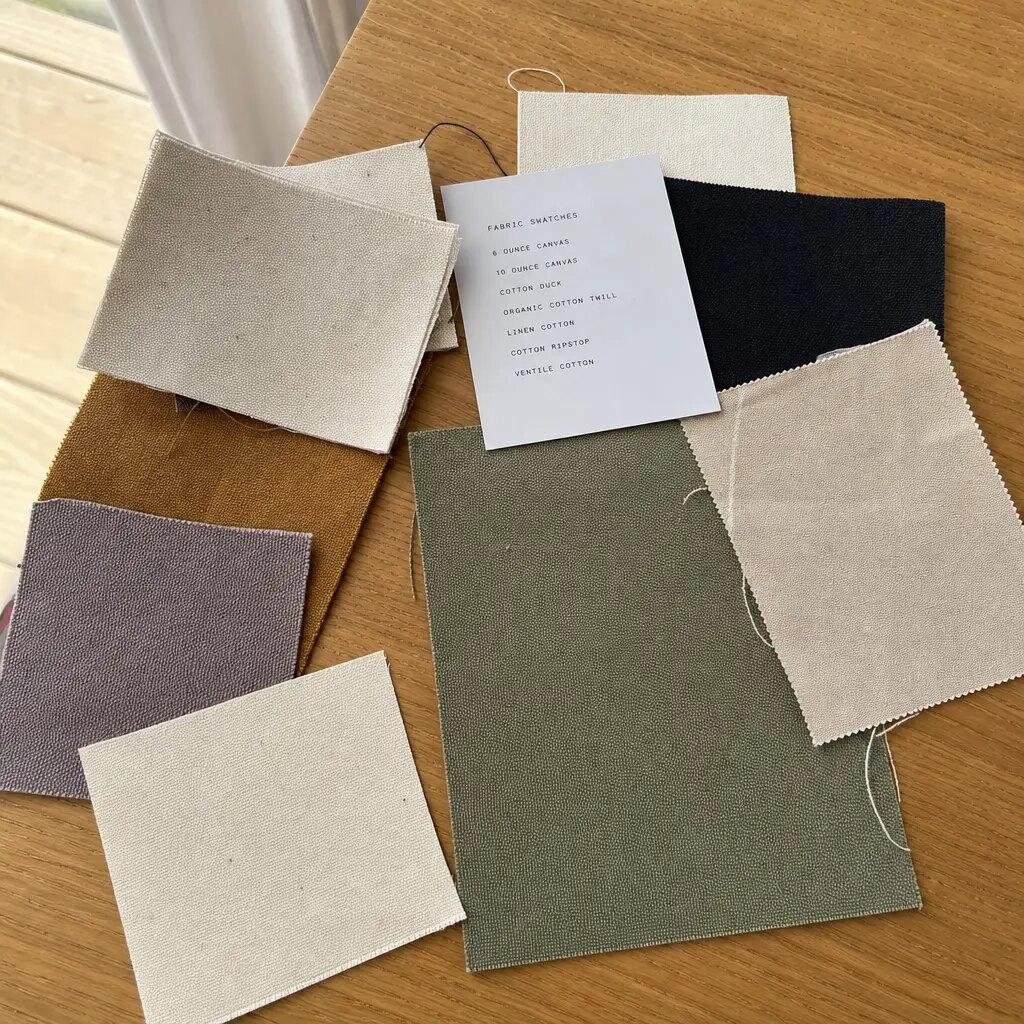
For grocery totes, fabric weight drives almost everything else: handle performance, drape, perceived value, print result, and freight density. In practice, 10 oz canvas is often the low-cost entry point for lighter use, while 12 oz is the safer default when the tote will carry groceries regularly. If the buyer wants a heavier retail feel or more body in the bag, 14 oz may be justified, but it usually raises cut loss, sewing effort, and carton weight.
Do not treat GSM or ounce weight as a marketing label. Ask whether the quoted fabric is finished fabric weight, whether it is pre-wash or post-finishing, and whether the weight is measured with the same tolerance used by the mill. A tote that looks fine in a sample room can still arrive too soft, too floppy, or too heavy once the fabric finish and stitching are locked in.
- 10 oz: lower cost, lighter hand, suitable for giveaways or light retail use.
- 12 oz: balanced option for farmers market groceries and repeat carry use.
- 14 oz: premium feel, better body, but only worth it if the buyer can absorb the cost and weight increase.
Specify Construction Details That Affect Load Performance
A grocery tote is not just a printed rectangle. The handle join, side seam, gusset, and base determine whether the bag feels solid when it is full. Boxed bottoms and reinforced gussets help the bag sit flat in a cart and make packing easier for the end user. Reinforced seams at stress points matter more than decorative details, because many quality issues show up only after the bag is loaded, lifted, and set down repeatedly.
The factory should quote the exact handle type and reinforcement method. Self-fabric handles are common and can work well if the seam is clean and the width is consistent, while webbing handles can improve load comfort and durability. Ask for the stitch style at the handle attachment point, the number of passes, and the seam allowance. If those details are missing, the factory may use a lighter construction than the buyer assumed.
- Request handle length in finished inches or millimeters, not just 'long handles'.
- Ask whether the bottom seam is single-stitched, double-stitched, or reinforced with a box-X pattern.
- If the tote will carry heavy produce or canned goods, require a load-related sample test, not only visual approval.
Decide Early How the Bag Will Be Branded
Print method changes both cost and appearance. For most canvas grocery tote programs, 1 to 2 color screen print is the most practical option because it is durable, repeatable, and easy to quote. It also gives the buyer a clear basis for comparing suppliers, because setup cost and unit cost are usually predictable once the artwork and screen count are fixed. If the design has many colors or small type, the cost and defect risk can climb quickly.
Branding is not limited to printing. A sewn side label, woven label, or small patch can add perceived value and help the bag read as a retail item rather than a promotional bag. That said, every label creates another sewing operation and another place where the bag can be misaligned or damaged. Decide whether the brand story needs decoration on the body panel, a side label, or both, then lock the placement before sample approval.
- Use screen print for simple logos and clean pricing.
- Use woven or sewn labels when the bag needs a stronger retail identity.
- Do not approve artwork before the supplier confirms placement tolerances and print area size.
Make MOQ and Price Breaks Work for Real Purchasing
MOQ should be read as a production logic issue, not a sales objection. A factory may be able to accept a low total order quantity, but the real cost driver is usually the combination of fabric color, print version, size, and packing method. If the buyer requests custom fabric plus custom print plus retail packaging, the MOQ can rise even if the total bag count looks modest. That is normal and should be visible in the quote.
The best RFQ asks the factory to show price breaks at realistic order bands. For example, a quote might look different at 1,000, 3,000, and 5,000 pieces, and each tier should use the same spec. That lets the buyer decide whether a slightly higher MOQ gives a better landed cost per unit. A weak quote gives only one number and hides whether the bag becomes much cheaper once the run size reaches the factory's efficient cutting and printing setup.
- Ask for pricing by colorway, not only by total quantity.
- Separate setup charges from unit price so the first order is not misread as the ongoing cost.
- Watch for hidden costs in custom packaging, barcode application, or label changes.
Build Supplier Comparison Around Evidence, Not Claims
The cheapest quote is not useful if it cannot be verified. A supplier should be able to show recent production photos, material references, stitching examples, and a clear process flow from cutting to packing. Buyers should also know whether the supplier is the actual factory or a trading company. Neither model is automatically wrong, but the quote should make the route visible so the buyer can judge who controls quality and schedule.
For this product, the most useful comparison is not simply price per piece. Compare quote completeness, spec consistency, response time, sample quality, and whether the supplier can commit to the same construction across repeat orders. A good supplier will separate the fabric cost, sewing cost, print cost, and packing cost. If everything is blended into one unexplained unit price, the buyer has very little leverage when something changes later.
- Ask for actual sample photos with close-ups of seams and print edges.
- Request the factory name, production location, and whether key operations are in-house.
- Reject quotes that do not identify the same spec across all suppliers.
Compare Sourcing Routes Before You Compare Unit Prices
The same canvas grocery tote can be sourced through different routes, and each route changes cost, control, and lead time. A direct factory is usually the best fit when the buyer has a stable spec and needs custom sewing, printing, and carton packing under one roof. A trading company may be useful when the program is small, when the buyer needs faster communication across multiple factories, or when the sourcing team values consolidated support over factory direct pricing.
Domestic decorators and stock-bag importers can also work, but only when the bag spec is close to what they already carry. If the buyer needs a precise fabric weight, a specific print placement, or a custom retail label, those routes often become expensive or rigid. The key is to compare the sourcing path against the real buying goal: repeatability, speed, margin, or packaging control.
- Direct factory: better for custom control and repeat orders.
- Trading company: useful for coordination, but verify who makes the bag.
- Stock program: good for speed, poor for exact spec control.
Approve Samples Like a Production Buyer, Not a Shopper
A sample should prove manufacturability, not only appearance. The buyer should compare the sample against a written approval sheet covering fabric weight, finished dimensions, seam appearance, handle length, label position, and print alignment. If the sample has the right look but the wrong base, weak stitching, or a print that bleeds at the edge, the order will probably repeat the same problem at scale unless the issue is documented and corrected before production starts.
The best sample flow is simple: reference sample, pre-production sample, then shipment check against the approved piece. Each stage should be tied to a specific approval reason. For example, the buyer may approve the fabric hand feel but reject the handle width, or approve the print but require a stronger base seam. That level of control saves time later because the factory knows exactly what must change.
- Compare the sample to the finished spec sheet, not to memory.
- Take measured photos with a ruler or tape measure in frame.
- If one sample looks good but another varies, require a revised pre-production sample before bulk.
Plan Packing and Cartons Before the Order Is Placed
Packing is often treated as an afterthought, but it affects freight cost, warehouse efficiency, and retail readiness. For a grocery tote program, the buyer should decide whether the bags ship bulk packed, folded with simple protection, or individually packed with barcodes and hangtags. Bulk packing usually gives the best cost and carton density, but retail sale may require a cleaner presentation and stricter inner packing rules.
Carton details matter because they affect the quote and the actual landed cost. Ask for carton dimensions, units per carton, gross weight, and whether the supplier can keep carton stacking safe for export. If the bags are too tightly packed, the canvas can crease badly and the print can rub. If they are too loose, the cartons become inefficient and freight cost rises. The factory should be able to quote a packing format that fits both the bag and the distribution plan.
- Confirm whether polybags are required, optional, or prohibited.
- Ask for a barcode or carton mark format before packing starts.
- Make sure the carton pack count matches the buyer's warehouse receiving workflow.
Use Landed Cost, Not Ex-Factory Price, to Make the Decision
For imported canvas grocery totes, the ex-factory number only tells part of the story. Two suppliers can quote nearly the same unit price and still deliver very different landed costs because of carton size, weight, packing efficiency, inland freight, and sampling policy. A slightly cheaper tote can become the more expensive program once the shipment is packed, booked, and received.
To compare quotes properly, normalize the numbers. Make sure every supplier is quoting the same fabric weight, same print count, same packing format, and same Incoterm. Then add sample charges, packaging charges, and expected freight density. Buyers who skip this step often select the lowest piece price and then discover that the packing is inefficient or the production lead time forces expensive air freight. The goal is not the cheapest quote on paper; it is the cheapest repeatable tote that meets the spec.
- Compare quotes on one sheet with the same Incoterm and the same pack count.
- Include sample cost and tooling cost in the first-order view.
- Estimate freight by carton dimensions and gross weight, not by bag count alone.
Specification comparison for buyers
| Spec decision | Recommended option | When it fits | Buyer risk to check |
|---|---|---|---|
| Supplier route | Direct factory with sewing and printing in-house | Repeat orders, custom spec, and buyers who need control over fabric, print, and packing | Confirm who actually cuts, sews, prints, and packs; multi-step subcontracting can hide quality drift |
| Fabric weight | 12 oz canvas as the default starting point | Grocery totes that must hold produce, canned goods, and regular retail use without feeling bulky | Verify whether the quoted weight is finished fabric or greige weight; mills and factories do not always state it the same way |
| Handle construction | Self-fabric or webbing handles with box-X reinforcement | Higher load use, retail sale, and repeated carry cycles | Check handle length, stitch count, and whether reinforcement is tested with filled bags, not empty samples |
| Bottom structure | Gusset with reinforced seams and boxed base | When the tote must stand in a cart, fill easily, and present well at point of sale | A neat sample can still fail at the base if seam allowance and stitch density are thin |
| Print method | 1-2 color screen print for most grocery programs | Simple logos, farmer's market branding, and price-sensitive runs | Screen counts, registration tolerance, and ink hand feel must be approved on pre-production samples |
| Branding method | Woven label or sewn side label for premium retail positioning | When the bag needs durable branding beyond a print run | Label placement can trigger sewing changes; confirm the label does not interfere with seam strength or packing |
| MOQ logic | 3,000-5,000 pcs for custom color, size, or print combinations | New custom programs where the factory must set up fabric, cutting, and print screens | Split MOQ by color and print method; low total MOQ can still mean high per-SKU cost and slow response |
| Packing route | Bulk packed in export cartons with simple inner protection | Distribution buyers, club stores, and buyers who relabel or pack locally | Require carton count, net/gross weight, carton test limits, and barcode placement before quote acceptance |
Buyer checklist before sampling
- Confirm exact bag size, finished fabric weight, handle length, and gusset depth before asking for pricing.
- State whether the tote is for retail sale, giveaways, or store use, because load expectation changes construction and QC.
- Specify print artwork format, number of colors, print placement, and whether both sides need decoration.
- Ask for a quote that separates fabric, sewing, print, label, packaging, inland charges, and sample fees.
- Request pre-production sample photos and physical approval on the actual fabric color, not a generic library sample.
- Define carton pack count, carton dimensions target, and whether polybags or inserts are allowed.
- Ask the supplier to confirm lead time by stage: material booking, sample approval, production, and export booking.
- Compare quotes on the same Incoterm, same packing spec, and same fabric basis weight to avoid fake price differences.
Factory quote questions to send
- What is the finished fabric weight in oz or GSM, and is that before or after washing and finishing?
- What are the exact finished dimensions, handle length, gusset depth, and seam allowance?
- Is the print screen, heat transfer, embroidery, woven label, or sewn patch, and what is the setup charge for each color?
- What is the MOQ by color, by print version, and by size, and how does the unit price change at each tier?
- Which parts are made in-house and which are outsourced, including cutting, sewing, printing, labeling, and packing?
- What sample type do you provide before production, and how many rounds are included before the order starts?
- What is the standard carton pack, carton size, gross weight, and outer carton mark format?
- What is the production lead time after sample approval, and what factors can add delay?
- Which inspection standard do you follow for size tolerance, stitch quality, and print alignment?
- Can you quote the same tote with and without polybag, barcode sticker, hangtag, and insert card?
Quality-control points to confirm
- Fabric weight tolerance should be stated in the spec sheet, and the finished bag should not feel noticeably thinner than the approved sample.
- Stitching at handle joins, side seams, and gusset corners should be even, with no skipped stitches or loose thread tails.
- Handle reinforcement should survive a filled-bag lift test without seam tearing or handle twisting.
- Print should match approved placement and color range, with no smearing, cracking, or visible misregistration on the front panel.
- Bag opening and finished dimensions should stay within an agreed tolerance so retail shelving and packing are consistent.
- Carton count should match the packing list, and the carton should not deform under normal export stacking.
- Sample approval should include fabric hand feel, actual color, decoration placement, and label position, not just artwork proof.
- Final inspection should include random filled-bag checks, because empty-bag appearance can hide load-related defects.