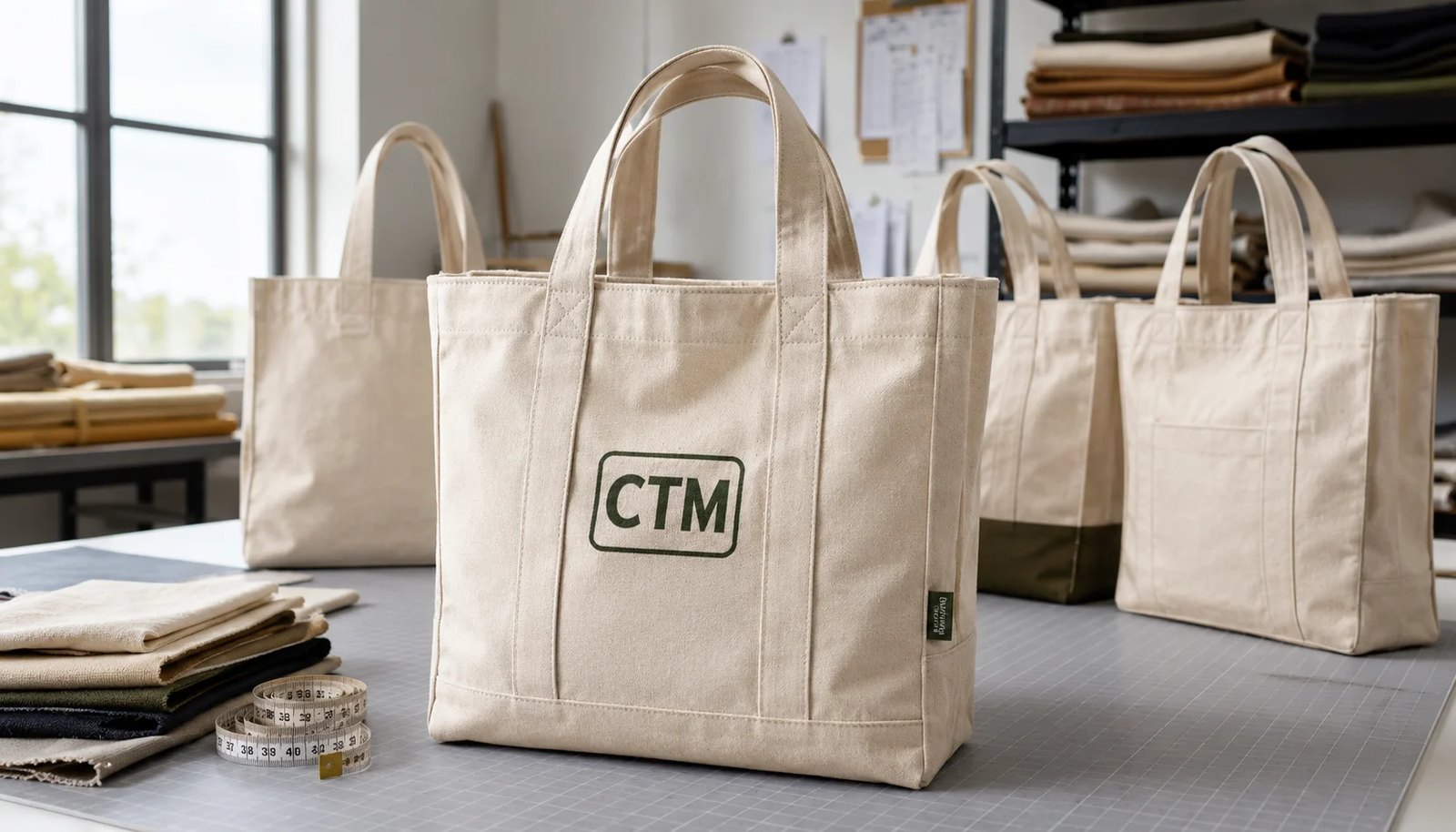
RFQ Scope for Grocery Totes
A useful RFQ for canvas grocery totes should begin with the job the bag must do. Natural grocers usually need a stronger bag than a thin event tote because customers may carry glass bottles, boxed grains, produce, frozen goods, and bulk-bin items in one trip. The RFQ should tell the factory whether the tote is a paid retail item, a promotional gift, a loyalty program bag, or a distributor resale SKU. Those use cases do not need the same fabric, packing, or QC threshold.
The biggest quoting problem is that buyers often send artwork and a target price but leave construction open. Factories then quote different bag sizes, fabric weights, handle types, and packing assumptions. The lowest quote may simply be a lighter bag. A better RFQ fixes the functional details first, then lets suppliers compete on execution, lead time, and commercial terms.
- State expected carry load, for example groceries up to 8-12 kg, if that matches your retail use.
- Define whether the tote must stand open at checkout, fold flat for retail display, or ship inside another kit.
- Include target retail price or promotional budget only after the minimum construction is clear.
- Tell suppliers whether the same tote will be reordered, because repeat volume can change fabric booking and screen setup logic.
Canvas Fabric Choices
For canvas grocery totes, fabric weight is usually the first commercial decision. A light 8 oz canvas may work for giveaways, but it can feel weak for natural grocery use. A 10 oz fabric can suit budget retail promotions if the bag is modest in size. A 12 oz to 16 oz canvas is more typical when the buyer wants a durable grocery tote with a better hand feel and stronger shelf impression. In GSM terms, buyers often see roughly 340 GSM to 540 GSM depending on yarn, weave, and finishing.
Do not assume every supplier uses the same ounce system. Some quote greige fabric weight before washing or finishing, while others quote finished fabric. Natural canvas also varies in shade because cotton fiber color, seed flecks, bleaching level, and finishing are not identical between mills. If your brand depends on a clean natural look, the RFQ should define acceptable shade range or require fabric lot approval before cutting.
- For low-cost promotion: consider 8 oz to 10 oz canvas only when the expected load is light.
- For standard reusable grocery tote: 12 oz canvas is often a practical balance of cost, strength, and printability.
- For premium resale tote: 14 oz to 16 oz canvas gives a heavier hand feel but raises sewing time, carton weight, and freight cost.
- For sustainability claims: separate the fabric claim from the bag style, and request documents only for claims that will appear on packaging or retail copy.
Size and Construction
A grocery tote is not only a rectangle with handles. The same front size can behave very differently depending on gusset depth, bottom construction, seam allowance, and handle attachment. A flat tote is cheaper and packs neatly, but it does not load as cleanly at a grocery counter. A boxed-bottom or full-gusset tote costs more because it uses more fabric and sewing steps, yet it gives the shopper a more useful bag for jars, cartons, and produce.
Your RFQ should list finished dimensions in a way the factory can measure. Use width, height, gusset, handle width, handle total length, and handle drop. If the tote needs to fit a retail display hook, self-checkout bagging area, or subscription carton, provide those constraints too. A one-centimeter difference in gusset may not matter visually, but it can affect carton packing and usability.
- Common grocery tote direction: medium width, generous gusset, and handle drop suitable for shoulder carry.
- Reinforced mouth hem helps the top edge keep shape and makes the bag feel less promotional.
- Inside seam finishing should be defined if loose fibers or raw edges are unacceptable for your retail positioning.
- For heavy canvas, confirm needle size and thread quality because thick seams can create skipped stitches if the line is rushed.
Print Method Decisions
Most natural grocer canvas totes use screen printing because it is stable, cost-efficient, and well suited to bold logos or simple brand artwork. Water-based screen print is a common choice when buyers want a softer hand feel on cotton canvas. Plastisol or heavier ink systems may produce stronger opacity, but they can feel less aligned with a natural canvas product if the print area is large. Digital print can handle gradients and many colors, but it is often less economical for bulk grocery tote orders.
The RFQ should give suppliers artwork in vector format, Pantone references, print size, print location, and number of print positions. Natural canvas is not a bright white print base, so very pale ink colors can lose contrast. Fine reverse text, small certification marks, and thin line art may fill in on coarse canvas. A strike-off or printed pre-production sample is the only practical way to approve ink behavior before mass printing.
- Use one to three spot colors when cost and repeatability matter most.
- Avoid tiny legal text on coarse canvas unless the factory confirms printable minimum line width.
- Set print placement tolerance, for example plus or minus 5 mm to 10 mm depending on bag size and method.
- Require curing and rub resistance checks so ink does not transfer during packing or customer use.
MOQ and Cost Drivers
MOQ for canvas grocery totes is not one fixed number. It comes from fabric availability, cutting efficiency, sewing setup, print setup, packing work, and whether the supplier must buy or dye fabric specifically for your order. If the factory has natural canvas in stock, MOQ may be driven mainly by sewing and printing efficiency. If the fabric is custom dyed, organic certified, recycled blend, or unusually heavy, the mill MOQ can become the real minimum.
A professional RFQ should ask suppliers to explain MOQ by component. This is especially important for buyers comparing quotes from trading companies, cut-and-sew factories, and factories with their own fabric sourcing. A higher MOQ is not always unreasonable if it includes fabric booking stability, better shade control, and lower unit cost. A lower MOQ may be useful for a test launch, but it can carry a higher unit price and less flexibility on custom packing.
- Fabric MOQ: driven by canvas weight, width, color, certification, and mill availability.
- Print MOQ: affected by screen setup, number of colors, and whether multiple artwork versions are needed.
- Sewing MOQ: affected by bag complexity, handle type, reinforcement, and line changeover time.
- Packing MOQ: affected by barcode labeling, retail banding, display cartons, or plastic-free packing requirements.
- Quote comparison: request price breaks at realistic quantities, such as trial order, first rollout, and reorder volume.
Quote Data to Require
A usable canvas tote quotation should do more than list unit price. Procurement teams need enough data to compare landed cost and production risk. The quote should identify fabric specification, bag dimensions, print method, packing plan, carton data, Incoterm, sample cost, mold or screen charges, payment terms, quote validity, and lead time basis. Without these details, two quotes cannot be compared fairly.
Carton data matters earlier than many buyers expect. Heavy canvas grocery totes can push up carton gross weight quickly. A low unit price can lose its advantage if the packing method creates oversized cartons, poor container utilization, or handling problems at the distribution center. Request estimated carton size and gross weight with the first quote, then refine after the approved sample.
- Unit price should state Incoterm, currency, shipment port, and quantity break.
- Sample cost should state whether it is refundable or credited after bulk order.
- Screen charges should be separated by artwork version and print color.
- Carton specification should include pieces per carton, carton dimensions, gross weight, and carton mark method.
- Lead time should be separated into sample time, fabric preparation, bulk sewing, printing, inspection, and export booking.
Sample Approval Workflow
For grocery totes, a photo approval is not enough. The pre-production sample should use actual canvas, actual handle material, actual stitching method, actual print ink, and the intended packing fold if possible. Buyers should keep one approved sample at headquarters and require the factory to keep a sealed matching sample on the production floor. This sample becomes the practical reference for shade, hand feel, print size, handle drop, and sewing quality.
The sample review should be disciplined. Measure the bag flat, weigh the finished piece, load it with realistic groceries, inspect handle stress points, rub the print after curing, and fold it as it will be packed. If the buyer changes fabric weight, handle length, or print area after sample approval, the quote and schedule should be refreshed. Small changes can affect fabric consumption, labor time, and carton count.
- Approve fabric swatch before bag sample if shade or certification claim is important.
- Approve print strike-off before full sample when artwork has tight color or registration requirements.
- Record finished bag weight and use it to catch fabric substitution during inspection.
- Photograph measurement points so the factory and inspection team measure the same way.
- Do not release bulk cutting until artwork, sample, packing, and purchase order data match.
QC Thresholds for Bulk Production
Canvas grocery totes need QC criteria that match their real use. Cosmetic perfection is not realistic for natural canvas because seed flecks, minor slubs, and shade variation are part of the material. But functional defects should be tightly controlled. Weak handles, open seams, broken stitches, poor print curing, strong odor, and serious stains can create returns or brand damage.
The purchase order should define inspection level, AQL, measurement tolerance, and defect classification. A practical approach is to classify safety and function issues as critical or major, while small natural fabric variations may be minor if they fall within the approved sample range. If your retailer has its own routing guide or inspection manual, attach it to the RFQ before pricing so suppliers include the right inspection and packing work.
- Dimension tolerance: define acceptable variance for width, height, gusset, and handle drop.
- Load test: use the intended grocery weight plus safety margin and hold time, then inspect handle stitching and seam stress.
- Print test: check rubbing, cracking, peeling, color accuracy, registration, and placement.
- Sewing test: inspect bar tacks, backstitching, skipped stitches, broken thread, and seam slippage.
- Odor and cleanliness: reject strong chemical odor, oil stains, dirt marks, and wet cartons.
- Count accuracy: verify inner packs, carton counts, and total shipment quantity before balance payment or release.
Packing and Distribution Fit
Packing is part of the product, not an afterthought. Natural grocers may want plastic-free presentation, but import shipping still needs protection from moisture, carton abrasion, and handling damage. Some buyers choose paper bands or recycled paper wraps for retail presentation, then protect the export carton with a master poly liner only when required by the route. Others accept individual polybags for warehouse control. The RFQ should state the preference clearly because packing labor and material affect cost.
Carton quantity should balance efficiency and warehouse handling. Too few pieces per carton increases carton count and freight handling. Too many pieces can make cartons overweight, damage tote shape, or violate distribution center limits. For heavy canvas grocery totes, carton gross weight should be reviewed early. If the tote will be floor-loaded, palletized, or sent through a retailer distribution center, specify carton marks, barcode labels, pallet height, and mixed-SKU rules.
- Define fold method so the printed logo does not crease sharply through the main artwork.
- Set maximum carton gross weight based on your warehouse or retailer requirement.
- Use carton marks that include item number, PO number, color, quantity, carton number, and destination when needed.
- For retail-ready units, define hangtag, belly band, barcode sticker, country-of-origin label, and warning label requirements.
- For plastic reduction, approve the exact alternative packing material before mass packing.
Lead Time and Schedule Risk
Canvas tote lead time should be counted from a real production start point, not from the date of first conversation. The clock normally starts after sample approval, artwork approval, deposit, fabric confirmation, and packing data approval. If a supplier quotes a short lead time without saying whether fabric is in stock, the schedule may be optimistic. Natural canvas stock can move quickly during peak promotional seasons, and heavy canvas may need earlier booking.
Schedule risk often comes from late artwork changes, shade rejections, unclear certification requirements, and missing carton labels. For natural grocers, the calendar may be tied to store openings, Earth Month promotions, private-label launches, or holiday gift programs. The RFQ should ask suppliers to provide a milestone schedule with dates for fabric booking, strike-off, pre-production sample, bulk cutting, inline inspection, final inspection, packing, and shipment booking.
- Add buffer for sample shipping and buyer review, not only factory sample making.
- Freeze artwork before screen making to avoid repeated setup charges and lost production days.
- Confirm whether printing happens before or after sewing because each route has different risk and alignment limits.
- Book third-party inspection early if the shipment date is fixed.
- For launch programs, request partial shipment options only if the packing and carton labels can support split delivery.
Specification comparison for buyers
| Spec decision | Recommended option | When it fits | Buyer risk to check |
|---|---|---|---|
| Fabric weight for grocery load | 12 oz to 16 oz cotton canvas, roughly 400-540 GSM depending on yarn and finishing | Reusable grocery bags expected to carry produce, bottles, and boxed goods without feeling flimsy | Do not compare only by ounces; request GSM, yarn count if available, and finished bag weight because suppliers may quote different canvas constructions |
| Bag structure | Flat tote with boxed bottom or gusseted grocery tote with side and bottom panels | Retail counters and natural grocer promotions where the bag must stand better during loading | A low-cost flat tote may look acceptable in artwork but perform poorly when loaded with jars or cartons |
| Handle construction | Self-fabric handles with cross-stitch reinforcement or cotton webbing handles bar-tacked at stress points | Orders where customers reuse the tote for weekly shopping and shoulder carry | Weak handle stitching is a common claim point; define handle length, width, stitch pattern, and load test target |
| Print method | Water-based screen print for solid logos; pigment print or transfer only when artwork requires finer detail | Natural grocer branding with one to three colors, sustainability messaging, or store logos | Large ink coverage on natural canvas can change hand feel; require strike-off approval and rub test after curing |
| MOQ logic | Separate MOQ by fabric availability, dyeing requirement, print colors, and carton packing plan | Buyers comparing domestic stock decoration, import custom production, and repeat replenishment orders | A single MOQ number hides cost drivers; custom dyed canvas or special trim usually raises MOQ more than printing |
| Sample approval | Pre-production sample using actual canvas, actual handle, actual print ink, and final dimensions | Brand owners and retailers that need a reliable reference before bulk cutting | A photo sample or similar-material sample is not enough for approving shrinkage, print hand feel, and handle strength |
| Packing method | Flat packed by defined quantity per polybag or paper band, then export carton with carton marks and gross weight limits | Retail distribution centers, store replenishment, and promotional kitting | Loose packing can cause creases and uneven carton counts; over-heavy cartons increase warehouse handling complaints |
| Lead time basis | Quote lead time from approved sample, approved artwork, deposit, and confirmed packing data | Importers coordinating launch dates, seasonal campaigns, or store-opening programs | Supplier lead times are not comparable unless the start point is the same and fabric booking is included |
Buyer checklist before sampling
- Define the tote use case: checkout resale bag, loyalty gift, produce department promotion, subscription box insert, or distributor resale item.
- State target finished size with tolerance, including width, height, gusset, handle length, and handle drop.
- Specify fabric as cotton canvas with target oz and GSM, and state whether natural, bleached, dyed, recycled cotton, or organic-certified fabric is required.
- Request finished bag weight per piece, not only fabric weight, so quotes can be compared against freight and durability expectations.
- Include expected carry load and require handle reinforcement details, such as cross stitch, bar tack, or box stitch.
- Send vector artwork with Pantone references and define print position, print size, number of colors, and whether both sides are printed.
- Require a pre-production sample using actual material and actual print method before bulk cutting or before mass printing.
- State acceptable measurement tolerance, print tolerance, color tolerance, stitching defects, and carton shortage policy.
- Define packing: pieces per inner pack, polybag or plastic-free option, carton quantity, carton marks, barcode labels, and pallet requirements if any.
- Ask each supplier to separate tooling, sample cost, unit price, inland freight, export carton cost, and any testing or certification charges.
Factory quote questions to send
- What exact canvas weight are you quoting in oz and GSM, and is this greige, washed, finished, or coated weight?
- Is the fabric in stock, mill-made to order, or custom dyed, and what fabric MOQ applies before bag sewing MOQ?
- What is the finished bag weight per piece for the quoted size and construction?
- Which handle construction is included in the price, and what load test can the factory perform before shipment?
- Which print method is quoted, what is the maximum print area, and how many colors are included before extra screen charges apply?
- Can the pre-production sample be made with actual fabric, actual handle, actual print ink, and final packing method?
- What are the quoted tolerances for bag dimensions, handle drop, print placement, and color variation on natural canvas?
- How many pieces per export carton, what is the estimated carton size and gross weight, and can carton marks follow our routing guide?
- What is the production lead time after sample approval, and how many days are needed before that for fabric booking and strike-off approval?
- Which quote validity period, payment terms, Incoterm, and shipment port are included in this quotation?
Quality-control points to confirm
- Fabric weight verified by GSM cut sample or factory fabric report, with finished bag weight checked against approved sample.
- Finished dimensions measured flat on a table with tolerances agreed before production, especially gusset depth and handle drop.
- Handle pull strength checked by static load test using the buyer's intended grocery load plus a reasonable safety margin.
- Stitching inspected for skipped stitches, broken threads, loose backstitching, untrimmed threads, and weak reinforcement points.
- Print checked for registration, edge sharpness, curing, crocking, odor, ink cracking, and placement against approved artwork.
- Natural canvas shade compared by production lot because undyed cotton can vary from cream to beige between fabric batches.
- Carton count, inner pack count, barcode labels, carton marks, and gross weight verified before release.
- Random inspection level and AQL agreed in the purchase order, not after goods are finished.