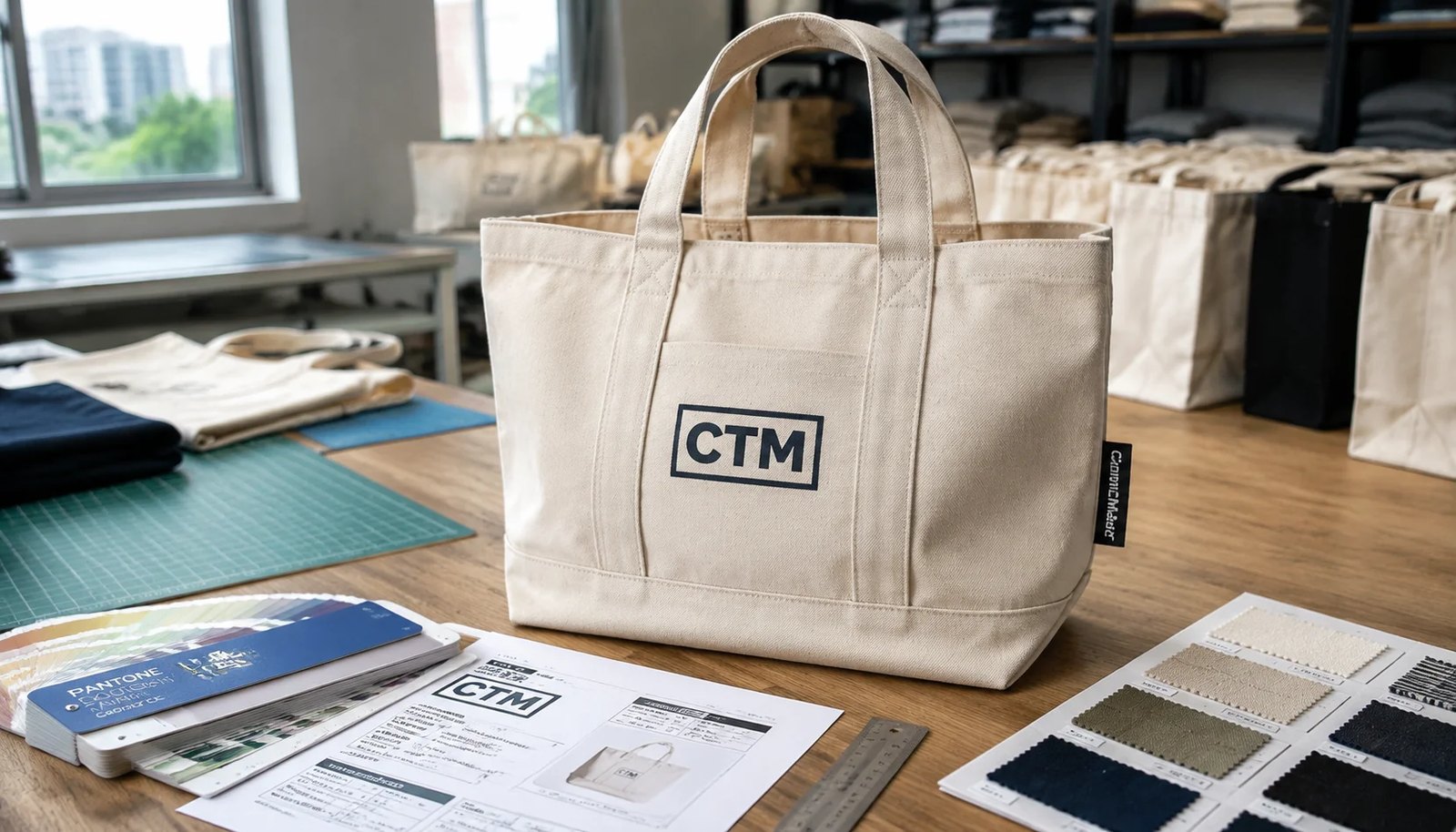
Start with the retail use, not the artwork
A canvas grocery tote for a liquor retailer is both a branded shopping bag and a load-bearing package. It may carry glass bottles, mixed groceries, gift sets, or event purchases. That makes print proofing different from approving a light promotional giveaway. The logo still matters, but so do fabric weight, gusset shape, handle strength, packing method, and how the print looks once the bag is filled.
The most useful canvas grocery totes print proofing checklist for liquor retailers starts by defining the job the tote must perform. A bag used for a short tasting event can be specified differently from a reusable checkout tote intended for repeated bottle carry. Procurement should make that use clear before suppliers quote, because it affects fabric, sewing, print durability, carton packing, and inspection criteria.
Many disputes begin with partial approvals. A buyer signs off a PDF, but the real canvas is darker than expected. A logo looks centered on the flat proof, then lands near the gusset fold on the sewn bag. A heavy ink area looks clean at sampling, then develops fold marks after tight packing. These are avoidable issues when the product spec, artwork, proofing route, and QC standard are handled together.
- Define whether the tote is for checkout, gifting, event promotion, or repeat grocery use.
- State the expected load in practical terms, such as bottle count or equivalent weight.
- Treat print approval as part of product approval, not a separate graphic design step.
- Include operations and receiving requirements before finalizing the quote.
Lock the base bag specification before proofing print
Print cannot be approved properly until the bag construction is fixed. The same logo can look different on a flat tote, a side-gusseted grocery tote, and a bottom-gusseted bottle-carry bag. Canvas texture, panel size, seam position, and handle attachment all influence the live print area and final appearance.
For mainstream reusable liquor retail programs, buyers often consider a mid-heavy canvas specification, such as about 12 oz or 340 GSM finished canvas, as a practical starting point. This should be framed as specification guidance, not a universal rule. Lighter weights may work for short promotional use. Heavier weights may be appropriate for premium programs or repeated heavy loads. The right choice depends on bottle count, gusset depth, handle design, budget, and desired hand feel.
Finished dimensions should be written in millimeters. Include body width, body height, bottom gusset, side gusset, handle width, and handle drop. Do not rely on a supplier photo or a general description such as large grocery tote. If the tote needs to hold wine bottles upright, the opening width, base depth, and handle drop are as important as the front panel height.
Handle details deserve early attention. Wider cotton webbing or reinforced self-fabric handles can improve comfort for heavier purchases. Box-X or cross-stitch reinforcement at the handle roots may be appropriate where repeated bottle carry is expected. These details affect both performance and available visual space near the top of the bag.
- Quote from finished measurements, not estimated template proportions.
- Ask for finished GSM tolerance and confirm how it will be checked.
- Specify handle material, width, drop, attachment pattern, and reinforcement area.
- Make the approved blank bag construction the base for all print decisions.
Choose a print method with use limits in mind
Screen printing is often the practical default for solid logos and spot-color branding on canvas grocery totes. It can be efficient for medium and larger runs, supports Pantone-targeted colors, and is relatively easy to standardize for reorders when the same artwork and fabric are used. That said, it should not be described as the best method in every situation. The artwork, quantity, fabric, budget, and durability expectation should decide the process.
For liquor retailers, screen print usually fits bold store marks, private-label logos, event graphics, and seasonal campaign artwork. Buyers should ask about ink opacity, edge sharpness, rub resistance, and hand feel on the actual canvas. Natural cotton is not a smooth coated surface. Ink may absorb into the weave, fine lines may thicken, and light colors may need stronger opacity control.
Heat transfer or digital methods may be proposed for gradients, small batches, or complex imagery. These can be useful when the artwork cannot be separated cleanly into spot colors. Procurement should still request proofing on the actual bag material and ask how the print performs when folded, rubbed, and carried. A sample that looks good flat may not be suitable for repeat grocery use if the surface cracks, peels, or scuffs too easily.
Embroidery, woven labels, or sewn patches can add a premium detail, but they are usually better for small brand marks than for large grocery-tote graphics. They also change sewing flow, cost, and lead time. The safest approach is to ask the supplier why the proposed method fits the artwork and use case, then test that method before bulk production.
- Use screen print guidance for bold spot-color artwork, not as an automatic rule for every design.
- For light ink on natural or dark canvas, ask how opacity will be achieved.
- For transfers or digital print, check fold, rub, and edge performance on the real fabric.
- For reorders, ask how screens, color standards, and artwork coordinates will be retained.
Set the live print area in measurable terms
A vague instruction such as center the logo on the front panel is not enough for production. On a gusseted canvas grocery tote, the visible front face is not the same as the full cut fabric panel. Side folds, bottom expansion, top hems, and handle stitching all reduce the practical print area.
Buyers should define the artwork size in millimeters and place it from fixed reference points. For example, state the print width and height, the distance from the top seam to the top of print, and the distance from the left side seam to the left edge of print. If the design must be visually centered after the bag is filled, review a stuffed or loaded sample rather than only a flat one.
Safe margins are especially important for liquor retail programs because bottle loads change the bag shape. A logo that looks balanced on an empty tote can appear low or distorted when the base opens and side gussets expand. Fine text near folds may become hard to read. Heavy ink blocks placed across fold lines may show creasing after transit.
If both sides are printed, confirm whether front and back need the same vertical reference. Two-sided placement can be controlled, but tighter tolerance usually requires more careful handling and may affect cost or reject rate. Procurement should set realistic placement tolerances before the order is priced.
- State print size in mm, not only as a percentage of panel size.
- Define distances from top seam and side seam, plus a placement tolerance.
- Keep artwork away from gusset folds, handle roots, and bottom expansion zones.
- Review filled-bag appearance if the tote will regularly carry bottles.
Use digital proof, strike-off, and pre-production sample correctly
A digital proof is useful, but it is only the first approval stage. It confirms spelling, logo version, color callouts, approximate scale, and placement logic. It does not prove ink color on natural canvas, print opacity, edge sharpness, or how the artwork behaves near stitching and folds.
The physical strike-off should come next. It should be printed with the proposed ink system on the actual production fabric or a clearly identified equivalent approved by the buyer. This stage is where brand and procurement teams can judge Pantone target, opacity, line quality, texture, and fabric show-through. The signed strike-off should become the controlling color and print-quality reference.
The pre-production sample should then combine the approved print with the actual bag construction. This is the sample that confirms total product readiness: finished dimensions, handle placement, print position, gusset behavior, fold method, and basic packability. If the sample reveals that the logo is too close to a fold or that the print marks during packing, those issues can still be corrected before bulk production.
For larger orders, import programs, or chain rollouts, the approval sequence should be written into the purchase order or supplier confirmation. State that bulk production cannot begin until the required proofing stage is approved in writing. This avoids pressure to proceed based on a PDF when the commercial risk requires a physical benchmark.
- Digital proof approves content and layout intent.
- Strike-off approves color, opacity, and print behavior on canvas.
- Pre-production sample approves the finished tote as a complete product.
- Retain the signed sample or strike-off as the inspection benchmark.
Define acceptance standards before production starts
Print quality is easier to manage when the buyer defines what good means. General wording such as high quality or match brand color leaves too much room for interpretation. Cotton canvas has texture and color variation, so procurement should define a realistic standard tied to a signed strike-off rather than expecting a monitor preview to be binding.
Color should be controlled by Pantone target plus physical approval. The Pantone reference tells the supplier the intended direction; the approved strike-off shows the acceptable result on the chosen canvas. Inspection should compare bulk goods under neutral lighting against the retained sample. Phone photos, compressed images, and uncalibrated screens should not be used as final color approval tools.
Placement should also be measurable. A common commercial tolerance may be a few millimeters from the approved seam reference, but the buyer and supplier should agree on the number. If the artwork includes a border, fine alignment, or a secondary element such as a label or hangtag, tighter controls may be needed and should be priced accordingly.
Readability matters for campaign text, store names, sub-brands, and responsible-use messages. Fine text can fill in on canvas, especially with heavy ink or low contrast. Buyers should identify minimum acceptable text clarity during strike-off review, not after thousands of units have been printed.
- Use the signed strike-off as the binding print reference.
- Agree on placement tolerance from fixed seams before bulk production.
- List reject defects such as smudges, ghosting, unreadable text, severe pinholes, and major color drift.
- Inspect fine text and reverse areas separately from the overall logo impression.
Make MOQ and quote comparisons specific
MOQ for printed canvas grocery totes is driven by more than total order quantity. Suppliers may set minimums by fabric color, bag size, print design, print color count, and packing route. A 5,000-piece project can become several smaller production lots if it includes multiple sizes, regional logos, canvas colors, or destination packs.
A useful procurement tactic is to standardize the base tote wherever possible. If the same fabric, dimensions, gusset, handle construction, and carton plan can be shared across stores, the supplier may be able to consolidate cutting and sewing even when print artwork changes. Separate logos may still require screen charges or setup time, but the overall program is easier to manage.
Quote comparisons should include all proofing and control costs. Ask whether digital proofs, strike-offs, pre-production samples, screen charges, revised samples, special packing, carton labels, and inspection support are included or separate. A low unit price can become less attractive if it excludes the steps needed to approve the bag safely.
Buyers should also ask how reorders are handled. If a liquor retailer expects recurring seasonal campaigns or replenishment, the supplier should keep print coordinates, artwork files, color references, and packing instructions. Reorder consistency depends on retained standards, not memory.
- Compare quotes by finished spec, not only by unit price.
- Ask MOQ separately for body fabric, print design, color count, size, and packing route.
- Confirm whether screen charges are one-time, recurring, or volume-dependent.
- Keep base construction consistent when multiple store logos are needed.
Build packing requirements into the RFQ
Packing affects print condition, freight cost, and receiving accuracy. For liquor retail programs, totes may need to ship to a central DC, a distributor, stores, event sites, or regional warehouses. If the packing plan is not defined before quotation, the supplier may pack in the easiest bulk format, leaving the buyer to sort cartons later.
Flat packing is common, but the fold direction and bundle method should be reviewed when the print area is large or heavily inked. Folding directly across a thick ink block can create set marks during long transit. Buyers should ask to see the proposed fold on the pre-production sample and confirm whether front print faces inward or outward, whether bundles are banded, and whether individual polybags are needed.
Carton specifications should be operationally realistic. Define pieces per bundle, pieces per carton, maximum gross weight, carton size, PO number, SKU, destination code, country of origin wording, and any barcode or retail DC requirement. These details are not cosmetic. They influence receiving time, manual handling, freight cube, and mis-ship risk.
Destination sorting should be priced clearly. Store-pack assorting, mixed cartons, or region-specific labels may be worthwhile, but they add labor and require stronger carton control. Procurement should include those instructions in the RFQ instead of adding them after production is packed.
- Confirm bulk pack, SKU pack, region pack, or store pack before quotation.
- Review fold method if print creasing would be unacceptable.
- Set carton weight limits that match warehouse handling rules.
- Require carton marks that support fast receiving and allocation.
Plan the timeline around approvals
Lead time is often underestimated because buyers focus on bulk sewing days. For custom printed canvas totes, the critical path usually includes artwork review, supplier proofing, strike-off production, courier transit, internal signoff, pre-production sample review, production, inspection, packing, and shipping.
Each stage should have an owner and a target date. Brand teams may approve color and logo size. Procurement may approve cost and supplier terms. Operations may approve carton plan and destination sorting. Legal or compliance stakeholders may review certain alcohol-related promotional messages. If these reviews happen late, the supplier timeline can look delayed even when the factory is waiting for buyer approval.
A realistic schedule separates supplier work from buyer response time. Ask the factory how many days are needed for each proofing stage and whether any steps can run in parallel without risking wrong output. For example, blank material planning may begin after bag construction approval, but bulk printing should wait for the signed strike-off and pre-production sample when those controls are required.
For repeat orders, retain the approved sample, strike-off, artwork coordinates, carton plan, and inspection notes. This can reduce avoidable sampling loops and helps prevent shade or placement drift between campaigns.
- Separate artwork proof, strike-off, PPS, bulk production, inspection, packing, and shipping.
- Assign internal approvers before the sample arrives.
- Do not hide buyer approval time inside supplier lead time.
- Keep physical and written references for future reorders.
Inspect against the buying decision, not a generic checklist
Final inspection should reflect the reasons the tote was purchased. For a liquor retailer, that usually means the bag must carry the intended load, present the brand cleanly, arrive in the right cartons, and match the approved construction. A generic appearance check is not enough.
Inspection should include measurements, fabric weight confirmation by agreed method, print comparison to the approved strike-off, placement measurement, seam inspection, handle-root review, and carton verification. For bottle-carry programs, selected units should be load tested using the intended bottle count or an agreed equivalent weight. The purpose is to confirm practical performance, not to create unrealistic lab claims.
The approved strike-off and pre-production sample should be available to inspectors. Without them, inspection becomes subjective. With them, the inspector can compare color, print placement, handle construction, dimensions, and overall workmanship against the actual approved benchmark.
Landed cost should be reviewed alongside quality. A slightly higher quote may be better value if it includes the correct fabric, proper proofing, reinforced handles, clear carton packing, and measurable inspection support. A cheaper quote that misses these controls may create rework, late delivery, warehouse sorting, or brand-quality problems. The best procurement result is not the lowest opening price; it is the tote that arrives as approved and performs in the intended retail setting.
- Use the signed sample and strike-off as inspection references.
- Check print, construction, load behavior, and packing in the same QC plan.
- Include carton count, destination marks, and gross weight in final inspection.
- Compare suppliers on total delivered risk, not only ex-factory unit price.
Specification comparison for buyers
| Spec decision | Recommended option | When it fits | Buyer risk to check |
|---|---|---|---|
| Fabric weight | Specify finished canvas weight, often around 12 oz or 340 GSM for bottle-carry programs | Reusable grocery totes where the bag must feel stable, carry glass bottles, and remain presentable after repeat use | Some quotes use nominal or greige fabric references; ask for finished GSM tolerance and verify against the approved sample |
| Bag shape | Bottom gusset plus side gussets | Liquor retail checkout, gifting, and mixed grocery orders where the bag should open easily and stand better | Flat-looking proofs can hide gusset distortion, reduced live print area, and different carton cube |
| Handle construction | Reinforced self-fabric or cotton webbing handles with box-X or cross-stitch attachment | Orders expected to carry 4-6 bottles or heavier mixed purchases | Weak handle roots may pass visual review but fail in use; confirm stitch pattern, handle drop, and load expectation |
| Print method | Pantone-targeted screen print with physical strike-off for spot-color artwork | Solid logos, store branding, campaign graphics, and repeat orders | Digital proofs do not show ink opacity, edge gain, or fabric show-through on textured canvas |
| Artwork control | Live print area measured in mm from seams and folds | Programs where logo readability matters at checkout and when the bag is filled | A centered PDF can still place artwork too close to gusset folds, handle stitching, or bottom expansion |
| Color standard | Pantone target plus signed strike-off on actual canvas | Brand-controlled programs across multiple stores, seasons, or replenishment runs | Natural canvas tone can shift perceived color; uncalibrated screens and phone photos are not reliable approval standards |
| MOQ structure | Shared base bag with separate print versions where possible | Multi-store or regional liquor retailers using different logos on the same tote body | Different sizes, fabric colors, print colors, or packing routes may create separate MOQs and setup costs |
| Packing route | Flat packed by SKU, destination, or store code as required | Distributor allocation, chain rollout, or event distribution | Late store-pack requests can change labor cost, carton marks, receiving speed, and mis-ship risk |
| Sample path | Digital proof, print strike-off, then pre-production sample | Import orders or larger domestic runs where corrections after bulk printing are costly | Skipping the physical print stage can leave color, opacity, placement, and fold-mark risks undiscovered until production |
Buyer checklist before sampling
- State finished bag dimensions in mm: width, height, bottom gusset, side gusset, handle width, and finished handle drop.
- Specify finished canvas weight in GSM or oz after finishing, with tolerance, rather than relying only on nominal fabric wording.
- Confirm canvas color and treatment: natural, dyed, washed, pre-shrunk, coated, or untreated, because each affects print appearance and final dimensions.
- Describe intended use, such as 4 wine bottles, 6 spirits bottles, mixed grocery items, event giveaway, or reusable checkout bag.
- Define handle material, reinforcement method, stitch pattern, and any load test requirement tied to the intended bottle count or equivalent weight.
- Provide vector artwork and final print size in mm, including one-side or two-side printing, print colors, and any small text that must remain readable.
- Set print position from fixed reference points, such as top seam and side seam, with an agreed placement tolerance.
- List Pantone references for each color and state that the signed physical strike-off on production fabric is the controlling color reference.
- Require approval stages in writing: digital proof, physical strike-off, pre-production sample, and bulk production only after signed approval.
- Define packing before quotation, including bundle quantity, pieces per carton, carton marks, destination sorting, and maximum carton gross weight.
Factory quote questions to send
- What finished fabric weight are you quoting, and what GSM or oz tolerance applies in bulk production?
- Is the canvas natural, dyed, washed, pre-shrunk, or otherwise treated, and how will that affect finished size and print shade?
- What bag dimensions, gusset depth, handle width, handle drop, and reinforcement are included in the quoted price?
- What print method is included, how many colors and sides are included, and are screens, strike-offs, and sampling charges separate?
- What maximum print area do you recommend before artwork enters side folds, bottom gusset distortion zones, or handle stitch areas?
- Can you provide a physical strike-off on the actual production fabric before making the full pre-production sample?
- What is the MOQ by bag size, fabric color, print design, and packing route, and can related SKUs share the same body production?
- What are the carton dimensions, pieces per carton, gross weight, net weight, and how does store or destination sorting affect cost?
- How many working days are needed for digital proofing, strike-off, pre-production sample, bulk production, packing, and export readiness?
- What in-line and final checks do you perform for print color, placement, opacity, seam quality, handle security, dimensions, and carton accuracy?
Quality-control points to confirm
- Check finished width, height, bottom gusset, side gusset, handle width, and handle drop against approved tolerances.
- Confirm fabric weight by agreed method, such as weighing random units or fabric cuts, and compare against the specified finished GSM tolerance.
- Compare bulk print color to the signed strike-off or retained approved sample under neutral lighting, not only from phone photos.
- Measure print placement from fixed seam reference points and record whether it stays within the approved mm tolerance.
- Inspect print opacity, edge sharpness, pinholes, smudges, over-inking, ghosting, transfer marks, and unacceptable canvas show-through.
- For multi-color artwork, check registration, small text, reverse areas, outlines, and color trapping on the textured canvas surface.
- Review handle roots for stitch pattern, stitch density, reinforcement size, skipped stitches, broken threads, and uneven attachment.
- Inspect top hems, side seams, bottom seams, gusset corners, seam grin, puckering, raw edge exposure, and loose threads.
- Load test selected samples using the intended bottle count or agreed equivalent weight to check handle security and bag behavior when filled.
- Verify bundle count, carton quantity, destination sorting, carton marks, carton weight, and outer carton condition against the purchase order.