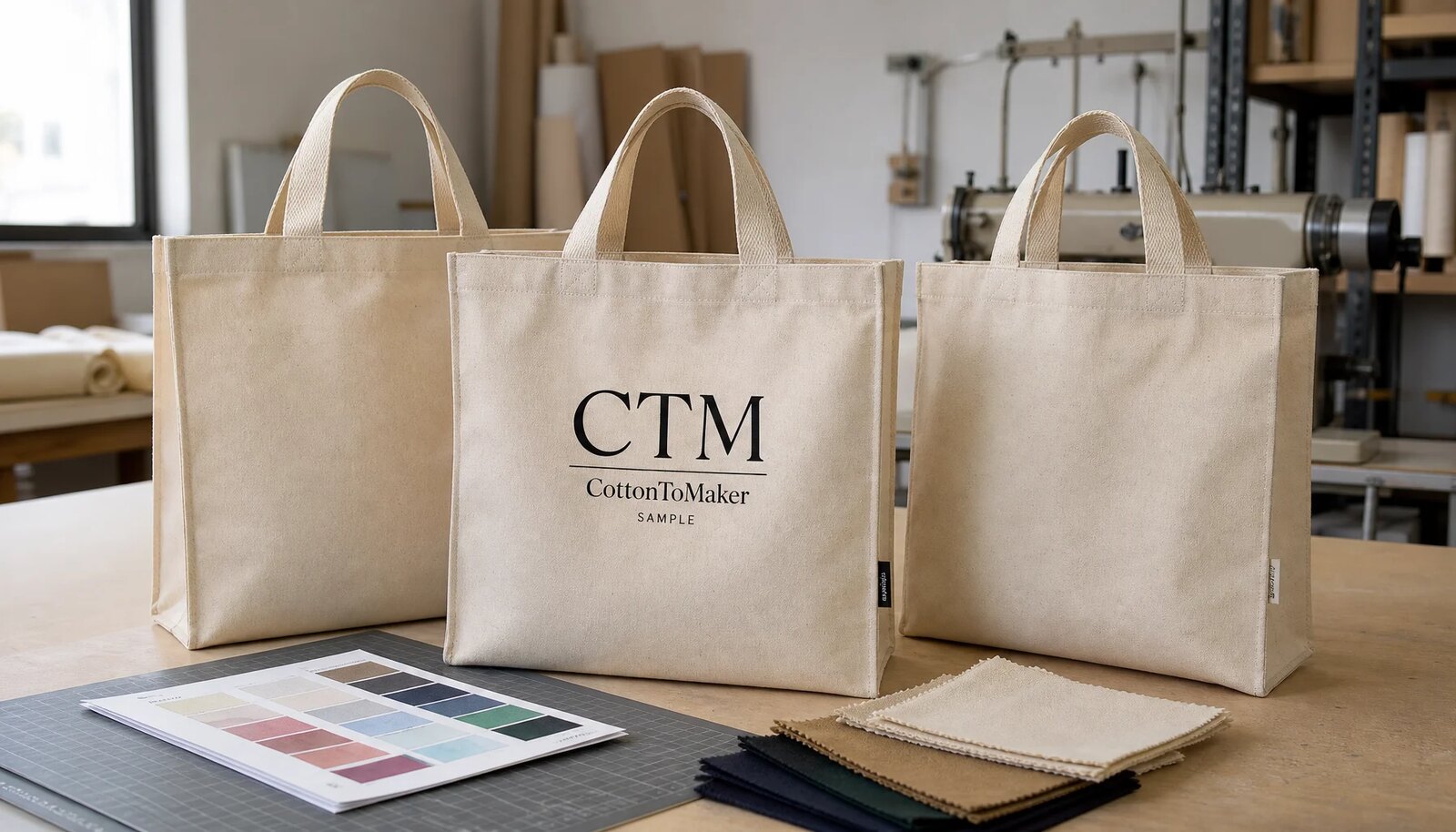
Start With the Retail Use Case
Canvas grocery totes for hotel retail are not only packaging. Guests may see them in a lobby market, spa boutique, resort sundries area, golf shop, café, or pre-opening retail display before anyone explains the material story. The bag has to look intentional on shelf, carry real purchases, and reproduce the property brand cleanly.
Proofing is also a cost-control step. Two suppliers can quote a “canvas grocery tote with logo” while assuming different fabric weights, gusset depths, handle widths, print areas, packing methods, and inspection standards. A low unit price may simply exclude strike-offs, screen charges, stronger handle reinforcement, inner bundle packing, carton labels, or photo reporting.
The most useful buyer brief turns taste into production language: 10 oz to 12 oz canvas, finished width x height x gusset, print size, Pantone references, placement from physical reference points, handle drop, reinforcement type, bundle count, carton marks, and inspection tolerances. Then the factory, distributor, inspector, and hotel receiving team all work from the same target.
- Define whether the tote is paid retail, amenity packaging, or a light promotional item.
- Approve canvas, print, construction, packing, and QC as one finished product.
- Use a written spec sheet before comparing quotes.
- Keep signed approval samples with both buyer and factory.
- Separate visual approval from measurable pass/fail criteria.
Match Specifications to Guest Carrying Needs
The right tote begins with what the guest will carry. A lobby market tote for snacks, bottled drinks, sunscreen, and convenience items needs gusset capacity and comfortable handles. A boutique tote for robes, towels, books, wine, or spa products needs stronger seams and a cleaner shelf face. A souvenir tote sold at the front desk may need neat folding, barcode labeling, and easy replenishment more than a rigid standing shape.
Finished size alone can mislead buyers. A flat 40 x 35 cm bag may photograph large but carry boxy goods poorly. Add a 10 cm side-and-bottom gusset and the capacity improves, but the printable front panel may sit differently. Handle drop also changes the experience: hand-carry handles can work for small purchases, while shoulder carry needs a longer drop and a webbing width that does not bite into the guest’s hand or shoulder.
Put the use case in the RFQ. It helps suppliers avoid quoting a lightweight promotional construction when the channel is paid retail. It also makes tradeoffs clear. Heavier canvas can improve shelf body, but it raises carton weight. Individual polybags can protect print, but they add cost, volume, and unpacking labor.
- Lobby market: prioritize gusset capacity, handle comfort, and rub resistance.
- Boutique retail: prioritize fabric cleanliness, print sharpness, and presentation fold.
- Amenity bundle: prioritize consistent placement and efficient carton packing.
- Multi-property program: prioritize shared construction and artwork control.
- Heavy-use guest tote: prioritize reinforced handles and practical load checks.
Specify Canvas Weight, Color, and Surface
For hotel retail grocery totes, 10 oz to 12 oz canvas, roughly 270-340 GSM, is a practical starting range. It gives more body and carrying confidence than lightweight cotton without the freight and folding penalties of very heavy canvas. An 8 oz canvas can work for lighter-duty or budget programs, but expect less shelf structure and more print-through risk. A 14 oz canvas can feel premium, yet it may reduce pieces per carton and make thick sewing points harder to manage.
Fabric weight needs a tolerance. Canvas is a textile, not a machined component. Many commercial specs use +/-5% to +/-10% by GSM, but the range should be agreed before the purchase order. If a quote says only “10 oz canvas,” ask whether that is measured fabric weight, an approximate category, or a catalog description.
Natural unbleached canvas is common because it feels relaxed and reusable. It also brings seed specks, slubs, shade movement, and yarn irregularity. These traits are not automatically defects, but the acceptable range should be approved with swatches. Bleached canvas may make colors appear cleaner. Dyed canvas needs lab dip approval and dry and wet crocking checks, especially for dark colors.
Recycled cotton, organic cotton, and cotton blends may be suitable, but claims and consistency need control. Recycled feedstock can show more shade variation and fiber flecking. Cotton-poly blends can change shrinkage, hand-feel, and sustainability positioning. If the tote is sold with a material claim, request documentation instead of relying on catalog wording.
- Standard retail range: 10 oz to 12 oz canvas, about 270-340 GSM.
- Budget option: 8 oz canvas for lighter loads and lower shelf-structure needs.
- Premium option: 14 oz canvas when bulk, freight, and folding impact are acceptable.
- Natural canvas: approve shade range, specks, slubs, and surface irregularity.
- Dyed canvas: require lab dip, rub checks, and underbase discussion for light prints.
Choose the Print Method by Artwork Risk
Screen printing is usually the safest choice for solid hotel logos, property names, destination marks, and one-to-four-color graphics. It gives good opacity on cotton canvas and can be repeatable when the order quantity supports screen setup. For hotel groups that reorder the same tote seasonally, screen printing often makes color and placement control easier than short-run methods.
Not every logo is easy. Coarse canvas can break thin strokes, close the counters in small letters, and soften sharp corners. Reversed text, serif fonts, narrow rules, QR-style artwork, and small icons should be reviewed at actual size. Ask the factory for minimum printable line width, minimum text height, minimum reversed text size, planned ink type, curing method, and whether a white underbase is needed on dyed or dark canvas.
Digital pigment printing can work for detailed illustrations, destination scenes, many-color seasonal graphics, or smaller design splits. The tradeoff is color. On natural canvas, digital color may look quieter than the monitor proof. Approval should focus on physical color balance, edge clarity, hand-feel, crocking, and whether the artwork still reads after the fabric absorbs ink.
Heat transfer can handle complex graphics, but canvas needs careful testing. Check film-like hand-feel, edge adhesion, flexing, cracking, lifting, and blocking when printed panels press against each other in cartons. Embroidery can feel premium for small marks, but dense embroidery may pucker canvas and is rarely efficient for a large grocery tote front panel.
- Screen print: best for solid logos, Pantone colors, and repeat programs.
- Digital print: useful for detailed graphics and many colors, but requires canvas proofing.
- Heat transfer: approve only after adhesion, flex, blocking, and hand-feel checks.
- Embroidery: best for small premium marks, not large front-panel grocery graphics.
- Patch or label: useful when dimensional branding matters more than print area.
Build a Proof Package Production Can Follow
A useful proof package is not a styled image. It uses the intended canvas, selected print method, confirmed artwork file, final print size, and measured placement. On a gusseted tote, be precise about centering. Is the artwork centered on the visible front panel, between gusset folds, or across the full flat bag width? Each choice can produce a different-looking bag.
Artwork files should be production-ready. Vector AI, EPS, SVG, or editable PDF files are preferred for logos and solid graphics. Fonts should be outlined, images embedded or supplied separately, and Pantone references listed. The proof should show final logo width and height in centimeters or inches, not only a visual scale. If two sides are printed, state whether the artwork is the same, different, mirrored, or independently positioned.
A practical approval sequence is fabric swatch, print strike-off, pre-production sample, then bulk top sample or first-article photo report. The swatch confirms the base material. The strike-off confirms color, opacity, registration, edge quality, ink behavior, and odor before a full tote is sewn. The pre-production sample confirms dimensions, gusset, handle drop, logo position, sewing, and packing fold.
Version control matters in hotel retail. A multi-property program may use one tote body with many property names, destinations, or seasonal graphics. Each artwork should carry a file name, revision date, SKU or artwork code, Pantone references, print method, placement diagram, and approval status. Without that control, the issue may not be poor printing; it may be a correct tote carrying the wrong hotel logo.
- Fabric swatch: approve base material before judging ink.
- Strike-off: approve print behavior before sewing full samples.
- Pre-production sample: approve construction, placement, and packing fold.
- Bulk top sample: confirm production starts from the approved standard.
- Approval record: include file version, date, fabric, print method, and approver.
Set Measurable Print Acceptance Rules
Print quality should be defined before production starts. For standard tote printing, a placement tolerance of +/-5 mm to +/-10 mm is often realistic, depending on print size, construction, jig setup, and whether the bag is printed before or after sewing. Tighter tolerance may be possible, but it can increase labor, inspection time, and reject rates. If the artwork must align with seams, pockets, or gusset folds, confirm feasibility before issuing the purchase order.
Color approval needs a practical standard. Pantone references are useful, but Pantone on natural cotton will not look identical to Pantone on coated paper. Canvas absorbs ink and breaks up solid color with fiber texture. Some strict brand programs use instrument readings and Delta E targets; many hotel retail programs rely on a signed physical strike-off viewed under consistent light. Either approach is workable if the comparison method is written down.
Registration matters whenever more than one color is printed. Small screen shifts can make outlines, shadows, icons, and property names look blurred. If the artwork includes fine lines, small reversed letters, or narrow gaps, ask the supplier to identify risk areas before screens are made. It is better to simplify or enlarge details before strike-off than to argue about filled-in type during bulk production.
Ink coverage should be checked on the actual canvas. Large solid areas can show pinholes, uneven opacity, screen marks, ink drag, or a heavy hand-feel. Fine artwork can lose clarity if ink spreads into the fabric. Define unacceptable defects: missing strokes, clogged counters, heavy bleeding, obvious pinholes at normal viewing distance, patchy solids, visible registration errors, and strong odor.
- Placement: commonly +/-5 mm to +/-10 mm unless tighter tolerance is confirmed.
- Color: compare bulk to signed strike-off on the same fabric type.
- Registration: define acceptable shift for outlines, shadows, and small text.
- Coverage: reject obvious pinholes, missing strokes, bleeding, and patchy solids.
- Rub resistance: prevent smearing and heavy transfer during normal handling.
- Odor: reject strong solvent, curing, mildew, or damp storage smell.
Control Construction Details That Affect Print
Print proofing cannot be separated from construction. Top hem thickness, gusset folds, handle attachments, seams, inside pockets, and reinforcement stitching all affect printable area and final appearance. If panels are printed before sewing, placement can shift when fabric is folded, hemmed, and stitched. If finished bags are printed after sewing, seams and gussets may limit the flat print area and make edge control harder.
Gusset construction should be written clearly. Bottom gusset, side gusset, and side-and-bottom gusset all change capacity and shelf presentation. A tote that appears large in flat measurements may still carry poorly if the gusset is shallow. For grocery-style hotel retail, state gusset depth, whether the bottom is boxed, whether the tote should stand when filled, and how the gusset is measured during inspection.
Handles are a frequent source of guest complaints and visible QC variation. Handle drop should be measured from the top edge of the bag to the top of the handle curve when laid flat. Handle width affects comfort when guests carry bottles, books, towels, packaged food, or spa products. Cotton webbing often gives a cleaner and stronger feel than thin self-fabric handles, although either can work when reinforcement is suitable.
Stitching should not be left to factory default. Box-X reinforcement, bartack, cross-stitch, double stitching, and reinforcement patches can all be valid, depending on load expectations. Specify thread color, stitch appearance, reinforcement location, and thread trimming standard. Paid hotel retail merchandise can look unfinished if loose thread tails are scattered around the handles and top hem.
- Print route: confirm printing before sewing or after sewing.
- Gusset: define depth, construction, capacity expectation, and measurement method.
- Handles: define material, width, drop, placement, and reinforcement.
- Stitching: confirm box-X, bartack, cross-stitch, thread color, and trim standard.
- Load check: test with realistic retail goods, not only an empty sample.
Compare Quotes by Real Cost Drivers
B2B quote comparison works best when recurring unit cost is separated from one-time and variable charges. Recurring cost includes fabric, cutting, sewing, printing, trimming, standard packing, and export cartons. One-time charges may include screens, lab dips, color mixing, artwork cleanup, strike-offs, sample making, courier, and approval samples. Variable retail costs may include hangtags, barcode stickers, paper bands, individual polybags, inner cartons, special carton labels, and mixed-SKU packing.
Print cost is not only color count. A large one-color front print may use more ink, drying space, and handling time than a small two-color logo. A two-sided print doubles placement checks and increases abrasion risk in packing. Printing near seams or across thick areas can slow production. Artwork with fine detail may require screen adjustment or file cleanup. Ask what maximum print area and complexity are included before treating two quotes as equal.
MOQ should be requested by production driver, not only by total quantity. A supplier may accept a lower order if every unit uses the same body size, fabric, handle, and packing, with only controlled artwork changes. MOQ rises when the program splits by fabric color, dyed lab dips, handle color, print method, packing style, or many property versions.
For hotel groups and distributors, the most efficient structure is often one shared blank tote with artwork variations. Cutting, sewing, and inspection stay consistent while property-level branding remains possible. If local storytelling is needed, hangtags or barcode labels may be cheaper and less risky than changing fabric color or bag size for every property.
- Recurring cost: fabric, cutting, sewing, printing, trimming, standard packing.
- One-time cost: screens, lab dips, strike-offs, samples, artwork adjustment, courier.
- Variable cost: hangtags, barcodes, polybags, paper bands, special carton marks.
- MOQ driver: size, fabric color, artwork, color count, handle, and packing.
- Landed data: carton size, quantity per carton, gross weight, and shipment timing.
Inspect Samples Like Production Goods
A pre-production sample should be inspected against the specification sheet, not just reviewed on a desk. Lay the tote flat and measure finished width, height, gusset depth, handle width, handle drop, and logo position. Confirm whether dimensions are taken after sewing and pressing. Compare the sample to the approved fabric swatch and print strike-off.
Print checks should include handling. Rub the print with a dry white cloth, flex the printed panel, fold the bag using the planned packing method, and place printed areas in contact to check for blocking or transfer. Look closely at letter edges, small type, large solids, and registration between colors. If the bag will be displayed folded, confirm the fold does not cut through a critical logo area.
Construction checks should reflect real use. Load the tote with likely hotel retail goods and lift it by the handles. Look for seam strain, twisting, handle discomfort, puckering at reinforcement, or distortion of the printed panel. Check that handles are the same length and attached symmetrically. Inspect top hems, corners, gusset seams, thread trimming, labels, and hangtags.
Packing should be tested before bulk packing starts. A sample folded one way may look clean, while a different bulk fold may crease the logo. Printed panels packed directly against each other may scuff or block if ink is not fully cured or pressure is high. Ask the supplier to show the intended fold, inner bundle count, carton quantity, and carton label format before final approval.
- Measure the sample against the spec before approving appearance.
- Rub, flex, fold, and stack the print to check practical handling risk.
- Load the tote with realistic hotel retail goods.
- Verify fold method, inner bundle count, and carton labeling.
- Keep signed buyer and factory approval samples.
Set Inspection and Shipment Release Rules
Inspection standards should be agreed before bulk production, not after a dispute. Many B2B soft-goods orders use AQL-based random sampling, but the exact inspection level, sample size, and acceptable quality limits should be selected with the buyer, supplier, and inspection provider. For hotel retail totes, the checklist should cover measurements, print, stitching, handle reinforcement, fabric shade, odor, packing, carton marks, and SKU separation.
Defect classification should be practical. Critical defects create safety, compliance, or unusable-product risk, such as broken handles under normal use, sharp foreign objects, severe odor, wrong material claim, or wrong artwork. Major defects affect saleability or brand presentation, including misprinted logos, large placement errors, heavy ink transfer, severe shade mismatch, open seams, or incorrect carton labels. Minor defects are small issues that do not materially affect function or retail appearance, such as a short loose thread within the agreed trim standard.
Measurement inspection should use the same method as the spec sheet. If body width is measured flat after pressing, the inspector should not measure it expanded or pulled by hand. If logo placement is measured from the top hem to the center of the print, the report should use that same reference. Consistent methods prevent both false failures and false passes.
Shipment release should require more than attractive photos. Review inspection results, open-carton odor, print rub checks, carton quantity, carton labels, and corrective actions before authorizing shipment. If defects are found, the supplier should separate affected goods, rework where possible, and provide evidence before release. For multi-property programs, artwork and carton-mark accuracy are as important as sewing quality.
- Agree AQL level, sample size, and pass/fail rules before production.
- Classify critical, major, and minor defects in writing.
- Measure dimensions and placement using the same method as the spec.
- Check carton marks and artwork codes for every SKU split.
- Release shipment only after inspection results and corrections are reviewed.
Specification comparison for buyers
| Spec decision | Procurement-ready requirement | Typical tolerance or check | Buyer risk to control |
|---|---|---|---|
| Fabric weight | 10 oz to 12 oz canvas, approximately 270-340 GSM, with weight method and variance stated | Common commercial tolerance: +/-5% to +/-10% by GSM, or as confirmed in the PO | Too light can collapse on shelf and show print-through; too heavy can increase freight, reduce carton quantity, and make folding bulky |
| Finished size and gusset | State finished width x height x gusset after sewing and pressing; define flat or expanded measurement | Often +/-1 cm for body and gusset unless tighter tolerance is confirmed | Ambiguous sizing creates poor capacity, distorted panels, and unreliable quote comparisons |
| Canvas color and surface | Natural, bleached, dyed, recycled cotton, or blend specified with approved swatch or lab dip | Approve shade range, specks, slubs, and dry/wet crocking for dyed fabrics | Natural lots vary; dark dyed canvas may bleed or need a white underbase for light logos |
| Print method | Screen print for solid logos; digital pigment for detailed artwork; heat transfer only after adhesion approval | Check opacity, edge sharpness, registration, curing, rub, odor, and placement | Fine lines can fill on canvas; large solids can look patchy; transfers may lift or feel heavy |
| Logo placement | Define print size and location from top edge, side seam, gusset fold, centerline, or pocket edge | Common placement tolerance: +/-5 mm to +/-10 mm depending on construction and print route | Mockups do not define production location; printing before sewing and after sewing carry different risks |
| Handle construction | Specify cotton webbing or self-fabric handles, width, drop, stitch pattern, thread color, and reinforcement | Measure handle drop; inspect box-X, bartack, or cross-stitch; run agreed load or pull check | Weak or narrow handles reduce guest usability and make paid retail merchandise feel promotional |
| MOQ and artwork splits | Quote MOQ by body size, fabric color, print design, color count, handle, label, and packing method | Separate setup charges from recurring unit cost | A large order can become many inefficient small runs if property artwork, colors, and packing differ |
| Retail packing and cartons | Use flat inner bundles or retail-ready packing with print protected and cartons labeled by SKU | Carton marks should include PO, SKU, artwork version, quantity, color, carton number, and gross/net weight if needed | Loose bulk packing can scuff ink, deform handles, slow receiving, and create mixed-property errors |
Buyer checklist before sampling
- Define the tote as a finished product: width x height x gusset, measurement method, seam construction, top hem, pressing condition, and whether gusset depth is measured flat or expanded.
- Specify canvas weight in oz and GSM where possible, with an agreed variance such as +/-5% or +/-10%, and ask how the supplier verifies fabric weight.
- Confirm base cloth: natural, bleached, dyed, recycled cotton, organic cotton, cotton-poly blend, or other construction, including shade range, slub level, cotton specks, and acceptable fabric marks.
- State whether washability is claimed. If yes, define wash method, shrinkage allowance, colorfastness expectation, and post-wash print appearance before sampling.
- Provide editable artwork in AI, EPS, SVG, or PDF with outlined fonts, embedded images, Pantone references, final print size, and minimum line width identified.
- Define logo placement using physical reference points such as top edge, side seam, gusset fold, bottom seam, pocket edge, or panel centerline.
- Choose the print method by artwork risk: screen print for solid hotel logos, digital pigment print for detailed multi-color graphics, and heat transfer only after adhesion and hand-feel approval.
- Require a strike-off on the intended canvas before pre-production sample approval, especially for natural canvas, dyed canvas, fine lines, large solid areas, or brand-critical color.
- Set print acceptance criteria for Pantone appearance, opacity, registration, edge definition, pinholes, ink bleeding, line fill-in, curing, odor, dry rub, light wet rub, and placement tolerance.
- Confirm whether printing is one side, two sides, same artwork both sides, different artwork each side, inside-pocket print, woven label, hangtag, barcode sticker, or carton-only branding.
Factory quote questions to send
- What exact canvas construction is included in the quote, including oz, GSM, fabric source if available, and allowed weight variance?
- Is the quoted fabric natural, bleached, dyed, recycled cotton, organic cotton, cotton-poly blend, or another material, and can you provide a swatch or lab dip before sampling?
- What shrinkage expectation is assumed, and is the tote quoted as washable, spot-clean only, or with no wash-performance claim?
- What finished dimensions, gusset style, seam allowance, top hem, handle placement, and dimensional tolerances are included in the price?
- Which print method is quoted, how many colors are included, what ink type is planned, and what maximum print area is included before the price changes?
- For this canvas, what minimum printable line width, minimum text height, minimum reversed text size, and expected opacity can production hold?
- Will the bags be printed before sewing or after sewing, and how does that affect placement near seams, gussets, hems, pockets, or handles?
- Are screen setup, color mixing, artwork cleanup, lab dip, swatch, strike-off, pre-production sample, courier, and photo report fees included or separate?
- What is the MOQ per body size, fabric color, print design, color count, handle color, label type, barcode sticker, hangtag, and packing method?
- What carton dimensions, pieces per carton, gross weight, SKU labeling, and shipment-ready date are assumed in the quote?
Quality-control points to confirm
- Fabric weight should match the approved specification within the agreed tolerance, such as +/-5% or +/-10% by GSM, and panels should not feel significantly thinner, looser, or more transparent than the approval sample.
- Canvas shade should remain within the approved swatch or lab-dip range; natural cotton specks, slubs, and yarn irregularities should match the accepted visual standard.
- Finished body width, height, gusset depth, and handle drop should be measured after sewing and pressing; a common commercial tolerance is +/-1 cm unless tighter tolerance is agreed.
- Logo placement should be measured against the approved placement diagram; center alignment and distance from top edge or side seams should not be judged only by eye.
- Pantone color should be checked on the actual canvas under consistent light because natural cotton, dyed fabric, and recycled yarns change perceived brightness.
- Screen print edges should be clean, with no obvious pinholes, ink drag, heavy bleeding, missing strokes, clogged fine details, patchy solid areas, or fiber contamination trapped in the ink.
- Multi-color prints should hold registration within the approved tolerance; outlines, shadows, icons, and small property names should not appear doubled or visibly misaligned at normal viewing distance.
- Dry rub and light wet rub checks should be performed according to the agreed method; printed areas should not smear during normal retail handling or transfer heavily to adjacent bags in cartons.
- Printed bags should not have strong solvent, curing, mildew, or damp storage odor when cartons are opened; odor should be treated as a shipment-release issue.
- Handles should be symmetrical and reinforced, with no skipped stitches, loose thread nests, weak bartacks, uneven box-X patterns, broken threads, or untrimmed thread tails at stress points.