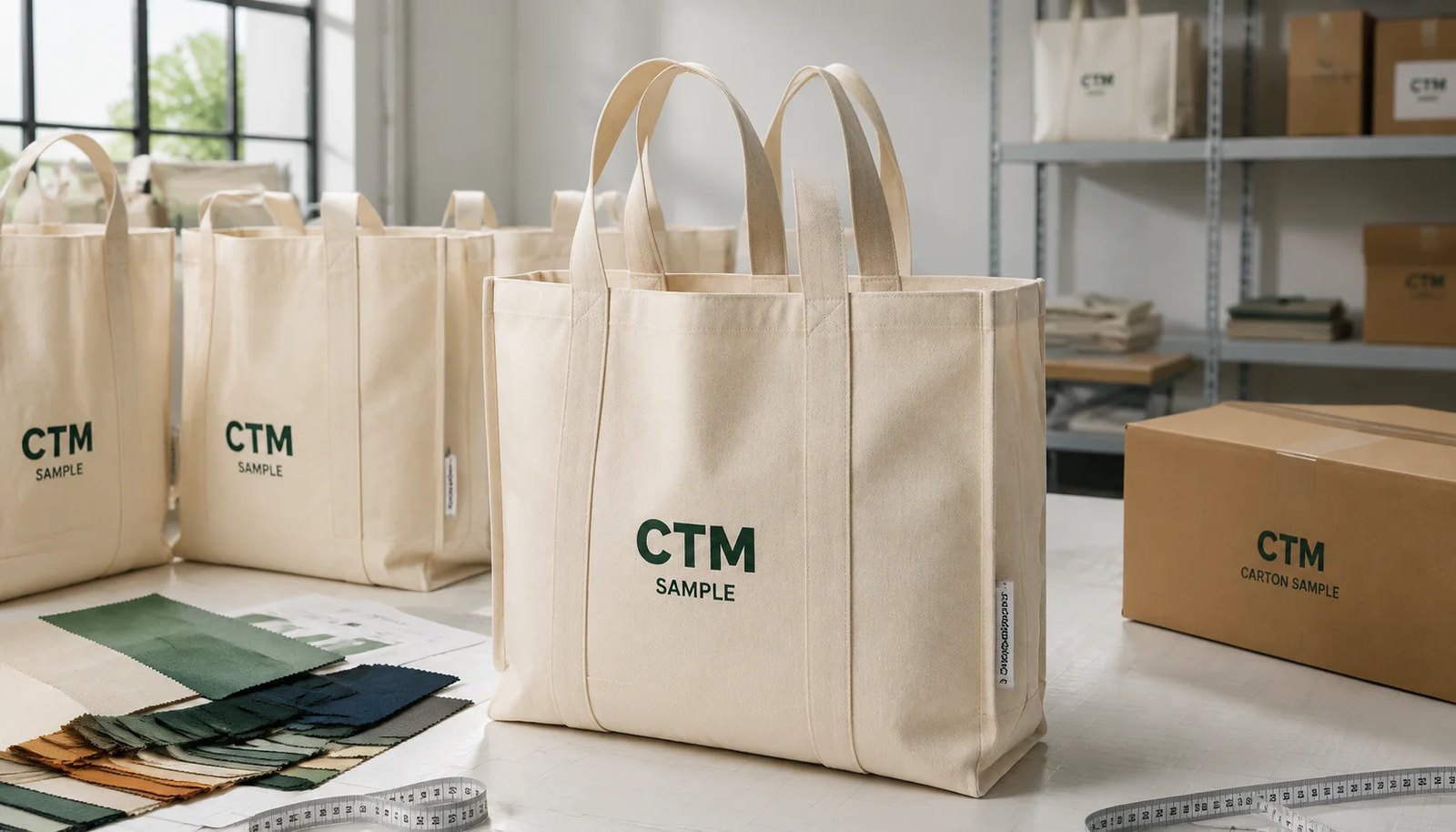
Start the RFQ With the Real Grocery Use Case
A strong RFQ for canvas grocery totes for natural grocers begins with operational use, not just a reference photo. Grocery totes are usually expected to carry heavier and less uniform products than a standard promotional tote: glass jars, canned goods, boxed pantry items, produce, bakery packs, and sometimes chilled items placed inside after checkout. That practical load changes the correct fabric weight, gusset depth, handle construction, seam reinforcement, and packing method. If the RFQ only says natural canvas tote with logo, suppliers will fill in those missing details differently, and their prices will not be truly comparable.
Procurement teams should define whether the tote is a free giveaway, a checkout resale item, a loyalty or membership bag, a seasonal event bag, or a distributor stock SKU. Each route has different cost tolerance and quality expectations. A giveaway may accept a lighter body and simpler finishing. A paid retail bag normally needs better shape, cleaner stitching, more consistent print, and stronger retail intake controls. A replenishable chain-wide program needs repeatable material sourcing and version control so that a second or third order does not drift in size, shade, or carton data.
This scope section also helps the factory recommend sensible construction choices instead of guessing. For example, if the tote must stand open at a bagging counter, a boxed bottom with side gussets is often the practical starting point. If the store plans to stack folded bags near checkout, the thickness and foldability of the fabric become part of the decision. If the tote is meant to feel premium enough to resell, the RFQ may need seam binding, cleaner inside finishing, better label placement, and stricter stain tolerance on natural fabric.
Natural grocers often have brand positioning concerns that conventional gift-bag programs do not. Buyers may prefer undyed canvas, reduced-plastic packing, softer-feel water-based print, or documented fiber claims. Those preferences should be stated clearly as requirements or preferences, because they affect price, lead time, and the supplier pool. Procurement gets better quotes when the RFQ distinguishes what is mandatory from what is negotiable.
- State the buying channel: store giveaway, paid retail item, event bag, online bundle, or distributor inventory.
- List the intended load: for example, everyday grocery carry with jars and produce, not only light merchandise.
- Mention whether the tote must stand open at checkout, fit a bagging station, or nest in a retail display.
- Separate must-have requirements from preferences so suppliers can quote alternatives without hiding substitutions.
- Tell suppliers whether the order is a pilot, a seasonal buy, or a repeatable chain program.
- Note whether the bag will be resold, because resale usually raises finishing, labeling, and consistency expectations.
Define Fabric Precisely: Canvas Type, GSM, Shade, and Claim Level
For canvas grocery totes, fabric should be specified by both ounce weight and GSM, not by the word canvas alone. Buyers often use 10 oz or 12 oz as shorthand, but mills and regions may not interpret those labels identically. A 10 oz canvas is often around 340 GSM and a 12 oz canvas is often around 400 GSM, but the weave, finishing, and testing basis can vary. The RFQ should therefore ask for the supplier's quoted oz and actual tested GSM, plus a swatch for approval. That gives procurement a physical standard to compare against bulk production.
For natural grocers, the difference between natural cotton canvas, bleached canvas, dyed canvas, organic cotton canvas, and recycled-content cotton should be explicit. These are not interchangeable categories. Natural canvas may show seed flecks, light shade variation, and occasional slub texture that many buyers accept as part of the material character, but the acceptable range should still be agreed. Bleached canvas usually gives a cleaner print base but may not fit an earthy brand aesthetic. Dyed canvas opens more branding options, yet it increases color control needs and can affect rub fastness. Organic or recycled-content claims may require separate document review, longer sourcing lead times, and higher MOQ thresholds depending on the mill route.
Fabric handfeel matters as much as number-based weight. Two swatches with similar GSM can feel different in stiffness, body, and print behavior. A softer fabric may fold better for packing and consumer use, but a stiffer one may stand more upright at checkout. If the retailer cares about exact finished dimensions, pre-shrinking or at least shrinkage disclosure becomes important. This matters when stores want a bag that fits fixture widths, shelf slots, or bagging station guides.
A practical RFQ asks for a fabric swatch, fabric composition, GSM test result if available, shrinkage expectation, and whether the quoted fabric is stock or made to order. Stock fabric can shorten lead time, but buyers should verify that restock shade consistency is realistic if the program will reorder. Made-to-order fabric can offer more control, but often raises MOQ and schedule risk. Procurement should decide which trade-off fits the program stage.
- Typical light promotion: 8 oz canvas, roughly 270 GSM, suitable only when load expectations are modest.
- Balanced grocery tote: 10 oz canvas, roughly 340 GSM, good for reusable checkout bags with controlled budget.
- Heavier retail tote: 12 oz canvas, roughly 400 GSM, better structure and durability but higher freight and fabric cost.
- Premium heavy bag: 14 oz canvas or above, useful for paid retail, but confirm sewing capacity and carton weight.
- Specify whether natural shade variation and seed flecks are acceptable within an approved swatch range.
- If making sustainability claims, ask what documents will support the fiber claim before issuing the PO.
Engineer the Bag Body: Size, Gusset, Base Shape, and Finished Tolerance
One of the most common RFQ problems is requesting a tote bag when the store team actually needs a grocery tote. A flat tote may look acceptable in a photo, but it performs differently at checkout and when loaded with bulky products. Natural grocers usually benefit from a boxed bottom and side gussets so the bag opens wider, fills more evenly, and carries square or rectangular grocery items with less distortion. If buyers omit gusset information, suppliers may quote different constructions that cannot be compared on price or use.
Finished dimensions should be written clearly and in one format across all suppliers. Width, height, side gusset, bottom gusset, and handle drop should all be stated. If the bag needs to fit a particular store rack, cubby, or bagging platform, note that operational reference in the RFQ. Procurement should also define how dimensions are measured. On textile products, measurement method matters: laid flat, lightly pulled, after pressing, or after packing. This is especially important when several factories are quoting the same bag from different regions.
Tolerance should be written into the RFQ rather than argued later during inspection. Cotton sewing naturally has some variation, but that does not mean every difference is acceptable. For grocery totes, a practical tolerance may be around plus or minus 1 cm for many dimensions, though fixture-dependent programs may require tighter control. If bag opening width is critical for bagging speed, that point should receive special attention. Handle drop should also be measured separately from overall handle length so the bag carries as intended.
Body construction details influence both user experience and cost. Inside seam binding can improve finish and reduce fraying, but it adds labor. A boxed base may require more fabric and more cutting precision than a flat tote. Some buyers may want an inside pocket, bottle divider, snap closure, or reinforced base insert, but each addition should be justified against the actual retail program. Good RFQs keep the bag functional and comparable rather than over-accessorized.
- Specify finished dimensions and tolerance, for example plus or minus 1 cm unless the fixture requires tighter control.
- Choose a gusset depth that matches expected grocery volume; 5 to 7 inches is common for reusable grocery formats.
- Define handle drop separately from total handle length so the supplier does not misread the carry height.
- State whether the bag should stand open reasonably well when empty or only when filled.
- Clarify if internal seam binding is required, optional, or only wanted on retail-resale versions.
- If comparing quotes, keep body shape identical across suppliers before evaluating price.
Specify Handles and Reinforcement for Real Carry Weight
Handle failures create outsized complaints because a bag that looks acceptable on arrival may still fail in use. For natural grocers, handles must be designed for repeated grocery carry, not only for a one-time event handout. The RFQ should therefore state handle material, width, attachment style, and target use. Many programs choose 22 to 24 inch shoulder handles so shoppers can carry the bag on the shoulder or by hand. Shorter handles may reduce cost, but they often reduce comfort when the bag is heavily loaded.
Buyers should decide between self-fabric handles and cotton webbing handles based on brand look, strength, and budget. Self-fabric handles create a consistent visual appearance, but they may twist more depending on construction. Cotton webbing often improves feel and durability, especially on heavier bags, but it can increase material cost and may require color matching. If the quote uses webbing, the RFQ should state width and color. If using self-fabric, the buyer should ask about folded handle construction and the number of layers at the attachment point.
Reinforcement details should not be left vague. Cross-stitch, box stitch, bartack, or a combination can all be appropriate depending on the load target and the factory's equipment. The key is to ask how the handle will be attached and what load performance the supplier expects. While a formal engineering standard may be unnecessary for all orders, procurement should still require a practical loaded sample test using realistic grocery weight. A tote that carries two catalogues is not the same as one carrying jars, canned beans, citrus, and dry goods.
Comfort matters too. A technically strong handle can still perform poorly if it digs into the hand or sits awkwardly on the shoulder. For paid retail bags, buyers should handle the sample under load, not empty. This is one of the simplest but most overlooked approval steps in tote bag sourcing.
- Require reinforced handle stitching and request a load test standard for approval.
- State handle material: self-fabric, cotton webbing, or another specified construction.
- Specify handle width, especially if comfort under load matters.
- Review loaded samples with realistic grocery weight, not only empty visual samples.
- Ask whether handle stitching uses box-x, bartack, or another reinforcement pattern.
- If comparing suppliers, keep handle length and material constant before judging unit price.
Match the Print Method to Artwork, Fabric Texture, and Brand Positioning
For many natural grocer programs, water-based screen printing is the practical starting point for canvas grocery totes. It suits simple logos, store names, seals, and one- to three-color graphics while maintaining a softer handfeel than heavier plastic-like print films. That said, the best print method still depends on artwork complexity, quantity, and the fabric surface. Natural canvas is textured and often slightly uneven, so print behavior on it will differ from coated paper proofs or smooth synthetic bags.
The RFQ should specify artwork size, print position, number of colors, Pantone references if applicable, and any restrictions on handfeel or finish. Large flood coverage may need separate testing. Fine text and thin lines can break up on coarse canvas, especially if the fabric has slubs or seed flecks. If the logo includes gradients or photographic detail, digital print may be worth reviewing, but only after the factory confirms achievable sharpness and cost at the target volume. Procurement should not assume a print method based only on a PDF artwork file.
A print strike-off is a key approval tool. It shows actual color, edge quality, and interaction with the chosen fabric before full sample or mass production. This matters because natural canvas can absorb ink differently from bleached or dyed canvas. Dark green, black, deep navy, and broad solid shapes often need rub or crocking review, especially if bags will be tightly packed face-to-face in export cartons. If the order involves two print positions, inside print, or registration across gussets, that complexity should be priced and tested early.
For B2B buyers, the main goal is not choosing the fanciest print option. It is selecting the method that remains readable, durable enough for the use case, and commercially stable across reorders. The best RFQ asks the supplier to recommend the print route and explain its limits instead of silently substituting methods during production.
- Use screen print for clean solid logos, store slogans, and simple badge artwork.
- Use digital print only after confirming color saturation, edge sharpness, and unit cost at target quantity.
- Avoid tiny legal text on rough canvas unless the factory proves readability on the actual fabric.
- Request rub testing for dark ink, large print areas, and prints that may touch other bags during carton packing.
- Approve a print strike-off before pre-production sample approval.
- Ask whether the quote includes one side print only or both sides, gusset print, or bottom print.
Build an RFQ Template That Produces Comparable Quotes
A buyer-friendly RFQ template should make it easy for suppliers to quote the same bag, the same assumptions, and the same trade term. Without that structure, factories may each price a different interpretation: one quotes 10 oz stock canvas, another quotes lighter fabric, a third omits labels, and a fourth assumes a flat tote instead of a boxed grocery bag. Procurement then spends time normalizing data after the fact. A better RFQ prevents those differences before quotes arrive.
A useful template begins with a short program summary, then a specification block. That block should cover item name, intended use, target quantity breaks, destination market, target incoterm, required delivery window, and whether the order is a trial or long-term repeat style. Then come the physical specifications: finished dimensions, gusset type, fabric composition, target GSM, color, handle type and length, print details, labels, packaging, and inspection requirement. If there is a reference sample or sketch, attach it, but do not let the image replace written dimensions.
The RFQ should also include a supplier response section. Ask factories to fill in exact quoted GSM, MOQ basis, sample lead time, bulk lead time, pieces per carton, carton dimensions, gross weight, CBM, and what is excluded from price. This turns quote collection into a procurement comparison exercise rather than a chain of clarifying emails. It also exposes where a factory is using assumptions that may create cost or quality risk later.
For natural grocers, it is wise to include a note about sustainability-related preferences without overstating claims. For example, a buyer may ask suppliers to indicate whether organic, recycled-content, plastic-reduced packing, or origin-label support is available. That invites options while keeping the current quote grounded in what is actually required.
- List quantity breaks in the RFQ so all suppliers quote the same ladder.
- Use one unit of measure consistently: inches or centimeters, not both mixed casually.
- Add a supplier response field for quoted GSM, MOQ basis, carton data, and lead time.
- Require suppliers to note assumptions and exclusions rather than hiding them in email follow-up.
- Attach artwork and a simple dimension sketch if available.
- If the order is for resale, state that retail labeling and presentation matter from the start.
Ask for Complete Commercial Data: MOQ, Unit Cost, Packing, and Terms
MOQ for canvas grocery totes is driven by fabric sourcing, cutting efficiency, print setup, and sewing line planning. A supplier may accept a low MOQ on stock natural canvas with a simple one-color print, but the cost per unit can be far above the economic level for a chain program. Conversely, a supplier offering a very low price at 5,000 pieces may not be realistic for a 1,000-piece pilot. That is why the RFQ should request price breaks and identify how MOQ is calculated: per size, per fabric color, per print artwork, or total order quantity.
Commercial comparison should not stop at unit price. Procurement should ask for setup costs such as screen charges, sample fees, label charges, and any fabric surcharge. For imported programs, carton dimensions and CBM matter because canvas bags are relatively bulky. Two quotes with similar FOB unit cost can produce different landed costs if one supplier overpacks cartons, increases gross weight, or uses inefficient carton sizing. The RFQ should therefore request pieces per carton, carton dimensions, net and gross weight, and total CBM at each quantity break if possible.
Payment terms, quote validity, and trade term must also be stated clearly. A quote based on EXW cannot be compared directly to a quote based on FOB or a rough landed estimate. If the buyer needs supplier support on freight coordination, that should be discussed at quote stage, not after PO issue. For repeat buyers, it is also useful to ask about production capacity and whether seasonal demand affects quoted lead times.
When reviewing quotes, procurement should separate pilot-order economics from long-run economics. A slightly higher pilot price from a factory using stable stock materials may be safer than chasing an artificially low number tied to unrealistic assumptions. The goal is to identify the real cost of the approved bag, not the lowest headline price on a simplified interpretation.
- Request pricing at 1,000, 3,000, 5,000, and 10,000 pieces for the same exact specification.
- Ask whether MOQ is per artwork, per fabric color, per bag size, or total order quantity.
- Get setup costs itemized: screens, sample fees, labels, carton customization, and any surcharges.
- Request pieces per carton, carton size, gross weight, and total CBM to estimate landed cost.
- State the required trade term for comparison, such as EXW, FOB, or a destination estimate.
- Check quote validity so pricing does not expire during sample approval.
Cover Compliance, Labels, and Retail Intake Before Production Starts
For B2B buyers, many avoidable problems happen after the bag is made but before it is sold or received into inventory. A natural grocer RFQ should therefore cover labels, origin marking, barcode needs, and any retailer-specific intake details early. Requirements vary by market and by sales channel, but procurement should at minimum ask what labeling is needed for country of origin, fiber content where applicable, and any care or brand label instructions. If the tote is resold at checkout, internal or side-label presentation may matter more than for a giveaway.
If the buyer is making specific environmental or fiber claims, documentation expectations should be discussed before confirming production. A supplier may be able to source organic or recycled-content fabric, but the claim route, MOQ, and paperwork handling can differ from standard natural canvas. The RFQ should not assume documentation exists simply because a material option is mentioned verbally. Buyers should ask what proof can be supplied and at what stage.
Retail intake also includes practical warehouse data. Some natural grocers need barcode stickers on cartons, store allocation notes, or no-polybag packing rules. Others need cartons to stay below a certain manual handling weight. These details are easy to treat as minor, but they affect labor time and can change the quote. If the order will move through a distributor or 3PL, carton mark format and count accuracy become even more important.
A strong RFQ turns these intake requirements into written specifications rather than post-PO requests. That helps the supplier plan labor and helps procurement avoid change charges and relabeling delays.
- Specify whether the bag needs inside care/origin labeling, a side label, hangtag, or barcode sticker.
- State destination market so the supplier can flag likely marking requirements.
- If fiber or sustainability claims are important, ask what documentation is available before sampling.
- Note any no-polybag or reduced-plastic packing requirement in the RFQ.
- Confirm carton marking format, PO number format, and any store allocation information.
- If the bag is sold at retail, clarify whether presentation quality differs from bulk giveaway quality.
Use a Sample and Approval Workflow That Reduces Rework
Sampling for canvas grocery totes should be staged, not compressed into one approval step. A practical workflow usually starts with fabric swatch approval, then a blank construction sample, then a print strike-off, then a full pre-production sample made with the intended bulk materials and methods. For large or retail-sensitive orders, a packed-carton reference can also be useful. This sequence may feel slower at the beginning, but it reduces the much larger cost of changing fabric, dimensions, or print after bulk cutting starts.
The swatch stage is especially important on natural canvas. It lets buyers review shade, slub level, weight impression, and print suitability before the supplier invests in sewing. The blank sample then proves body shape, gusset behavior, handle drop, and general construction. A print strike-off confirms that the artwork behaves acceptably on the actual fabric. Only then should a pre-production sample be treated as the final approval sample for bulk. Each approval should be tied to a dated PO or spec version so everyone is referencing the same standard.
For natural grocer programs, procurement should physically test the sample with realistic grocery weight. Fill it with items similar to expected end use, then check handle comfort, seam stress, opening behavior, and whether the base carries squarely. This is more informative than evaluating a photo or an empty bag. If the tote is meant for checkout resale, store operations or merchandising teams may need to review the sample too, not just sourcing.
A disciplined approval workflow also makes inspections easier. The approved sample becomes the reference point for dimensions, print appearance, stitching quality, and general workmanship. Without that anchor, quality discussions become subjective after goods are packed.
- Approve fabric swatch before cutting samples, especially for natural shade and GSM.
- Measure sample dimensions flat and compare against the RFQ tolerance.
- Review handle comfort with loaded weight, not an empty bag.
- Keep one signed or sealed sample as the inspection reference for bulk production.
- Use a print strike-off to approve color and detail before full PPS approval.
- Document every approval stage with date and spec version.
Plan Quality Control, Packing, and Lead Time as One Procurement Decision
Quality control for canvas grocery totes works best when the buyer defines measurable checkpoints before production starts. Fabric should be checked against the approved swatch and stated GSM expectation. Finished bags should be measured consistently for width, height, gusset, and handle drop. Handle attachments should be reviewed for stitch count, reinforcement pattern, and loaded performance. Print should be checked under consistent lighting against approved color or strike-off, not only through phone photos. Common sewing issues such as skipped stitches, loose threads, raw edges, and misaligned gussets should be included in the inspection brief.
Inspection planning should align with order risk. For first orders, retail-resale programs, or larger quantities, buyers often benefit from a pre-shipment inspection before final balance payment. For repeat styles with stable history, the process may be simpler, but that should be earned through consistency rather than assumed from the beginning. Procurement should ask the supplier what QC standard is used and how defects are classified as critical, major, and minor. Even if the buyer uses an internal standard, this discussion reveals the factory's discipline level.
Packing deserves equal attention because it affects both product condition and warehouse efficiency. Canvas grocery totes are heavy and bulky compared with many promotional products, so overpacked cartons can create handling issues, excessive creasing, or print transfer. A common export approach is flat packing in bundles and then master cartons sized to keep gross weight manageable. If individual polybags are not wanted, the RFQ should still define how the bags will be kept clean and dry during ocean transit. Moisture protection, liner choice, and print-facing direction can all matter.
Lead time should be broken into stages: artwork confirmation, fabric booking, sample making, sample approval, bulk cutting, printing, sewing, packing, inspection, and freight booking. A quoted sewing lead time alone is not a reliable delivery promise. Fabric availability is often the hidden risk, especially for unusual GSM, organic content, custom dyed canvas, or special webbing. Buyers should build the calendar backward from the in-store date and include buffer for revisions, inspection, and freight delays. This is especially important for seasonal launches, store openings, and promotional events where a late bag loses much of its value.
- Check fabric, dimensions, stitching, handles, print, labels, and packing against an approved reference.
- Use pre-shipment inspection before final balance payment when the order is large or first-time.
- Limit carton gross weight to a practical receiving range for manual handling.
- Approve carton dimensions and marks before mass packing begins.
- Reserve time for at least one sample revision if the tote will be sold rather than given away.
- Do not book launch dates from factory sewing time alone; include freight and customs buffer.
Specification comparison for buyers
| Spec decision | Recommended option | When it fits | Buyer risk to check |
|---|---|---|---|
| Fabric weight | 10-12 oz canvas, roughly 340-400 GSM, pre-shrunk if washing or exact sizing matters | Standard grocery promotions, paid retail tote programs, and repeated shopping use | Low GSM quotes may look attractive but can collapse when loaded with cans, bottles, or produce |
| Bag structure | Boxed bottom gusset with side gussets, reinforced handle stitching, and internal seam binding when budget allows | Natural grocers needing a bag that stands open at checkout and carries bulky grocery items | Flat tote quotations may not be comparable if your store team expects a square grocery base |
| Handle length | 22-24 inch shoulder handles in self-fabric or 1.5 inch cotton webbing | Most retail buyers want shoulder carry plus comfortable hand carry | Short handles reduce cost but create complaints when customers carry heavy groceries |
| Print method | Water-based screen print for one to three solid colors; pigment discharge only after strike-off testing | Natural-positioned branding where soft handfeel and lower plastic feel are important | Fine type, large flood coverage, and dark canvas require separate testing before approval |
| Labeling | Printed logo plus woven side label or inside care/origin label as required by destination market | Retail resale, brand programs, or distributor stock that needs traceability | Missing country-of-origin and fiber content rules can delay customs or retail intake |
| MOQ logic | Start quote at factory economic MOQ per color and print design, then request price breaks at 1,000, 3,000, 5,000, and 10,000 pcs | Importers comparing sample programs against full chain rollout | A low MOQ quote may hide higher unit cost, fabric surcharge, or non-standard packing |
| Packing plan | Flat pack 50 pcs per inner bundle, 100-200 pcs per export carton, with carton weight kept manageable | Warehouse receiving, store allocation, and distributor pallet handling | Overpacked cartons can crease prints, exceed manual handling limits, or distort bag shape |
| Supplier route | Direct factory for custom canvas specs; trading company for mixed low-volume accessories; local decorator for urgent small replenishment | Buyers balancing unit cost, customization control, and delivery timing | Comparing routes without separating bag cost, print cost, duty, freight, and inspection cost creates false savings |
Buyer checklist before sampling
- Define bag size using finished dimensions: width, height, side gusset, bottom gusset, and handle drop, with tolerance stated in millimeters or inches.
- State fabric as cotton canvas with target oz and GSM, not only the word canvas.
- Specify natural, dyed, bleached, or organic canvas separately; each affects price, MOQ, shrinkage, and compliance documents.
- Include print artwork size, number of colors, print position, Pantone references, and whether water-based ink is preferred.
- Require photo and physical approval of fabric, stitching, print strike-off, label, carton mark, and packed carton before mass production.
- Request price breaks by quantity and split them by bag color, print design, and shipping term.
- Define carton packing method, carton dimensions, gross weight target, barcode or store allocation requirements, and pallet preference.
- Set acceptable quality thresholds for fabric stains, loose threads, skipped stitches, print smears, color deviation, and carton damage.
- List required quote data: EXW, FOB, or landed estimate, sample fee, tooling or screen fee, lead time, payment term, HS code, carton CBM, and production capacity.
- Reserve time for sample revision, fabric procurement, print testing, pre-shipment inspection, and freight booking instead of using only the sewing lead time.
Factory quote questions to send
- What exact fabric oz and GSM are you quoting, and is it stock canvas or made-to-order fabric?
- Can you provide fabric swatch, weight test result, shrinkage estimate, and color standard before sampling?
- What is the minimum order quantity per bag size, fabric color, and print artwork?
- Which print method do you recommend for our artwork, and what are the limits for fine lines, ink coverage, and wash or rub resistance?
- Are handles self-fabric or cotton webbing, and what reinforcement stitch pattern will be used at the handle attachment?
- What finished-size tolerance do you apply for canvas grocery totes after cutting, sewing, pressing, and packing?
- How many pieces per carton, what are the estimated carton dimensions, gross weight, and total CBM for each quantity break?
- What sample stages are included: blank sample, print strike-off, pre-production sample, and packed carton sample?
- What QC standard do you use for inspection, and what defects are classified as critical, major, and minor?
- What is your production lead time after artwork approval and deposit, and what part of the schedule depends on fabric availability?
Quality-control points to confirm
- Fabric weight should be verified against the approved swatch; a practical tolerance may be agreed in advance rather than discovered during inspection.
- Finished bag dimensions should be measured on a flat bag, including width, height, gusset depth, and handle drop.
- Handle attachment must be load tested using the buyer's expected carrying weight, especially for grocery bags promoted for reuse.
- Print color should be compared against approved Pantone or strike-off under consistent lighting, not only by phone photo.
- Print adhesion and rub resistance should be tested before bulk packing, especially on natural canvas with slubs or uneven texture.
- Seams should be checked for skipped stitches, broken threads, raw edges, poor backstitching, and misaligned gussets.
- Carton packing should prevent transfer marks, heavy creasing, moisture exposure, and excessive compression of printed panels.
- Carton marks, inner bundle count, barcode labels, and country-of-origin labeling should match the purchase order.