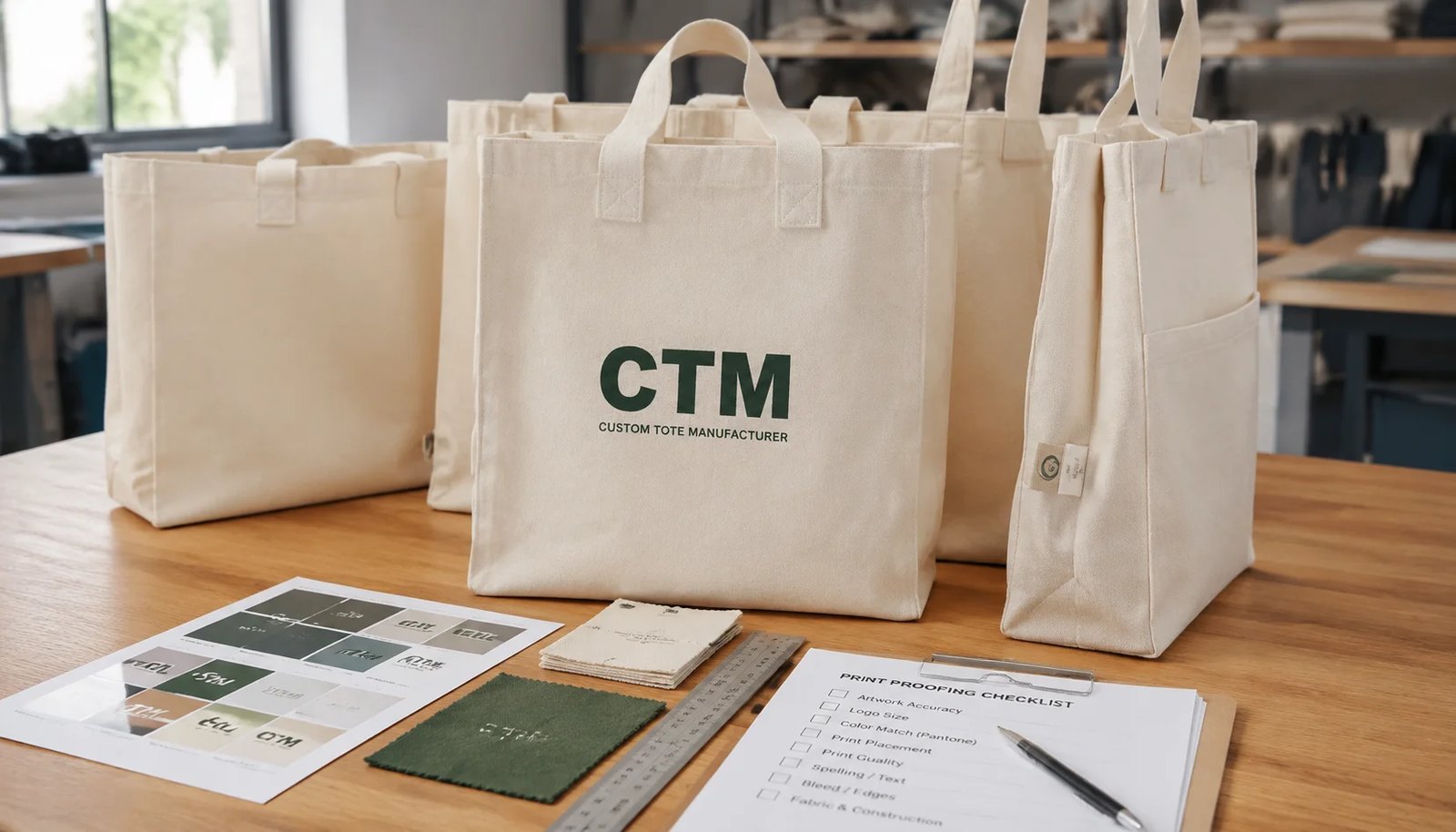
Why print proofing matters more on grocery totes than on standard promo bags
Natural grocers usually reorder bags because the store wants a practical, reusable carry item that also holds up at checkout and on the shelf. That makes print proofing a commercial issue, not only a graphic issue. A logo that looks acceptable on a paper proof can still lose edge sharpness, darken, or fade visually once printed onto absorbent canvas. Grocery totes also tend to use larger print areas than giveaway totes, so any centering error or seam interference becomes obvious in store stacks.
The most common import disputes in this category come from a simple gap: the buyer approved artwork, but the factory printed onto a different fabric base, with different absorbency, different shrink behavior, or a different sew reference. If the order is for natural grocers, earthy brand colors such as olive, black, rust, or forest green are common. These shades are especially sensitive to natural fabric undertone. A proofing process that starts and ends on actual production fabric saves more time than repeated email comments on digital layouts.
- Paper proofs confirm artwork content, not final color behavior on canvas.
- Natural canvas shade variation can make one print batch look warmer or duller than another.
- Large front logos must be reviewed against seam locations, gusset fold, and top hem depth.
- A proofing sequence should cover art layout, strike-off, pre-production sample, and final bulk standard.
Choose the right canvas spec before approving any print file
Print quality starts with the base fabric. For grocery totes, 10 oz to 12 oz canvas, roughly 280-340 GSM, is the practical middle range for most buyers. It carries enough weight for store purchases, gives a stable surface for screen printing, and does not push freight cost as high as very heavy canvas. Below that range, the fabric can feel too promotional and may wrinkle heavily around large printed areas. Above that range, bag folding gets bulky and print hand can feel stiffer unless ink coverage is carefully controlled.
The buyer should also lock the fabric finish before discussing logo tolerance. A bleached or optical-white canvas gives cleaner color contrast and more predictable logo appearance. Natural canvas has a warmer base and may show seed specks or slubs, which many grocers accept as part of the look, but those same features can interfere with fine lines or small reverse text. If recycled content or organic content matters, request fabric swatches early because surface texture can change print edge quality.
- Common workable range: 280-340 GSM for reusable grocery applications.
- Natural canvas looks authentic but can reduce sharpness on small text and thin lines.
- Bleached canvas improves print brightness but may cost slightly more than standard natural fabric.
- If bag body color is dyed, request approval swatch before print strike-off because dye lot affects logo contrast.
Match the print method to the artwork, not to the factory habit
Many tote factories default to screen printing because it is efficient and low cost on simple logos. That is usually the correct route for natural grocer totes, especially for one to three solid colors. But not every logo should be treated the same. Fine typography, halftones, or distressed artwork may look very different on textured canvas. Water-based screen print generally gives a softer hand and retail-friendly look, while plastisol can give stronger opacity on darker dyed bags but may feel heavier. Digital printing works for photo graphics or many colors, yet it can be slower and more expensive on medium MOQs.
Print proofing should therefore evaluate both appearance and failure points. A buyer who only requests a unit price often gets a print method chosen for factory convenience. Better RFQs ask for at least two print method options if the artwork is not straightforward. For example, a 2-color logo with broad shapes may print cleanly by screen print, while a small ingredient-style message under the logo may blur if line weight is too thin. The proofing stage should decide whether to simplify the art, enlarge the text, or move it to a woven label or hangtag.
- Water-based screen print: good for soft hand and common natural-grocer logo use.
- Plastisol: stronger opacity, but heavier feel and more obvious print layer.
- Heat transfer: useful for detail, but durability and hand feel must be tested.
- Digital print: useful for multi-color art, often less cost-efficient on simple bulk logos.
- Thin lines and small reverse text are the first elements to fail on textured canvas.
Build the artwork approval around measurable placement and readable line weights
Artwork approval should not stop at logo width and height. Grocery totes often have gussets, longer handles, and deeper top hems than a basic promo tote. A centered logo on a flat dieline may look off once the bag is stitched, turned, and folded. Instead of approving only a visual mockup, define placement from physical references such as top hem edge, side seam, and panel centerline. This is particularly important if the tote has a side gusset because the front panel visual center can shift if the gusset fold steals part of the print area.
Line weight is the second major approval issue. On canvas, a line that looks safe on screen can partially close or spread in production. As a practical rule, very thin strokes and tiny reverse text should be tested on strike-offs before committing to MOQ. If the buyer needs legal copy, website text, or sub-brand lines under the main logo, it may be more reliable to increase size or use one-color, non-reverse text. The bag is a sewn textile, not a coated paper package, so print legibility must follow textile limitations.
- State logo location in millimeters from top hem and side seam.
- Approve print size against actual sewn panel dimensions, not cut panel only.
- Keep critical artwork away from gusset fold and heavy seam zones.
- Review minimum line thickness and minimum text size on actual fabric strike-off.
- If artwork has a border, add tolerance because slight skew becomes highly visible.
Use a three-stage sample route to prevent bulk print disputes
For this product, the safest approval route is digital layout first, print strike-off second, and pre-production sample third. The digital layout confirms content, scale, and placement intent. The print strike-off confirms how the ink actually behaves on the chosen canvas. The pre-production sample then proves whether the print still looks correct after sewing, folding, and handle attachment. Skipping the middle step is where many buyers lose control, because a sewn sample can hide the fact that the print itself was never approved on the right substrate.
A useful strike-off is not just a color swatch. It should show the actual artwork or at least the critical part of it at real scale on production fabric. If the order uses two print colors, approve both color relationship and opacity. If the bag body is dyed, the strike-off should be done on that dyed fabric, not on natural fabric. Once the pre-production sample is made, compare it against the strike-off and note whether hem depth, seam pull, or body panel tension changed the appearance.
- Stage 1: digital artwork sheet with dimensions and placement references.
- Stage 2: print strike-off on actual bulk fabric with actual ink system.
- Stage 3: pre-production sewn sample using approved print standard.
- Retain one signed standard sample for inspection reference before shipment.
- If retail launch timing is tight, approve strike-off by couriered fabric swatch, not phone photos only.
Understand MOQ logic so print variants do not quietly inflate cost
MOQ on canvas grocery totes is usually driven by fabric sourcing, printing setup, and sewing efficiency together. Buyers often assume MOQ is only about total pieces, but print proofing choices can split the order into smaller cost buckets. One body size in one fabric color with three logo variants may still be combinable if the printer can change screens efficiently and the total run keeps the sewing line busy. However, if each variant also changes bag color, gusset size, or handle length, the order is no longer a simple combined MOQ.
For natural grocers with regional store programs, the best cost structure is usually a common bag body with multiple front prints. This allows bulk fabric purchase and stable sewing output while spreading setup cost. In RFQs, request pricing by total volume and also by artwork split. That reveals whether the printer is charging screen setup once, per color, or per SKU. It also helps buyers compare suppliers fairly, because one quote may look cheap until added screen charges and low-volume surcharges appear after approval.
- MOQ may be set by fabric color, bag size, print color count, and SKU split.
- Shared body spec across stores usually lowers total landed unit cost.
- A 1-color logo is usually more MOQ-flexible than a 3-color registration print.
- Separate dyed body colors can add fabric minimums even if print quantity is high.
- Request clear tool-up, screen, and sample charges outside unit price.
Evaluate quote data with a cost breakdown, not just ex-works unit price
When comparing quotes, the practical question is not who is cheapest per bag, but who is pricing the same build and proofing path. A lower quote may be based on lighter fabric, smaller print area, looser GSM tolerance, simpler handle attachment, or basic packing. For grocery totes, these differences matter in both retail impression and return risk. Procurement teams should request line-item quote data or at least enough notes to normalize offers across suppliers.
Useful quote comparisons include fabric GSM, print method, number of print colors, sample route, reinforcement, packing ratio, and export carton specs. Freight is sensitive to carton size and bag bulk, especially on gusseted canvas. If one supplier quotes 100 pieces per carton and another quotes 50, the warehouse handling profile changes too. A disciplined quote table often exposes where a supplier is pushing risk back to the buyer, such as omitting strike-offs or leaving print tolerance undefined.
- Separate likely cost drivers: fabric weight, dyed fabric, print colors, gusset size, handle webbing, and packing density.
- Screen print setup cost should be visible somewhere in the quote, even if amortized into unit price.
- Heavier GSM reduces complaint risk but increases ocean freight and storage volume.
- Inner packing can add labor but helps DC counting and store allocation.
- If comparing FOB and EXW offers, include inland transport and export handling in the landed comparison.
Set QC thresholds for print, sewing, and load-bearing areas before production starts
Print proofing only works if final inspection uses the same approval logic. For canvas grocery totes, QC should combine visual print standards with physical construction checks. The front logo must match the approved strike-off within an agreed tolerance, but the bag also needs usable reinforcement. Handles that look fine in photos may fail if stitch density is inconsistent or if bartacks are missed. Since grocery use means repetitive lifting, the load-bearing zones deserve equal attention with print appearance.
The most useful QC standard is one that defines rejectable defects clearly. For example, major off-center print, double impression, severe pinholes in large solid logos, broken seam ends, open handle stitch lines, and mixed fabric shades within the same carton should be rejectable. Minor slubs may be acceptable on natural canvas if declared in advance. Without that distinction, inspectors and factories argue over aesthetics instead of applying a predictable threshold.
- Inspect print position against measured tolerance, not visual guesswork.
- Review random pieces for ink rub, cracking, or uneven coverage after curing.
- Test handle attachment strength on random samples if bag is sold for grocery carry use.
- Separate acceptable natural-canvas character from unacceptable front-panel defects affecting logo readability.
- Require carton-level shade consistency if bags are used for retail floor presentation.
Packing details can protect print quality as much as curing quality
Packaging is often treated as an afterthought on tote orders, but poor packing can damage an otherwise acceptable print run. Freshly printed bags stacked too tightly can offset, especially if cure time was short or humidity is high. Heavy folding pressure can also leave crease lines across large logos. For importers shipping to distribution centers, a stable packing plan reduces both cosmetic defects and receiving problems. Flat folding with moderate compression is usually safer than over-packed cartons intended only to reduce freight volume.
Buyers should define inner pack quantity, carton quantity, gross weight limit, and carton dimensions before production. A practical range is often 25 to 50 pieces per polybag depending on bag bulk and whether the tote has thick gussets or long handles. Cartons should be marked with style code, print version, quantity, and PO reference. If several store prints share one shipment, clear carton coding prevents warehouse mis-sorts that are much more expensive than a slightly larger carton.
- Avoid excessive compression that can transfer print or set deep fold marks.
- Use packing ratios that fit receiving and store-allocation workflow, not only freight math.
- Keep carton gross weight manageable for manual handling where required.
- If shipping mixed SKUs, carton marks must clearly separate artwork variants.
- Moisture protection matters on ocean shipments, especially for natural and bleached canvas.
Plan lead time around approvals, material route, and likely delay points
Lead time on custom canvas grocery totes usually fails at the approval stage, not on the sewing line. Standard programs with stock-like natural canvas and simple screen printing may move from sample approval to bulk completion in roughly 25 to 35 days, but that only works if the artwork, strike-off, and pre-production sample are approved without revision loops. Dyed fabric, revised logos, holiday closures, and added store variants can easily extend that by a week or more.
Buyers should break the schedule into approval gates: artwork approval, fabric confirmation, print strike-off, pre-production sample, bulk production, final inspection, and vessel booking. That makes delay ownership visible. If the factory says 30 days, ask how many of those days depend on buyer sign-off and how many are actual production time. This is especially useful when comparing suppliers, because some quote an attractive total lead time while assuming instant approvals or using substitute stock fabric.
- Typical sample window: about 7-10 days depending on print complexity.
- Typical bulk window after approval: about 25-35 days for standard orders.
- Dyed fabric and multi-color registration usually add time.
- Peak season, public holidays, and port booking congestion should be discussed before PO placement.
- A realistic schedule separates material sourcing days from print and sewing days.
Specification comparison for buyers
| Spec decision | Recommended option | When it fits | Buyer risk to check |
|---|---|---|---|
| Fabric weight | 10 oz to 12 oz canvas, about 280-340 GSM | Best for grocery carry use, repeat retail sale, and medium to heavy load without excessive cost | Below about 250 GSM may twist or show print through; above 380 GSM raises freight, slows sewing, and can make folded packing bulky |
| Fabric base color | Dyed or optical-white matched to approved swatch before printing | Needed when brand colors or clean natural-grocer shelf presentation matter | Natural canvas shade variation can shift green or black logo appearance; approve fabric swatch and print on actual fabric, not only paper proof |
| Print method | Water-based screen print for bold 1-3 color logos | Best for grocery tote front branding with solid coverage and good hand feel on canvas | Fine text, halftones, and exact Pantone matching can drift if mesh count, underbase, or fabric absorbency are not controlled |
| Artwork placement | Centered on front panel with 20-30 mm tolerance from seam and top hem | Fits most standard retail totes and avoids seam distortion on gusseted bodies | Large art too close to gusset fold can crack visually or look off-center after sewing; require measured placement from cut panel reference |
| Bag construction | Bottom and side gusset with cross-stitched webbing or self-fabric handles | Preferred for grocery use because bag opens wider and carries boxed items better | Flat totes may be cheaper but are less stable in store use; handle stitching area must be reinforced or return complaints increase |
| MOQ structure | One body spec across 2-3 print variants to combine MOQ | Useful for chains testing multiple regional store graphics while keeping factory efficiency | Separate body sizes or fabric colors usually break consolidation and raise unit cost; clarify whether MOQ is by SKU, colorway, or total order |
| Sample approval route | Digital layout plus physical print strike-off on bulk fabric plus one pre-production sample | Best when print color, ink penetration, and seam-to-art spacing need real-world confirmation | Skipping strike-off often causes disputes over dull ink, pinholes, or logo size; pre-production sample should be from production fabric and print setup |
| Packing method | Folded flat, 25-50 pcs per polybag, export carton with size and print code outside | Works for wholesale and retail replenishment with easier warehouse counting | Over-tight compression can set print offset or seam creases; carton dimensions should match importer pallet plan and avoid over-weight cartons |
| Lead time planning | About 7-10 days for sampling, 25-35 days bulk after approval for standard screen print orders | Realistic for custom canvas totes with fabric sourcing, printing, sewing, and final inspection | Holiday shutdowns, dyed fabric, or multi-color registration can add a week or more; quote should separate raw material lead time from sewing lead time |
Buyer checklist before sampling
- State intended carrying use and target load range so supplier can match canvas GSM and handle reinforcement.
- Specify finished bag size, gusset size, handle width, and handle drop in millimeters, not only inches or a reference photo.
- Identify whether fabric should be natural, bleached, dyed, recycled canvas, or organic cotton canvas if required.
- List acceptable fabric weight tolerance, for example plus or minus 5 percent GSM on finished material.
- Provide artwork in vector format and state whether logo size is measured before or after seam allowance and hem.
- Name the print method you want quoted separately: water-based screen print, plastisol, heat transfer, or digital print.
- Request Pantone references and note where a visual match on canvas is acceptable versus exact lab match requirements.
- Approve print strike-off on actual production fabric before pre-production sample sewing starts.
- Set artwork placement tolerance from top hem and side seam, especially on gusseted tote bodies.
- Define print coverage expectations, including whether minor fabric specking is acceptable on natural canvas.
Factory quote questions to send
- What exact fabric composition, weave, and finished GSM are you quoting, and is the canvas sourced in greige, bleached, or dyed form?
- Is the unit price based on flat tote construction or side-and-bottom gusset construction, and what seam allowance is included?
- Which print method are you using for this artwork, and how many print colors, screens, and strike-offs are included in the quote?
- What is the maximum print area you can hold accurately on this bag size without distortion from seams or gusset folds?
- Can you provide a print strike-off on actual bulk fabric before making the pre-production sample, and what is the added time or cost if any?
- What is the MOQ by SKU, by artwork colorway, and by combined order if body fabric and size stay the same?
- What are the expected tolerances for bag size, handle drop, print placement, and color variation on natural canvas?
- What reinforcement is included at handle joints: box stitch, cross stitch, bartack, or hidden patch reinforcement?
- How many pieces per polybag and per export carton are included, and what carton dimensions and gross weight are expected?
- Does your quote include metal detection, needle control records, third-party inspection support, or only in-house final inspection?
Quality-control points to confirm
- Finished GSM should match approved material within agreed tolerance and feel consistent across random cartons.
- Bag body size, gusset width, and handle drop should meet agreed measurements after sewing and before packing.
- Print color should match approved strike-off under standard daylight conditions, allowing only the agreed visual tolerance on natural canvas.
- Artwork position should stay within stated tolerance from top hem and side seam on both front and back if printed.
- No major pinholes, blurred edges, double print, ghosting, off-registration, or excessive ink buildup on visible logo areas.
- Handle attachment stitches should be even, secure, and free of skipped stitches, with reinforcement pattern matching approved sample.
- Bottom and side seams should be straight, locked, and without open seam ends or severe puckering.
- Fabric should be free from major stains, slubs affecting logo legibility, holes, shade panels, and unacceptable weave bars on front panels.
- Packing should prevent print offset, moisture exposure, and carton collapse during ocean transit or warehouse stacking.