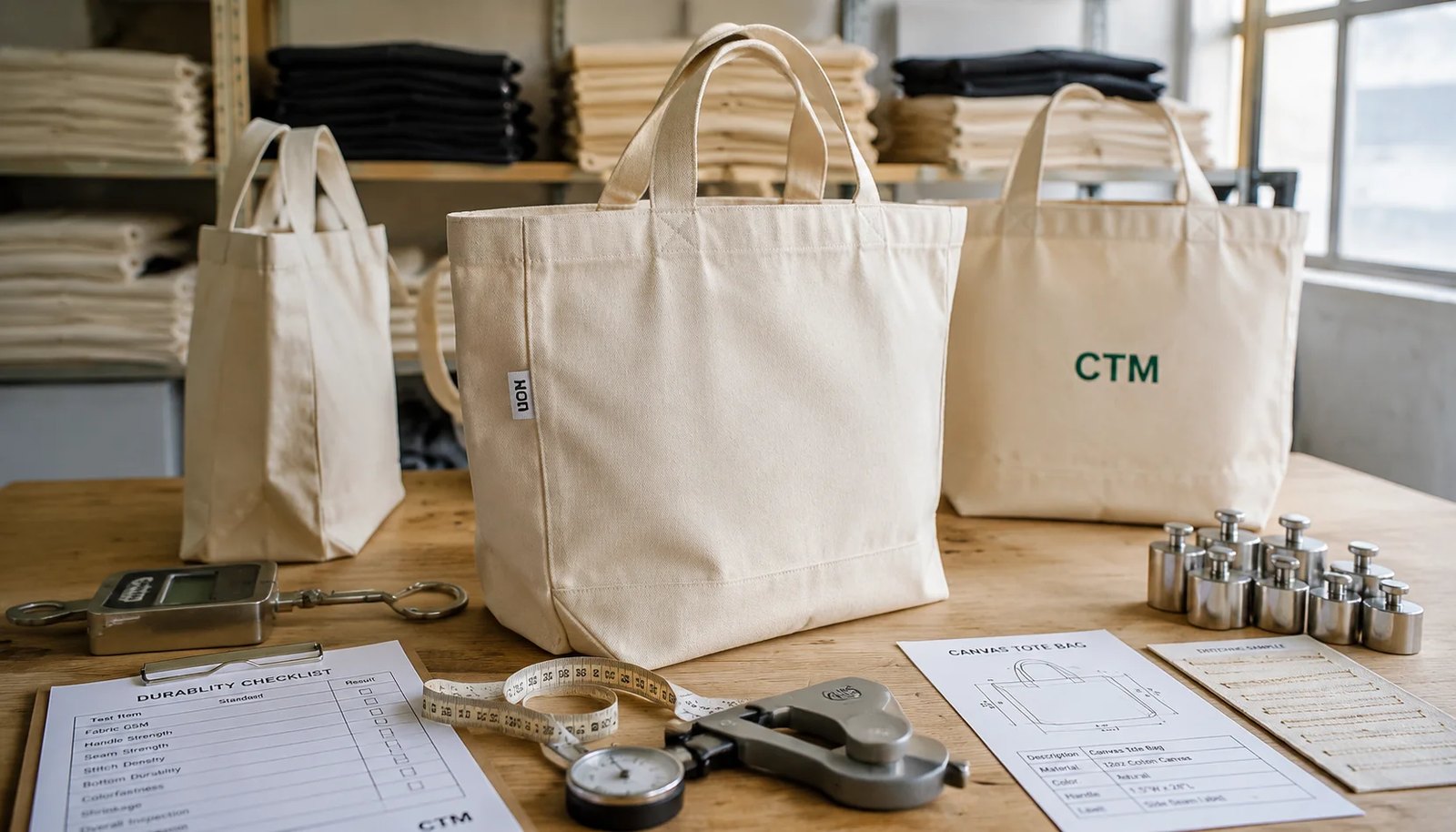
Start with the grocery use case
Canvas totes for natural grocers are not the same as light event giveaways. They may be sold at checkout, used in loyalty programs, packed by cashiers, carried through parking lots, folded into carts, and reused for mixed grocery trips. The bag has to look natural and brand-appropriate, but procurement should judge it first as repeat-use packaging.
The RFQ should define the actual use: retail resale, private-label merchandise, customer reusable bag, store opening gift, or staff operations bag. Each use changes the risk. A tote sold as merchandise needs cleaner sewing and more consistent print placement. A checkout-use tote needs stronger handles and predictable packing shape. A private-label natural grocer may also need hangtags, belly bands, UPC labels, carton segregation, or retail-ready folding.
Natural grocer programs also have category-specific pressures. Produce can be damp. Glass bottles and jars create point loads. Natural canvas shows stains, odor, and shade mismatch more readily than synthetic materials. Some markets regulate reusable checkout bags by minimum durability, washability, labeling, recycled content, or fee rules. Procurement should check local requirements before locking a fabric and claim.
- Define the channel: resale, checkout, promotion, loyalty, or private-label retail
- List the normal contents: produce, bottles, jars, cans, boxes, and chilled items
- Confirm any reusable bag rules or labeling requirements in the selling market
Specify fabric by finished performance
Terms such as heavy canvas or premium cotton are not enough for a factory quote. For many grocery tote programs, 12 oz to 14 oz canvas, roughly 340-400 GSM finished, is a practical baseline. It usually balances strength, sewing behavior, customer comfort, and freight weight. Heavier cloth can suit premium resale bags, but it increases cost, stiffness, and carton weight.
The important point is finished fabric, not only the nominal cloth name. Ask for GSM tolerance, fiber content, weave, and whether the fabric is natural, bleached, dyed, washed, or treated. A 12 oz canvas from one supplier may not behave the same as another if yarn, weave density, finishing, or shrinkage differs.
For natural canvas, agree on the visual standard early. Minor yarn slubs may be part of the material character, but stains, mildew odor, holes, oil marks, and severe shade mismatch should be rejectable. If handles are cut from a different roll or batch, shade difference can make an otherwise sound bag look inconsistent on shelf.
- Use a finished GSM target such as 380 GSM +/-5%
- Ask whether the quote is based on greige, natural, bleached, dyed, washed, or finished fabric
- Approve a shade range and defect standard for natural canvas before bulk cutting
Choose dimensions that carry well
Bag size affects durability as much as fabric weight. A very large tote encourages customers or cashiers to overload it. A wide shallow tote can twist under bottles and jars. A narrow tall tote may hide contents and feel unstable at checkout. The best shape is usually the one that carries a realistic grocery mix without asking the handle roots to solve every problem.
A practical starting point is 35-40 cm width, 35-38 cm height, and a 10-15 cm bottom gusset. That is not a universal rule; it is a useful range for sampling. The final size should be tested with the actual products the bag is expected to carry. If the tote needs to stand upright at checkout or on a retail display, gusset balance and fabric stiffness matter.
Handle drop should be tested for both hand carry and shoulder carry. Longer handles improve comfort but can cause the bag to drag or swing when loaded. Shorter handles may be stronger in use but less convenient. Set handle width and drop tolerances so bulk production does not drift from the approved sample.
- Control width, height, bottom gusset, and side gusset separately
- Test the filled bag, not only the flat measurement
- Set handle drop tolerance, for example +/-0.8 cm, and handle width tolerance, for example +/-0.3 cm
Engineer the usual failure points
Most grocery tote failures start at handle roots, bottom seams, side seams, or gusset corners. A strong body panel does not help if the handle attachment opens after repeated lifting. The PO should describe the reinforcement, not just request strong handles.
A box stitch with cross reinforcement at all four handle roots is a common baseline for durable canvas grocery totes. Some programs add bar-tacks, but they should be specified by count and position. Structural seams often work well around 7-9 stitches per inch on medium to heavy canvas, assuming suitable thread, needle, and tension. Too few stitches can reduce seam strength; poor tension can cause loose loops or puckering even when stitch count looks acceptable.
Thread choice should match the use. Polyester or poly-core thread is often practical for strength and consistency, while a cotton-look finish may better fit natural brand aesthetics. The supplier should state the thread type rather than leaving it to the sewing line.
- Specify box stitch, cross stitch, and bar-tack use in writing
- Inspect all four handle roots, not just the most visible side
- Control stitch density, thread type, loose ends, skipped stitches, and back-tacking
Set pass/fail durability tests
Durability testing only helps when the test has numbers. A supplier photo of a loaded tote does not tell you the load, hold time, cycle count, or failure definition. Procurement should set the load test before sampling so every quote and sample is judged against the same expectation.
A useful baseline is a static load test of 15 kg held for 2 hours on the approved pre-production sample. After the hold period, the tote should show no handle detachment, no broken structural seams, no seam slippage over 6 mm at key load seams, and no deformation that prevents normal use. If the program is regulated or intended for heavier loads, raise the threshold and document why.
Static strength does not prove repeat-use performance. Add a cyclic carry test, such as 10 kg for at least 500 lift cycles. The apparatus can vary by factory, but the record should show the load, cycle count, sample identity, and result. Inspect the same handle roots and gusset seams before and after the test.
- Static baseline: 15 kg x 2 hours
- Cyclic baseline: 10 kg x 500 lift cycles minimum
- Failure limit: no broken seams, no detached handles, and no seam slippage above 6 mm
Use recognized methods where practical
Not every tote order needs a full laboratory program, but recognized methods make buyer and supplier communication more precise. ASTM D3776 is commonly used for fabric mass per unit area. ISO 13935-2 or ASTM D1683 may be used for seam strength depending on factory or lab capability. For rubbing or colorfastness, ISO or AATCC methods may be relevant when dyed fabric, dyed handles, or colored print areas could transfer.
The test plan can be tiered. A lower-risk replenishment order may use factory measurement logs, a retained approved sample, and in-house load testing. A new private-label retail style, larger order, dyed material, or claim-bearing product may justify third-party confirmation. The buyer should decide the escalation point before production starts.
Dimensional checks do not need complex lab language, but measuring points must be clear. Define whether width is measured at the top opening or body panel, whether gusset is measured flat or expanded, and whether handle drop is measured from the top edge to the handle apex.
- Reference ASTM D3776 for fabric mass where useful
- Use ISO 13935-2 or ASTM D1683 for seam strength when lab confirmation is needed
- Define measuring points on the spec sheet so inspectors measure the same way
Make sample approval evidence-based
A sample approval process should confirm both appearance and performance. Many tote approvals focus on logo size, color, and placement, while handle roots and seam interiors receive little attention. For grocery use, the approved sample should be measured, photographed, loaded, cycled when required, and retained.
Request flat front and back photos, side and bottom gusset photos, inside seam photos, and close-ups of all handle attachments. Record actual body dimensions, gusset width, handle drop, handle width, stitch pattern, and print placement. If the printed sample is approved but the durability sample is separate, connect both records to the same style revision.
The pre-production sample should represent bulk production. If the supplier hand-makes a sample with extra care, different thread, different canvas, or a different print process, it is not a reliable standard. The approval record should state the sample code, date, revision, test result, and any approved exceptions.
- Do not approve a grocery tote on artwork alone
- Keep one retained approved sample for buyer reference and one for factory reference
- Record test results and measurements before bulk production release
Write QC tolerances before production
AQL inspection works best when the defect standard is already agreed. For reusable canvas totes, common measurable points include fabric weight, body dimensions, gusset width, handle drop, handle width, handle-root construction, stitch quality, print placement, shade, odor, stains, and carton identity.
A practical final inspection baseline is AQL 2.5 for major defects and 4.0 for minor defects, with zero tolerance for critical defects. Critical defects usually include mold or mildew contamination, missing handles, broken load-bearing seams, unsafe contamination, or wrong SKU identity. Major defects may include severe print offset, broken stitches at handle roots, dimensions outside tolerance, large stains, mismatched panels, or carton mispack. Minor defects may include small loose threads or slight cosmetic irregularities if they do not affect use or retail presentation.
The written standard should separate natural material character from poor workmanship. Natural canvas can have limited slubs and small shade variation, but that does not excuse dirty panels, odor, holes, needle cuts, or obvious weaving flaws.
- Use AQL 2.5 major / 4.0 minor as a common export baseline
- Make critical defects zero tolerance
- Tie the inspection checklist to the retained approved sample and written tolerances
Protect retail condition in packing
Packing decisions affect usable quality. Over-compressed cartons can create hard fold marks, distorted handles, and print blocking if ink cure is incomplete. Natural canvas can absorb odor and moisture, and it shows dirt transfer more easily than darker synthetics. Packing should be part of the RFQ, not an afterthought.
For many grocery tote programs, 25-50 pieces per export carton is a workable range depending on bag size, fabric weight, labels, and inserts. Set a maximum gross carton weight that your warehouse can handle, often in the 12-18 kg range. Confirm fold method, whether print faces inward or outward, and whether bags are bundled, tied, belly-banded, tagged, or individually packed.
If the buyer avoids individual polybags for sustainability reasons, the supplier still needs a cleanliness and moisture plan. Use clean cartons, inner liners where appropriate, controlled storage, and clear carton markings. For multiple store logos or destinations, carton labels should show PO number, SKU, quantity, destination, and version to prevent misallocation.
- Set pieces per carton and max gross carton weight
- Confirm fold method before production packing starts
- For no-polybag programs, require clean cartons and moisture protection
Compare quotes on landed value
A low unit price is not meaningful if the compared bags are different. Normalize fabric GSM, finished size, gusset style, handle construction, print method, sample stages, load testing, AQL level, packing, carton cube, lead time, and inspection support before ranking suppliers.
Ask each supplier to state what is included and what changes the price. Testing may be included by one factory and treated as an extra by another. A heavier canvas may raise unit price but reduce complaint risk for a resale program. A tighter carton weight limit may increase carton count but improve handling and retail condition. These are landed-value decisions, not just material decisions.
The strongest supplier offer is usually the one with the fewest hidden assumptions. It should identify the exact material, construction, testing evidence, approval process, defect standard, packing method, and production lead time. That gives procurement a controllable order and gives the factory a clear target.
- Normalize all technical assumptions before comparing unit price
- Ask what testing, samples, packing, and inspection support are included
- Choose the offer that is easiest to verify, repeat, and inspect
Specification comparison for buyers
| Cost driver | Lower-risk procurement choice | What to compare across suppliers | Buyer risk to control |
|---|---|---|---|
| Fabric weight | 12 oz to 14 oz canvas, about 340-400 GSM finished | Finished GSM target, tolerance, fiber content, weave, and shrinkage behavior | Nominal oz labels can hide lighter finished cloth; require GSM tolerance such as +/-5% |
| Handle construction | Box stitch with cross reinforcement at four handle roots; bar-tack if required | Handle width, drop, stitch pattern, thread, reinforcement size, and SPI | Straight stitching may pass a visual check but fail under repeated grocery loads |
| Bag shape | Bottom gusset 10-15 cm; side gussets only when merchandising or standing shape requires them | Finished width, height, gusset, usable volume, and carton impact | Oversized bags increase load stress, freight cube, and customer discomfort if handles are not matched |
| Print method | Water-based screen print for 1-3 color natural canvas programs | Ink type, print size, color count, curing, placement tolerance, and strike-off approval | Large solids on textured canvas may show pinholes or fold cracking if not tested on production fabric |
| Testing package | Static load plus cyclic carry test on pre-production sample | 15 kg x 2 hours, 10 kg x 500 cycles, seam slippage limit, and written pass/fail result | A photo of a loaded bag is not a durability test unless the load, time, and failure criteria are defined |
| Inspection plan | AQL 2.5 major / 4.0 minor with zero tolerance for critical defects | Sample size, defect classes, approved sample access, and third-party inspection support | Without agreed AQL and defect definitions, shipment disputes become subjective |
| Packing format | Clean export cartons, controlled carton weight, no over-compression | Pieces per carton, gross weight, fold method, carton marking, moisture protection, and no-polybag handling | Poor packing can damage print surfaces, create hard folds, or expose natural canvas to odor and dirt |
| Landed value | Comparable spec, comparable test evidence, comparable packing and lead time | Unit price, testing cost, sample cost, carton cube, inspection cost, and rework exposure | The cheapest quote may be a different bag if GSM, reinforcement, testing, or packing assumptions vary |
Buyer checklist before sampling
- Define the end use in the RFQ: retail resale, loyalty program, private-label merchandise, checkout bag, or staff/store operations bag
- State the expected grocery load, including bottles, jars, cans, boxed goods, produce, and occasional chilled or damp items
- Specify finished fabric weight in GSM or oz with tolerance, for example 380 GSM +/-5%, rather than only saying cotton canvas
- Confirm fiber content, weave, natural canvas shade range, and whether any bleaching, dyeing, or washing process is included
- Set finished size as width x height x gusset, with tolerances such as body dimensions +/-1 cm and gusset width +/-0.7 cm
- Set handle drop and width tolerances, for example handle drop +/-0.8 cm and finished handle width +/-0.3 cm
- Write handle reinforcement into the PO: box stitch size, cross stitch, bar-tack count if used, thread type, and stitch density target
- Require a pre-production sample to pass static load and cyclic carry testing before bulk cutting or full production approval
- Reference recognized methods where practical, such as ASTM D3776 for fabric mass and ISO 13935-2 or ASTM D1683 for seam strength
- Define acceptable natural canvas character versus defects: minor slubs may be acceptable, but stains, mildew odor, holes, and severe shade mismatch are not
Factory quote questions to send
- What is the exact fabric construction, finished GSM target, tolerance, weave, and fiber content of the quoted canvas?
- Is the canvas natural, bleached, dyed, washed, or treated, and what shade variation should we expect between lots?
- Which recognized test methods can you support for fabric weight, seam strength, rubbing/colorfastness, and dimensional checks?
- What static load test can you perform on the pre-production sample, at what weight and hold time, and what is your written pass/fail definition?
- Can you run a cyclic handle-lift test; if yes, how many cycles, at what load, and what record will you provide?
- How are the handles attached at all four points: stitch pattern, SPI, thread specification, reinforcement size, and bar-tack use?
- What seam strength or seam slippage controls do you apply on side seams, bottom seams, gussets, and handle-root areas?
- Which print method is included in the quote, and what print coverage, color count, curing method, and placement tolerance are assumed?
- Can you provide a strike-off on the actual production canvas before bulk printing?
- What sample stages are available: blank sample, printed sample, pre-production sample, test sample, and retained golden sample, and which are chargeable?
Quality-control points to confirm
- Finished fabric weight must meet the approved spec tolerance, for example 380 GSM +/-5%, measured on finished goods using an agreed method such as ASTM D3776
- Body dimensions must remain within +/-1 cm of approved size; gusset width within +/-0.7 cm; visible skew should not affect folding, standing, or retail presentation
- Handle drop must be within +/-0.8 cm of approved spec, and the difference between two handles on one bag should not exceed 0.5 cm
- Finished handle width should be within +/-0.3 cm, with no twisting, rolling, or visibly uneven handle-root alignment
- Structural seams should target 7-9 SPI unless otherwise approved, with no skipped stitches, broken thread runs, open back-tacking, or loose ends over 1 cm on retail-facing areas
- Handle-root reinforcement must match the approved construction at all four attachment points; box stitch and cross pattern variance should remain within +/-0.5 cm of the approved sample
- After agreed load testing, there should be no seam breakage, handle detachment, seam slippage above 6 mm at key load seams, or permanent distortion that prevents normal use
- Print placement should remain within +/-0.7 cm left-right and +/-1 cm vertical from the approved artwork position
- Print quality must match the approved strike-off for color density and registration, with no severe smearing, ghosting, cracking, or objectionable pinholing in critical logo areas
- Natural canvas should be free from oil stains, mildew odor, needle cuts, holes, major panel shade mismatch, and obvious weaving defects; minor yarn slubs are acceptable only if pre-approved