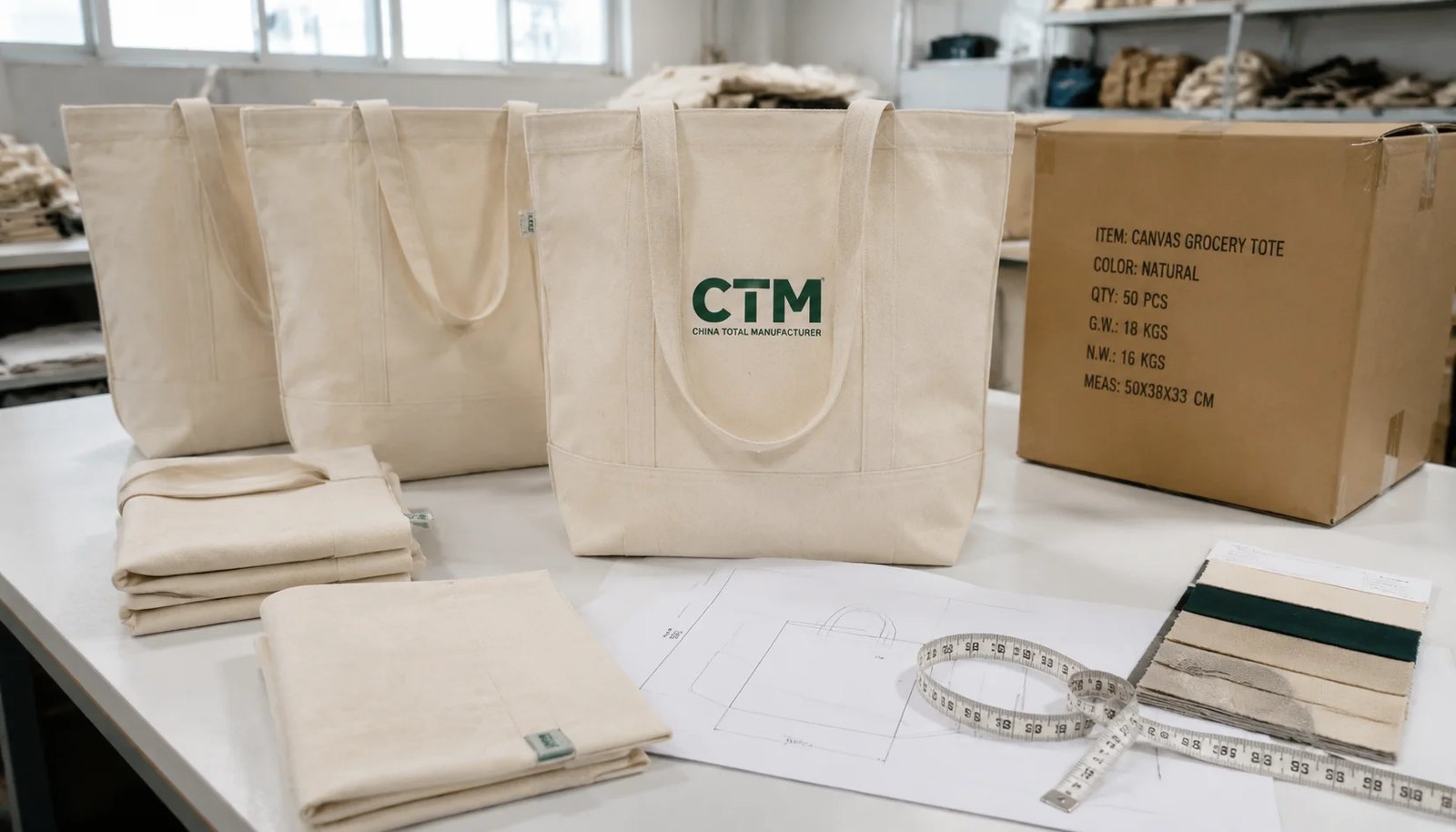
Start With The Grocery Use Case
Canvas grocery totes for natural grocers are not the same as thin promotional cotton bags. They are handled at checkout, loaded with produce, glass bottles, boxed goods, supplements, and sometimes frozen items. The packing plan must support the product promise: durable, reusable, natural-looking, and easy for store teams to receive and distribute.
Before quoting, separate the order into its real commercial use. A tote sold as retail merchandise needs better folding, cleaner stitching, more controlled print position, and possibly hangtags or barcode labels. A free store-opening tote may allow simpler bulk packing, but it still needs enough strength to avoid brand damage. This early decision changes fabric weight, carton count, inspection level, and landed cost.
- Retail resale tote: prioritize fabric handfeel, sewing finish, barcode readiness, and carton presentation.
- Promotional giveaway: prioritize unit cost, fast production, high carton efficiency, and basic QC coverage.
- Store replenishment program: prioritize repeatable specs, stable fabric supply, and consistent carton dimensions.
- Distributor stock tote: prioritize neutral packing, SKU separation, and warehouse-friendly carton markings.
Choose Canvas Weight By Load, Not Habit
For grocery use, 10 oz to 12 oz canvas is often the practical range. In GSM terms, this is roughly 340 to 407 GSM, depending on yarn, weave, and finishing. An 8 oz canvas may be acceptable for light promotional events, but it usually feels less substantial when the bag is loaded with jars or heavy produce. Heavier 14 oz canvas gives a premium handfeel but increases sewing difficulty, carton volume, and freight cost.
Natural grocer buyers often prefer an unbleached canvas appearance because it matches organic and low-waste positioning. That choice needs honest tolerance management. Natural canvas can show cotton seed flecks, small slubs, and shade variation. These are not always defects, but oil spots, dark stains, large weaving flaws, and obvious shade panels should be controlled. The RFQ should define acceptable natural characteristics instead of leaving the factory and inspector to argue later.
- 8 oz canvas: lighter, lower cost, better for giveaways, weaker retail feel for grocery loads.
- 10 oz canvas: good balance for reusable grocery totes with controlled cost and packing volume.
- 12 oz canvas: stronger handfeel and better retail perception, with higher CBM and sewing cost.
- 14 oz canvas: premium and durable, but may reduce pieces per carton and raise freight per unit.
Build The Tote Around Real Basket Volume
A grocery tote needs usable volume, not just a large flat panel for a logo. The important dimensions are finished width, finished height, gusset depth, and handle drop. A common retail grocery tote might use a wide side and bottom gusset so the bag can stand more easily and accept boxed goods. Flat totes are cheaper and pack tightly, but they behave more like document bags than grocery bags.
Handle engineering is a common weak point in cheap quotes. Self-fabric handles should have enough width for comfort and enough reinforcement for repeated loading. Box-X stitching, dense bartacks, or well-executed cross-stitch reinforcement are better than a simple straight seam. If the tote is expected to carry heavy groceries, include a basic load test requirement in the QC plan rather than relying on a visual inspection only.
- Finished size must be measured after sewing and pressing, not from cut panels.
- Gusset width should match the expected grocery basket, often more important than adding extra height.
- Handle drop should clear bulky contents but not drag when carried by hand.
- Reinforcement stitches should be neat, dense, and consistently placed on all handles.
Match Print Method To Brand Artwork
Most canvas grocery totes use screen printing because it is cost-efficient, durable, and clean for solid-color logos. Water-based ink is often a good match for natural grocers because it keeps a softer handfeel than heavy plastisol-style prints. For simple CTM-style sample logos, store names, produce icons, or short slogans, one to three screen print colors normally keep cost and production risk under control.
Artwork with gradients, photographic effects, or many colors changes the quote structure. Digital print can handle more detail, but it may require higher unit cost, extra pretreatment, and different rub or wash testing. Heat transfer can look sharp but may feel less natural and can crack or peel if poorly selected. The safest buying approach is to request a print strike-off on the actual canvas, then approve color, edge sharpness, ink penetration, and placement before mass production.
- For natural canvas, PMS color can shift because the fabric base is not pure white.
- Large solid print areas may feel stiff and can show uneven ink coverage on coarse canvas.
- Artwork close to seams or gussets needs wider placement tolerance.
- Repeat orders should keep the same mesh, ink reference, and approved strike-off record.
Understand MOQ Logic Before Negotiating
Canvas tote MOQ is rarely just one number. A factory may quote a low total MOQ, but the real limits can sit inside fabric procurement, dyeing, cutting efficiency, print setup, and packing labor. A 2,000-piece order in one natural canvas color with one print is different from 2,000 pieces split across four store logos and three ink colors. The second order creates more setup time, more print screens, more labeling risk, and more carton segregation.
For natural grocers with multiple store locations or regional branding, the cleanest negotiation is often to consolidate the base bag spec and split only the print artwork. This helps the factory buy fabric efficiently and keep sewing consistent. If several artwork versions are required, the buyer should request the MOQ per artwork and any screen charges separately. That makes quote comparison fair and prevents hidden costs from being buried in the unit price.
- Clarify MOQ per fabric color, not only total order quantity.
- List every artwork version and print color count in the RFQ.
- Separate tooling, screen, label, and sample costs from unit price.
- Ask whether overrun or underrun tolerance applies to each SKU.
Turn Carton Packing Into A Cost Item
The carton packing plan affects freight, warehouse receiving, damage rate, and store distribution. For canvas grocery totes, factories often fold bags flat and pack them in bulk by artwork and color. This is efficient, but it can create deep fold marks across the print if the fold line is poorly placed or cartons are over-compressed. Buyers should approve the folding method and carton count before mass packing starts.
A practical carton target keeps gross weight manageable while using carton volume efficiently. Many buyers prefer cartons under about 15 to 18 kg for easier manual handling, but the right limit depends on the warehouse and import country. Very large cartons can crush bottom-layer bags and fail retail receiving expectations. Very small cartons increase handling cost, carton material cost, and CBM. The quote should include pieces per carton, carton dimensions, net weight, gross weight, and CBM.
- Bulk folded packing is efficient for warehouse distribution and lower plastic use.
- Individual polybags protect each tote but add cost, labor, plastic, and carton volume.
- Paper belly bands improve retail presentation but require extra material and packing labor.
- Carton labels should identify SKU, artwork, quantity, PO, carton number, and destination.
Plan Samples That Prevent Production Mistakes
A single photo sample is not enough for a canvas grocery tote program. The buyer should move through a controlled sample sequence: fabric swatch, print strike-off, prototype sample, and pre-production sample. Each sample answers a different question. The fabric swatch confirms weight and handfeel. The strike-off confirms ink behavior. The prototype confirms construction. The pre-production sample confirms the actual approved materials and workmanship before bulk output.
Sample comments should be written as measurable corrections, not general preferences. Instead of saying the handle feels short, state the required handle drop. Instead of saying the logo is too low, state the distance from the top seam or bottom edge. The approved sample should also show folding and packing if carton efficiency is important. A tote that looks good unfolded may create problems when folded into a tight export carton.
- Approve fabric by weight, color tone, surface cleanliness, and shrinkage if relevant.
- Approve print by color, edge quality, handfeel, placement, and rub result.
- Approve sewing by finished size, seam allowance, handle reinforcement, and loose-thread standard.
- Approve packing by fold direction, pieces per carton, carton mark, and inner protection.
Set Inspection Thresholds That Fit Retail
Inspection for grocery totes should focus on defects that affect function, brand appearance, and receiving accuracy. Critical defects include mold, contamination, broken needles, unsafe metal pieces, and wrong artwork. Major defects include broken stitches at handles, severe stains, wrong size outside tolerance, badly skewed print, missing labels, and incorrect carton quantity. Minor defects include small loose threads, slight natural slubs within tolerance, and small print specks that are not visible at normal viewing distance.
Load testing deserves a place in the QC plan for reusable grocery bags. The test does not need to be complicated, but it should be consistent. For example, the factory and inspector can agree on a test weight, hanging duration, and acceptance condition. Handle seams should not tear, stitches should not pop, and the fabric around reinforcement should not distort excessively. Without this requirement, an inspection can pass bags that look fine but fail under real shopping use.
- Use defined AQL levels for visual inspection, with separate critical, major, and minor categories.
- Measure finished size across a sample set, including gusset and handle drop.
- Perform print rub checks on dark ink, large print areas, and high-friction fold locations.
- Open random cartons to verify count, SKU mix, carton label, and packing condition.
Compare Quotes On Landed Cost
The lowest unit price can become the expensive option when carton volume, packing method, reject rate, and receiving labor are added. A thicker canvas may raise unit price but improve resale value and reduce complaints. Individual polybags may protect goods but increase CBM and conflict with a low-plastic retail policy. A smaller carton may be easier to lift but increase carton count and destination handling charges.
Procurement teams should compare quotes using a simple landed-cost worksheet. Include unit price, sample charges, screen charges, label or hangtag cost, carton cost if special, inland freight, export charges, ocean or air freight estimate, duty basis, inspection cost, and expected destination handling. For canvas grocery totes, CBM per 1,000 pieces is especially useful because fabric thickness and folding style can move freight cost more than buyers expect.
- Request CBM per carton and calculate CBM per 1,000 pieces.
- Compare gross weight per carton against warehouse handling limits.
- Separate required packing costs from optional retail presentation costs.
- Treat repeatability and defect risk as commercial factors, not only QC issues.
Protect The Lead Time From Late Changes
Canvas tote lead time depends on fabric availability, printing setup, sewing capacity, sample approval speed, inspection booking, and shipping space. A factory may quote production days after sample approval, while the buyer reads it as days from purchase order. That mismatch causes late delivery. The RFQ should state the lead time trigger clearly: deposit received, artwork approved, fabric ready, pre-production sample approved, or all of these completed.
Late artwork changes are one of the most common schedule risks. A small logo revision can require new screens, new strike-offs, or reapproval from the brand team. Packing changes can also delay the order because carton size, labels, barcode files, and warehouse routing may need to be updated. The most reliable schedule holds a freeze date for artwork, tote construction, packing method, carton mark, and inspection standard.
- Build time for fabric procurement before counting sewing production days.
- Book inspection after the factory confirms packed quantity, not only sewing completion.
- Freeze artwork before screens are made to avoid rework and schedule loss.
- Confirm shipping mode early because air freight and ocean freight favor different carton strategies.
Specification comparison for buyers
| Spec decision | Recommended option | When it fits | Buyer risk to check |
|---|---|---|---|
| Fabric weight | 10 oz to 12 oz cotton canvas, roughly 340 to 407 GSM | Reusable grocery totes that must stand repeated loading without feeling too heavy at checkout | Quotes using 8 oz canvas may look cheaper but can sag, show print strike-through, and reduce perceived retail value |
| Bag construction | Boxed bottom or wide gusset with reinforced handle stitching | Natural grocers selling bulk produce, jars, supplements, and mixed basket items | Flat totes pack tighter but hold less volume and may fail buyer expectations for grocery use |
| Print method | Water-based screen print for 1 to 3 solid colors | Brand logos, store slogans, organic/natural positioning, and medium to large production runs | Digital print can be useful for gradients but may increase unit cost and require stricter wash/rub testing |
| Handle style | Self-fabric canvas handles with cross-stitch or box-X reinforcement | Retail grocery bags positioned as durable reusable merchandise | Webbing handles can be strong but may change appearance, color matching, and packing thickness |
| MOQ planning | Negotiate by fabric color, print color count, and carton quantity, not only total pieces | Programs with several store locations or seasonal replenishment | Multiple artwork versions split the MOQ and can increase setup, wastage, and sample rounds |
| Inner packing | Bulk folded packing by color/artwork with moisture protection, unless retail barcode polybags are required | Store distribution, wholesale cartons, or backroom merchandising | Individual polybags add labor, plastic cost, carton volume, and may conflict with natural grocer packaging policies |
| Carton size | Export carton sized to keep gross weight usually under 15 to 18 kg while avoiding over-compression | Ocean freight, LCL shipments, and mixed SKU consolidation | Oversized cartons crush lower layers and create receiving complaints; very small cartons increase handling and CBM |
| Sample approval | Pre-production sample approved for fabric handfeel, gusset depth, print position, folded size, and carton count | Any order where the tote will be sold or distributed through retail stores | Approving only a flat photo misses handle drop, load behavior, color cast, and carton packing fit |
Buyer checklist before sampling
- Define the tote use case first: paid retail merchandise, loyalty giveaway, staff shopping bag, or store opening promotion.
- Specify finished size, gusset depth, handle drop, fabric weight in oz or GSM, and whether shrinkage allowance is acceptable.
- State whether the canvas must be natural, bleached, dyed, recycled cotton blend, organic cotton, or conventional cotton.
- Lock print artwork size, color count, print placement tolerance, and whether PMS matching is required on natural canvas.
- Decide whether individual barcode labels, hangtags, belly bands, or plain bulk packing are needed before requesting final quotes.
- Set target carton quantity per carton and maximum carton gross weight for warehouse handling and retail receiving.
- Request carton dimensions, net weight, gross weight, CBM, and estimated pieces per 20 ft or 40 ft container.
- Approve a folded packing sample or packing photo before mass production packing begins.
- Include inspection criteria for fabric stains, loose threads, handle reinforcement, print registration, and carton markings.
- Reserve time for fabric procurement, print strike-off, pre-production sample approval, bulk production, inspection, and shipment booking.
Factory quote questions to send
- What exact fabric weight will be used, in oz and GSM, and is the weight measured before or after finishing?
- Is the canvas greige, washed, bleached, dyed, recycled blend, or certified organic cotton, and what documentation can be supplied?
- What is the finished bag size, gusset width, handle width, and handle drop after sewing tolerance?
- Which print method is quoted, how many colors are included, and what is the maximum print area included in the price?
- What is the MOQ per fabric color, per print artwork, and per shipment lot?
- What sample types are included: material swatch, print strike-off, prototype sample, and pre-production sample?
- How many pieces fit in one export carton under the proposed folding method, and what are the carton dimensions and gross weight?
- Are inner polybags, barcode labels, hangtags, recycled paper belly bands, silica gel, or master carton labels included or extra?
- What inspection standard will the factory accept for major and minor defects, and can load testing be added?
- What lead time is counted from deposit, artwork approval, sample approval, or fabric arrival?
Quality-control points to confirm
- Fabric weight tolerance should be defined, commonly within an agreed range such as plus or minus 5 percent, rather than described only as heavy canvas.
- Finished size tolerance should cover width, height, gusset, and handle drop; grocery totes need enough usable volume after seams are sewn.
- Handle reinforcement must be consistent, with box-X or dense bartack stitching cleanly placed and no skipped stitches at stress points.
- Print position tolerance should be agreed before production, especially when artwork sits close to the gusset fold or top hem.
- Print adhesion and rub resistance should be reviewed on the actual canvas color, not only on white test cloth.
- Natural canvas should be inspected for oil marks, weaving slubs, black specks, and shade variation according to an agreed acceptance limit.
- Carton compression should not deform the bottom layers of bags or leave hard fold marks across the printed logo.
- Carton labels should match SKU, artwork version, color, quantity, gross weight, net weight, PO number, and destination requirements.
- Random carton count checks should verify actual pieces per carton before shipment, not only total packed quantity.
- Moisture protection should be suitable for cotton canvas, especially for ocean freight and humid-season production.