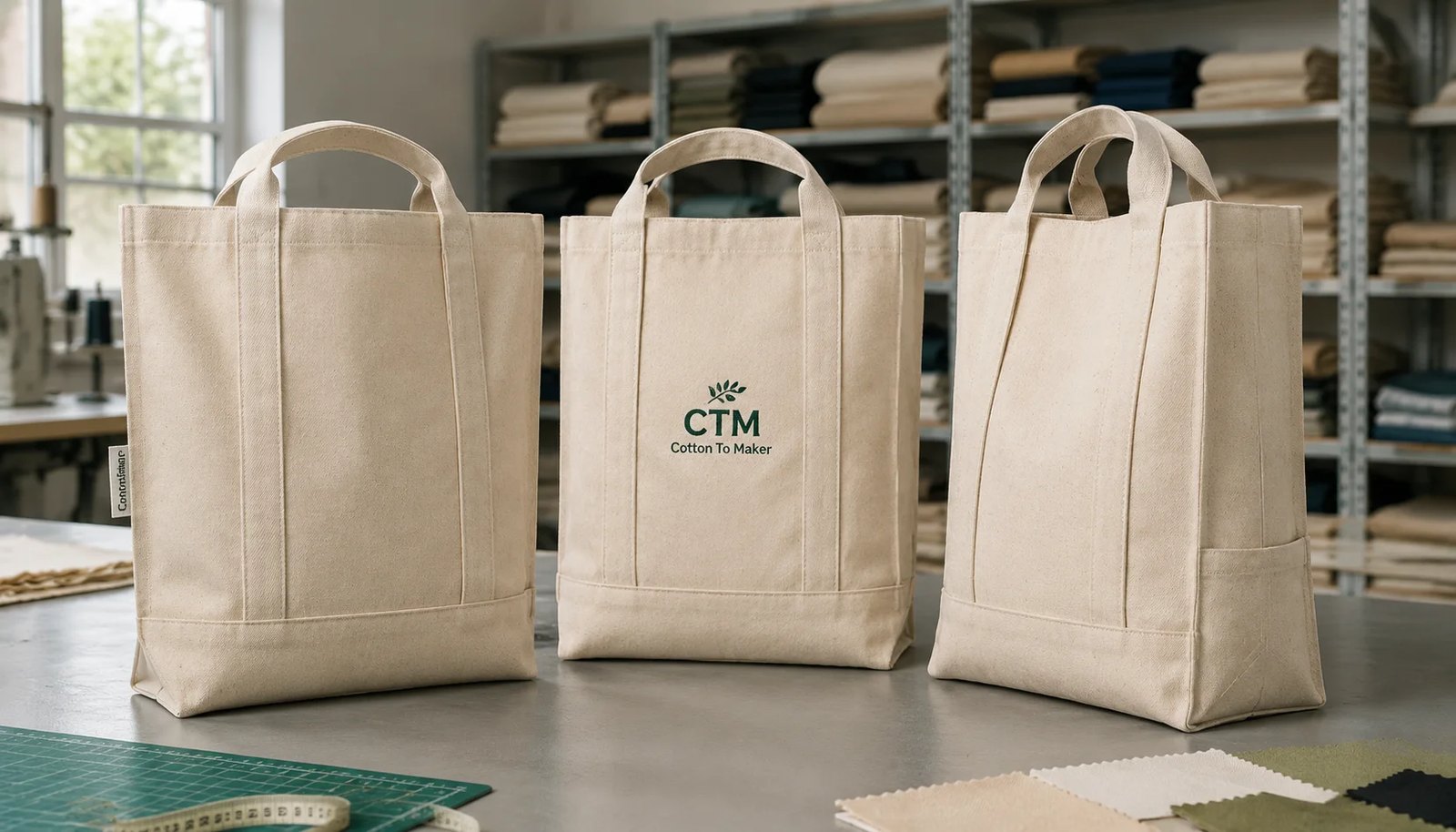
Start With Store Use
A bulk order of canvas grocery totes should begin with the store job, not a generic cotton tote description. Natural grocers may need a low-cost opening giveaway, a paid reusable checkout bag, a loyalty gift, a staff issue bag, or a private-label retail item. Each use has a different cost ceiling, durability target, packing requirement, and visual standard.
The search phrase canvas grocery totes for natural grocers bulk pricing plan points to a real procurement task: building a repeatable price model for a tote that will work in stores. A flat 8 oz promotional bag should not be compared with a gusseted 12 oz grocery tote with reinforced handles, retail folding, and barcode labels.
Before collecting quotes, define the basket profile. Will the tote carry jars, bottles, produce, boxed groceries, wellness items, or mixed baskets? A bag can look inexpensive but fail in use if the gusset is too shallow, the handles are uncomfortable, or the fabric collapses at checkout.
- Define the tote role before choosing fabric weight or print method.
- Set the expected carrying load and whether the bag must stand open at checkout.
- Separate free promotional bags from paid merchandise because tolerance and packing needs differ.
- Use one baseline specification when requesting supplier price tiers.
Lock the Base Specification
A useful RFQ states finished dimensions and construction. For grocery use, buyers often evaluate a tote around 38-42 cm wide, 35-40 cm high, and 10-15 cm deep, but the correct size depends on checkout workflow and product mix. A wider gusset helps boxed goods and bottles sit upright. A tall flat tote may be cheaper but harder to pack.
Canvas weight should be quoted using the supplier's stated basis. Some mills and factories use ounces per square yard; others use GSM. Approximate planning conversions can help buyers compare early quotes, but the purchase file should rely on the mill specification or supplier test report because weave, finishing, shrinkage, and moisture content can affect measured weight.
For many standard reusable grocery programs, 12 oz natural cotton canvas is a practical starting point. A 10 oz canvas can suit lighter promotional use. A 14-16 oz canvas may fit premium paid bags where structure, shelf appearance, and service life matter more than the lowest unit price.
- State finished width x height x gusset, handle drop, handle width, and seam construction.
- Request the supplier's fabric weight standard and material documentation.
- Clarify natural, bleached, dyed, recycled, or organic cotton requirements at quote stage.
- Avoid reducing gusset depth only to lower price if the tote must carry real grocery baskets.
Quote Practical Tiers
Bulk pricing is not a smooth discount curve. The first price break usually comes from spreading fixed costs across more units: sampling, cutting setup, screen making, artwork setup, sewing line preparation, inspection, and export paperwork. Later breaks may come from fabric purchasing, cutting efficiency, or longer sewing runs.
Request tiers that match the buying plan. A pilot tier may cover 1,000-3,000 pieces for store feedback. A rollout tier may cover 5,000-10,000 pieces for a region. A replenishment tier may cover 10,000 pieces or more after the specification is stable. The supplier should show which charges are one-time and which repeat on every purchase order.
For multi-location programs, separate the tote body from logo versions. If the same gusseted tote is printed with five store logos, ask for a base tote price, setup charge per logo, and minimum per print design. This keeps the benefit of one common tote while making artwork cost visible.
- Quote pilot, rollout, and replenishment tiers using the same specification.
- Show screen, sample, label, and setup charges separately from unit price.
- Ask where the real production break occurs: fabric roll, cutting table, print setup, or sewing line.
- For multiple logos, price the shared tote body once and print changes separately.
Compare Landed Cost
FOB unit price is only one line in the buying decision. Canvas totes can be bulky, and heavier fabric increases gross weight. Retail folding, hangtags, barcode stickers, individual bags, or tissue inserts can improve presentation but add labor and carton volume. A lower factory price may lose its advantage after freight and handling are included.
A practical worksheet should include unit price by tier, setup amortized per bag, packing cost, carton quantity, carton CBM, gross weight, freight estimate, duty or tax assumption, inspection cost, and warehouse handling cost. Use the same columns when comparing overseas custom production with domestic blank tote printing so speed and cost tradeoffs are visible.
Add a commercial target. A paid tote displayed near checkout must support the planned retail price. A free opening-week tote may have a fixed promotion budget. Procurement should set the ceiling before adding heavier canvas, complex decoration, or retail packaging.
- Compare FOB price, setup charges, carton CBM, freight, duty, inspection, and warehousing in one view.
- Calculate setup cost per bag at each quantity tier.
- Compare bulk packing and retail-ready packing separately.
- Use estimated landed cost, not only supplier unit price, when selecting fabric weight.
Watch the Cost Drivers
Fabric consumption is usually the main cost driver. A small increase in width, height, or gusset can use more canvas once seam allowance, handle strips, shrinkage allowance, and cutting waste are included. Ask whether the requested size fits efficiently on the available fabric width. That question is more useful than asking for a lower price without changing any spec.
Print cost depends on method, color count, print area, ink coverage, and curing control. One-color screen printing is often economical for clean logos on natural canvas. Multiple spot colors add screens and setup. Large solid areas use more ink and may feel stiff. Full-color artwork may require heat transfer or digital printing, so approve hand feel, edge definition, rub resistance, and wash behavior on a sample.
Handles also affect cost and performance. Shoulder-length handles use more webbing or canvas than short hand-carry handles. Wider handles improve comfort but increase material and sewing time. Reinforcement should be part of the costed specification, not left to factory habit.
- Main cost drivers are fabric weight, bag size, gusset depth, handle length, print method, and packing.
- Large logos, heavy ink coverage, and multiple artwork versions can change reject risk and lead time.
- Retail labels, hangtags, barcodes, and individual packaging should be priced as separate line items.
- Ask the supplier to flag dimension changes that improve fabric yield without hurting store use.
Clarify MOQ and Documents
MOQ can mean total order quantity, but it may also apply per fabric color, size, artwork, label, or shipment release. This matters for natural grocers with store-level branding. If each logo version is only a few hundred pieces, print setup and changeovers may reduce the value of bulk pricing.
Material claims need clearer documentation than a loose statement in a quote. For organic cotton, ask which certification scope and transaction documents can be provided for the order. For recycled cotton, ask for recycled-content support tied to the material lot or supplier declaration. For any composition claim, request a material specification or test report. These requirements should be confirmed before artwork approval, not after goods ship.
Natural canvas may have a lower MOQ than dyed fabric because dyed fabric can be tied to dye lots. Labels, hangtags, and barcode stickers may also have separate minimums. If the buyer needs mixed logos, keep the tote construction unchanged and group print batches on one production schedule.
- Confirm MOQ per order, size, fabric color, artwork, label, and shipment release.
- Require documentation that matches any organic, recycled, certified, or composition claim.
- Keep one tote body across store versions where possible.
- Ask for surcharge and setup cost per additional logo instead of treating each logo as a separate project.
Approve Samples With Evidence
Sample approval should prove appearance and function. A blank size sample confirms dimensions, gusset shape, fabric hand feel, handle drop, and sewing structure. A printed pre-production sample confirms color, print placement, ink coverage, artwork edge quality, and how the logo behaves on natural canvas texture.
Measure the sample and record results in a signed approval sheet. Include finished width, height, gusset depth, handle drop, handle width, print placement, and packing format if available. Photograph handle attachment, bottom corners, side seams, inner seams, and print edges. These images help resolve inspection disputes later.
Function testing should reflect the buyer's grocery use. Set a load target and hold time before production. The sample should not show handle tearing, seam opening, major stitch failure, or severe distortion. If the tote will be sold as washable or promoted for long-term use, add wash and rub checks before mass production.
- Approve a physical sample or signed sample report before production.
- Measure dimensions and print placement against written tolerance.
- Run a load test using the buyer-defined weight and hold time.
- Check dry rub and damp rub with an agreed method or simple signed standard.
- Do not approve mass production from photos alone for a new tote specification.
Define QC Thresholds
QC should focus on failures customers see or feel: broken handles, open seams, crooked logos, dirty fabric, mildew odor, weak stitching, wrong packing, and inconsistent sizing. A general AQL inspection can be useful, but product-specific defect rules are still needed. Define critical, major, and minor defects before production begins.
Critical defects should include broken handles, open seams that affect strength, wrong artwork, wrong material, severe stains, mildew odor, sharp contamination, or unsafe foreign material. Major defects can include skipped stitches at stress points, visibly crooked print, wrong carton quantity, heavy shade mixing, large fabric holes, or print transfer beyond the approved limit. Minor defects may include small loose threads, light creasing, or natural slubs that match the approved fabric character.
Stitch density and reinforcement should be measurable. If the buyer wants 7-9 stitches per inch or another range, state it as a buyer-defined target or confirm the supplier's sewing standard in writing. For print durability, specify dry rub pass/fail rules and add damp rub or wash checks when the tote is sold for repeated use.
- Use AQL sampling with written critical, major, and minor defect categories.
- Set load-test weight, hold time, and failure rules before production.
- State stitch density target or accepted supplier sewing standard.
- Set print rub, wash, color, and placement tolerances in the QC file.
- Include carton count, carton marks, and packing format in final inspection.
Plan Packing and Freight
Packing decisions affect both cost and store operations. Bulk-packed totes are efficient for checkout counters, backroom distribution, and low-waste programs. Individual packaging protects retail surfaces but adds material, labor, and carton volume. Hangtags and barcode labels help paid merchandise scan correctly, but they require placement control and carton sorting by design.
Cartons should be designed around freight and handling. A carton that is too heavy can slow distribution or exceed warehouse limits. A carton packed too tightly can crease printed panels, especially with large ink areas. Request units per carton, carton dimensions, gross weight, net weight, and estimated pallet loading with the first quote.
For orders with multiple store logos, carton marks should identify logo version, quantity, PO number, carton count, and destination where needed. Sorting rules should be agreed before packing so the warehouse does not become the first place the program is organized.
- Use bulk packing for checkout use and retail packing only when needed.
- Request carton size, carton weight, units per carton, and estimated CBM in the quote.
- Confirm warehouse maximum carton weight before final packing approval.
- Avoid over-compressed packing that permanently creases printed panels.
- For multi-logo programs, require carton marks and packing lists by logo version.
Protect the Schedule
Lead time should be counted from complete approval, not from the first RFQ email. A factory can schedule accurately only after tote specification, artwork, sample approval, payment arrangement, material availability, documentation needs, and packing requirements are clear. Natural canvas with simple one-color print is usually easier to schedule than dyed canvas, certified materials, multiple logo versions, or retail packing components.
Build the schedule backward from the required in-warehouse date. Include sample making, sample shipping, approval time, material preparation, production, inspection, export handling, freight, customs, and domestic delivery. For store openings, Earth Month promotions, membership campaigns, or holiday retail sets, late artwork is a common source of avoidable cost.
Air freight can solve timing but may damage the economics of heavy canvas totes. If the date is fixed, state the required ex-factory date and shipping method in the RFQ. Ask which approvals would put the schedule at risk, such as late Pantone confirmation, dimension changes after sampling, added logos, or a packing format switch.
- Work backward from the in-warehouse date, not only the marketing launch date.
- Freeze fabric, size, handle, artwork, print method, and packing before production approval.
- Separate sample lead time, production lead time, inspection time, and freight time.
- Reserve extra time for dyed fabric, certified materials, multiple logos, and retail labels.
- Do not release production until carton marks and packing requirements are confirmed.
Specification comparison for buyers
| Pricing scenario | Target quantity example | Spec basis to quote | Numeric fields to request | Cost-per-bag logic |
|---|---|---|---|---|
| Pilot order for 1-3 stores | 1,000-3,000 pcs | One gusseted tote size, natural 10-12 oz canvas, one logo, bulk packing | MOQ basis, sample fee, setup charge, units/carton, carton L x W x H, gross weight, estimated CBM | FOB unit price + setup divided by order qty + sample/courier allocation + estimated freight per bag |
| Regional rollout | 5,000-10,000 pcs | Same tote body across stores, 12 oz canvas, reinforced handles, 1-2 print colors | Price at 5k and 10k, extra logo fee, carton qty, carton CBM, gross weight, production lead time | Unit price by tier + logo change cost divided by logo qty + freight/CBM estimate + inspection allocation |
| Retail merchandise tote | 3,000-8,000 pcs | 12-16 oz canvas, cleaner visual tolerance, hangtag or barcode, retail folding | Retail packing cost, label/hangtag cost, reject allowance, carton compression limit, barcode sorting requirement | FOB + retail packing + label cost + inspection + freight; compare landed cost against planned retail margin |
| High-volume replenishment | 10,000-30,000 pcs per release | Approved tote body and artwork repeated without spec changes | Annual forecast, release qty, fabric reservation terms, reorder lead time, price-validity period | Repeated unit price + storage or split-shipment cost + freight per release; track price stability by reorder |
| Multi-logo distributor program | Common body, 500-2,000 pcs per logo | One blank tote construction with several printed account logos | Base tote price, minimum per print design, setup per logo, sorting fee, carton marks by logo | Base tote price + per-logo setup divided by each logo qty + sorting/carton cost + blended landed cost |
| Urgent event or opening order | 250-1,500 pcs | Ready-stock blank tote with local decoration, limited fabric control | Available stock qty, blank tote dimensions, local print cost, rush fee, delivery date | Blank tote cost + local decoration + rush/domestic freight; compare premium against missed-date risk |
Buyer checklist before sampling
- Define the commercial role: checkout giveaway, paid reusable bag, loyalty gift, staff issue, event bag, or retail merchandise.
- Set one approved finished size in width x height x gusset and include measurement tolerance before collecting prices.
- Choose a quoting fabric range, such as 10 oz for light promotions, 12 oz for standard grocery use, or 14-16 oz for premium merchandise.
- State whether the canvas is natural conventional cotton, dyed cotton, recycled cotton, organic cotton, or another certified material.
- Require documentation for any certified claim: transaction certificate or scope certificate where applicable, recycled-content support, material composition report, or supplier declaration tied to the purchase order.
- Specify handle drop, handle width, handle material, attachment pattern, and buyer-defined load target.
- Separate artwork quote cases: one-color logo, two-color logo, full-color artwork, woven label, hangtag, or barcode program.
- Ask for pricing at practical tiers such as pilot, rollout, and replenishment quantities, not only one order size.
- Require MOQ basis by purchase order, tote size, fabric color, print design, label, and shipment release.
- Request carton dimensions, units per carton, gross weight, net weight, carton marks, and estimated CBM with the first quotation.
Factory quote questions to send
- What canvas weight, GSM, weave construction, composition, shrinkage range, and finished fabric width are used for this price?
- Can you provide a fabric mill specification or test report for weight, composition, and shrinkage for the material quoted?
- If the canvas is organic, recycled, or otherwise certified, which transaction certificate, scope certificate, recycled-content support, or traceability document will be supplied with the order?
- Is MOQ calculated per total order, per size, per fabric color, per print design, per label, or per shipment release?
- What are the exact finished dimensions, gusset depth, handle drop, handle width, seam allowance, and accepted tolerance in your quote?
- What is the price difference for the same tote at 10 oz, 12 oz, 14 oz, and 16 oz canvas using the same size and artwork?
- Can you quote pilot, rollout, and replenishment tiers using the same specification and show setup charges separately?
- How much does each additional logo version cost if the tote body remains unchanged?
- Which print method do you recommend for this artwork, and what buyer-defined rub, wash, or crocking check can you support?
- What is the maximum print area before ink use, drying time, setup cost, hand feel, or reject risk changes?
Quality-control points to confirm
- Finished width, height, and gusset should match the approved sample within the written tolerance, such as plus or minus 0.5-1 cm when agreed before production.
- Handle drop should remain consistent across cartons so the bag works as the intended hand-carry or shoulder-carry tote.
- Handle attachment should match the approved box stitch, cross stitch, bar tack, or reinforced pattern with no skipped stitches, broken threads, needle cuts, or loose ends at stress points.
- Stitch density should be stated in the QC file as a buyer-approved target or supplier sewing standard; do not rely on an unstated assumption.
- Load testing should use the buyer-defined grocery weight and hold time, with no handle tearing, seam opening, major stitch failure, or severe deformation.
- Canvas surface should be free from oil marks, mildew odor, large weaving holes, heavy shade mixing, sharp contamination, and severe slubs outside the approved natural fabric character.
- Print color should be checked against Pantone reference, approved sample, or signed color standard under consistent lighting, with acceptable variation documented before mass production.
- Print placement should stay centered and level within the agreed tolerance, especially on gusseted totes where fabric movement can shift the logo.
- Dry rub testing should use the agreed method and pass/fail limit; damp rub or wash checks should be added when the bag is marketed for repeated use.
- Cartons should match the packing specification, quantity, carton marks, inner protection, barcode sorting, and weight limit, with no over-compression that damages print panels.