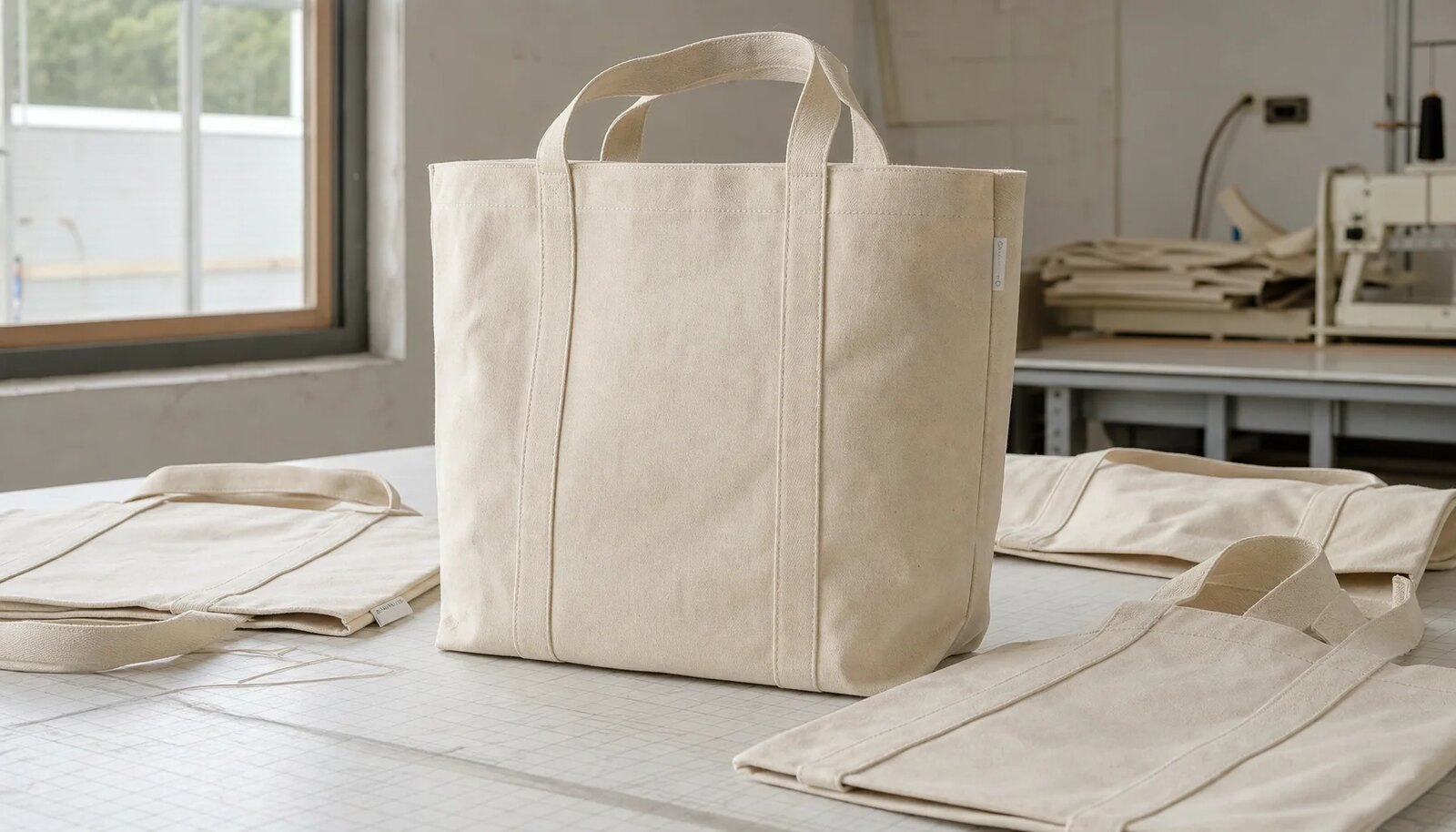
Start With MOQ Economics, Not A Lower-Price Argument
For canvas grocery totes, MOQ is usually a production threshold, not an arbitrary barrier. A supplier may need enough quantity to buy fabric efficiently, set up screens, train the sewing line, prepare labels, pack cartons, and inspect the order without spreading fixed costs across too few pieces. If the buyer only pushes for the lowest possible minimum, the supplier may quietly change the canvas weight, shorten the handle, simplify reinforcement, or exclude packing details to make the number work.
Eco apparel brands should treat the tote as a brand-facing product, even when it is used as packaging or gift-with-purchase. Customers notice thin fabric, twisted handles, weak seams, uneven print, and excessive plastic packing. The negotiation goal is therefore not the smallest order at any cost. It is the lowest workable MOQ that protects the tote’s core performance and gives the factory a realistic production path.
The right question is: what changes if the order drops from 2,500 pieces to 1,000 or 500? If the answer is stock fabric, one-color print, standard labels, and bulk packing, that may be a smart concession. If the answer is lighter fabric, less reinforcement, or undefined subcontracting, the lower MOQ may create more risk than savings.
- Negotiate the minimum around the specification, not around a vague product name.
- Protect fabric strength, handle reinforcement, and print quality before trimming extras.
- Ask the supplier to separate fixed setup fees from unit cost.
- Compare landed cost and inspection risk, not only the first quoted unit price.
Write A Specification That Every Supplier Can Quote
MOQ comparisons become unreliable when suppliers are not quoting the same tote. One supplier may assume a 10 oz flat natural canvas bag, another may price a 12 oz bottom-gusset tote, and a third may include woven labels, individual polybags, and export cartons. All can call the product a canvas grocery tote, but the cost basis is different.
A procurement-ready spec should include finished dimensions, fabric, construction, decoration, labels, packing, and tolerances. For dimensions, list width, height, gusset depth, handle length, handle drop, and handle width. A practical starting tolerance for many tote programs is plus or minus 12 mm on body dimensions, plus or minus 6 mm on handle length, and plus or minus 6 mm on print placement, unless the design needs tighter control. Write these tolerances into the RFQ and purchase order before sampling.
Fabric should be stated in both ounces and gsm because suppliers across regions use different conventions. As a useful reference, 10 oz canvas is about 339 gsm, 12 oz is about 407 gsm, and 14 oz is about 474 gsm. Also ask whether the quoted weight is finished fabric weight or greige weight before processing. That distinction matters when comparing quotes from different mills or factories.
- Define use case: grocery carry, retail resale, apparel packaging, event bag, or staff tote.
- Include finished size, gusset, handle, seam, and reinforcement details.
- State canvas weight in oz and gsm and ask how it is measured.
- Attach artwork with exact size, placement, and color requirements.
- Put tolerances in writing before the supplier makes the pre-production sample.
Know Which Details Push MOQ Up
MOQ flexibility comes from standardization. A stock natural canvas tote with standard webbing handles, a one-color print, and bulk carton packing is easier to produce at a lower quantity than a custom-dyed, multi-color, retail-packed tote with multiple labels. The buyer’s task is to identify which features are essential and which can move for the first run.
Fabric is often the first constraint. Stock natural or black canvas is usually easier to source in smaller quantities than a custom brand color. Custom dyeing may require lab dips, shade approvals, minimum fabric yardage, and longer lead time. If the tote is part of a brand launch, a natural canvas base with well-controlled artwork can often deliver a strong sustainability message without triggering a custom-dye minimum.
Decoration is the second major driver. One-color screen printing is normally simpler than multi-color artwork with tight registration, large ink coverage, gradients, or fine lines. Labels and packing add their own minimums: woven side labels, care labels, hangtags, barcode stickers, individual polybags, and retail cartons each create setup and labor.
- MOQ-friendly: stock canvas, standard handles, one-color print, bulk cartons, simple label.
- MOQ-raising: custom dye, special fabric weight, oversized print, multi-color artwork, inner pocket, closure, retail polybagging.
- Simplify packaging and trims before reducing canvas weight.
- Ask which exact feature creates the current MOQ barrier.
Use Quantity Breaks To See The Real Price Curve
A useful MOQ negotiation needs more than one number. Ask suppliers to quote the same exact specification at 500, 1,000, 2,500, and 5,000 pieces. The price curve will show where setup costs are being absorbed and where production becomes efficient. If the unit price drops sharply between 500 and 1,000 pieces, fixed costs may be the issue. If it flattens after 2,500 pieces, the factory may already be near an efficient batch size.
Quantity breaks also help buyers consolidate demand. An eco apparel brand may use the same base tote for stores, e-commerce packaging, wholesale accounts, events, and staff kits. If those channels can share one body specification and differ only by carton label or limited artwork variation, the brand may reach a better production band without over-ordering one channel.
Ask the supplier to show setup fees separately where possible. Screens, strike-offs, labels, and sample development may be better handled as one-time costs rather than hidden inside a very high unit price on a pilot order. That makes the next order easier to evaluate.
- Request 500, 1,000, 2,500, and 5,000 piece quotes for the same spec.
- Separate setup fees from recurring unit costs.
- Do not use pilot-order pricing as the long-term benchmark.
- Use shared base specs across channels to improve order efficiency.
Choose Fabric And Construction For The Load
Canvas weight should match how the tote will actually be used. A 10 oz canvas can work for lighter promotional or occasional carry programs. A 12 oz canvas is often a practical starting point for reusable grocery and retail-facing totes because it gives a more substantial hand feel without becoming overly stiff. A 14 oz canvas can feel premium, but it increases cost, weight, sewing difficulty, and freight impact.
Weight alone does not make a durable tote. A lighter canvas with strong handle reinforcement can outperform a heavier fabric with weak stitching. For grocery use, focus on the bottom structure, seam allowance, stitch density, thread quality, and strap attachment. Wider handles, often around 25 to 38 mm, spread load better than narrow straps. Bartacks are common; an X-box or extended reinforcement zone is useful when the tote is expected to carry heavier mixed loads.
Gusset choice also matters. A flat tote is cheaper and packs efficiently, but it does not hold groceries or folded apparel as cleanly. A bottom gusset or boxed bottom improves usable volume and presentation. If the tote is sold at retail, displayed in-store, or used as a reusable grocery bag, the extra construction may be justified.
- Use 10 oz canvas for lighter or cost-sensitive programs.
- Start around 12 oz for reusable grocery and retail programs, then test load and hand feel.
- Consider 14 oz only when the premium feel justifies cost, stiffness, and freight.
- Protect handle reinforcement and seam quality in every MOQ negotiation.
Balance Decoration, Labels, And Packaging
Decoration can improve perceived value, but it can also raise MOQ and defect risk. Screen printing is usually efficient for bold one-color artwork on natural canvas. It becomes more complex when artwork has multiple colors, large coverage, fine detail, or tight Pantone requirements. Buyers should approve a print strike-off on the actual canvas because natural fibers and textured surfaces can affect opacity and edge sharpness.
Heat transfer can work for certain designs, but buyers should test adhesion, cracking, and hand feel on the chosen canvas. Embroidery can look premium, yet it may pucker lighter canvas and slow production. Woven side labels are useful for subtle branding, but they add placement control, sewing labor, and often their own minimum order.
Packaging is a major lever. Individual polybags may be necessary for retail resale, dust protection, or barcode scanning. If the totes are going to a distribution center, back room, or event team, bulk carton packing with a liner may be enough. For eco apparel brands, removing unnecessary plastic can support both cost and brand positioning.
- Approve decoration on real fabric, not only a digital mockup.
- Use one-color screen print when MOQ, cost, and consistency matter most.
- Treat woven labels, hangtags, barcode stickers, and polybags as separate cost drivers.
- Simplify the label and packing stack before compromising tote construction.
Compare Sourcing Regions And Supplier Routes Realistically
Supplier geography affects MOQ, lead time, communication, freight, and replenishment risk. Domestic or nearshore suppliers may offer lower MOQs and faster turnaround, especially when using stock blanks and local printing. Unit prices are often higher, but smaller inventory exposure and faster replenishment can offset the difference for test programs or urgent launches.
Overseas bag factories in established textile regions can be stronger for custom construction, larger runs, and recurring programs. Buyers may see better unit costs at production quantities, but they must allow more time for sampling, export preparation, freight, customs, and receiving. A realistic planning window for a custom overseas tote program is often several weeks for sampling and approvals, followed by bulk production and transit. Exact timing depends on country, factory capacity, decoration, season, and shipping mode.
Do not assume every quote from the same country carries the same risk. A direct bag factory, print shop, stock blank supplier, and trading company all control different parts of production. The best supplier route is the one that can explain who owns fabric sourcing, cutting, printing, sewing, inspection, packing, and corrective action.
- Use domestic or nearshore routes for pilots, urgent events, and lower inventory risk.
- Use overseas custom factories for larger recurring programs and controlled construction.
- Ask which steps are in-house and which are subcontracted.
- Compare landed cost, lead time, visibility, and replenishment flexibility together.
Plan Sampling, Approvals, And Lead Time By Stage
A complete timeline includes more than bulk production days. Build the schedule backward from the delivery date and include specification confirmation, fabric sourcing, lab dips if dyeing is required, artwork setup, print strike-off, pre-production sample, buyer comments, bulk cutting, printing, sewing, trimming, inspection, packing, export documents, freight, customs, and warehouse receiving.
For a simple stock canvas tote with one-color decoration, sampling can be relatively quick if materials are available. A custom-dyed or custom-constructed tote needs more time because fabric, shade, construction, and decoration approvals must line up before bulk starts. Buyers should not approve bulk production from a substitute-fabric sample unless the difference is documented and a final pre-production sample follows.
Use a staged sample process. First approve fabric swatches for weight, hand feel, and color. Then approve a print strike-off on the actual canvas. Next approve a pre-production sample made with final construction, labels, and packing assumptions. Finally, keep sealed reference samples with both buyer and supplier so inspection has a physical standard.
- Ask for sample lead time and bulk lead time separately.
- Do not let bulk cutting begin before final size and fabric are approved.
- Use measurable sample comments: placement, stitch count, handle width, and tolerance.
- Keep a sealed reference sample for inspection and receiving.
Check Packing And Freight Before You Accept The Unit Price
Canvas totes can be bulky even when they are not especially heavy. Packing method can therefore change landed cost. A low unit price may become less attractive if every tote is individually polybagged, folded inefficiently, or packed in oversized cartons. Ask for carton dimensions, pieces per carton, net weight, gross weight, carton markings, and folding method before comparing suppliers.
A simple carton calculation can reveal hidden cost. If one supplier packs 100 totes per carton at 60 x 40 x 35 cm and another packs 50 totes per carton at 60 x 40 x 35 cm, the second supplier uses twice the carton cube for the same quantity before freight is even quoted. If individual polybags increase carton size or reduce pieces per carton, the landed cost and warehouse handling cost may rise.
Confirm carton weight against warehouse handling rules. A carton that is too heavy may create receiving problems, while a carton that is too light but oversized wastes space. If barcodes, PO numbers, destination labels, color codes, or retailer-specific carton marks are required, include them in the RFQ so they do not become late-stage add-ons.
- Request carton dimensions, pieces per carton, gross weight, and carton marks with the quote.
- Calculate cube per 1,000 pieces when comparing suppliers.
- Use bulk carton packing when individual polybags are not needed.
- Align packing with warehouse receiving and sustainability goals.
Set QC Standards Before Bulk Production
Quality control should be defined before the purchase order, not after defects appear. For canvas grocery totes, the main inspection risks are dimensional variation, fabric defects, weak handle attachment, seam failure, print problems, label errors, stains, odor, and packing mismatch. The approved sample, written specification, and tolerance table should all agree.
Many buyers use an AQL-based final inspection for production orders. The exact plan should be agreed with the supplier or inspection partner, but a common framework is to classify unsafe or unusable issues as critical, functional failures and wrong branding as major, and small cosmetic issues as minor. For example, a detached handle, wrong logo, severe stain, missing label, or failed load test would normally be treated more seriously than a small loose thread.
A practical tote inspection should include measurement checks, seam and reinforcement review, print testing, label verification, carton review, and a load test using the buyer-approved target weight. The load test should reflect realistic use, not an extreme stunt. If the tote is intended for groceries, test for strap stretch, seam opening, bottom distortion, and handle twist after the bag is held and moved under load.
- Agree on AQL level, sample size, defect categories, and pass/fail rules before production.
- Define critical, major, and minor defects in plain language.
- Measure against written tolerances, not subjective impressions.
- Include load testing, print rub or fold checks, label checks, and carton verification.
Specification comparison for buyers
| Supplier route | Typical MOQ posture | Cost behavior | Best use case | What to negotiate first |
|---|---|---|---|---|
| Stock blank tote from a bag factory | Lowest entry point when size, canvas color, handles, and packing are already standard | Low setup cost, fast quoting, but limited control over fabric weight, dimensions, and finishing | Pilot launches, staff bags, event use, and early retail testing | Confirm actual finished size, fabric weight, handle reinforcement, carton quantity, and available stock before negotiating price |
| Stock canvas tote plus one-color print | Common low-to-mid MOQ route because the base bag is standardized and only decoration changes | Cleanest price curve when print area is modest and artwork is bold | Eco apparel store bags, gift-with-purchase programs, simple merch drops, and wholesale account support | Keep the same tote body and negotiate print area, print color count, screen fees, and bulk packing |
| Full custom bag factory | MOQ rises when the factory must buy fabric, cut panels, sew custom construction, and manage approvals | Better control, but material commitments and line setup become real cost drivers | Retail resale totes, custom grocery shapes, branded packaging systems, and recurring programs | Ask which minimum is driven by fabric, sewing efficiency, printing, labels, or packing |
| Print shop sourcing blank totes | May support small decorated runs, but construction options depend on available blanks | Decoration can be efficient; tote quality may vary if blanks are sourced from changing suppliers | Short-deadline branded campaigns where the tote body is not highly customized | Request the blank tote specification, origin, current inventory, and replacement plan if stock changes |
| Trading company or managed sourcing partner | Flexible on paper, but the true MOQ comes from the factory, printer, label vendor, and packing process behind the quote | Coordination may be easier, while transparency can be weaker unless responsibilities are documented | Small teams needing one point of contact across tote, labels, inspection, and export packing | Ask who cuts, prints, sews, inspects, packs, and owns corrective action if bulk differs from the approved sample |
| Regional nearshore or domestic supplier | Often accepts lower MOQs, especially for stock blanks and local decoration | Higher unit cost can be offset by shorter transit, smaller inventory risk, and faster replenishment | Market tests, urgent replenishment, regional retail events, and programs needing quick artwork changes | Compare landed cost and delivery speed, not only unit price |
Buyer checklist before sampling
- State the intended use: retail resale, grocery carry, apparel packaging, event giveaway, staff bag, or gift-with-purchase.
- Lock the finished dimensions: width, height, gusset depth, handle length, handle drop, and handle width.
- Specify fabric composition and weight in both oz and gsm, and clarify whether the weight is finished fabric or greige fabric.
- Define construction: flat, bottom gusset, side gusset, boxed bottom, inner pocket, closure, binding, and top hem.
- Name the handle build: self-fabric or webbing, attachment position, bartack count, X-box reinforcement, thread color, and seam allowance.
- Provide print details: method, artwork size, placement, number of colors, Pantone target, print tolerance, and whether artwork crosses a seam or fold.
- List all trims and packing: woven label, care label, hangtag, barcode sticker, individual polybag, carton liner, carton label, and export carton.
- Request the identical specification at 500, 1,000, 2,500, and 5,000 pieces so the price curve and MOQ drivers are visible.
- Ask for sample stages: fabric swatch, print strike-off, pre-production sample, sealed reference sample, and bulk inspection plan.
- Confirm lead time by stage, not only production days: sourcing, sampling, approvals, bulk production, inspection, packing, export, and transit.
Factory quote questions to send
- What exact finished size, gusset style, canvas weight, composition, handle build, print method, label package, and packing method are included in this quote?
- Is the fabric weight quoted as finished fabric weight or greige fabric weight before dyeing, washing, or finishing?
- Which part of the MOQ is the binding constraint: fabric purchase, dye lot, print setup, sewing line efficiency, label minimum, packing labor, inspection, or export carton quantity?
- Can you quote the same specification at 500, 1,000, 2,500, and 5,000 pieces, with setup fees separated from unit price?
- What is included and excluded from the unit price: screens, print, woven label, care label, hangtag, barcode sticker, polybag, carton label, export carton, inspection, and inland freight?
- Where will cutting, printing, sewing, labeling, inspection, and packing happen, and which steps are subcontracted?
- What are the sample lead times and bulk lead times by stage, and what approval is required before each stage starts?
- What dimensional, print placement, fabric shade, and quantity tolerances do you normally apply, and can they be written into the purchase order?
- Which AQL level or inspection standard do you recommend for this order, and what defects will be considered critical, major, and minor?
- What carton dimensions, pieces per carton, gross weight, and carton markings are assumed for freight calculation?
Quality-control points to confirm
- Measure finished width, height, gusset depth, handle length, handle drop, and print placement against the approved specification and written tolerance.
- Verify fabric weight, composition claim, hand feel, weave consistency, shrinkage risk, and visible defects such as stains, holes, broken yarns, heavy slubs, or thin areas.
- Check cutting accuracy, square panels, symmetrical gussets, straight side seams, clean top hem, and whether the tote folds or stands as intended.
- Inspect handle width, length, symmetry, angle, attachment position, seam allowance, and whether both handles match the approved reference sample.
- Confirm reinforcement method at strap ends, including bartack count, X-box shape, stitch density, thread color, and skipped-stitch control.
- Perform a practical load test using the buyer-approved target weight and check for seam opening, strap stretch, handle twist, bottom strain, and body distortion.
- Verify print color, opacity, registration, placement, edge sharpness, curing, crocking resistance, and whether the print cracks when folded.
- Check brand labels, care labels, hangtags, barcode stickers, and carton labels for correct placement, orientation, spelling, scanability, and attachment quality.
- Review loose threads, seam puckering, needle holes, fraying, dirty marks, odor, color contamination, and inconsistent trimming.
- Confirm carton quantity, carton strength, gross weight, dimensions, carton marks, packing sequence, moisture protection, and match to the freight plan.