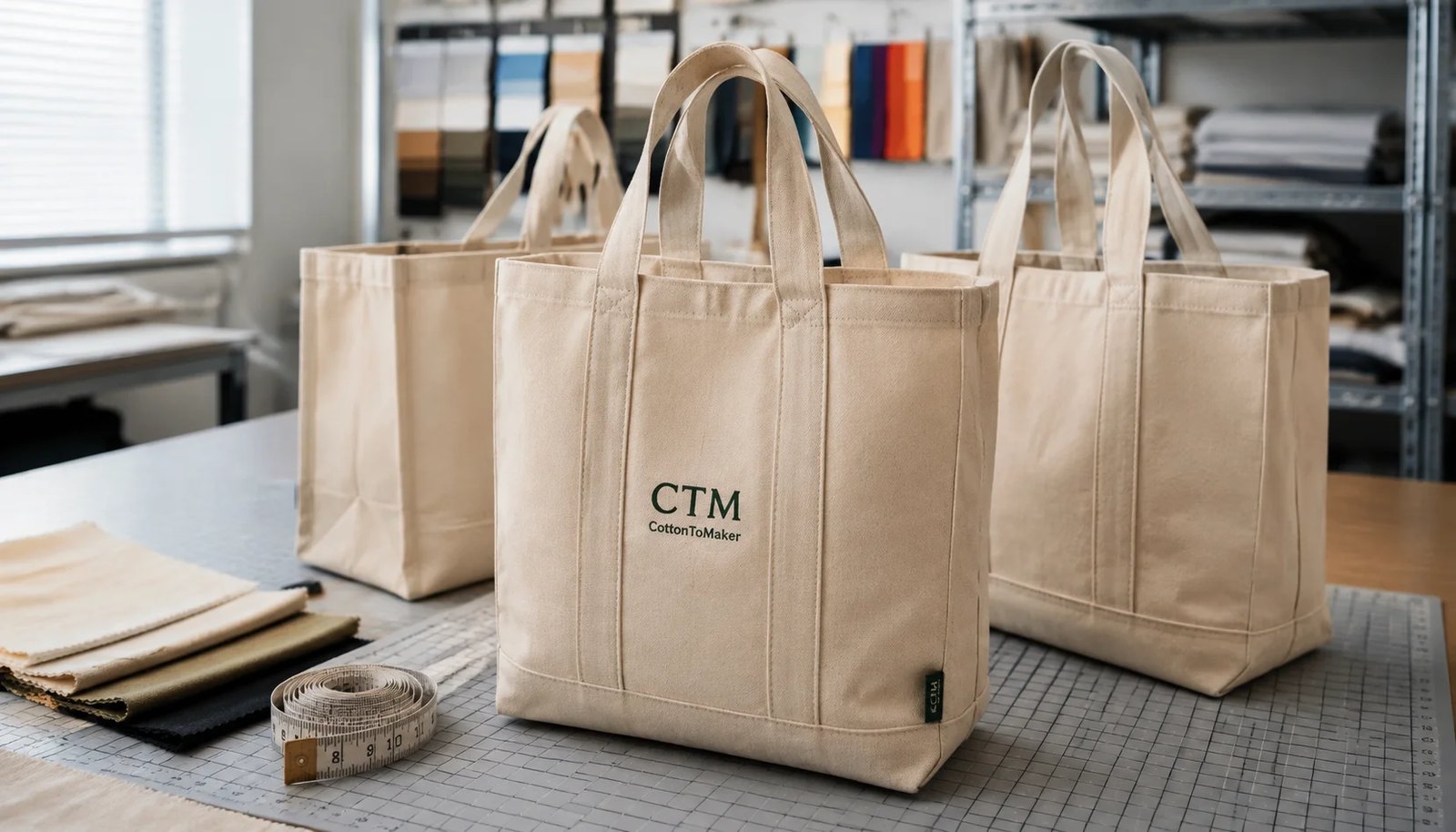
Start With the Load, Not the Logo
For wholesale canvas grocery totes for liquor retailers, MOQ negotiation becomes easier when the factory understands what the bag must carry. A tote used at a wine shop counter has a different duty than a light promotional cotton tote handed out at an event. Liquor retail buyers should define the expected load before talking about price: two 750 ml glass bottles, four cans, a bottle plus mixers, or a mixed grocery basket. That load drives fabric weight, handle reinforcement, gusset size, stitch density, and carton packing.
A clear use case also prevents suppliers from quoting the cheapest canvas grocery tote that looks acceptable in a photo but fails in store use. If the bag must support glass bottles, avoid vague RFQ wording such as custom canvas tote bag with logo. Write the requirement as a retail grocery tote for liquor store checkout, intended for repeated carrying of bottles and packaged goods, with reinforced handles and a stable base. This gives the factory enough context to quote a practical construction instead of a thin event giveaway.
- Light promotional use: 6 oz to 8 oz cotton canvas, lower cost, not ideal for heavy bottles.
- Standard liquor retail grocery use: 10 oz canvas, usually a good balance of cost, strength, and printability.
- Premium or repeat-use program: 12 oz canvas, firmer handfeel, better structure, higher freight weight.
- Heavy specialty use: 14 oz canvas or laminated jute/canvas alternatives, useful only when the retail position supports the added cost.
Fabric Weight and GSM Choices
Canvas weight is often quoted in ounces, but procurement teams should also request GSM because fabric mills and suppliers may describe weight differently. A 10 oz canvas is commonly in the range of roughly 330 to 360 GSM, while 12 oz canvas is often around 390 to 420 GSM, depending on yarn, weave, and finishing. These ranges are examples, not fixed global rules, so the RFQ should state the target and an acceptable tolerance.
For liquor retailers, the mistake is using a lower fabric weight to force a smaller MOQ and then discovering that the finished tote lacks shape. A thin canvas bag can fold nicely in a sample photo, but it may collapse at the checkout counter or feel underbuilt when carrying glass. If the buyer wants the bag to stand better, the answer may be a boxed bottom and gusset rather than simply heavier fabric. Fabric weight, base construction, and handle reinforcement should be evaluated together.
- Request fabric weight in both oz and GSM on the quotation sheet.
- Ask whether the fabric is greige, bleached, dyed, washed, or pre-shrunk.
- Confirm whether natural canvas shade variation is acceptable, especially for repeat orders.
- For dyed canvas, state Pantone reference and accept that MOQ may increase due to dye lot requirements.
- For sustainability claims, require proper documentation instead of accepting marketing wording in the quote.
Construction That Fits Liquor Retail
A grocery tote for liquor retailers should normally have a gusseted body, a boxed or squared bottom, and handles reinforced with box-stitch or cross-stitch. Flat totes are easier and cheaper to sew, but they do not hold bottles and retail goods as cleanly. When buyers compare quotes, a flat tote and a gusseted grocery tote should never be treated as the same product. The sewing time, fabric consumption, carton cube, and retail function are different.
Handle length also needs a decision. Short handles work for hand carry and reduce fabric consumption, but many customers expect a grocery tote to fit over the shoulder. A finished handle length around 55 to 65 cm is common for shoulder carry, while shorter handles may suit small bottle shops or compact checkout bags. The RFQ should define finished handle length, handle width, and whether self-fabric handles or webbing handles are required.
- Use a side and bottom gusset when the tote needs to hold bottles upright.
- Specify reinforced handle stitching, not only strong handles.
- State seam finishing: overlock, bound seam, or turned seam depending on price level.
- Define whether the bag must fold flat for storage or stand partly upright for checkout display.
- Include a target load test, for example a controlled static load using the buyer's expected retail weight.
MOQ Logic Behind the Factory Quote
MOQ is not a single number pulled from a price list. For canvas grocery totes, it is driven by fabric availability, cutting efficiency, print setup, sewing line changeover, packing labor, and the factory's minimum profitable production run. A supplier may accept a lower MOQ when the buyer uses stock natural canvas, a standard bag size, one color print, and bulk packing. The same supplier may raise MOQ for custom dyed fabric, unusual dimensions, multi-position print, individual retail packing, or store-by-store carton sorting.
A buyer has more leverage when the RFQ separates what is fixed from what can be adjusted. If the first order is a market test, tell the factory the projected reorder volume and the decision date. This allows a factory to consider a lower opening MOQ without assuming the buyer will only place one small order. However, pushing too far below a factory's normal MOQ can create hidden problems: leftover fabric lots, rushed sewing, limited inspection time, or a quote that excludes costs later added as extras.
- Lower MOQ levers: stock canvas, standard size, natural color, one-color screen print, flat bulk packing.
- Higher MOQ triggers: custom fabric dyeing, organic certified fabric, all-over print, complex insert labels, multiple store allocations.
- Negotiation point: approve a standard construction for the trial order and reserve custom upgrades for reorder.
- Commercial safeguard: request separate pricing for trial MOQ, normal reorder MOQ, and higher volume break.
Print Method and Artwork Risk
For most liquor retailer grocery totes, screen printing is the practical default. It works well for solid logos, store names, event marks, and simple promotional messages. It is cost-effective at wholesale quantities and stable for repeat orders when the artwork size and ink color remain the same. The buyer should still specify print size, position from top seam, ink color reference, and whether the print must pass a dry rub or fold test.
Heat transfer can reproduce detailed artwork or gradients, but it adds a different handfeel and may not suit every canvas texture. Embroidery gives a premium result for small marks, but large embroidered logos can distort fabric and raise cost. Digital printing may be useful for small runs or complex artwork, yet it should be tested on the exact canvas because natural fabric texture affects sharpness. When MOQ is the main issue, reducing the number of print colors is usually more effective than arguing over sewing cost.
- Best cost route: one-color screen print on natural canvas.
- Best detail route: heat transfer or digital print, after testing adhesion and handfeel.
- Best premium small logo: embroidery or woven side label.
- Avoid very large solid ink blocks unless the factory confirms curing, flexibility, and opacity.
- Keep artwork files in vector format and include print dimensions in millimeters.
Sample Approval Before Bulk Cutting
A physical sample is where many quote differences become visible. The sample should be made in the correct fabric weight, finished size, handle length, print method, and packing style. A showroom sample or blank tote from another order is useful for discussion, but it is not enough for approval. For liquor retail programs, the buyer should test how the sample behaves with actual bottles and retail items, not only how it looks on a desk.
The approved sample should become the reference for mass production. Mark the approved sample with date, version, fabric weight, print color, and any approved tolerance. If changes are made after approval, document them clearly. Small changes such as increasing gusset depth, moving a logo, or changing handle width can affect fabric consumption and unit price. This is why late artwork or construction changes often create quote disputes.
- Measure finished width, height, gusset, and handle drop on the sample.
- Load the sample with the expected bottle count and carry it for a short functional test.
- Rub the print with dry white cloth to detect poor curing or loose pigment.
- Fold the printed area to see whether thick ink cracks or feels too stiff.
- Photograph approved logo position with a ruler so production has a clear visual reference.
Quote Data That Makes Comparisons Fair
Canvas tote quotes can look close on unit price while being very different in real cost. Procurement teams should compare quotes only after aligning Incoterm, currency, fabric weight, finished size, print method, packing, carton count, sample fee, screen charge, and lead time. A lower FOB unit price can become more expensive if carton volume is larger, packing is weaker, or rework risk is higher.
The quote should include enough data for landed cost calculation. Ask for carton dimensions, gross weight, net weight, pieces per carton, and estimated CBM. This matters because canvas grocery totes are not tiny flat items once gussets and heavier fabric are involved. A 12 oz gusseted tote with individual polybag packing can occupy noticeably more volume than a 10 oz bulk-packed version. Freight and warehouse handling can erase a small unit price saving.
- Quote basis: EXW, FOB, CIF, DDP, or another agreed Incoterm.
- Product basis: fabric oz/GSM, dimensions, gusset, handle length, print size, print colors.
- Cost basis: unit price, screen fee, sample fee, label fee, packing fee, testing fee if applicable.
- Logistics basis: pieces per carton, carton size, gross weight, net weight, CBM.
- Schedule basis: sample time, revision time, bulk lead time after approval, inspection window.
Packing Decisions Affect MOQ and Freight
Packing is often treated as an afterthought, but it affects both MOQ and delivered cost. Bulk flat packing, such as 50 pieces per export carton, is usually the most efficient format for distributors and retail warehouse replenishment. Individual polybags keep bags clean but add labor, plastic use, and carton volume. Retail belly bands, hangtags, barcodes, and store allocation labels add more handling steps and should be included in the RFQ from the beginning.
Liquor retail buyers should think through how the totes will move after arrival. If the goods are shipped to one warehouse and distributed later, simple carton labels may be enough. If the supplier must pack by store, by region, or by mixed artwork, the factory needs an allocation file and extra time. Store-level packing can be useful, but it is not free and can create errors if the purchase order changes late.
- Lowest cost: bulk flat pack, no individual polybag, standard export carton.
- Cleaner presentation: individual polybag, but higher labor and carton cube.
- Retail-ready option: hangtag or belly band, barcode label, and carton SKU marking.
- Distribution option: cartons packed by store or region, requiring a final allocation file.
- Inspection point: carton quantity and mixed SKU ratio must match the packing list.
Lead Time and Schedule Risk
A realistic schedule starts after artwork, construction, and sample approval are complete. Buyers sometimes count production lead time from the purchase order date, but factories usually count from deposit, artwork confirmation, material availability, and approved sample. For a standard natural canvas grocery tote, sampling may take several working days, and bulk production may take a few weeks depending on quantity and factory load. Custom dyed fabric, special labels, or complex packing can add time before sewing begins.
Liquor retailers often use tote bags for holiday promotions, store openings, tastings, loyalty gifts, or seasonal packs. These dates are not flexible once marketing has started. Build a schedule that includes sample approval, possible sample revision, bulk material booking, printing, sewing, packing, inspection, shipment, customs, and inland distribution. The highest risk is not always sewing speed; it is late artwork approval, fabric dye delay, or packing allocation changes after production has started.
- Separate sample lead time from bulk production lead time.
- Confirm whether fabric is in stock before accepting a short delivery schedule.
- Reserve time for print proof approval before fabric is cut or printed.
- Schedule inspection before the final shipment booking whenever possible.
- Avoid changing packing allocation after cartons and labels have been prepared.
QC Thresholds for Retail Acceptance
Quality control for canvas grocery totes should focus on functional safety and retail appearance. The critical points are fabric consistency, handle strength, seam security, print placement, print curing, finished dimensions, and cleanliness. For liquor store use, handle attachment deserves special attention because a failure can damage glass goods and create a poor customer experience. The inspection plan should include both visual checks and simple functional load checks.
Acceptance criteria should be written before production, not debated after defects appear. For example, define how much print position variation is acceptable, whether natural cotton specks are allowed, how many loose threads require trimming, and what counts as a major defect. Natural canvas will not look like coated synthetic fabric, so buyers should distinguish acceptable fabric character from stains, weaving defects, or shade mismatch between panels.
- Major defect: open seam, broken handle stitch, wrong fabric weight, wrong print color, missing logo, severe stain.
- Minor defect: small loose thread, slight natural cotton fleck, minor crease that can be pressed or settles in packing.
- Functional concern: handle distortion, weak reinforcement, print cracking, excessive shrinkage after handling.
- Dimensional control: agree finished tolerance before mass production.
- Retail presentation: front print should be centered and cartons should arrive clean, dry, and properly labeled.
Specification comparison for buyers
| Spec decision | Recommended option | When it fits | Buyer risk to check |
|---|---|---|---|
| Fabric weight for liquor grocery use | 10 oz or 12 oz cotton canvas; request actual GSM and tolerance | Best for carrying glass bottles, mixers, snacks, and repeat shopping trips | Light 6 oz to 8 oz canvas may quote cheaper but can sag, shrink, or feel weak when loaded |
| Bag construction | Boxed bottom with side gusset, reinforced handle cross-stitch, inside seam binding if budget allows | Fits 2 to 4 bottles plus retail items without the bag collapsing at checkout | Flat tote pricing can look attractive but may not stand on counter or pack liquor purchases well |
| Print method | Screen print for solid logos; heat transfer only for detailed multicolor art; embroidery for small premium marks | Screen print is usually the most stable MOQ and cost route for liquor retail branding | Large ink coverage on heavy canvas can crack or feel stiff if ink system and curing are not controlled |
| MOQ negotiation route | Use standard fabric, standard size, one-color print, and shared production color to lower entry MOQ | Works for first seasonal launch, store test, or distributor program with uncertain reorder volume | Pushing MOQ too low may move production to leftover fabric lots with color and shrinkage variation |
| Supplier option | Direct tote factory with in-house sewing and regular canvas inventory | Best when buyer needs technical answers, sample revisions, and repeatable replenishment | Trading-only quotes may hide subcontracted sewing, weaker QC control, and slower defect resolution |
| Alternative sourcing route | Local decorator using blank imported totes | Useful for rush domestic events or very small trial quantities | Blank tote origin, fabric weight, handle strength, and reorder consistency may vary between lots |
| Packing format | Flat bulk pack 50 pcs per export carton, with inner polybag only if retail cleanliness requires it | Controls freight cube and keeps unit cost reasonable for warehouse distribution | Individual retail packing improves presentation but adds labor, plastic, carton volume, and inspection points |
| Approval sample level | Pre-production sample in correct fabric, handle length, print size, and packing method | Needed before mass production when logo placement, load performance, and carton pack-out matter | A digital proof alone will not reveal handle comfort, fabric handfeel, shrinkage, or ink opacity |
Buyer checklist before sampling
- Define the intended load: number of 750 ml bottles, mixers, cans, or mixed grocery items the tote must carry.
- State the required fabric as oz and GSM, with an acceptable tolerance instead of only saying canvas.
- Specify finished bag dimensions, gusset depth, handle length, and whether the bag must stand upright at checkout.
- Limit first-order artwork complexity if MOQ is the main negotiation point; one-color screen print gives the factory more flexibility.
- Request a physical pre-production sample made with the nominated fabric and actual print method.
- Set acceptance criteria for fabric shade, print placement, print opacity, stitch strength, and finished size tolerance.
- Confirm whether packing is flat bulk, individual polybag, retail belly band, carton label by store, or mixed SKU distribution.
- Compare quotes using the same Incoterm, carton quantity, gross weight, carton size, sample cost, tooling cost, and lead time basis.
- Separate the test order MOQ from the reorder MOQ so the supplier can price the launch and replenishment correctly.
- Reserve time for sample revision, artwork approval, and incoming inspection before committing to a retail promotion date.
Factory quote questions to send
- What is your minimum order quantity for this tote if we use your standard natural 10 oz or 12 oz canvas?
- What MOQ changes if we require dyed fabric, custom Pantone fabric, organic cotton, or recycled cotton canvas?
- Please quote the same bag in 10 oz and 12 oz canvas with the actual GSM, yarn type, and shrinkage tolerance.
- What finished size tolerance do you hold after sewing and pressing, and how do you measure width, height, and gusset?
- Which print method do you recommend for our artwork, and what is the maximum print area before cost or defect risk increases?
- Are screen setup, film, sample, packing, and carton marking costs included or listed separately?
- Can the pre-production sample be made from bulk fabric and printed on the same equipment used for mass production?
- What stitch reinforcement is included at the handle joint, and can you provide a recommended load test threshold?
- How many pieces per export carton, and what are the carton dimensions, gross weight, and net weight?
- What is the realistic production lead time after sample approval, and what material booking step could delay the schedule?
Quality-control points to confirm
- Fabric weight should match the approved sample within the agreed GSM tolerance, with no obvious thin sections, oil marks, or mixed fabric lots.
- Finished tote dimensions should stay within agreed tolerance, commonly plus or minus 1 cm for width and height and plus or minus 0.5 to 1 cm for gusset depending on construction.
- Handle length should be consistent across the lot so the bag can be carried by hand or over the shoulder as specified.
- Handle attachment should show complete cross-stitch or box-stitch reinforcement with no skipped stitches at stress points.
- Print placement should match approved artwork position within the agreed tolerance, commonly plus or minus 5 mm for normal tote production.
- Ink coverage should be opaque enough on canvas texture, fully cured, and resistant to dry rub and light folding.
- Seams should be straight enough for retail presentation, with trimmed threads and no open seam sections.
- Carton pack count, carton label, barcode or SKU marking, and mixed color ratio should match the purchase order.