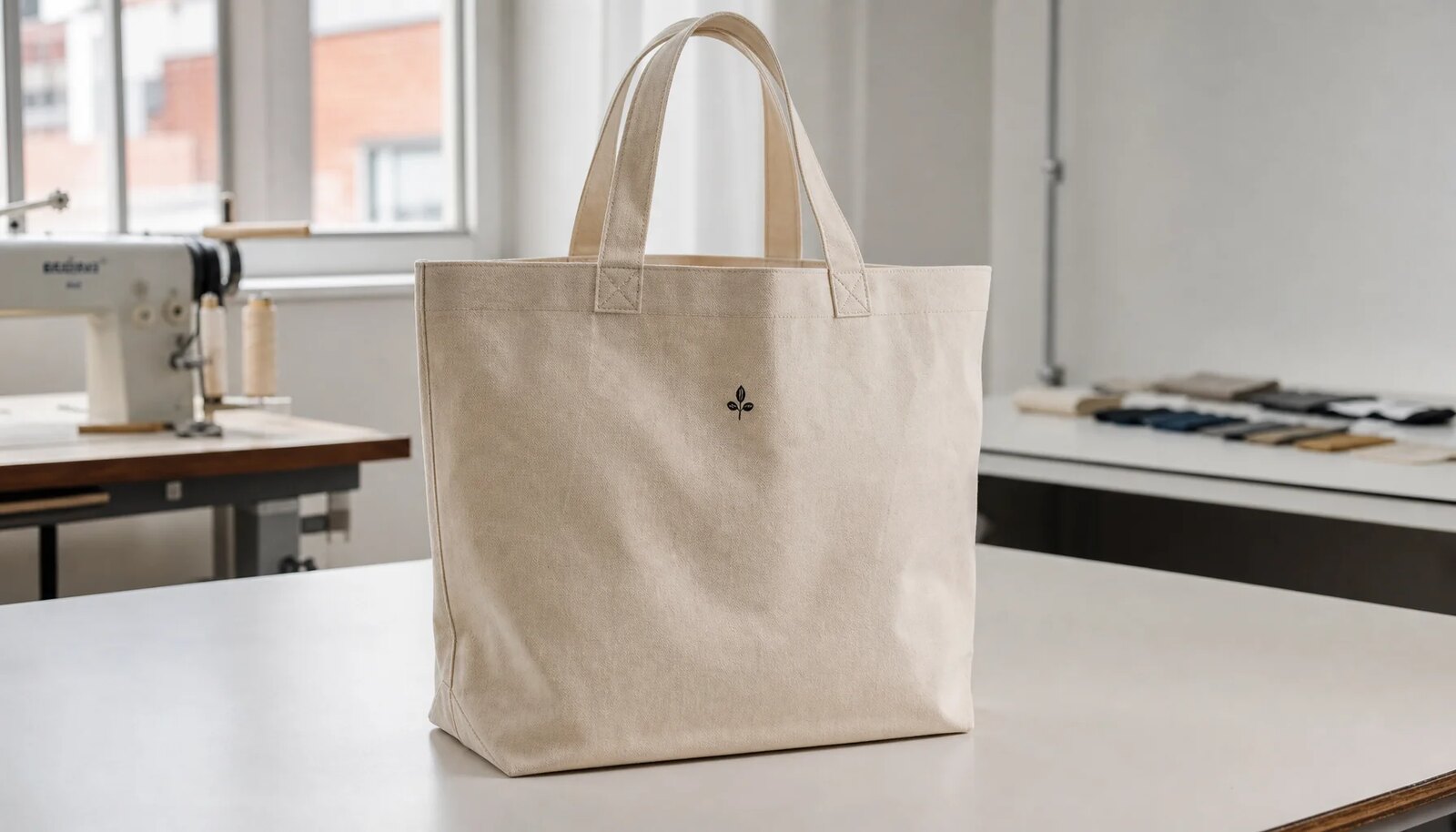
Start with the event load, not the mockup
A canvas grocery tote can look finished in a digital proof while still being under-specified for production. Event planners need the bag to carry real contents, move through freight and venue receiving, look presentable on handout tables, and survive attendee use after the event. Material selection should begin with that operating reality, not only with the logo placement.
List the expected contents before choosing fabric weight. A tote for agendas, flyers, badge inserts, and a notebook can be lighter than a tote filled with bottled drinks, jars, books, boxed samples, produce, or retail merchandise. Also note whether staff will pre-stuff the bags. Pre-stuffed totes put stress on seams during packing, pallet handling, staging, and movement between rooms before attendees ever touch them.
Separate baseline requirements from upgrades. The baseline might be 12 oz natural canvas, side gusset, shoulder-length handles, reinforced joins, one-color print, inner bundles of 25, and carton labels by destination. Upgrades might include dyed fabric, individual polybags, woven labels, hang tags, barcode stickers, or a boxed bottom. Keeping these choices separate makes quote comparison faster and avoids redesigning the bag every time budget changes.
- Define contents, maximum load, carry distance, handout method, and venue receiving rules before sending the RFQ.
- Use one spec sheet for every supplier so fabric, dimensions, print, construction, and packing are quoted consistently.
- Mark upgrades separately from required specifications so the team can approve or remove them cleanly.
- Keep approved swatches, print strike-offs, samples, carton data, and packing instructions in one buying file.
Match canvas weight to the program
Fabric weight affects structure, load capacity, print result, folding, carton count, and freight. For B2B event buying, the useful question is not which weight is best in general. It is which weight is strong enough for the contents without adding unnecessary cost, stiffness, or carton bulk.
For light handouts, 10 oz canvas, usually around 330 to 360 gsm, can work well. It is suitable for brochures, lanyards, agendas, flat sponsor pieces, and simple welcome kits. It folds efficiently and helps keep carton weight down. If the bag will be pre-stuffed or carried for long periods, reinforce the handles and inspect the bottom seam closely.
For most reusable grocery-style event totes, 12 oz canvas, often around 390 to 430 gsm, is the practical starting point. It has more structure than 10 oz without the freight and sewing pressure of heavier canvas. It is a sound comparison weight for conferences, campus events, employee kits, retail activations, and sponsor programs.
Move to 14 oz or 16 oz when the program calls for heavier fill, premium hand feel, resale positioning, or repeat use. This range can be useful for farmer market campaigns, food gifting, book programs, and high-value merchandise kits. Review a finished sample because heavier fabric changes seam bulk, handle comfort, fold behavior, and small print clarity.
- 10 oz: choose for light contents, lower freight pressure, and budget-sensitive handouts.
- 12 oz: use as the default benchmark for reusable grocery-style event totes.
- 14 oz to 16 oz: reserve for heavier loads, premium positioning, or long-use merchandise.
- Ask suppliers to quote 10 oz, 12 oz, and 14 oz with the same dimensions, print, handles, and packing so tradeoffs are visible.
Choose construction and finish deliberately
The purchase order should not say only canvas. It should identify fabric construction, fiber content, finish, weight, and tolerance. Plain cotton canvas, cotton duck, cotton-poly canvas, and recycled cotton blends can behave differently even when the gsm looks similar. Cotton duck is often tighter and more structured. Blends may change shrinkage, print response, heat tolerance, labeling, and hand feel.
Natural unbleached canvas is common because it is familiar, widely available, and efficient for bulk programs. Its main issue is shade variation. A lot may look warmer, cooler, creamier, or more speckled than a showroom sample. Approve an intended-production swatch or shade band and state whether shade mixing is allowed across cartons.
Bleached canvas gives a cleaner base and can make artwork appear brighter. It also shows stains, oil marks, dirt, and handling marks more easily. If the totes will be distributed outdoors, around food sampling, or in a fast venue setup, write a clear inspection standard for visible marks.
Dyed and washed canvas need extra approval control. Dyed canvas requires color approval, dye-lot rules, and rub testing. Washed canvas can feel softer and more retail, but washing can change dimensions, twist seams, shift shade, or affect print behavior. Measure the finished tote after the final process, not only before cutting.
- State construction, fiber content, finish, gsm, and tolerance in the RFQ and PO.
- For natural canvas, approve a shade range instead of relying on a single showroom sample.
- For dyed canvas, require lab dip or swatch approval, dye-lot control, and crocking checks.
- For washed canvas, confirm shrinkage, post-wash dimensions, seam twist, handle drop, and final hand feel.
Specify the stress points
A tote rarely fails in the middle of the fabric. Failures usually happen at handle joins, top hems, side seams, bottom seams, gusset corners, and thick folded areas. A heavier tote with weak handle stitching can perform worse than a lighter tote with proper reinforcement. For grocery-style event use, construction details belong in the quote, not in assumptions.
Handle drop should match how attendees will carry the bag. A shorter drop can be tidy for hand carry at registration. A longer drop is better for shoulder carry, especially when the tote is filled with groceries, books, or samples. Handle width also matters. Narrow handles save material but feel less comfortable under load; wider handles improve comfort and perceived quality but add cost and bulk.
Name the reinforcement method. Common options include folded-in handle ends, double stitching, box stitching, cross stitching, bartacks, or a combination. Bottom construction should also be chosen intentionally. Flat totes are economical and easy to fold. Side gussets add volume. Boxed or side-and-bottom gussets help the bag stand and carry grocery items more naturally.
Finishing details affect handout speed. Loose threads, twisted handles, uneven hems, poor folding, and inconsistent bundle counts slow down event teams. Trimming, pressing, folding, bundling, carton labels, and destination marks should be included in the supplier scope.
- Lock body width, height, gusset depth, bottom style, handle drop, handle width, and measurement tolerance.
- Specify reinforcement at handle joins for books, bottles, food kits, groceries, or pre-stuffed bags.
- Inspect handle symmetry, stitch density, top hem, bottom seam, gusset corners, skipped stitches, and loose threads.
- Confirm whether trimming, pressing, folding, inner bundling, carton labels, and destination marks are included.
Test decoration on production fabric
Decoration should be approved on the intended production canvas. Texture affects ink edges, opacity, adhesion, color, and small details. Natural canvas can warm printed colors. Dyed canvas can reduce contrast. Heavy canvas can make transfers feel thicker or show edge lift if the process is not tuned.
Screen printing is often the best value for simple one-color or limited-color artwork, especially on natural canvas and larger runs. It is less suitable for gradients, photographic graphics, very small sponsor text, or frequent artwork changes at low quantities.
Heat transfer and digital print can help with detail, gradients, or many colors, but they should be checked for hand feel, cracking, edge lift, texture show-through, and rub resistance. Embroidery can feel premium, but it adds stitch-count cost and may distort lighter fabric. Woven labels create a clean retail detail, though they add trim MOQ, placement checks, and label inventory control.
Write the artwork standard in measurable terms. State print size, placement from the top edge, centerline or side-edge position, color target, opacity expectation, and acceptable placement movement. If bags are folded for distribution, check whether the fold crosses the logo or hides sponsor artwork when stacked.
- Use screen print for simple logos, solid artwork, larger quantities, and value-focused natural canvas programs.
- Use heat transfer or digital print when artwork complexity justifies testing the process on the selected canvas.
- Use embroidery or woven labels for premium presentation, with trim MOQ and placement checks included.
- Approve a decorated strike-off or pre-production sample on the intended fabric before bulk release.
Choose the sourcing route by quantity and timing
The best sourcing route depends on quantity, lead time, customization, and how much control the event requires. A small urgent order should not be sourced the same way as a repeat 10,000-unit sponsor program with multiple destinations.
For under 250 units or an urgent local need, domestic stock totes or a local decorator may be the cleanest path. The unit price may be higher and material options limited, but the schedule is easier to control. This route works when the event can accept available sizes, colors, and handle styles.
For 250 to 1,000 units, compare stock blanks decorated locally against low-MOQ custom suppliers. This range is useful for pilot programs, regional events, and smaller activations. Sample approval still matters, especially if the bags will be pre-stuffed or the logo has fine detail.
For 1,000 to 5,000 units, use a structured RFQ with exact fabric, construction, print, packing, carton, and QC requirements. For 5,000 units or repeat annual programs, a factory-direct or managed factory route can make sense because you can lock fabric standards, retained samples, carton formats, reorder documentation, and SKU rules. Overseas production may improve unit economics at scale, but it needs more time for swatches, pre-production samples, freight, and inspection.
- Under 250 units: use domestic stock or local decoration when timing matters more than customization.
- 250 to 1,000 units: compare low-MOQ custom options with decorated stock blanks.
- 1,000 to 5,000 units: require full specifications, sample approval, carton data, and inspection rules.
- 5,000+ units or repeat programs: lock factory specs, retained samples, fabric standards, and reorder procedures.
- Multiple destinations or artwork versions: require SKU-level packing lists, carton marks, barcode rules, and separate approvals.
Make quotes easy to compare
A low unit price can hide lighter fabric, narrower handles, weaker reinforcement, excluded setup charges, thin cartons, loose packing, or incomplete freight assumptions. Quotes are comparable only when the material, construction, decoration, packing, and inspection scope match.
Ask suppliers to separate the main cost drivers: fabric, cutting, sewing, handle reinforcement, decoration setup, decoration running cost, labels, hang tags, inserts, folding, polybags, cartons, inspection, and freight assumptions. Not every factory will price each operation the same way, but the quote should show what is included and what is extra.
Packing data is critical for event planners. Heavier canvas reduces units per carton and raises gross weight. Boxed bottoms, wide handles, hang tags, individual polybags, or retail presentation can increase carton volume and packing time. A lower ex-factory price may lose value if cartons are bulky, weak, mislabeled, or hard for the venue to count.
Use controlled alternates instead of open-ended quote requests. Ask for the same tote in 10 oz, 12 oz, and 14 oz canvas. Or ask for one 12 oz tote in bulk folded packing, inner bundles, and individual polybags. This shows the cost of each decision without changing too many variables at once.
- Request itemized lines for fabric, sewing, reinforcement, decoration, trims, packing, cartons, samples, inspection, and freight assumptions.
- Ask for units per carton, carton dimensions, gross weight, carton count, pallet rules, and shipping marks.
- Compare base and upgraded versions so heavier fabric, stronger handles, and retail packing have visible costs.
- Confirm whether sample fees, screen charges, artwork fees, courier fees, and inspection charges are included or separate.
Control MOQ by component
MOQ is usually created by several components, not one headline number. The tote body may have one minimum, fabric color another, print setup another, labels another, and special packing another. Ask for the MOQ by component before changing the entire product.
Natural canvas with one-color decoration and simple folded packing usually supports more flexible quantities because it uses common fabric and fewer setup points. Custom dyed fabric, washed finishes, multiple artwork versions, woven labels, barcode stickers, hang tags, inner pockets, and individual retail packing can raise the minimum.
Once the MOQ driver is clear, adjust the right part of the spec. If fabric color drives the minimum, use natural canvas or a stock shade. If print setup is the issue, reduce artwork versions or combine sponsors on one panel. If packaging is the constraint, use inner bundles instead of individual polybags. If trims drive MOQ, replace a woven label with a printed mark or approve extra trim inventory for repeat use.
The right quantity also depends on event certainty. A repeat program may justify a higher order to secure consistent material and lower unit cost. A one-time activation with uncertain attendance may be better served by a smaller order at a higher unit cost. Storage, reorder timing, artwork changes, and venue receiving limits should be part of the quantity decision.
- Ask MOQ separately for tote body, fabric color, each artwork, labels, trims, hang tags, barcode stickers, and packing format.
- Identify the component setting the minimum before changing fabric weight or bag dimensions.
- Use natural canvas or available stock fabric when timing is tight or quantity is low.
- Reduce artwork versions if decoration setup is driving cost or MOQ.
- For repeat events, ask how samples, fabric standards, artwork files, and carton rules will be retained.
Approve samples and inspect for event readiness
A pre-production sample should represent the actual order. It should use the intended production fabric, weight, finish, thread, handle construction, reinforcement, decoration method, labels, trims, fold method, and packing approach. A similar blank bag with a similar logo is useful for discussion, but it should not release bulk production.
Sample approval should be measured, photographed, and written. Check finished width, height, gusset, handle drop, handle width, print size, print placement, fabric shade, stitch quality, fold method, and packing presentation. For dyed or washed fabric, measure after the final process. For multiple SKUs, verify artwork version, barcode scanability, label placement, carton mark logic, and packing list rules.
Avoid vague comments such as make the handles stronger or move the logo up. Convert each change into a measurable requirement. Name the reinforcement method. State the revised distance from the top edge or centerline. Define the acceptable shade band. Confirm whether the approved sample replaces earlier mockups and whether a new sample is required before production.
Inspection should focus on defects that can disrupt the event. Critical issues include broken handles, open seams, wrong artwork, wrong fabric, severe stains, mold, strong odor, missing required labels, unsafe contamination, or cartons packed with the wrong SKU. Major issues include off-center print, poor cure, skipped stitches, incorrect barcode, dimension problems, weak cartons, or incorrect carton quantity. Minor issues may include small loose threads or slight shade variation inside the approved range.
Carton checks are part of quality control. Inspectors should verify carton count, units per carton, inner bundle count, gross weight, shipping marks, destination labels, SKU marks, and artwork-version marks. Good carton control prevents the event team from opening every box just to understand what arrived.
- Require the pre-production sample to match intended bulk fabric, decoration, construction, folding, and packing.
- Measure the sample against the spec sheet before signing approval.
- Keep the approved sample, fabric swatch, print strike-off, trim sample, and packing reference for inspection and reorders.
- Classify critical, major, and minor defects before production inspection begins.
- Check handle joins, seam strength, print cure, rub resistance, odor, stains, carton labels, and SKU accuracy before shipment.
Specification comparison for buyers
| Material option | Typical weight / gsm | Relative cost | Practical load rating | Best event use |
|---|---|---|---|---|
| 10 oz natural cotton canvas | About 330 to 360 gsm | Low | Light to moderate | Brochures, agendas, lanyards, flat samples, simple welcome kits |
| 12 oz natural cotton canvas | About 390 to 430 gsm | Medium | Moderate | Reusable grocery-style totes, sponsor kits, campus events, employee programs, retail activations |
| 14 oz cotton canvas or cotton duck | About 470 to 500 gsm | Medium-high | Moderate to heavy | Farmer market activations, food gifting, heavier merchandise, premium event kits |
| 16 oz heavy canvas or duck | About 520 to 560 gsm | High | Heavy | Bottle programs, book programs, resale totes, high-value reusable merchandise |
| Bleached canvas | Weight depends on base cloth; often 10 oz to 14 oz | Medium to medium-high | Same as base cloth | Clean retail-style presentation, brighter artwork, white or light brand base |
| Dyed canvas | Weight depends on base cloth and dye process | Medium-high to high | Same as base cloth | Brand-color totes, sponsor colorways, premium campaigns, SKU-based programs |
| Washed canvas | Often quoted in 12 oz to 16 oz before or after wash | High | Moderate to heavy | Soft hand feel, lifestyle retail, premium gifting, relaxed brand presentation |
| Cotton-poly canvas blend | Supplier-specific; require exact fiber content and gsm | Low to medium | Light to moderate | Budget-sensitive programs needing steadier shrinkage or different hand feel |
| Recycled cotton blend canvas | Supplier-specific; require blend percentage, gsm, and swatch | Medium to high | Light to moderate | Sustainability-positioned events where shade variation is acceptable |
Buyer checklist before sampling
- Define the event use case: giveaway, registration tote, sponsor kit, retail item, staff bag, food program, farmer market tote, or reusable grocery bag.
- Record typical contents, maximum expected load, whether bags are pre-stuffed, and how far attendees may carry them.
- Lock finished dimensions: body width, body height, gusset depth, bottom construction, handle drop, handle width, and measurement method.
- Specify fabric weight in both oz per square yard and gsm, with a written tolerance for bulk fabric.
- Name the fabric construction and finish: natural canvas, cotton duck, cotton-poly blend, recycled cotton blend, bleached, dyed, washed, coated, or laminated.
- Require an intended-production fabric swatch before pre-production sample approval.
- State handle reinforcement, stitch type, stitch density expectation, thread color, thread strength expectation, and stress-point construction.
- Define print method, artwork size, placement, color target, opacity requirement, cure expectation, and placement tolerance.
- Ask for packing data: units per carton, carton size, gross weight, carton count, inner bundles or polybags, carton marks, and pallet assumptions.
- Separate MOQ for tote body, fabric color, artwork version, labels, hang tags, barcode stickers, trims, and packing format.
Factory quote questions to send
- What exact canvas weight are you quoting in oz and gsm, and what tolerance will apply to bulk fabric?
- Is the fabric plain canvas, cotton duck, cotton-poly canvas, recycled cotton blend, or another construction?
- What finish is included: natural, bleached, dyed, washed, pre-shrunk, brushed, coated, or laminated?
- Can you send a swatch from the intended production fabric before making the pre-production sample?
- What finished dimensions, gusset, handle drop, handle width, seam type, stitch density, and reinforcement method are included?
- Which thread type and stitch method are used at the handle joins, top hem, side seams, bottom seam, and gusset corners?
- Which decoration method, ink or transfer system, setup charges, and running charges are included in the quote?
- What print placement tolerance, color tolerance, opacity standard, cure check, and rub-resistance check can you support on this canvas?
- What are the MOQs for the tote body, fabric color, each artwork, labels, trims, hang tags, barcode stickers, and packaging configuration?
- Can you quote 10 oz, 12 oz, and 14 oz versions with the same dimensions, handle construction, print, carton data, and lead time assumptions?
Quality-control points to confirm
- Bulk fabric weight should remain within the agreed tolerance, commonly around plus or minus 5 percent unless the contract states otherwise.
- Fiber content, weave, and finish should match the approved specification and intended production swatch.
- Natural, bleached, dyed, or recycled canvas shade should match the approved swatch or shade band, with no uncontrolled shade mixing across cartons.
- Finished body width, body height, gusset depth, handle drop, handle width, and bottom shape should match the approved spec sheet within written tolerance.
- Washed, dyed, pre-shrunk, or heat-processed canvas should be measured after the final process because finishing can change dimensions.
- Stitching should be secure and consistent, with no skipped stitches, broken thread, seam puckering, open seams, twisted handles, or loose reinforcement.
- Handle attachment should be inspected as a priority because it is the main functional failure point for grocery, sponsor-kit, and venue distribution use.
- Print should match approved artwork size, placement, color target, opacity, and detail, with no obvious bleed, cracking, pinholes, ghosting, smudging, or misregistration.
- Print cure and rub resistance should be checked on production samples, especially for dark ink on natural canvas, light ink on dyed canvas, large solids, or heat transfers.
- Labels, hang tags, barcodes, inserts, carton marks, and artwork-version marks should match the PO and packing list.