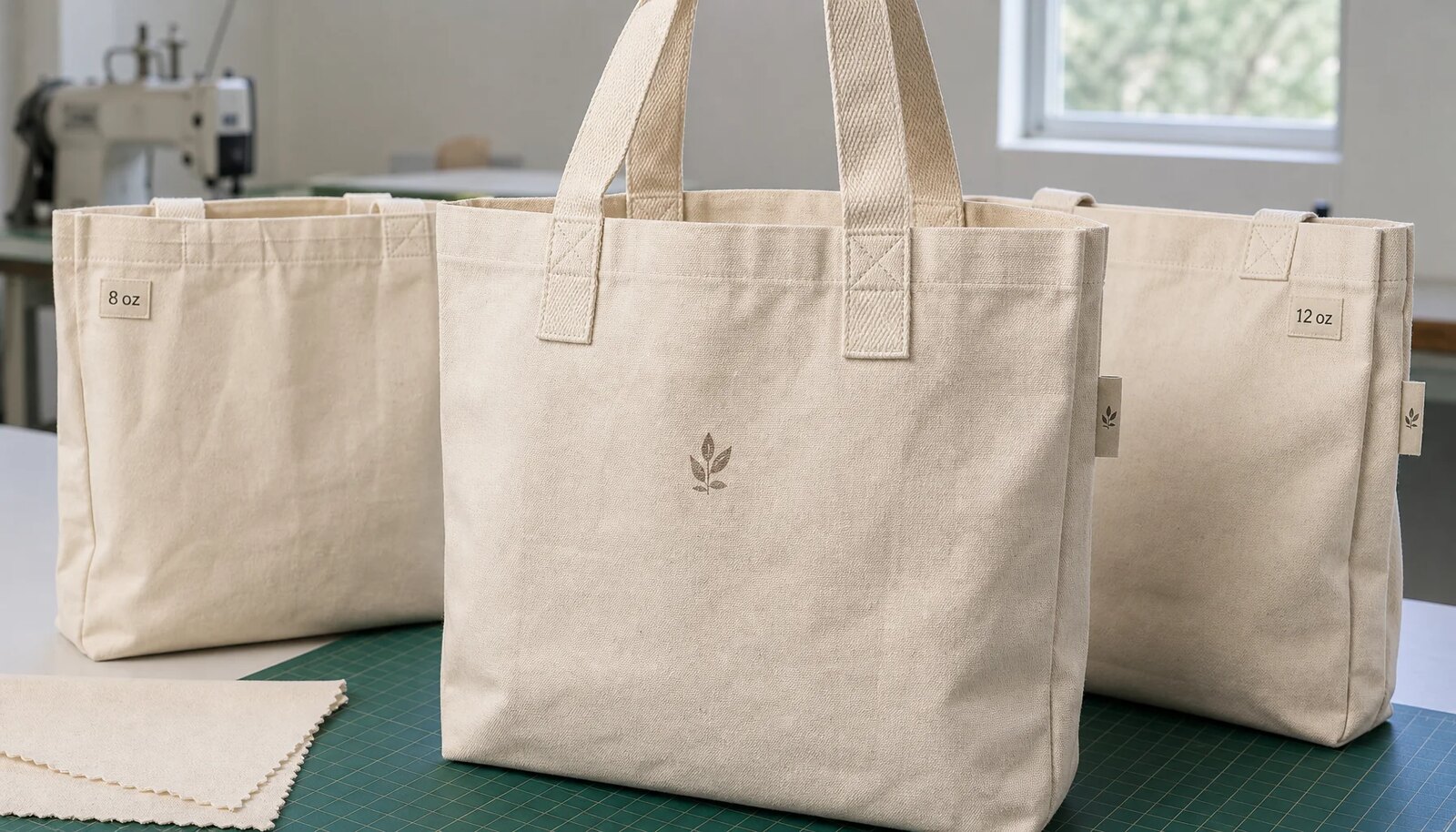
Begin with the carrying job, not the tote sketch
A canvas grocery tote looks simple on a line drawing: one body, two handles, maybe a gusset and a front logo. In production, that same drawing can become very different products. A 38 x 42 cm tote in light promotional canvas will not behave like a grocery carrier made with tighter fabric, wider handles, reinforced stitching, and a boxed bottom. For B2B procurement, the first question is not what size should the bag be. It is what job must this bag survive.
Eco apparel brands often use canvas grocery totes as more than packaging. They become loyalty gifts, retail merchandise, store carryout bags, trade-show giveaways, or subscription inserts. Customers keep them in cars, fold them into backpacks, carry produce, stack cartons, and sometimes wash them even when the care label does not encourage it. That real handling pattern should shape the RFQ.
Over-specifying is not automatically safer. A very heavy tote can feel premium, yet it may cost more, occupy more warehouse space, increase freight cube, crease badly in cartons, and feel bulky for everyday use. Under-specifying is worse: narrow handles, loose weave, or weak print cure can create complaints quickly. The practical target is a construction that is strong enough for the intended load, clean enough for the brand channel, and efficient enough for repeat purchasing.
Before comparing prices, write the commercial context into the brief. A retail SKU may need barcode labels, consistent carton quantities, a smoother print face, and stricter inspection. A lower-cost campaign bag may accept lighter canvas and simple bulk packing. A weekly grocery tote should usually give more attention to gusset depth, handle comfort, and load testing. Once these assumptions are visible, suppliers are less likely to quote different products under the same friendly phrase: custom canvas tote.
- Define the channel before asking for unit price: retail, giveaway, GWP, subscription, employee kit, or store carryout.
- State the expected load in kilograms instead of using loose words such as sturdy, strong, or premium.
- Connect fabric, handle, gusset, print, label, and packing requirements in one RFQ.
- Ask suppliers which choices drive cost, MOQ, carton volume, and lead time.
- Keep physical approved standards for fabric, color, print, labels, and packing with the purchase order.
Fabric weight: turn canvas into a measurable specification
Canvas weight is usually the first material decision buyers discuss, and for good reason. It influences handfeel, structure, sewing difficulty, print result, packing volume, and cost. For many reusable grocery tote programs, 10-12 oz cotton canvas, commonly about 340-410 GSM depending on weave and finish, is a useful middle range. It feels more substantial than a light event tote and is still practical for sewing, folding, and repeat orders.
Lighter 8-9 oz canvas, roughly 270-320 GSM, has its place. It can work well for apparel packaging, event bags, low-load promotions, and subscription inserts where foldability and price matter. But a buyer should be careful if the marketing message says grocery tote or market bag. Cans, jars, bottles, cartons, and dense produce create concentrated stress. With lighter canvas, handle roots, top hems, and side seams need more attention, not less.
Heavier 12-16 oz canvas, roughly 410-540 GSM, creates a firmer body and a more substantial retail feel. It can be a good match for premium market totes, structured accessories, and resale items. The tradeoffs are real. Thick folded seams are harder to sew neatly. Needle marks can be more visible. Cartons become larger. Freight cube increases. Fold creases may remain after compression packing. Heavy fabric also cannot compensate for bad construction; a 14 oz tote with narrow handles and poor reinforcement can still fail at the handle root.
Buyers should also clarify what the weight means. Some suppliers quote greige fabric. Others quote finished, washed, dyed, softened, or pre-shrunk fabric. A tote inspected after sewing may not match the number used in the original quote if the measurement point was unclear. State the target weight, the accepted tolerance, and whether inspection applies to bulk fabric or finished goods. A tolerance of plus or minus 5% is common for many programs, but stricter brands may set their own standard.
- 8-9 oz, about 270-320 GSM: light promotions, apparel packaging, and low-load programs.
- 10-12 oz, about 340-410 GSM: common middle range for many reusable grocery tote orders.
- 12-16 oz, about 410-540 GSM: premium or structured totes when cost and carton volume are acceptable.
- Agree GSM or oz tolerance before production, commonly plus or minus 5% unless the program requires otherwise.
- Record whether the quoted weight is greige, finished, dyed, washed, softened, or pre-shrunk.
Weave, yarn, finish, and shrinkage matter as much as weight
A fabric scale does not tell the whole story. A tightly woven 10 oz canvas can print better and carry better than a loose 12 oz canvas. Tight plain weave gives the bag a more stable surface, helps logo edges stay cleaner, and reduces distortion around seams. Loose weave may open around needle holes, stretch at handle roots, and create uneven ink deposit. If the tote is meant for retail or repeat grocery use, weave stability should be inspected, not assumed.
Ask for yarn count and weave type when the supplier can provide them, but do not rely only on technical words. Hold the swatch. Bend it. Look across the surface. Check both sides. Surface lint, heavy neps, broken yarns, slubs, weaving bars, and oil spots all affect final appearance. Natural canvas may show cotton character, including small specks and tonal movement. That can be acceptable when it is intentional and approved. It becomes a problem when stains, mildew, dirty handling, or poor fabric sorting are excused as natural variation.
Finishing changes how canvas feels and behaves in production. A crisp, sized canvas may look structured and print sharply, but it can feel stiff. A softened or washed canvas may feel more consumer-friendly, yet it can shrink, torque, or vary more if the process is not controlled. Pre-shrinking or sanforizing can reduce dimensional change, but those treatments should be confirmed in writing. If the end user may wash the tote, even occasionally, shrinkage expectations belong in the specification and care guidance.
For repeat orders, a retained swatch is worth more than a photo. Screens shift color. Lighting changes texture. A physical standard gives the factory, buyer, and inspector something concrete to compare against. Keep approved fabric swatches for weight, shade, slub level, and handfeel, especially if the tote will be reordered season after season.
- Prefer a tight plain weave when the tote has printed logos and reinforced grocery-use seams.
- Approve acceptable slub, speck, lint, handfeel, and natural shade variation with a retained swatch.
- Ask whether the canvas is greige, sized, softened, washed, enzyme finished, pre-shrunk, or sanforized.
- Define shrinkage expectations if the tote carries care instructions or may be washed by consumers.
- Reject oil spots, mildew marks, weaving bars, broken yarns, heavy lint, dirty handling marks, and obvious shade mismatch.
Fiber and sustainability claims need documentation, not assumptions
Eco apparel brands naturally care about the material story, but procurement teams should separate material selection from claim approval. Conventional cotton, organic cotton, recycled cotton blends, and cotton-poly canvas can all be reasonable choices in the right program. The best option depends on brand policy, target price, durability expectations, documentation needs, and the market where the tote will be sold or distributed.
The main risk is unsupported language. A quote that says eco canvas or sustainable cotton is not enough for a hangtag, product page, retailer compliance form, or customs file. Organic cotton claims may require transaction certificates or chain-of-custody documents, depending on the claim and selling market. Recycled cotton blends need recycled-content documentation and accurate percentage wording. Cotton-poly blends may improve dimensional stability or pricing, but they may conflict with a plastic-free material policy. Undyed natural canvas can simplify dye processing, but it should not be described as impact-free without evidence.
Before the creative team approves label copy, ask the supplier what documents they can provide and what wording those documents support. The fiber label, woven side label, hangtag, website description, and purchase order should not tell five different stories. If a retailer or buyer has restricted-substance requirements, confirm testing responsibilities and timing before shipment planning becomes tight.
Durability also belongs in the sustainability discussion, but keep claims factual. A tote designed for repeated use has a stronger product story than a flimsy giveaway, provided the construction actually performs. Still, avoid broad environmental comparisons unless they are backed by verified data. Procurement-safe language usually focuses on fiber content, dye route, reusable design, care instructions, and available certification documents.
- Ask for fiber content by percentage, not just a fabric nickname.
- Confirm which organic, recycled, or restricted-substance documents are available before approving labels.
- Use precise wording such as 100% cotton, organic cotton, recycled cotton blend, or undyed natural canvas only when supported.
- Check whether the buyer, retailer, or destination market requires chemical testing before shipment.
- Avoid broad sustainability claims that go beyond the supplier documentation and approved test evidence.
Color route: natural, bleached, dyed, and shade tolerance
Color is not only a design choice. It affects MOQ, lead time, defect visibility, print opacity, and inspection rules. Natural undyed canvas is often the simplest route because mills and tote factories may hold it as stock fabric. It also gives the familiar oatmeal or off-white look many eco apparel brands want. The tradeoff is variation. Cotton source, yarn lot, finishing, storage, and washing can shift the tone. Approve a physical shade range rather than expecting every shipment to match a digital image.
Bleached or optical white canvas gives stronger logo contrast and a cleaner retail appearance. It also exposes problems quickly. Oil spots, dust, handling marks, smudged ink, needle marks, and carton dirt are easier to see on white fabric. If the program uses white canvas, build cleanliness into production: protected work surfaces, careful bundling, clean packing, and clear rejection standards for stains.
Piece-dyed canvas allows closer alignment with brand palettes, but it adds steps. Buyers should request lab dips before bulk dyeing and approve the final shade on actual canvas, not only against a Pantone reference. Pantone is useful for communication; cotton canvas absorbs dye differently from coated paper. For repeat orders, decide whether new production should match the original approved standard or the most recent shipment. Without that instruction, the shade can drift over multiple buys.
Print planning changes with body color. A dark tote with a pale logo may need an underbase, which can increase cost, ink thickness, and handfeel. Bright dyed canvas should be reviewed for crocking or color transfer. Natural canvas can warm up pale artwork, so white, beige, pastel green, and muted brand colors may look different from the digital proof. Always approve the strike-off on the final body color.
- Natural canvas needs an approved shade range and speck standard.
- Bleached white canvas needs tighter cleanliness, stain, and handling controls.
- Dyed canvas needs lab dips, shade bands, and colorfastness or crocking review.
- Dark body colors may require a print underbase for opacity.
- Keep physical color standards for reorders, inspections, and dispute resolution.
Handles, gussets, and stress points decide real durability
When grocery totes fail, the problem often starts at the handle root, top opening, side seam, gusset fold, or bottom corner. The body fabric matters, but the bag works as a system. A midweight tote with wide reinforced handles can outperform a heavier tote with narrow straps and weak stitching. That is why the handle spec deserves the same attention as GSM.
Handle drop should match how the customer will carry the bag. Short handles may be fine for hand carry. Many grocery users prefer shoulder carry, especially when the bag is full. A shoulder-friendly drop may be around 25-30 cm, but the best number depends on bag height, body shape, and target user. Longer handles create more leverage at the attachment point, so reinforcement becomes more important. Handle width matters too. Very narrow straps can dig into the hand when the tote is loaded with dense goods. For many grocery formats, 2.5-4 cm cotton webbing or properly folded self-fabric handles are more comfortable.
Reinforcement should not be left to the factory's interpretation. Common choices include box stitch, box with cross stitch, bar-tack, reinforced top hem, and extra back-tacking at stress points. Ask for stitch density, thread color, seam allowance, reinforcement size, and attachment position. Crooked stitching, short back-tacks, skipped stitches, weak thread tension, and poor seam allowance can weaken a bag that otherwise looks acceptable in photos.
Gusset design controls usable capacity. A flat tote can look large but carry groceries poorly because contents stack vertically and pull the bag out of shape. A 10-15 cm side gusset or boxed-bottom gusset is common for grocery-oriented formats, though the right depth depends on carton sizes, desired silhouette, and packing volume. Measure the finished gusset after sewing, not the cut panel. Small construction changes can reduce the space customers actually use.
- Specify handle drop, width, material, attachment position, and reinforcement pattern.
- Use box stitch, cross stitch, or bar-tack at handle roots for grocery-use programs.
- Inspect stitch density, seam allowance, back-tacking, thread tension, and skipped stitches.
- Define finished gusset depth instead of relying only on flat body dimensions.
- Run a practical load test at the expected grocery weight before approving bulk production.
Print and branding choices for canvas grocery totes
Screen printing is still the default choice for many B2B canvas grocery tote orders, especially when the artwork uses one to three solid colors. It can deliver good unit economics, a textile-compatible handfeel, and repeatable placement when the artwork is not too fine. Still, buyers should ask about ink type, curing method, opacity target, print setup, and placement tolerance. Under-cured ink can rub, crack, block, or transfer to nearby fabric during carton compression.
Water-based inks can create a softer handfeel and are often chosen when the brand wants a less plastic surface. Plastisol-style prints can deliver strong opacity and color consistency, although the feel may be heavier depending on ink deposit. Neither option is automatically best. The right choice depends on fabric color, logo color, line detail, order quantity, folding method, and the conditions the tote will face after delivery.
Transfer, DTF, or digital methods can work for smaller runs, gradients, photographic artwork, or many-color designs. Do not approve them only because the table sample looks sharp. Transfers may show an edge, feel less textile-like, peel at corners, crack at folds, or scuff during use. The decorated sample should be rubbed, flexed, folded, compressed, and checked again after resting in the approved packing format.
Branding may also include woven labels, printed care labels, hangtags, barcode stickers, and carton marks. These small items often have their own MOQ, lead time, and approval cycle. Label placement should be measured from fixed points and checked for folding interference, seam bulk, and consistency. For many eco apparel brands, a clean front screen print plus a small side label gives a polished result without overcomplicating production.
- Approve a print strike-off on the final canvas and final body color.
- Check opacity, registration, edge sharpness, cure, rub resistance, handfeel, and fold cracking.
- Use screen print for solid logos and repeatable medium-to-large orders.
- Use transfer methods only after testing edge feel, peeling, cracking, abrasion, and carton compression.
- Measure logo and label placement from the top edge, side seam, gusset fold, pocket edge, or another fixed reference.
Quote comparison, MOQ, and lead-time reality
Supplier quotes can look similar while describing very different bags. One price may assume 8 oz stock natural canvas, short handles, one-color print, and bulk packing. Another may include 12 oz canvas, shoulder-length webbing handles, reinforced top hem, woven side label, barcode sticker, and export cartons. If procurement compares only the unit price, the lower quote may simply be a lower-spec product.
A useful quote separates the cost drivers. Ask for the base tote cost, fabric or dye surcharge, decoration setup, per-unit print cost, label cost, hangtag or barcode cost, packing cost, sample fee, carton dimensions, carton quantity, and estimated CBM. This makes design changes easier to evaluate. It also helps future replenishment because setup charges, component minimums, and fabric availability may change between the first order and the reorder.
MOQ often comes from components rather than sewing capacity. Stock natural canvas may allow a lower starting quantity. Custom dyed fabric, unusual weight, washing, custom woven labels, several logo versions, retail packaging, and special carton marks can each create separate minimums. Ask whether MOQ is per style, per body color, per print design, per label, per carton mark, or per shipment. A program with many colorways can become difficult even when the total quantity sounds high.
Lead time should be tied to the step that controls the schedule. A standard natural canvas tote with one-color print may move quickly after approvals. A dyed, washed, labeled, retail-packed tote can depend on fabric booking, lab dip approval, dyeing, drying, shrinkage stabilization, printing, sewing, inspection, and final packing. Ask the supplier to identify the longest step and the last approval date needed to protect the ship window.
- Compare quotes only after normalizing fabric, size, handle, gusset, print, label, and packing.
- Ask for separate MOQ by fabric, body color, artwork, label, hangtag, barcode, and packaging.
- Request price breaks at realistic order quantities, not only the launch MOQ.
- Confirm which production steps are in-house and which are subcontracted.
- Tie lead time to sample approval, fabric readiness, print approval, inspection, and final packing date.
Sample approval workflow that prevents bulk rework
A good sample process feels slower at the beginning and faster later. Start with fabric swatches whenever possible. Approve weight, handfeel, weave, lint level, shade range, and visible cotton character before the factory cuts a full tote. If the body is dyed, approve lab dips before bulk dyeing. If the logo is printed, approve a strike-off on the final canvas before mass printing. These small gates prevent a finished sample from hiding unresolved material decisions.
The pre-production sample should match the real order: correct canvas, final body color, finished dimensions, gusset, handle drop, reinforcement, thread color, print size, print placement, labels, hangtags, barcode if needed, and packing method. A shape sample made with substitute fabric can be useful for early review, but it should not authorize bulk cutting. If anything is still temporary, write that clearly in the approval comments.
Measurements belong on the finished sewn tote. Cutting, folding, seam allowance, washing, pressing, and packing can all affect dimensions. Buyers should set tolerances before mass production. Practical tolerances often include plus or minus 1 cm for main body dimensions and plus or minus 0.5 cm for print placement, but the right standard depends on the product, channel, and buyer expectation.
A practical load test is essential when the tote will be positioned for grocery use. Fill the sample to the stated test weight, lift it repeatedly, hold it by the handles, and observe the stress points. Record the load, duration, repetitions if used, and result. This does not replace a lab test when a retailer requires one, but it quickly reveals weak handle roots, seam opening, bottom distortion, and uncomfortable straps.
- Approve fabric swatches before full samples when possible.
- Approve lab dips for dyed canvas and strike-offs for printed artwork.
- Use the complete pre-production sample as the final production gate.
- Measure finished dimensions and logo placement against written tolerances.
- Document load-test weight, method, duration, repetitions, and observed result.
Bulk QC: write inspection points into the purchase order
Bulk quality control should be defined before production starts. If tolerances are debated only after defects appear, the buyer and supplier may disagree about what acceptable means. The purchase order or tech pack should state fabric weight tolerance, shade standard, dimension tolerance, print placement tolerance, stitching expectations, label requirements, packing method, and inspection criteria.
Fabric inspection should separate acceptable natural variation from true defects. For natural canvas, cotton specks and slight tonal movement may be approved when they match the standard. Oil stains, mildew, dirty marks, weaving bars, broken yarns, heavy lint, and obvious shade mismatch should not pass as character. For dyed or bleached canvas, compare bulk against the approved physical standard under consistent light and check panel-to-panel consistency.
Sewing inspection should focus on stress points: handle roots, top hems, side seams, bottom corners, gusset folds, and pocket edges if the design includes pockets. Check stitch density, thread tension, skipped stitches, broken threads, loose threads, seam allowance, back-tacking, reinforcement size, and reinforcement position. A tote can look clean from a distance and still have weak handle attachment.
Print inspection should cover color density, opacity, registration, edge sharpness, smudges, pinholes, cure, rub resistance, fold behavior, and placement. Packing inspection should include fold direction, print-to-print contact, inner bundle quantity, units per carton, carton marks, moisture risk, odor, and carton strength. Some defects appear only after compression, so inspect a selection of units after they have been packed in the approved format.
- State QC tolerances in the purchase order or approved tech pack.
- Check fabric, sewing, print, labels, and packing as separate inspection areas.
- Inspect stress points instead of judging only the front-panel appearance.
- Review packed samples for creases, scuffs, blocking, odor, moisture, and print transfer.
- Match labels, hangtags, barcodes, carton marks, and country-of-origin wording to the approved order.
Specification comparison for buyers
| Spec decision | Recommended option | When it fits | Buyer risk to check |
|---|---|---|---|
| Supplier route | Cut-and-sew tote factory or managed supplier that discloses the production site and any subcontracted steps | Custom dimensions, reinforced handles, printing, labels, export packing, and repeat replenishment need coordinated control | Confirm where cutting, sewing, printing, washing, inspection, and packing happen. Subcontracted printing or sewing can affect lead time, shade control, defect ownership, and traceability. |
| Fabric weight | 10-12 oz cotton canvas, commonly about 340-410 GSM depending on construction and finish | Most reusable grocery totes for retail, loyalty programs, gift-with-purchase, apparel-brand merchandise, and weekly light grocery use | Do not accept only descriptions such as heavy canvas. Ask for tested GSM or oz/yd2, tolerance, and whether the weight is greige, finished, washed, or after shrinkage. |
| Lighter weight option | 8-9 oz canvas, roughly 270-320 GSM | Promotional totes, apparel packaging, event bags, subscription inserts, or programs where foldability and price matter more than structure | Can sag under cans, jars, cartons, bottles, and dense produce. Require reinforced handle roots and a realistic load test if the bag will be marketed as reusable grocery grade. |
| Heavy weight option | 12-16 oz canvas, roughly 410-540 GSM | Premium retail totes, structured market bags, higher perceived value programs, or designs needing a substantial handfeel | More sewing difficulty at folded seams, larger needle marks, bulkier cartons, higher freight cube, and more visible fold creases after compression packing. |
| Weave and surface | Tight plain weave, controlled slub level, low-lint finish, and clean print surface | Brands needing sharp logo edges, stable seams, consistent retail appearance, and repeat-order control | Loose weave can distort print edges, open around stitch holes, stretch at handles, and show uneven ink deposit. Excess lint can contaminate screen print. |
| Color route | Natural undyed for simpler launches; bleached or piece-dyed only with approved physical standards | Eco apparel brands balancing material story, MOQ, logo contrast, and shade consistency | Natural canvas varies by cotton lot and finish. Dyed canvas needs lab dips, shade bands, colorfastness review, and usually higher fabric MOQ. |
| Logo method | Screen print for one to three solid colors; transfer or digital only when artwork complexity or low quantity requires it | Most B2B grocery tote orders with front-panel logos, slogans, icons, or simple brand artwork | Require a strike-off on the final canvas. Check ink cure, rub resistance, fold cracking, opacity, handfeel, registration, and print placement tolerance. |
| Handle construction | Cotton webbing or self-fabric handles, 2.5-4 cm width, reinforced with box stitch, cross stitch, or bar-tack | Weekly grocery use, retail resale, higher complaint-risk programs, and heavier expected loads | Handle failures often appear before body fabric failure. Check handle drop, seam allowance, stitch density, thread tension, back-tacking, and reinforcement at the handle root. |
| Gusset and capacity | Finished side gusset or boxed-bottom gusset, commonly 10-15 cm for grocery formats | Bags intended to carry cartons, produce, jars, folded apparel, boxed sets, or mixed retail goods without collapsing | Flat dimensions can be misleading. Measure the finished gusset after sewing and inspect bottom alignment so usable capacity matches the brief. |
Buyer checklist before sampling
- Define the business use case first: promotional giveaway, retail resale, loyalty gift, weekly grocery tote, subscription insert, uniform-store packaging, apparel-brand merchandise, or store carryout bag.
- State the target load in kilograms and the expected handling pattern, such as 6 kg occasional use, 8 kg weekly grocery use, or 10 kg heavier market use.
- Specify finished width, height, gusset depth, handle drop, handle width, pocket size if any, and logo placement from fixed reference points.
- Lock fabric weight in GSM and oz/yd2, with an agreed tolerance such as plus or minus 5% unless a stricter program standard is required.
- Specify fiber content and claim requirements: conventional cotton, organic cotton, recycled cotton blend, cotton-poly blend, undyed, bleached, dyed, washed, or pre-shrunk.
- Ask for yarn count, weave type, finish, visible slub standard, shade range, shrinkage range, and whether the canvas is stock fabric or made to order.
- Choose color route with physical standards: current bulk swatch for natural, approved white standard for bleached, or lab dip and shade band for dyed canvas.
- Select print method based on artwork color count, line detail, opacity target, handfeel, order quantity, rub performance, folding behavior, and care expectation.
- Specify handle material, length, width, reinforcement pattern, stitch density, seam allowance, thread color, and stress-point requirements before sampling.
- Confirm label and compliance items: woven label, care label, fiber label, barcode, hangtag, country of origin, carton marks, and documentation for organic or recycled claims.
Factory quote questions to send
- What is the exact fabric specification in GSM and oz/yd2, and is that weight measured after finishing, washing, dyeing, or pre-shrinking?
- Can you state fiber content, yarn count if available, weave type, canvas finish, and whether the fabric is natural, bleached, dyed, washed, softened, or sanforized?
- Is the canvas in stock, purchased after order confirmation, custom woven, or custom dyed? What MOQ and lead time apply to fabric only?
- What GSM tolerance, finished-dimension tolerance, shrinkage range, and shade tolerance do you propose for bulk inspection?
- What handle construction do you recommend for the stated load, including handle material, handle width, handle drop, stitch pattern, stitch density, and reinforcement method?
- What finished gusset depth and bottom construction will you make, and how will you measure usable capacity after sewing?
- Which print method, ink or transfer type, setup approach, curing method, and cost per color or placement are included in the quote?
- Can you provide a print strike-off on the final canvas, in the final body color, before bulk printing begins?
- What rub, wash, crocking, or fold-crack checks can you perform internally, and which tests would require a third-party lab?
- What are the MOQ and price breaks for the base tote, custom body color, each print design, woven label, hangtag, barcode sticker, and custom carton mark?
Quality-control points to confirm
- Fabric weight should be checked against the approved spec with an agreed tolerance, commonly plus or minus 5% for GSM or oz/yd2 unless the buyer has a stricter standard.
- Confirm fiber content, fabric finish, weave tightness, handfeel, lint level, visible slub level, stains, broken yarns, weaving bars, oil spots, and shade consistency on both sides of the canvas.
- For natural canvas, inspect against an approved shade range and speck standard so acceptable cotton character is separated from stains, mildew, dirty handling, and poor fabric sorting.
- For dyed or bleached canvas, compare bulk to the approved physical standard under consistent light and check obvious side-to-side, panel-to-panel, or lot-to-lot shade variation.
- Measure finished tote width, height, gusset depth, handle drop, handle width, pocket dimensions, label position, and logo placement from fixed reference points after sewing.
- Use practical finished-dimension tolerances, such as plus or minus 1 cm for main dimensions and plus or minus 0.5 cm for logo placement, unless the buyer's spec requires different limits.
- Inspect handle box stitches, cross stitches or bar-tacks, stitch density, seam allowance, thread tension, back-tacking, skipped stitches, broken threads, and reinforcement at the bag opening.
- Perform a practical load test at the buyer's stated use weight, such as 6 kg, 8 kg, or 10 kg, and observe handle stretch, seam opening, bottom distortion, tearing, and user comfort.
- Check print registration, color density, opacity, edge sharpness, ink cure, rub resistance, handfeel, pinholes, smudges, ghosting, and placement under daylight-equivalent and indoor light.
- After folding and carton compression, check that the print does not crack, block, peel, bleed through, transfer to adjacent fabric, or scuff at fold lines.