Why placement belongs in the sourcing spec
For a wellness studio, a canvas grocery tote is usually more than a quick giveaway. It may sit at reception as a retail item, hold a new-member kit, support a retreat merchandise bundle, carry towels and skincare, or go home from a local market collaboration. The logo has to look deliberate in all of those moments: empty on a shelf, hanging from a hook, folded in a carton, and loaded with 3-5 kg of real products. A mark that looks centered on a flat PDF can feel too high once the handles pull, too low once the bottom gusset opens, or crooked once the side folds relax.
That is why procurement teams should treat logo placement as a production specification, not a styling comment. The supplier needs finished dimensions, gusset depth, top hem height, handle stitch-box size, print method, logo artwork size, and clearances before confirming a safe print zone. Without those details, two factories can quote what appears to be the same canvas grocery tote while one is pricing a flat promotional tote and another is pricing a true gusseted shopping bag.
A written placement standard also protects reorder consistency. Wellness studios often reorder for seasonal promotions, teacher trainings, holiday retail, refill programs, or new-location launches. If the first order is approved only by a visual mockup, the second order may shift because a different operator, sewing line, or print jig interprets the layout differently. A dimensioned sample record gives both sides a practical reference for the next run.
- Use finished sewn-bag measurements, not only a front-panel artboard.
- Define the placement reference point: logo center, logo top edge, or logo bottom edge.
- Measure from stable points: top opening, side seams, bottom fold, and handle stitch boxes.
- Require a physical sample because canvas texture, gusset opening, and handle pull cannot be judged from a mockup.
- Photograph the sample empty, hanging, folded, and filled with 3-5 kg to confirm real-use visibility.
Start with the finished tote, not the artwork
A useful logo placement guide starts with the bag. A common wellness studio grocery tote might be 380 mm wide x 420 mm high x 100 mm gusset, but the usable print area is smaller than that rectangle. The top hem takes space. Handle stitch boxes interrupt the upper panel. Side seams and gusset folds pull the face outward. The bottom fold rises when the bag stands upright. Those construction details decide where the front logo can sit without looking forced.
In an RFQ, describe width carefully. Some suppliers measure the front face flat from side seam to side seam; others describe overall width with the gusset opened. Height should be measured from the top opening to the bottom fold on a relaxed finished bag. Gusset depth should be stated separately, such as 80 mm, 100 mm, or 120 mm. For textile totes, a finished body-size tolerance of around +/-10 mm is common, but the purchase order should still state the agreed tolerance.
Handle specs are part of the placement map. A shoulder-carry grocery tote often uses handles about 25-35 mm wide with a drop around 250-300 mm, depending on the intended carry style. The stitch box or box-X reinforcement may sit inside the upper front-panel zone. If the logo is placed too close, the print can visually fight the stitching or wrinkle when the tote is loaded. Ask for a construction drawing or measured sample before approving final artwork.
- Quote size as finished W x H x gusset in millimeters, for example 380 x 420 x 100 mm.
- State body tolerance, such as +/-10 mm, and logo tolerance separately.
- Confirm top hem height, side seam allowance, bottom fold location, and gusset style.
- Specify handle width, handle drop, handle fabric, and reinforcement pattern.
- Ask whether the quoted tote has side gussets, a bottom gusset, boxed corners, or a flat body.
Define the safe front logo zone
For many standard canvas grocery totes, the cleanest front logo zone is upper-middle to center, away from construction stress. On a 380 x 420 x 100 mm tote, a practical starting point is logo center 90-120 mm below the top opening. Then adjust for logo height, handle stitch-box position, and the studio's desired look. A quiet spa brand may prefer more negative space. A retail refill program may want the mark slightly more visible. The aim is not to fill the panel; it is to keep the logo readable after the tote is used.
Clearance is where many bulk-order problems start. Keep at least 40-50 mm from left and right side seams unless the supplier proves a wider flat print zone on the actual construction. Keep 35-50 mm above the bottom fold so the mark does not fall into the gusset shadow when the tote stands. Keep the logo below handle stitch boxes and top-hem ridges, especially if the tote will carry bottles, jars, towels, or grocery weight.
Logo size should serve both the brand and the production method. A simple wellness studio wordmark can often run 180-230 mm wide on a standard tote. A circular seal, thin botanical icon, or stacked wordmark with tagline may be safer at 120-170 mm wide. If the design team asks for a very large logo, have the factory confirm print-bed capacity after sewing and show how close the artwork comes to folds, seams, and gusset expansion.
- Start with logo center 90-120 mm below the top opening on a 380 x 420 x 100 mm tote.
- Keep 40-50 mm side clearance on gusseted bags unless the sample supports less.
- Keep 35-50 mm bottom clearance to avoid the lower fold and standing shadow.
- Keep logo artwork below handle stitch boxes and top-hem ridges.
- Approve the safe print zone on a photo or technical drawing of the actual sample.
Prepare artwork for textured canvas
Canvas is textured, absorbent, and less predictable than coated paper or synthetic film. Fine line art that feels refined on a screen can thicken, break, or fill in when ink meets a woven surface. For screen printing on canvas, minimum line thickness around 0.4-0.5 mm is a practical starting point, although the real limit depends on mesh, ink, fabric texture, and operator skill. Small text is also risky. Taglines below about 5-6 mm high should be tested before they are approved for bulk production.
Wellness brands often use gentle design language: serif wordmarks, botanical line drawings, moon symbols, hand-drawn icons, muted colors, and low-contrast ink. These can look beautiful on canvas, but they need a physical strike-off. A pale sage mark on natural canvas may be clear and calm. The same ink on oatmeal, washed gray, or clay fabric may lose contrast. Reversed-out lettering inside a filled shape needs extra care because ink gain can close small counters and reduce readability.
The RFQ should include vector artwork, final logo width and height, color count, Pantone references where relevant, and the intended print method. If the supplier recommends thickening a line, removing a small tagline, or converting a two-color mark to one color for repeatability, that feedback should happen before the pre-production sample. Do not leave artwork decisions to the print room during bulk production.
- Send vector artwork, not only PNG or JPG files, unless digital printing requires raster art.
- List logo width, logo height, color count, Pantone reference, and minimum line thickness.
- Test taglines, serif lettering, botanical details, and reversed-out text on actual canvas.
- Avoid low-contrast ink unless a fabric strike-off confirms readability.
- Freeze final artwork before sample approval to avoid new screen or setup charges.
Choose fabric weight with construction in mind
Canvas weight matters, but it is not the whole strength story. An 8 oz tote may be adequate for lightweight event distribution. A 10 oz canvas is often a balanced choice for wellness studio retail, member gifts, and moderate grocery use when handles and seams are built correctly. A 12 oz canvas gives more body and better shelf presentation, especially for refill shops or wellness retailers selling bottles, jars, candles, or supplements. A 14 oz canvas can feel premium, but it increases carton weight, sewing difficulty, and landed cost.
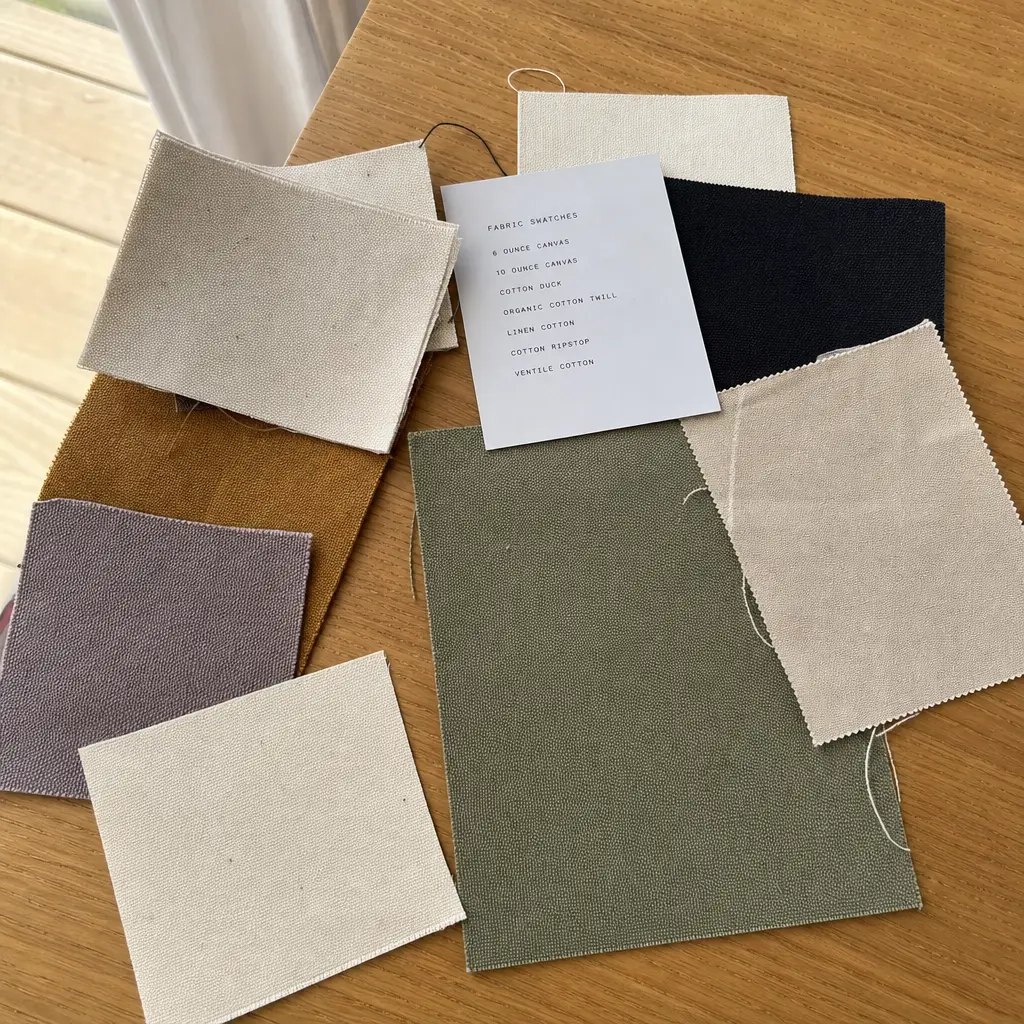
State both oz and GSM because conversions vary by yarn, weave, and finishing. As a general sourcing reference, 10 oz canvas often falls around 280-300 GSM, while 12 oz often falls around 320-340 GSM. These figures are useful for comparison, not a substitute for approval. Dyeing, washing, enzyme finishing, and pressing can change handfeel, shrinkage, odor, shade, and apparent weight. Approve a fabric swatch and a finished sample, not just a catalog line.
Construction should be specified at the same time as fabric. Handle width, handle drop, seam type, stitch density, reinforcement method, and bottom structure all affect performance. A heavier canvas with weak handle stitching can still fail. A balanced 10 oz tote with secure box-X reinforcement may perform better in normal studio use. If the tote is expected to carry 3-5 kg, ask how the supplier validates handle and seam security and whether they can perform or arrange a simple load test to the agreed standard.
- 8 oz: suitable for light promotional use, less ideal for grocery loads or premium retail display.
- 10 oz: balanced for many wellness studio programs, welcome kits, and retail counters.
- 12 oz: stronger body for product-heavy totes, refill shops, and higher perceived value.
- 14 oz: premium and structured, but heavier to ship and harder to sew consistently.
- Always pair GSM with handle reinforcement, seam quality, and expected load.
Match the print method to the brand mark
Water-based screen printing is often a strong fit for canvas grocery totes used by wellness studios. It supports clean one-color or two-color logos, has a softer handfeel than many heavy ink systems, and works well for repeat orders. The limitation is opacity. On darker or heavily textured fabric, water-based ink may look softer than the brand team expects, so buyers should approve both edge clarity and coverage on the actual canvas color.
Plastisol screen print, heat transfer, digital print, embroidery, and woven labels can also be appropriate. Plastisol can improve opacity, but the handfeel is usually heavier and cure quality must be checked. Heat transfer can reproduce gradients, small multicolor artwork, or detailed emblems, but adhesion, edge feel, flexibility, and cracking should be reviewed. Digital print can suit short runs or complex graphics, although color consistency and rub resistance need confirmation. Embroidery feels premium for small marks, but large filled graphics can pucker the fabric and distort the front panel.
For minimalist wellness branding, a woven side label or inner label can complement a front print. This is helpful when the studio wants a subtle retail product rather than a loud promotional tote. If using labels, specify label size, fold type, placement, color, weave quality, and whether the label edge should be sewn into a seam or topstitched onto the panel.
- Water-based screen print: best for soft, clean, repeatable one-color and two-color logos.
- Plastisol screen print: useful for opacity, but approve handfeel and cure quality.
- Heat transfer: useful for gradients or detailed art, but test adhesion and edge feel.
- Digital print: useful for complex graphics, but confirm rub resistance and color control.
- Embroidery or woven labels: best for small premium marks or subtle secondary branding.
Turn placement into inspection criteria
A placement note such as center front is too loose for a bulk order. A stronger instruction names the logo size, reference point, clearances, and tolerance. For example: front logo 210 mm wide x 62 mm high; logo center aligned to front-panel center line; logo center 105 mm below top opening; horizontal tolerance +/-5 mm; vertical tolerance +/-8 mm; print skew maximum 3 degrees. That gives the supplier, operator, and inspector the same target.
Tolerance should reflect the production method. Printing on cut panels before sewing gives a flatter surface and can improve speed, but cutting, hemming, and gusset formation may shift the final logo position. Printing on finished bags confirms the real finished surface, but seams, gusset thickness, and wrinkles make handling harder. If the buyer wants tighter placement than the factory's usual capability, the supplier may need a better jig, slower production speed, or more inspection time.
The approved sample should be measured and recorded. Keep a signed sample, a dimension sheet, and the approved strike-off together. For future reorders, reference the same standard rather than relying on photos alone. If the studio changes tote size, handle placement, gusset depth, or logo artwork, the old placement dimensions should be reviewed again.
- Define whether the reference point is logo center, top edge, or bottom edge.
- Set horizontal center tolerance, commonly +/-5 mm for standard front prints.
- Set vertical placement tolerance, commonly +/-8 mm from the approved measurement point.
- Set print skew tolerance, usually within 2-3 degrees unless a tighter jig is confirmed.
- Record logo size tolerance, such as +/-3 mm or +/-3%, depending on artwork.
Build an RFQ that makes quotes comparable
Canvas grocery tote quotes often vary because suppliers make different assumptions. One factory may quote 10 oz natural cotton with one-color screen print and bulk packing. Another may quote 12 oz dyed canvas, a custom label, individual packing, and stronger cartons. The unit prices are not comparable until the specification is normalized. A precise RFQ reduces back-and-forth and helps buyers compare real value, not just the lowest line item.
Include finished size, gusset depth, fabric weight, material type, fabric color, handle size, handle drop, reinforcement style, logo file, logo size, placement dimensions, print method, quantity tiers, packing method, carton marks, inspection requirement, incoterm, and required delivery window. If a detail is flexible, say so. For example, the buyer can leave the logo method open to supplier recommendation while requiring that final logo size, handfeel, and color are approved before bulk production.
Ask for logistics data with the quote. Pieces per carton, carton dimensions, gross weight, net weight, and CBM help estimate freight cost and warehouse handling. A low ex-factory price can lose value if cartons are too large, too weak, or packed in a way that creases the logo. A slightly higher unit price with realistic packing, clear carton marks, and lower defect risk may produce a better landed cost per approved usable tote.
- Request tiered pricing at 300, 500, 1000, 3000, and 5000 pcs when those tiers match the buying plan.
- Separate costs for screens, setup, strike-off, pre-production sample, sample freight, hangtag, label, and individual packing.
- Ask for MOQ by fabric, color, print method, label, carton mark, and packing method.
- Specify incoterm and quote validity so commercial terms are comparable.
- Compare landed cost per approved usable piece, not only the lowest unit price.
Approve samples with production-ready feedback
The pre-production sample becomes the control document for bulk production. It should use final canvas weight, final tote size, final gusset construction, final handle reinforcement, final logo method, final placement, and final packing fold. A substitute-material sample can help confirm shape, but it should not approve fabric handfeel, ink color, print opacity, or logo edge sharpness. Label each sample type clearly so no one treats a rough shape sample as a production approval.
Sample comments should be written as measurable instructions. Instead of saying move the logo slightly down, say move logo center down 15 mm and keep horizontal center tolerance within +/-5 mm. Instead of saying fabric feels too thin, state the required oz/GSM and request a new swatch or sample. Instead of saying print is too faint, reference the approved strike-off or ask for improved opacity on the same canvas color.
Review the sample the way the tote will be sold or distributed. If the tote will be folded and packed 50 pcs per carton, check whether the fold creates a hard crease across the logo. If it will be sold at reception, review stains, slubs, loose threads, odor, symmetry, and shelf presentation under retail lighting. If the order ships to multiple studio locations, confirm SKU labels, carton marks, and inner packing before the goods are closed.
- Measure finished width, height, gusset, handle drop, handle width, stitch box, and logo position.
- Check print opacity, edge sharpness, pinholes, cure, handfeel, and color on production fabric.
- Check seams, handle reinforcement, stitch density, loose threads, odor, stains, and symmetry.
- Approve the actual fold, hangtag, label, polybag or paper band, carton count, and carton mark.
- Keep one signed buyer sample and require the factory to retain a matching sample.
Control QC before the final inspection
Many canvas tote defects are cheaper to prevent than to find at final inspection. Cutting affects finished size and print alignment. Printing affects logo color, skew, opacity, and cure. Sewing affects handle symmetry, side seam placement, top hem shape, and gusset structure. Packing affects creasing, moisture exposure, carton damage, and retail presentation. A final inspection can identify defects, but it may not recover lost production time if the root problem started early.
For a first order, new supplier, new canvas color, or new logo method, request an inline checkpoint. The supplier can send photos or measurements from the first 20-50 bulk pieces showing logo placement, handle alignment, print color, and seam construction. This is not a replacement for buyer or third-party inspection, but it can catch systematic errors before the full lot is finished.
Define major and minor defects before production. Major defects may include wrong logo, wrong placement outside tolerance, missing reinforcement, open seam, strong odor, stained logo face, wet carton, or incorrect quantity. Minor defects may include a small trimable thread or a minor slub away from the logo zone, depending on the agreed quality level. Retail-facing wellness totes should usually have a stricter visual standard than simple event giveaways.
- Check cutting panels for size consistency before bulk printing or sewing.
- Check first bulk prints against the approved strike-off for color, placement, skew, opacity, and cure.
- Check sewing for handle position, box-X completeness, stitch density, seam security, and loose threads.
- Check finished bags for stains, odor, shade bands, slubs on logo face, broken stitches, and dimension tolerance.
- Check cartons for dry condition, correct SKU, correct quantity, approved fold method, and readable carton marks.
Specification comparison for buyers
| Spec decision | Recommended B2B specification | When it fits | Procurement risk to control |
|---|---|---|---|
| Finished tote reference | Quote finished sewn size as W x H x gusset, for example 380 x 420 x 100 mm, with tolerance usually +/-10 mm on body dimensions unless tighter is agreed | Best when comparing multiple suppliers, repeating the same wellness studio tote, or matching retail display fixtures | Flat fabric panel size is not finished bag size; hemming, seam allowance, gusset folding, and pressing can shift the final logo position |
| Logo placement reference point | Measure from stable finished-bag points: top opening after hem, left and right side seams, bottom fold, and handle stitch box | Useful for yoga studios, Pilates studios, spas, clinics, refill shops, wellness retailers, and corporate wellness programs | A digital mockup can look centered while bulk goods vary by 10-20 mm if no production reference and tolerance are written |
| Front-panel logo position | For a 380 x 420 x 100 mm grocery tote, start with logo center 90-120 mm below the top opening, then adjust for logo height and handle stitch box | Works for clean wellness branding where the mark should be visible without feeling oversized | Too high can wrinkle near handle stress points; too low can disappear when the tote is filled, boxed out, or standing on a counter |
| Logo size range | Use 180-230 mm wide for simple wordmarks on standard grocery totes; reduce to 120-170 mm for seals, thin-line icons, or wordmark plus tagline | Good for one-color or two-color wellness logos printed on natural or dyed canvas | Oversized artwork can cross gusset folds, exceed print-bed capacity after sewing, or increase rejection risk for skew and distortion |
| Clearance from construction | Keep at least 40-50 mm from side seams, 35-50 mm from bottom fold, and 25-35 mm below handle stitch boxes unless a sample proves more space is safe | Important for gusseted totes, boxed bottoms, and bags that will be folded for packing | Print near folds can crease, shadow, crack, or look off-center once the tote opens under load |
| Canvas weight | Specify both oz and GSM: 10 oz is often about 280-300 GSM, 12 oz about 320-340 GSM, depending on yarn, weave, and finish | Balances premium handfeel, print stability, foldability, freight cost, and retail shelf presentation | Oz and GSM are not perfectly interchangeable; supplier conversions vary, so approve actual fabric swatch and finished sample |
| Print method | Water-based screen print for simple logos; plastisol only if handfeel is approved; heat transfer or digital print for gradients and small multicolor artwork | Screen print suits repeat bulk orders with stable cost, soft touch, and controlled brand color | Fine lines below about 0.4-0.5 mm and text below about 5-6 mm high may fill in on textured canvas |
| Handle and reinforcement | Use 25-35 mm wide handles, 250-300 mm drop for shoulder carry, and box-X or reinforced cross-stitch at each attachment point | Fits totes carrying towels, retail products, supplement jars, bottles, groceries, and studio welcome kits | Logo zone must avoid handle stitch boxes; weak handle reinforcement can fail even when fabric GSM is adequate |
| Material and color | Natural, unbleached, recycled-look, oatmeal, sage, clay, charcoal, or other muted wellness palettes; approve logo ink on the final fabric color | Good for wellness brands wanting a calm retail look without full-surface print coverage | Dyed or washed canvas changes ink color, shrinkage, odor, and shade consistency; paper Pantone approval is not enough |
Buyer checklist before sampling
- Define finished tote size as width x height x gusset in millimeters, and state whether width is measured flat across the front face or opened across the gusseted body.
- Confirm body-dimension tolerance, commonly +/-10 mm for fabric totes, and set a tighter tolerance only if the supplier confirms production capability.
- Specify handle width, handle length, handle drop, handle fabric weight, and reinforcement style, including whether box-X stitching or bar-tacks are required.
- Map the printable front panel after sewing, including top hem height, handle stitch-box size, side seam position, bottom fold, and gusset fold lines.
- State logo width, logo height, distance from top opening, horizontal center point, side clearances, bottom clearance, and acceptable placement tolerance in millimeters.
- Confirm whether the factory prints on cut panels before sewing or on finished bags after sewing, because the control method and tolerance are different.
- Require a logo strike-off on the actual production canvas color before approving bulk ink color, opacity, line sharpness, and handfeel.
- Specify fabric weight in both oz and GSM, plus acceptable tolerance after finishing, dyeing, washing, or pressing.
- Confirm fiber content, such as conventional cotton, organic cotton, recycled cotton blend, cotton-poly blend, bleached canvas, unbleached canvas, dyed canvas, or washed canvas.
- Ask for available documentation before using sustainability claims, including transaction certificate, scope certificate, recycled-content declaration, or organic-cotton certificate where applicable.
Factory quote questions to send
- What finished tote size, gusset depth, top hem height, handle width, and handle drop do you recommend for a wellness studio grocery tote expected to carry 3-5 kg in normal use?
- What canvas weight do you propose in oz and GSM, and what finished-fabric tolerance should we expect after dyeing, washing, pressing, or other finishing?
- Is the quoted material conventional cotton, organic cotton, recycled cotton blend, cotton-poly blend, bleached, unbleached, dyed, washed, or enzyme finished?
- Which certificates or documents can you provide for the material claim, and are they valid for this order quantity and supply chain?
- Will the logo be printed before sewing or after sewing, and what jig, template, or measurement process will control final placement on the finished bag?
- What is the maximum safe printable area on the front panel after allowing for top hem, handle stitch boxes, side seams, bottom fold, and gusset expansion?
- For our artwork, what logo width, line thickness, minimum text height, color count, and ink type do you recommend for repeatable screen printing on canvas?
- Can you produce a physical logo strike-off on the same fabric color before the pre-production sample, and what are the cost, timing, and revision limits?
- What placement tolerance can you guarantee for horizontal center, vertical position, print skew, and logo size in bulk production?
- What body-size tolerance, handle-drop tolerance, stitch-density range, and seam-strength approach do you use for canvas tote production?
Quality-control points to confirm
- Finished tote width, height, and gusset should be measured on a relaxed sewn bag; a common tolerance is +/-10 mm unless the purchase order specifies otherwise.
- Handle drop should match the approved sample, commonly within +/-10 mm, with left and right handles visually balanced and not twisted.
- Logo horizontal center line should not deviate more than 5 mm left or right on standard grocery totes unless the supplier and buyer agree to a different tolerance.
- Logo vertical placement should remain within +/-8 mm from the approved measurement point, such as logo center to top opening, because hemming and fabric relaxation can vary.
- Print skew should normally be within 2-3 degrees on the front panel; stricter tolerance requires a confirmed jig and may increase cost or rejection rate.
- Logo width and height should remain within +/-3 mm or +/-3%, whichever is more practical for the artwork size, with no visible stretching or compression.
- Screen print color should be compared against an approved fabric strike-off under consistent light, such as D65 daylight or the buyer's agreed light source, not only against a digital proof.
- Print surface should show no heavy pinholes, ink cracking, sticky cure, smearing, ghosting, scorch marks, transfer edge lift, or contamination from lint and loose fibers.
- Fine lines, small text, and reversed-out details must remain readable at normal viewing distance according to the approved strike-off, not only the original vector file.
- Handle cross-stitch, box-X stitch, or bar-tack reinforcement should be complete at all attachment points, with no skipped stitches, broken threads, or loose handle ends.