Start With the Bookstore Job
A canvas grocery tote for a university bookstore has to do more than hold a logo. It may sit folded on a retail table, hang from a fixture near sweatshirts, carry course materials across campus, ship through an online store, or appear in a welcome kit for orientation. Those use cases create different logo-placement needs. A mark that looks balanced on a flat PDF can land too close to a handle shadow, disappear into the bottom gusset, or stretch visually once the bag is loaded with books and bottles.
Before requesting pricing, define how the buyer, store team, and customer will judge the item. Retail merchandise needs shelf presence and consistent repeat production. Event distribution may prioritize cost, lead time, and quick visual recognition. Online fulfillment needs packing that protects the print and keeps SKUs easy to identify. Multi-location bookstore programs need carton labels and replenishment files that prevent mix-ups between campuses, departments, or licensed marks.
University marks also bring extra review. Bookstore procurement may need approval from licensing, athletics, alumni relations, a central brand office, or an outside licensing agent. That makes improvisation risky. The RFQ should include a controlled artwork file, logo placement measurements, color reference, intended print method, sample sequence, and inspection expectations. For repeat orders, the goal is simple: a new production lot should be compared against the same approved baseline, not against someone’s memory of last fall’s tote.
- Define whether the tote is retail merchandise, event stock, online fulfillment inventory, or a replenishable core item.
- Decide how shoppers will first see the bag: front-facing, side-facing, stacked, folded, or hung.
- Put logo placement in the RFQ and purchase order as a measurable production requirement.
Build the Spec Before the Quote
Good tote pricing starts with a complete specification, not a loose description. At minimum, list finished bag width, finished height, gusset depth, handle drop, handle webbing width, canvas weight, fabric color, print method, print size, logo position, packing format, carton quantity, and delivery terms. Finished dimensions matter most because the shopper sees the sewn bag. Cut-panel dimensions can be useful for the factory, but seam allowance, pressing, and gusset construction change the visible surface.
For many campus grocery totes, finished dimensions often fall around 14-16 inches wide by 15-17 inches high with a 4-6 inch gusset. That is a starting point, not a rule. A textbook-friendly grocery tote may need more body depth. A compact retail tote for apparel add-on sales may need a smaller body and shorter handle drop. A bag intended for shoulder carry may need longer handles, which changes how it hangs and where the front-panel logo sits relative to the top hem.
Keep the unit system clear. Some suppliers quote fabric in GSM, while North American buyers may talk in ounces per square yard. Either can work if the quote states the actual weight, construction, and composition. Avoid vague fabric language such as heavy canvas or premium cotton. If the bookstore needs natural cotton, dyed canvas, recycled cotton blend, organic cotton, or documented certifications, include that in the RFQ. Adding material requirements after price negotiation usually forces a re-quote.
- Use finished dimensions in inches or centimeters and keep one unit system throughout the RFQ.
- Specify handle drop and webbing width because they affect both carry comfort and logo visibility.
- Attach artwork at final size or state the intended printed width and height.
Choose Canvas for Print and Use
Canvas weight affects structure, print quality, carton weight, and landed cost. An 8 oz canvas can work for budget promotions or light-use events, but it may feel less structured and show more distortion when filled. A 10 oz to 12 oz cotton canvas is often a practical baseline for university bookstore grocery totes because it balances body, printability, sewing efficiency, and freight. For a more substantial retail item, 12 oz to 14 oz can feel stronger and stand better on display, though it usually increases cost and shipping weight.
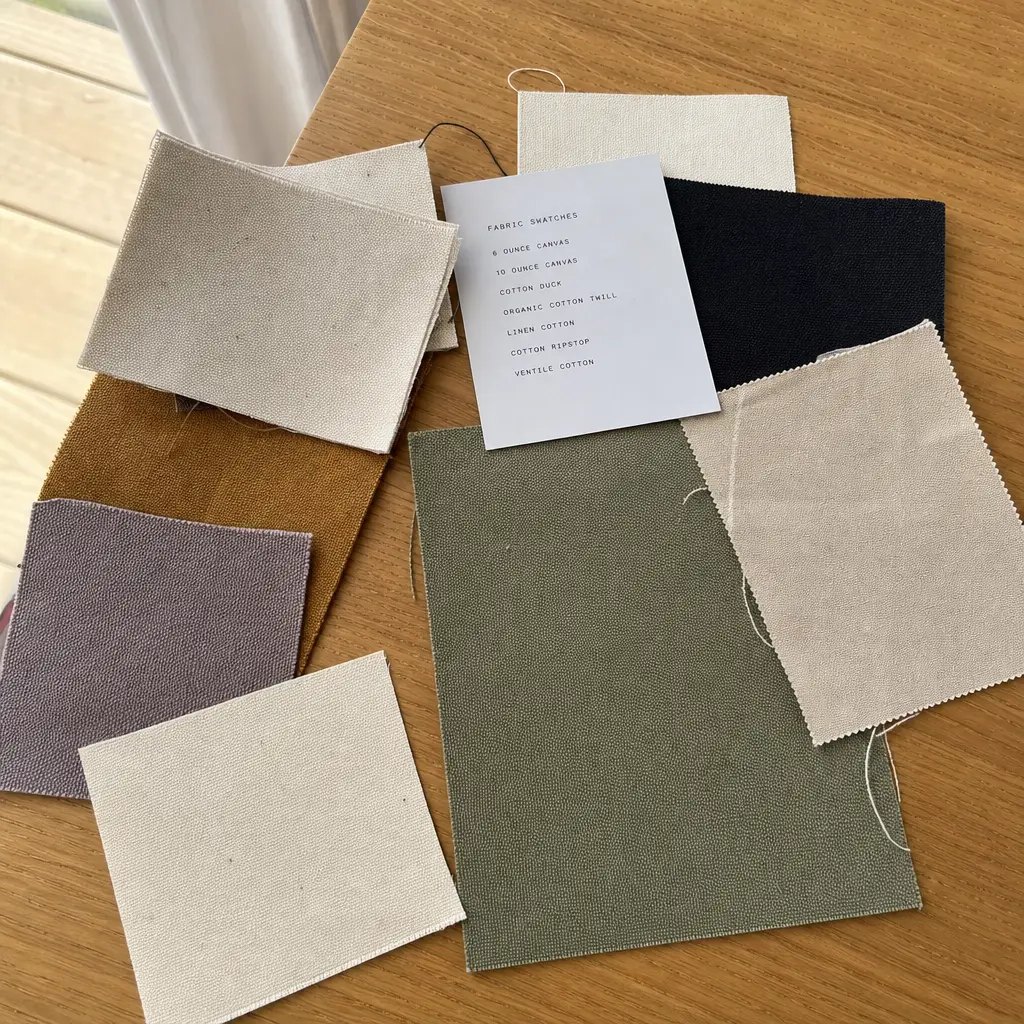
Fabric weight is only part of the decision. A tighter weave usually prints cleaner than a loose, open canvas. A washed, brushed, slubbed, or softened surface may look good in hand but can reduce edge sharpness or create uneven ink coverage. Natural cotton shade can also vary from lot to lot. A crimson, navy, green, or gold school color may look different on natural, bleached, dyed, or recycled canvas even when the ink formula is unchanged.
Ask how the fabric behaves after pressing, folding, and end use. If the tote may be washed by consumers, request shrinkage expectations and clarify whether the product is intended to be machine washable. If the supplier pre-shrinks or washes fabric before cutting, document that step because it affects finished dimensions and hand feel. For campus seals, small type, and thin line work, a physical print on actual bulk fabric is essential. A clean digital proof does not show fibrillation, ink absorption, or the unevenness of a real woven surface.
- Use 10 oz to 12 oz canvas as a common sourcing baseline, then adjust for cost, structure, and print detail.
- Ask for fabric weight, composition, color, finish, and shrinkage expectation in writing.
- Approve print quality on the actual canvas surface, not on paper or a screen image.
Map the Logo Zone
A useful canvas grocery totes logo placement guide for university bookstores has to move beyond visual centering. Define the logo zone from sewn reference points. For a front-panel print, measure from the top hem or top edge to the top of the artwork, from each side seam to the artwork edge, and from the bottom fold or gusset line to the bottom of the artwork. Those numbers make production and inspection much easier. They also reduce disputes when bulk cartons arrive and one side believes the print is centered while the other is looking at a different reference point.
On many standard grocery totes with an 18-22 inch body width, a 7-9 inch wide front logo is a practical range. Narrower bags may need a 5-7 inch mark to preserve breathing room. Larger bags may need a wider wordmark or a stronger lockup so the design does not look timid. As a working rule, keep artwork at least 2 inches away from side seams and bottom folds where the construction allows. Increase that clearance when the bag has a deep gusset, heavy canvas, post-sewing washing, or a packing fold near the print.
Do not judge placement only while the bag is lying flat. Hang the sample from a hook, fold it as it will ship, and load it with a realistic campus weight. A lower-front logo can look refined on an empty sample but fold under the bag when filled. Side-gusset branding can be attractive for subtle retail programs, yet long horizontal artwork often curves, collapses, or disappears when the gusset opens. If the bookstore expects the bag to sell from a side-facing fixture, request photos from that angle before approval.
- Dimension logo location from sewn seams, top edge, and bottom fold, not from a digital artboard.
- Keep primary logos clear of handle attachment areas, side seams, bottom gussets, and planned fold lines.
- Ask for approved-sample photos flat, folded, hanging, and loaded.
Select the Print Route
One-color screen printing is usually the most efficient and repeatable choice for bold university wordmarks, bookstore names, simplified seals, and clean athletic marks. It gives predictable setup costs by screen and print location, and it can produce strong opacity when the ink, mesh, pressure, and cure are controlled. Its weak point is fine detail. Very small seal text, narrow outlines, and distressed artwork can fill in or break up on textured canvas.
Multi-color screen printing can work when the artwork separations are realistic and the supplier can control registration. Ask for the registration tolerance before committing. A capable supplier may hold tight alignment on stable panels, but a soft canvas tote is not a rigid substrate. If the design has three or more colors, gradients, photographic detail, or very small elements, heat transfer may be worth testing. Transfers can reproduce detail, but they add different risks: edge lift, cracking, pressure marks, a heavier hand feel, or a plastic-like surface.
Embroidery is usually better as a secondary accent than as the main decoration on a grocery tote. Dense stitching can pucker canvas, stiffen the panel, and complicate folding. Woven labels can add a polished detail at the side seam or identify a collaboration, but they rarely provide enough retail visibility on their own unless the bag is merchandised sideways. Whatever method is chosen, color approval should be physical. Pantone references, ink drawdowns, or approved swatches are far more reliable than judging a school color on a monitor.
- Use screen print for bold low-color artwork and transfer for complex detail when the tradeoff is acceptable.
- Confirm setup cost by color, placement, and revision before comparing vendors.
- Approve color and edge quality on the chosen canvas at actual logo size.
Write Realistic Tolerances
Tolerances turn a design preference into a production rule. For logo placement, many buyers specify the maximum shift allowed from the approved sample, such as plus or minus 0.25 inch for a simple front-panel print. More exacting programs may use millimeter tolerances, but the number has to match the bag construction, fabric behavior, print method, and inspection plan. A sewn cotton tote will move more than a rigid molded part. The point is not perfection as a slogan; it is a shared definition of what still looks consistent on shelf.
Finished bag dimensions need tolerances too. Cotton canvas can shrink, stretch, relax, or change after pressing. A supplier may quote finished dimensions with a tolerance such as plus or minus 0.5 inch, depending on the material and production route. Handle drop, handle spacing, gusset depth, and top-hem width should be included because they affect appearance and usability. If the bookstore expects the tote to carry textbooks, notebooks, drink bottles, or apparel bundles, define handle reinforcement with stitch pattern and placement instead of using broad language like strong handles.
Print tolerances should cover size, position, color, opacity, registration, and curing. For one-color screen print, state whether minor pinholes, canvas show-through, or edge texture are acceptable. For multi-color screen print, write the registration tolerance into the approval record. For transfers, include adhesion, corner lift, cracking, and hand feel. The purchase order should refer to the approved sample, artwork file name, measurement sheet, and packing method so the supplier knows which version controls production.
- Set tolerances for logo position, printed size, finished dimensions, handle drop, registration, and carton quantity.
- Use the approved physical sample as the master reference, supported by ruler photos and written measurements.
- Define how each tolerance will be measured before bulk production starts.
Use Samples as Proof
Sampling should match the risk of the program. A blank sewn sample confirms body size, gusset depth, handle drop, canvas, and construction. A print strike-off confirms ink color, opacity, detail, and compatibility with the canvas surface. A full pre-production sample confirms the actual tote with actual artwork, actual print method, actual handles, and intended packing fold. For most university bookstore orders, the full pre-production sample is the most important approval because it shows how the logo sits after sewing, pressing, and handling.
Review the sample like an inspector, not like a catalog shopper. Lay it flat and measure logo location from fixed sewn points. Hang it as it will appear in the bookstore. Fold it as it will be packed. Load it with a realistic weight and watch how the panel changes. For online sales, remove it from the proposed polybag or carton and check wrinkles, transfer marks, and presentation. Handle shadows, press marks, and fold lines can change perceived quality even when the logo technically falls within tolerance.
Document the approved sample immediately. Photograph it with a ruler. Record the fabric, artwork version, print method, color reference, handle measurement, packing fold, and approval date. If a revision is rejected, label it clearly so it does not become the accidental master. That archive matters at reorder time. It lets procurement compare a new lot against the original canvas shade, logo size, placement, handle length, and folding method instead of restarting the approval process from scratch.
- Request a physical pre-production sample using actual bulk materials and the actual decoration method.
- Measure, photograph, and label the approved sample before releasing bulk production.
- Test the sample flat, folded, hanging, and loaded because each condition reveals different placement issues.
Inspect Construction and Print Together
A tote can pass logo inspection and still fail as bookstore merchandise if the construction is weak. Handle attachment deserves close attention because campus totes often carry dense loads. Ask which reinforcement is used: bar tack, box stitch, box with cross stitch, or another method. Check skipped stitches, loose threads, uneven tension, broken needles, raw edges, and whether the handle is properly captured in the top hem. If the buyer has a target load expectation, state it in the purchase order and ask how the supplier verifies it.
Print inspection should happen after curing and after the bag has cooled or rested enough for stacking. A screen print can look acceptable at the station and still transfer if the cure is incomplete. Inspect opacity, pinholes, edge feathering, ink buildup, misregistration, tackiness, and ink cracking. Rub the print with a dry white cloth and check for color transfer. Fold the tote along the planned packing line and review whether the print sticks, ghosts, or lands directly on a hard crease. On dark canvas, confirm whether an underbase is needed and whether it changes hand feel or edge thickness.
Quality control should cover the start, middle, and end of production. Early pieces catch setup errors. Mid-run pieces reveal jig movement, operator drift, fabric shade variation, ink viscosity changes, and registration fatigue. Final pieces confirm quality did not decline as the line rushed to close the order. If production runs across more than one print station, each station needs first-piece approval. Ask for an inspection report that includes measured logo-position photos, representative defect photos, carton labels, and final quantity confirmation.
- Inspect bag construction and decoration as one finished product, not as separate approvals.
- Check handle reinforcement, seam quality, print cure, rub resistance, fold behavior, and carton condition.
- Require first-piece approval when a production line, print station, or artwork setup changes.
Specify Packing and Receiving
Packing choices affect product condition, receiving labor, and total cost. Bulk packing may work for internal event distribution, but retail bookstore programs often need individual polybags, hangtags, barcodes, fixed inner counts, or shelf-ready preparation. E-commerce fulfillment may require a scannable SKU on each unit. Multi-campus distribution may need carton marks that identify location, style, color, size, artwork version, and quantity without opening the case. These details belong in the quote because destination repacking can erase a low unit price.
Canvas totes are vulnerable to dirt, moisture, and abrasion in transit. Prints can ghost or transfer if bags are stacked under pressure before cure is stable. Transfers can crease or crack if the fold line crosses the artwork. Ask how each tote is folded, whether the print faces inward or outward, whether slip sheets or tissue are used, how many units go into an inner bundle, and how many inner bundles go into a master carton. The approved packed sample should match the final packing method.
Carton specifications matter for campus receiving teams. A heavy master carton may be efficient for export freight but awkward in a bookstore stockroom. Request carton dimensions, gross weight, net weight, case count, carton marks, and pallet plan when applicable. If the university has routing rules, share them early: maximum carton weight, barcode format, delivery appointment requirements, label placement, or dock restrictions. The supplier’s default export carton is not automatically the right carton for a campus operation.
- Define whether units ship bulk packed, individually polybagged, barcoded, hangtagged, or shelf-ready.
- Confirm folded size and fold line so the logo is not damaged in transit.
- Include carton count, carton marks, case quantity, pallet plan, and gross weight limits in the packing spec.
Compare Landed Cost and Timeline
For B2B procurement, unit price is only one part of the decision. Compare quotes using the same incoterm, order quantity, packing method, artwork complexity, sample requirement, inspection scope, and destination. Ex-works pricing may exclude inland freight, export handling, international freight, duty, brokerage, destination handling, and domestic delivery. FOB pricing may still leave many destination charges outside the supplier quote. A landed-cost view shows what the tote actually costs when it reaches the campus warehouse or bookstore receiving door.
Lead time should be broken into real steps. Artwork review, license approval, sample production, sample transit, sample revision, fabric procurement, cutting, sewing, printing, curing, packing, inspection, factory handover, freight, customs, and final delivery can each affect the calendar. Ask which materials are stock supported and which require milling, custom dyeing, special webbing, or woven label production. Natural canvas may move quickly; custom-dyed canvas or unusual packing can stretch the schedule.
Campus retail dates are often fixed. Orientation, back-to-school, homecoming, graduation, alumni events, and holiday sales do not wait for a late sample revision. Work backward from the required shelf date and leave time for at least one correction cycle. If the order includes a new licensed mark, a new canvas color, or a new print method, do not assume the first sample will pass. A strong RFQ asks the factory for a defensible schedule, not the most optimistic date on a quote sheet.
- Request price at multiple quantity breaks with setup, sample, packing, inspection, and freight shown separately.
- Compare suppliers using the same incoterm and the same destination point.
- Build the calendar from the in-store date backward, including approval, revision, customs, and receiving buffer.
Specification comparison for buyers
| Sourcing decision | Recommended specification | Typical measurable range | Procurement risk to control |
|---|---|---|---|
| Primary front logo placement | Center the logo on the main face and dimension it from fixed sewn references | Logo width often 7-9 in. on a grocery tote with an 18-22 in. body width; keep at least 2 in. from side seams and bottom fold where possible | Do not approve placement from a flat digital mockup only; measure on a sewn sample after pressing |
| Lower front placement | Use a smaller mark above the bottom gusset with enough clearance from the fold line | Place the lowest artwork edge at least 2-3 in. above the bottom fold on most grocery totes | A mark set too low can disappear when the bag is loaded or crease during carton folding |
| Side gusset branding | Use compact vertical artwork or a small secondary logo on one side panel | Keep artwork inside the flat gusset face with 0.75-1.25 in. clearance from stitch lines, depending on gusset depth | Side panels distort when filled; require a loaded-bag sample photo before approval |
| Woven side label | Add a sewn woven label to the side seam as secondary branding | Common label widths are about 0.75-1.25 in.; confirm folded label size and seam capture depth | A side label is not enough for retail shelf visibility unless the tote is merchandised sideways |
| Handle or strap imprint | Use only for short text, date marks, or small collaboration icons | Printable strap area depends on webbing width; many cotton webbing handles allow only 0.375-0.75 in. high artwork | Handle ink wears faster because of hand contact and bending; require abrasion review |
| One-color screen print | Use spot-color screen print for bold wordmarks, seals with simplified line work, and repeat programs | Ask for print size, mesh selection, ink type, cure temperature, and color standard such as Pantone coated/uncoated reference | Poor curing leads to tackiness, transfer, cracking, or weak wash/rub performance |
| Multi-color screen print | Use only when registration tolerance and artwork separations are realistic for canvas texture | Require registration tolerance in writing, commonly within +/-1-2 mm for capable suppliers on stable panels | Fine outlines and small type can fill in on open-weave canvas; approve at actual size |
| Heat transfer route | Use transfer when the campus artwork has gradients, many colors, or very fine detail that cannot be screen printed cleanly | Specify transfer film type, press temperature, dwell time, pressure, and edge-feel expectations | Transfers can crack, peel, or feel plasticky if fabric prep and pressing are inconsistent |
| Bag-making plus logo in one controlled route | Prefer one accountable supplier for cutting, sewing, printing, QC, and packing when placement accuracy matters | Require confirmation whether printing is in-house or subcontracted and when printing happens relative to sewing | Outsourced decoration can shift responsibility when the logo is misaligned on the finished bag |
Buyer checklist before sampling
- Confirm finished tote width, height, gusset depth, handle drop, handle webbing width, seam allowance, and usable print area before artwork is released.
- State the intended sales channel: bookstore shelf, hanging fixture, event distribution, online fulfillment, or multi-location campus replenishment.
- Lock logo placement with measurements from sewn references: top hem or top edge, left and right side seams, and bottom fold or gusset line.
- Define logo size as actual printed width and height, not only as a percentage of the panel.
- Specify canvas weight in oz/yd2 or GSM, weave type if known, fabric finish, color, shrinkage expectation, and whether fabric is pre-shrunk or washed before cutting.
- State the print method, number of colors, ink or transfer type, Pantone or brand-color reference, and acceptable color tolerance under agreed lighting.
- Require a physical pre-production sample made from actual bulk fabric, actual handles, actual print method, and intended packing fold.
- Set written production tolerances for logo position, print size, registration, color, finished bag dimensions, handle drop, and carton quantity.
- Ask whether decoration occurs before or after sewing and whether the supplier uses placement jigs, registration boards, or printed templates.
- Request first-piece approval photos from the production line showing ruler measurements for logo position and print size.
Factory quote questions to send
- What are the finished bag dimensions, gusset depth, handle drop, handle webbing width, seam allowance, and fabric weight used in this quote?
- Is the canvas quoted in oz/yd2 or GSM, and can you provide the conversion basis, fabric composition, and fabric finish?
- What is the maximum safe print area on the sewn front panel, and what clearance do you require from the side seams, top hem, and bottom fold?
- Will the logo be printed before sewing or after sewing, and how do you control placement shift between cutting, sewing, pressing, and packing?
- What placement tolerance do you guarantee on bulk production from the approved sample: top reference, side reference, and bottom reference?
- What print method are you quoting, what ink or transfer system is included, and what are the setup charges per color, per placement, and per artwork revision?
- Can you match the university brand color to a Pantone reference on this canvas color, and what color tolerance or approval standard do you use?
- Is decoration performed in-house or by a subcontractor, and who is responsible if the logo is misregistered or off-position on finished bags?
- What sample will you provide before bulk production: strike-off, blank sewn sample, printed pre-production sample, packed sample, or all of these?
- What sample cost, courier cost, and revision cost should be expected if placement or color is not approved the first time?
Quality-control points to confirm
- Measure finished bag width, height, gusset depth, handle drop, and handle spacing against the approved sample before checking artwork placement.
- Measure logo position from sewn references, not cut-panel references; record top, left, right, and bottom distances on random units.
- Use a defined sampling plan or written AQL level for final inspection instead of checking only the top carton.
- Check print size and registration against the approved artwork at actual scale, including small campus seal text and thin outlines.
- Check color under consistent lighting and compare to the approved physical sample or approved swatch, not only to a screen image.
- Perform a dry rub test on the print after cure and review whether ink transfers to light fabric or packing material.
- Fold the tote along the intended packing fold and check whether the logo cracks, sticks, ghosts, or lands directly on a hard crease.
- Inspect ink opacity, pinholes, edge feathering, fibrillation, and uneven coverage caused by open canvas weave.
- For transfers, check edge adhesion, corner lift, cracking after bending, hand feel, and pressure marks around the transfer area.
- For screen print, confirm curing is complete so prints do not block, tack, or transfer when stacked in cartons.