Start with the buying job, not the mockup
Farmers market buyers order canvas grocery totes for a very practical reason. Shoppers need a bag that can handle produce, jars, flowers, bread, eggs, packaged foods, and the small purchases that accumulate as they move between stalls. The logo matters because the tote keeps advertising after the first use. It travels through the market, sits in a car, returns to the grocery store, and may even become a retail item in a farm shop.
That makes logo placement a procurement specification, not just a design preference. A flat mockup can make almost any position look balanced. A sewn canvas tote has top hems, handle bar-tacks, seam roll, gusset folds, bottom construction, stitch tension, and packing creases. The art that looks centered on a rectangle may look low once the bag is filled. A mark that looks clean on a PDF may land too close to a fold when the tote is packed 50 pieces per carton.
Before asking for prices, name the job the bag has to do. A market association giveaway usually prioritizes front visibility, simple printing, and a unit cost that works at volume. A retail farm shop tote may need heavier canvas, quieter logo placement, cleaner folding, hangtags, and better shelf presentation. A vendor co-op tote with sponsors may need front and back artwork, tighter approval control, and a clear rule for whose logo goes where. The sourcing path gets easier when the use case is stated early.
- Decide whether the tote is a giveaway, retail item, staff bag, CSA pickup bag, sponsor-funded market program, or farm shop product.
- Treat placement as part of the product specification, not an artwork note left for the factory to interpret.
- Ask suppliers to quote the decorated finished tote, including setup, sample, packing, and decoration costs.
- Use measurable placement language so the factory can sample, repeat, and inspect the same result you approved.
Define the sewn tote before sizing the logo
Logo size should be based on the usable sewn panel, not the advertised bag size. A tote described as 380 mm wide by 420 mm high does not give you a clean 380 mm by 420 mm print field. The top hem takes space. Handle stitching interrupts the upper area. Side seams and gusset turns reduce the true front face. A boxed bottom can shorten the visual panel once the bag is opened. Even a simple flat tote changes shape when it is filled with produce.
Ask for finished dimensions and construction details before approving artwork size. The RFQ should include bag width, height, gusset depth, bottom style, handle width, handle drop, top hem depth, seam allowance, and any inside pocket, snap, zipper, lining, woven label, care label, or hangtag. None of these details is decorative from a placement standpoint. A logo near the gusset can distort around the seam. A logo near the bottom can disappear when the bag opens into a base. A mark near the top can be crowded by handle bar-tacks.
A practical safe-zone approach is to keep artwork at least 25 mm away from simple seam lines and more generous around bar-tacks, bottom folds, and heavy gusset construction. For many canvas grocery totes, 35 mm to 50 mm above the bottom fold is easier to control than a logo that nearly touches the base. The exact clearance should come from the sewn dieline and then be confirmed on a physical sample, because fabric stiffness and sewing method change how the tote behaves.
- Request finished bag measurements, not only cut-panel measurements or catalog dimensions.
- Use a sewn dieline showing top hem, side seams, gusset turns, handle stitch boxes, bar-tacks, labels, and bottom fold.
- Keep logos away from bar-tacks, seam bulk, and fold lines unless the artwork is deliberately designed to cross them.
- Review placement with the tote empty, filled, carried by the handles, and folded for packing.
Choose the placement zone by market channel
A centered front-panel logo is the default for good reason. It gives the strongest visibility and is relatively straightforward for a factory to align. It works for farmers market associations, CSA programs, vendor-branded shopping bags, and sponsor-funded totes. On a common market tote around 380 mm by 420 mm, many logos land around 180 mm to 260 mm wide, depending on the artwork shape and desired visibility. That is a working range, not a rule. Tall badges, long wordmarks, and circular seals all need different clearances.
Lower-front placement changes the tone. It can make the tote feel more like merchandise and less like an event giveaway, especially on natural or heavier canvas. It leaves more blank fabric above the logo and works well for farm shop retail. The tradeoff is packing. If the supplier folds the bag through the lower panel, a crease can run straight through the ink or transfer. Approve the fold orientation on the decorated sample before bulk production begins.
Back-panel placement is useful when the tote needs secondary information: a website, market dates, care note, sponsor line, or QR code. Keep QR codes on a flat area, away from seams, coarse texture, and deep folds. Side gusset placement can look sharp when the bag is carried sideways, but it is less forgiving than a front print. Use it for short wordmarks, icons, or vertical marks. Avoid tiny type and wide graphics on narrow gussets, because seam roll can clip the design.
- Use front center when visibility is the main goal and the artwork is simple.
- Use lower-front placement when the tote should feel retail-ready or less promotional.
- Use back placement for secondary copy, sponsor messages, care notes, and QR codes after testing a printed sample.
- Use gusset placement only when the gusset is wide enough and the supplier can measure from both seam turns.
Specify canvas weight, finish, and color with care
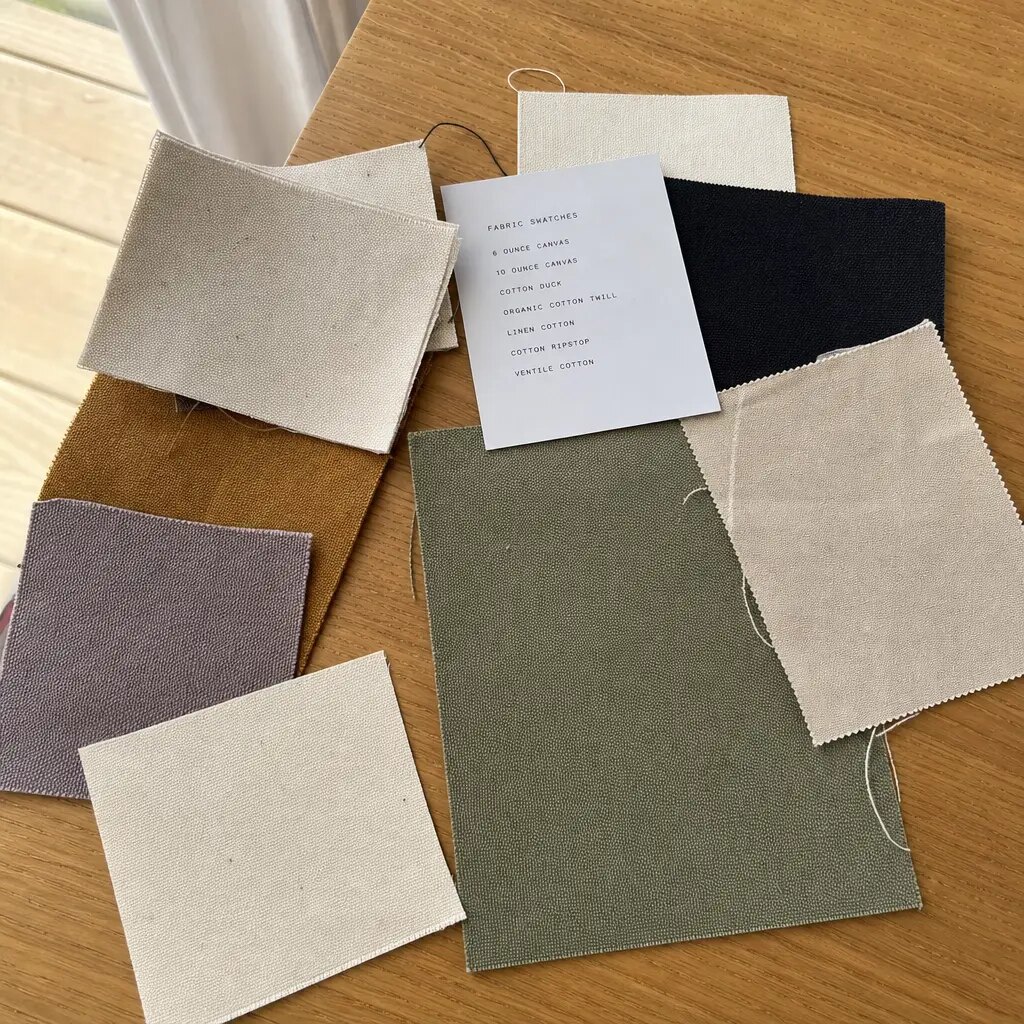
Canvas weight is one of the easiest places for quotes to drift apart. Some suppliers quote ounces. Others quote GSM. Some refer to greige fabric before finishing, while others refer to finished, washed, dyed, or coated weight. A buyer comparing 10 oz, 12 oz, and 14 oz totes should ask exactly what is being measured. As a broad reference, 10 oz canvas is common for practical reusable totes, 12 oz gives a sturdier hand and flatter print surface, and 14 oz moves toward a heavier premium bag. Do not rely on conversion charts alone when approving production.
Finish changes the way the logo looks. Natural unbleached canvas has flecks and shade variation, which can be attractive for farmers market branding but may reduce contrast for tan, pale green, light gray, or thin-line artwork. Bleached white canvas gives cleaner color but may show dirt faster in market use. Dyed canvas can require higher-opacity ink or an underbase, especially for bright colors. Prewashed canvas feels softer but may wrinkle more and can make very tight placement tolerances harder to hold.
Tie the fabric choice to the buyer's real use. A light promotional tote may be fine for flyers or small goods, but it may disappoint shoppers carrying root vegetables, glass jars, or multiple market purchases. A very heavy tote can improve perceived value but raises unit cost, carton weight, and freight. Many farmers market programs end up comparing 10 oz and 12 oz canvas, with 12 oz often preferred when the buyer wants a cleaner print face and a more durable retail feel.
- Write the fabric as a controlled spec, such as 12 oz finished cotton canvas, rather than just heavy canvas.
- Ask whether washing, dyeing, coating, or finishing changes the quoted weight, dimensions, and shrinkage.
- Check logo contrast on the actual fabric color, especially natural, pigment-dyed, and dark canvas.
- For repeat orders, require approval before the supplier changes fabric mill, yarn, finish, dye lot, or coating.
Match print method to artwork and quantity
Screen printing is usually the best starting point for bulk canvas grocery totes with simple artwork. It suits one-color and two-color logos, bold type, solid shapes, and repeat orders. It is also easier to cost once the screen setup is understood. The buyer still needs technical limits in writing: minimum line width, smallest readable type, Pantone target, ink opacity, registration tolerance, underbase requirements, and desired hand feel. On natural canvas, the texture of the weave can make coverage look less smooth than it does on a proof.
Heat transfer and DTF-style transfer can make sense for short runs, full-color graphics, or late artwork changes. They can reproduce more detail without multiple screens, but the risk profile is different. Buyers should check edge feel, adhesion, cracking, heat marks, pressure marks, and how the decoration behaves after folding. A transfer that photographs well may not be right for a tote that will be packed tightly, carried often, and rubbed against produce bins or market tables.
Embroidery, patches, applique, and woven labels create a more premium effect, but they are not drop-in substitutes for screen printing. Embroidery can pucker lighter canvas and may not reproduce small lettering. Patches add their own material MOQ, sewing tolerance, and sampling cycle. Woven side labels are useful for brand ownership, especially on retail merchandise, but they need separate artwork approval and seam placement checks. Quote each method as a separate option so the buying team can compare cost, lead time, and inspection risk.
- Use screen print for simple spot-color artwork and larger repeatable runs.
- Use heat transfer only after checking adhesion, edge feel, fold marks, and rub performance on the actual tote.
- Use embroidery, patches, or woven labels when premium texture matters more than the lowest unit cost.
- Ask the supplier to state the placement and registration tolerance they can hold in production.
Write an RFQ that removes guesswork
A strong RFQ saves time because it does not force the factory to fill in missing details. Instead of asking for a canvas tote with logo, specify the finished dimensions, canvas weight, fabric color, construction, handle details, decoration method, artwork size, placement measurements, number of print colors, packing method, quantity by colorway, delivery date, inspection needs, and incoterm. Attach vector artwork and a placement drawing. If the artwork includes small type, a QR code, halftones, gradients, reverses, or thin outlines, say so in the RFQ.
Price comparison only works when the quote structure is visible. Ask suppliers to break out the blank tote cost, decoration cost, setup charges, label cost, sample cost, packing cost, and freight where practical. A low unit price may exclude screen charges, custom labels, individual packing, barcode stickers, carton marks, export cartons, or domestic trucking. If the order may repeat, ask whether the supplier can hold the same pattern, fabric source, ink formula, and artwork files for future production.
Tolerances belong in the quote stage, not after the shipment is made. Common items include finished bag size, handle drop, logo position, print color, print registration, carton count, and carton dimensions. A 10 mm print shift may be acceptable on a rustic large front logo. The same shift may look careless on a small wordmark aligned under a pocket or side label. Ask the factory what it can actually hold, then decide whether that standard fits the sales channel.
- Attach vector artwork and a placement drawing with ruler dimensions from sewn reference points.
- Ask for line-item pricing by print location, print color count, label type, patch option, and packing method.
- State the intended channel: giveaway, retail sale, farm shop, CSA, sponsor program, or staff use.
- Require written tolerances before the decorated pre-production sample is approved.
Control samples in stages
Sampling should prove the tote, the artwork, and the process. A digital proof is useful for spelling, layout, scale, and color references, but it cannot confirm fabric hand, seam distortion, ink opacity, cure, handle drop, gusset shape, or folding effect. For a new supplier or new pattern, start with a blank sewn sample or an existing sample in the closest construction. If the artwork is risky, approve a strike-off or printed panel. Then approve a decorated tote made with the intended fabric, print method, logo size, placement, and packing.
Treat the pre-production sample as the contract reference for bulk goods. It should match the final canvas color, fabric weight, handle construction, label, print method, print position, folding method, and carton packing if those details affect saleability. Take ruler photos that show the distance from the top hem, side seam, bottom fold, and any gusset seam. Keep one physical master sample. If the factory changes fabric, ink, sewing pattern, label, or packing after approval, require a new confirmation.
Farmers market programs often involve more than one stakeholder. A market manager may care about association visibility. Sponsors may care about logo hierarchy. Vendors may care about how the bag looks at the booth. Sampling discipline keeps that discussion from spilling into production. Assign one approval owner and keep one written approval file. Include concrete notes such as logo width 220 mm, black screen print, centered on front panel, top of logo 95 mm below top hem, no fold through logo, packed 50 pieces per carton.
- Approve a decorated physical tote before bulk production when placement matters.
- Keep one master sample and one photo approval file with ruler measurements.
- Do not approve color from a screen image alone; review the print on the actual canvas shade.
- Require a new sign-off if the supplier changes material, pattern, ink, label, print method, or packing.
Set tolerances that fit sewn canvas
Canvas totes are soft sewn goods. They are not rigid plastic parts. Fabric can relax, shrink, skew, or shift during cutting, sewing, washing, and printing. Handles can pull the top edge slightly. Gussets can change the apparent center of the front panel. This does not mean buyers should accept vague quality standards. It means tolerances should be realistic, written, and tied to how the bag is made.
For many simple front-panel screen prints, buyers often request a placement tolerance around plus or minus 5 mm from the approved sample. Some factories may need more room depending on canvas softness, washing, gusset construction, print area, or manual loading method. Finished bag dimensions may have wider tolerances, sometimes several millimeters to more than 10 mm depending on construction and supplier standard. Handle drop should be controlled too, because it affects carry comfort and the visual balance of the logo.
Color needs the same practical approach. Pantone references are helpful, but ink printed on natural canvas will not look identical to ink on coated paper. Dyed canvas may require an underbase, which can change brightness and hand feel. Natural canvas shade variation can change the perceived ink color even when the ink is consistent. Approve color on the actual substrate and define whether shade variation across cartons is acceptable, must be sorted, or requires buyer approval.
- Agree on print placement tolerance in millimeters before bulk production starts.
- Measure from sewn references such as top hem, side seam, bottom fold, or gusset seam, not theoretical pattern edges.
- Approve print color on actual canvas, not only from a Pantone book or PDF proof.
- For washed, soft, or pigment-dyed canvas, expect more variation and set inspection criteria accordingly.
Protect the logo through packing
Packing can ruin the part of the tote that took the longest to approve. A lower-front logo may crease if the bag is folded in thirds. A heavy ink deposit may block or transfer if bags are packed before full cure. A transfer can show pressure marks if cartons are over-compressed. If the tote will be sold at a farm shop or stacked at a market booth, the front panel needs to arrive looking presentable.
Ask suppliers to quote packing choices separately. Bulk folded packing is economical and works for event distribution. Individual polybags protect the tote but add cost, plastic use, and handling labor. Some buyers prefer paper bands, belly bands, bundle ties, or plastic-free inner packs. Retail-ready totes may need barcode stickers, hangtags, care labels, or inner cartons. Each choice affects carton count, carton dimensions, gross weight, freight cost, and the time required to unpack goods on market day.
Approve fold orientation with the decorated sample. Request photos of the tote before folding, after folding, inside the carton, and after being removed from the carton. If the logo must remain visible when the totes are stacked, state that. If volunteers or staff will distribute bags quickly, choose bundle counts that match the operation, such as 25 or 50 pieces per bundle. A packing method that saves a little per unit can still create trouble if it slows receiving, sorting, or booth setup.
- Do not allow a hard fold through the logo unless it is approved on the physical sample.
- Confirm bags are fully cured before packing to prevent blocking, tackiness, or ink transfer.
- Quote bulk packing, paper banding, individual packing, hangtags, barcode labels, and retail cartons separately.
- Check carton dimensions and gross weight against freight, warehouse, and market handling requirements.
Inspect bulk goods against the master sample
Final inspection should compare production to the approved master sample, not to memory or the original mockup. Start with identity checks: correct tote size, fabric color, handle length, logo artwork, print method, label, and packing. Then measure placement on finished bags. For front-panel prints, record the distance from top hem to logo, side seam to logo, and bottom fold to logo. For gusset prints, measure from both seam turns because the panel can roll during sewing.
Print inspection should cover opacity, edge sharpness, cure, registration, and surface contamination. Look for tacky ink, cracking, flaking, pinholes, bleed, ghosting, scorching, pressure marks, off-color panels, and visible registration drift on two-color logos. If the artwork includes a QR code, scan multiple production pieces with a normal phone under realistic lighting. A QR code that scans from the digital proof is not enough. The printed code must work on the actual fabric texture and at the approved size.
Do not let a good print distract from a weak tote. Check seam security, loose threads, handle attachment, bar-tack strength, gusset shape, bottom stitching, and label sewing. A beautiful logo on a bag with open seams still fails the program. For larger orders or fixed launch dates, inline inspection is useful because it can catch placement drift or cure problems before the full run is packed. Final inspection should also verify carton count, assortment, labels, carton marks, moisture protection, and packing method.
- Use the master sample as the inspection reference for placement, color, construction, and packing.
- Measure a defined sample quantity and record actual placement results with photos.
- Treat wrong artwork, uncured ink, broken handles, unreadable QR codes, severe stains, mold odor, and mixed products as critical defects.
- Verify carton count, labels, and assortments before shipment so the receiving team does not inherit a sorting problem.
Specification comparison for buyers
| Logo placement or spec decision | Typical B2B specification | Best fit for farmers market buyers | Procurement risk to control |
|---|---|---|---|
| Centered front-panel logo | Logo centered on the sewn front face, often 75 mm to 120 mm below the top hem depending on tote height and handle stitch position | Market association bags, CSA pickup totes, vendor co-op programs, sponsor bags, and high-visibility shopper totes | Confirm the real sewn panel width. Gusset turns, seam roll, and handle stitching can make the visual center different from the flat artwork center. |
| Lower-third front logo | Logo placed above the bottom fold with 35 mm to 50 mm or more clearance from folds and seam lines | Retail-ready farm shop totes, quieter brand merchandise, and reusable grocery bags where the logo should feel branded rather than promotional | Folded packing can crease through the mark. Approve the folding method on the decorated pre-production sample, not only in a mockup. |
| Upper-front logo | Small wordmark or icon below the handle attachment area with clear space under the top hem and away from bar-tacks | Minimalist retail bags, premium produce totes, staff bags, and small farm brand marks | The shopper's hand or handle drop can hide the mark. Check visibility while the tote is carried and filled. |
| Side gusset print | Short wordmark, icon, or vertical mark placed on the gusset with measurements from both seam turns | Bags that need a clean front face or branding visible when carried sideways at a market booth | Gusset width tolerance and seam roll can clip artwork. Avoid fine type, QR codes, and wide logos on narrow gussets. |
| Back-panel print | Secondary logo, website, QR code, care note, market date, sponsor line, or recycling message on the reverse panel | Programs with clean front branding and extra information needs | Visibility is lower than front print. QR codes need adequate size, contrast, flat placement, and real printed scan checks. |
| Woven side label plus body print | Small woven label sewn into side seam plus screen print, transfer, or patch on the main panel | Retail merchandise, farm shop product lines, and brand-owned reusable tote programs | Label MOQ, color limits, sewing placement, label approval time, and needle marks should be quoted separately. |
| One-color screen print | Spot-color ink on natural, bleached, dyed, or black canvas with an approved Pantone target and substrate sample | Most cost-sensitive bulk orders with simple logos, bold text, and repeat artwork | Ink opacity, cure, fabric shade, and placement drift must be checked during production, not only at artwork proof stage. |
| Two-color screen print | Two registered spot colors with minimum line width, trapping, and print order reviewed before screen making | Market seals, sponsor lockups, and logos with a secondary color | Registration tolerance should be agreed in writing. Small misalignment is more visible on outlines, small type, and circular marks. |
| Heat transfer or DTF transfer | Decorated transfer applied to a sewn blank with controlled temperature, pressure, and dwell time | Short runs, multi-color graphics, late artwork changes, or programs where screen setup is inefficient | Check hand feel, edge lifting, rub performance, wash or abrasion needs, and heat marks on natural canvas before approving bulk. |
Buyer checklist before sampling
- Confirm finished tote dimensions in millimeters or inches, including width, height, gusset depth, handle drop, handle width, top hem depth, and whether the bottom is flat, boxed, or gusseted.
- Specify fabric weight using one consistent basis, such as 10 oz, 12 oz, 14 oz, or GSM, and ask whether the weight is greige, finished, washed, dyed, or coated weight.
- State fabric color and finish clearly: natural unbleached, bleached white, dyed canvas, pigment-dyed, prewashed, enzyme-washed, laminated, or coated if applicable.
- Request a sewn bag dieline with top hem, handle stitching, side seam, gusset turn, bottom fold, inside pocket, woven label, care label, and hangtag position marked.
- Define logo dimensions and placement using measurements from fixed sewn references, such as top hem edge, left side seam, gusset seam, and bottom fold, not only visual mockup position.
- Set minimum clearances from seams, hems, handle bar-tacks, fold lines, and boxed-bottom edges; for many flat-panel prints, 25 mm to 50 mm clearance is a practical starting point.
- List print method, number of colors, Pantone references, ink type, artwork line weight, smallest type size, and whether halftones, gradients, QR codes, reverses, or fine outlines are present.
- Ask for the factory's standard tolerances for finished bag size, handle drop, print position, color variation, print registration, carton quantity, carton dimensions, and gross weight.
- Confirm MOQ by bag color, canvas weight, print method, print color count, and print location; a second print position, custom label, or patch may create a separate MOQ.
- Require pre-production approval using the same fabric, same print method, same logo size, same placement, same folding method, and same carton packing intended for bulk production.
Factory quote questions to send
- What is the finished tote size tolerance for width, height, gusset depth, top hem, and handle drop, and how many pieces will you measure during inline and final inspection?
- Is the quoted canvas weight measured in ounces per square yard or GSM, and is it greige, finished, washed, dyed, or coated weight?
- Can you provide the safe print area for the sewn front panel, back panel, and side gusset, with top hem, seams, handle stitching, bar-tacks, and bottom fold marked?
- For our logo size, what clearance do you recommend from the top hem, handle bar-tacks, side seam, gusset turn, bottom fold, and folded packing lines?
- What print position tolerance can you hold in bulk production, for example plus or minus 3 mm, 5 mm, or 10 mm from the approved sample?
- Which decoration method do you recommend for this artwork and quantity, and what are the setup charges, MOQ, output speed, and defect risks for each option?
- For screen printing, what ink system will you use, how will you confirm cure, and how will you control opacity on natural, dyed, or dark canvas?
- For two-color print, what registration tolerance do you accept, and do you need artwork trapping, minimum line-width changes, or separate underbase artwork before screen making?
- For heat transfer or DTF, what are the recommended application temperature, pressure, and dwell time, and what rub, fold, or wash checks can you perform before shipment?
- Can you quote front-only print, front plus back print, gusset print, woven label, patch, hangtag, and retail packing as separate line items so we can compare total cost?
Quality-control points to confirm
- Approve a master sample that matches final fabric weight, fabric color, tote construction, handle length, logo size, logo position, print method, label, folding method, and carton packing.
- Measure print placement from sewn reference points on finished bags, not from the artwork file; record top, left, right, and bottom distances with clear photos.
- Set written placement tolerance before production. For simple front-panel prints, buyers commonly request plus or minus 5 mm, but wider tolerances may be needed on soft washed canvas or manual print setups.
- Define critical defects such as wrong logo, wrong artwork, unreadable QR code, uncured ink, severe stains, broken handles, open seams, mold odor, mixed product in carton, or incorrect fabric color.
- Define major defects such as print shift beyond tolerance, visible cracking, poor opacity, color outside approved limit, seam puckering affecting appearance, or incorrect folding through the logo.
- Define minor defects such as small loose threads, slight fabric slubs within the approved standard, minor shade variation, or small packing wrinkles that do not affect saleability.
- Check ink cure using the supplier's normal method, such as rub test, tape pull where appropriate, or wash and abrasion check if required by the product use.
- Inspect print edges for sawtoothing, pinholes, bleeding, underbase show-through, ghosting, scorching, pressure marks, and registration drift, especially on small type and two-color logos.
- Compare bulk fabric shade against the approved sample under consistent light; natural canvas can vary, so define how much shade variation is acceptable before ordering.
- Verify handle reinforcement, bar-tack location, seam allowance, bottom fold, gusset alignment, and label sewing because these details affect carrying strength and visual logo position.